[This is the second installment of my series of articles on theater education and training. Part 1 was posted on 3 October 2024. I recommend giving it a read before or after reading Part 2 below as there is information scattered through it that might illuminate aspects of the following articles.]
“PASSING THE TORCH
(WITHOUT GETTING BURNED)”
“From the Editor”
by Rob Weinert-Kendt
[Rob Weinert-Kendt’s editor’s note appeared in the Winter 2024 issue of American Theatre (40.2 – 25 March 2024): “Theatre Training: Passing the Torch.”]
In our Winter issue, we look at training that doesn’t simply instruct young artists in the ways of the world but aims to empower them to change it.
I am not a teacher, nor do I currently work in the field in which I was ostensibly trained (film production, for the record). So I would say I have very circumscribed authority on the subject of education, let alone theatre training, which is the theme of most of the stories in this issue, from high school theatre programs to graduate conservatories, from issues of censorship and safety to questions of mentorship and craft.
As with most aspects of the industry and art form I’ve spent my life writing about, what I do know of theatre training I have learned as a reporter and informed observer. One area I’ve kept a particular eye on is the natural tension or continuum between knowledge and freedom, or what might be called imitation vs. imagination. Put simply: Is the primary job of educators to prepare students for the world they will enter as professionals, or to equip them with the tools to keep dreaming beyond the confines of the world as it is? One consistent lament I have heard over the years from theatre students is that they feel they don’t get enough trade advice; they learn more about how to break down a script than about breakdowns, more about theatre history than career math. But another note I’ve heard loud and clear, particularly but not only in recent years, is that theatre schools too often replicate the industry’s harmful status quo—that in preparing students for the “realities” of a racist, sexist, ableist, and lookist business, schools just end up reifying and ratifying those realities.
In 2018, we published a speech the playwright A. Rey Pamatmat gave to college students and artistic professionals at the Humana Festival. It was mainly directed to the students, with real talk about how they could make their way in a hostile world and why it was nevertheless worth the struggle. But the part of the speech he directed to educators stuck with me: While Rey conceded that many of his theatre professors had had the best of intentions, and thought they were simply being “honest and realistic” when they tried to box in his queer, bicultural body and sensibility, he challenged “all those educators and future educators listening right now” to “consider whether it’s best to subject your students to bigoted systems, possibly for the first time in their lives, or to teach them about bigoted systems and how to handle them. The former shows them (and their peers witnessing their treatment) how to perpetuate bigotry when they’re leaders in the field themselves, while the latter gives them and their peers strategies for navigating and maybe even eliminating these challenges.” In other words, he said: “Do you want to limit your students or liberate them?”
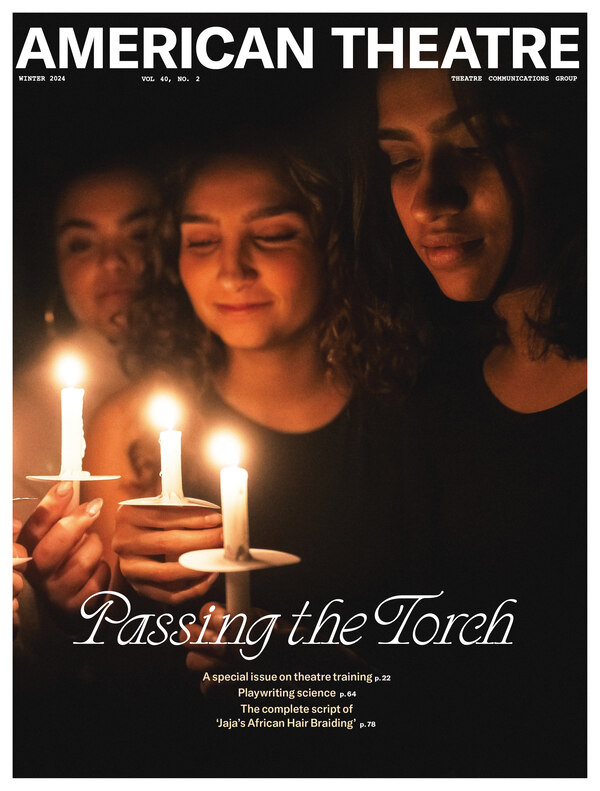
The stories in this issue show an industry and art form intent on throwing off, or at the very least working around, the limitations of historic assumptions and oppressions. Gabriela Furtado Coutinho’s piece about healing high school spaces [“Tomorrow’s Tamoras and Titanias: How to Heal the High School Space,” coming up on ROT in a later part of this series]—the tender cradle where so many theatre dreams have been born, only to be crushed—grounds and guides our coverage, whether of acting training, design mentoring, critical instruction, or the unique value of HBCU theatre programs [“The HBCU Edge” by Christopher A. Daniel, also coming up]. Gabriela’s piece (spoiler alert) concludes with Cristina Pla-Guzman’s image of students lighting each other’s candles to illuminate the way forward (also the inspiration for Joe Mazza’s beautiful cover photo [https://www.americantheatre.org/wp-content/uploads/at_winter-2024_cover.jpg]).
That strikes me as an apt metaphor for the tricky balancing act we’re addressing in many of these stories: how to maintain the fire of inspiration, and pass it along safely to new generations, without anyone getting burned (or burning out). I’m not sure that balance can be taught. But it can certainly be learned.
[Rob Weinert-Kendt (he/him) is an arts journalist and the editor-in-chief of American Theatre since 2015. He was the founding editor-in-chief of Back Stage West and writes about theater for the New York Times, Time Out New York, and the Los Angeles Times. He studied film at the University of Southern California and is a composer member of the BMI Lehman Engel Musical Theater Workshop. He writes a blog called The Wicked Stage.]
* *
* *
“THE PATH: HOW 6
ACTORS LEARNED THEIR CRAFT”
by Alexandra Pierson
[Alexandra Pierson’s “The Path” was published in the Winter 2024 issue (40.2 – 27 March 2024) of American Theatre: “Theatre Training: Passing the Torch.” It’s the first article from this issue of the Theatre Communications Group quarterly publication in my series on theater education and training (following a pair of articles from other publications in Part 1). I haven’t decided on all the articles I’ll include in the series, so I can’t tell readers how long it will be.]
From conservatories to MFAs to youth ensembles, the best training to reflect human behavior onstage can take as many forms as life itself.
Abigail C. Onwunali
Not too long ago, 2022 Princess Grace Award winner Abigail Onwunali was preparing for a career in medicine, not theatre. [The Princess Grace Awards recognize emerging and established artists in the performing arts.] When she told her family she had been accepted to Yale, they assumed she meant its School of Medicine. Most members of her Nigerian American family work in the medical profession, including her parents, who are both nurses. Though Abigail had studied human development and family sciences with a focus on child development at the University of Texas at Austin (where in-state tuition is currently $11,766), the way she got into that school was via a speech-and-debate scholarship.
“I got addicted to it,” Onwunali said of speech and debate, which she discovered in middle school and went on to excel at through high school and college, amassing a record of 13 national championships. While she studied to become a doctor, she kept what she thought of as her “hobby, the thing that I wanted to do outside of the stress of going to organic chemistry class. It became my safe haven to get away from the stress of preparing for the MCAT [Medical College Admission Test].”
Though she no longer intends to practice medicine, Onwunali still appreciates the value of her educational path, as she says she needed the time to try to understand this part of herself.
“I think at some point, I realized it was no longer that I wasn’t trying,” Onwunali said. “I think I did everything I possibly could. But I just couldn’t see myself—I couldn’t see my future. I saw it kind of miserable. Deep down inside, I know that my calling to healing wasn’t through medicine.”
She turned to a college mentor, who advised her to take a risk and try something else. At this point, Onwunali was performing slam poetry in College Station, Texas, and watching other friends pursue their creative passions. Feeling sure of her own talent but knowing very little about acting schools, she applied to four MFA [Master of Fine Arts degree; see my explanation in Part 1] programs and received final callbacks and acceptances from two schools.
“I had no idea I was signing up for one of the best acting schools in the country,” she said. It wasn’t until she arrived at Yale [David Geffen School of Drama at Yale University (formerly the Yale School of Drama) in New Haven, Connecticut] for the audition that Onwunali realized the enormity of the opportunity. Like many other emerging artists, Onwunali’s path was characterized by “a lot of naïve fumbling, but meaningfully falling onto things, and figuring out, ‘Oh, this is my calling. This is actually where I’m meant to be.’”
She marveled at the volume of information she was able to absorb during her MFA training (for which tuition was free) just by letting go and trusting the process.
“It may take years for you to be able to understand some of the things that you learned,” said Onwunali. “But to be able to keep yourself in practice and keep yourself available and open as an actor is the training that I learned at Yale. I really do feel like I could do any role safely. The training really did help me feel confident in myself as an actor, because I didn’t have that. There was talent, there was potential, there was drive—I just didn’t have the confidence. I didn’t have the assurance that I knew how to train myself for a Broadway production in a month and learn five tracks.”
Onwunali went on to understudy a role at the New York Theatre Workshop [The Half-God of Rainfall by Inua Ellams; 31 July-20 August 2023], filling in for an actor who was injured. She learned that role in just three days. Most recently, she understudied five roles in Jaja’s African Hair Braiding at Manhattan Theatre Club [Samuel J. Friedman Theatre (MTC’s Broadway house); 3 October 2023-19 November 2023]. When she’s not onstage, Onwunali teaches science and public speaking to students in the Bronx and New Jersey.
To those looking to pursue their passions, Onwunali advises, “Step into that part of yourself that wants to dare to be bold. Don’t think about it, just free fall into the experience and see what happens, because your life could really change. Mine’s really changed [180] because I decided one day to just do it.
“And believe that you’re enough as you are. You don’t need to work on anything but to be yourself when you come into this new step and phase in your life. You are exactly where you need to be.”
Caroline Chu
You wouldn’t know it today, but Caroline Chu used to be painfully shy. Growing up in Chicago, she remembers being picked to play a speaking role in her fifth grade student assembly. “I cried and cried and cried,” Chu recalled.
After the tears dried, her parents and teachers encouraged her to give it a try anyway. She faced her fear, stepped into the spotlight, and realized performing wasn’t so bad after all. Though Chu continued to perform in plays throughout middle and high school, and participated in the National High School Institute Cherubs program at Northwestern [University in Evanston, Illinois], when it came time to apply for college, she wasn’t looking at acting programs or preparing for auditions. She planned to study literature or marketing and add theatre as a second major.
As it turned out, the theatre major at Northwestern was a capped program—meaning that students could not declare theatre as a secondary major. So Chu double majored in Theatre and English literature, and earned a certificate in integrated marketing communications. She specifically chose Northwestern’s BA program (where tuition is currently $64,887) because of its flexibility.
“It was the only place I knew of where you could really go full throttle at both theatre and something else,” she said. “The idea of being an actor or an artist is pretty scary, and so having something else that I knew that I was passionate about, and a school that would support my academic pursuits outside of theatre as well, was really important to me.” She credits the decision to broaden her studies with helping her stave off burnout and reserve her creative classes for artistic expression.
As a mixed-race actor, Chu also appreciated the chance to choose the acting teacher for her two years there—in her case, Sandra Marquez, whose guidance “made all the difference,” Chu said. “It was really important to give due consideration to taking courses from a non-white acting teacher, because the experiences of a white working actor are very different, and the lessons that are applicable from their lived experiences would not have been as relevant to me.”
[According to Wikipedia: Sandra Marquez is an actor, director, and educator. She’s also a member of Teatro Vista, the Midwest’s only Equity (i.e., union) Latino theater company, where she served as the company’s Associate Artistic Director from 1998-2006. Marquez has worked at companies in the Chicago area and beyond, including Goodman Theatre, Steppenwolf Theatre, Victory Gardens, Oregon Shakespeare Festival (Ashland), Madison (Wisconsin) Repertory, and off-Broadway at Second Stage Theatre in New York City.]
In fact, Chu’s first professional acting job, playing a character called L in Jiehae Park’s Peerless [12 February-11 March 2017] at First Floor Theater [a resident company at The Den Theatre in Chicago, Illinois], a role she booked during her sophomore year, was also her first experience playing a character that matched her identity. It was also the first place she was “able to meet other artists and people who have spent their whole lives making this a career. Seeing people in action who have made it work for those lengths of time was really important in sustaining my hope for the rest of my life, and also giving me a picture of what that would look like.”
[Jiehae Park is a Korean-American playwright and actress, born in Seoul, South Korea, before emigrating and moving to Maryland and New York.]
Since graduating, Chu has taken various theatre workshops and on-camera classes. Acting education at the university level is very theatre-focused, she noted, while working in film and television can require a different skill set. She’s also had a chance to do more learning on the job as part of the cast of The Play That Goes Wrong, which she toured with in 2021 and is now performing in Off-Broadway. She also works as an assistant to an art consultant.
[The Play That Goes Wrong, a farce co-created by Henry Lewis, Jonathan Sayer, and Henry Shields, with original music by Rob Falconer, premièred in London in 2014 (and is still running). It ran on Broadway at the Lyceum Theatre from 2 April 2017 to 6 January 2019 (27 previews and 745 regular performances). The Broadway production transferred Off-Broadway to New World Stages on 11 February 2019 and is still running. (On 12 March 2020, production was suspended due to the COVID-19 pandemic; performances resumed on 15 October 2021.) Tours of the United States went out in 2018, 2019, and 2023.]
“In any production that I work on,” Chu said, “I feel like I always come away having learned a lot more than I came in the room with.”
Enoch King
Growing up in Atlanta, Enoch King didn’t know any performers besides his father, chief cook at South Fulton Hospital, who also practiced the gospel tradition of shape-note singing. King himself first joined the chorus in middle school and continued singing as part of the visual and performing arts magnet program at Tri-Cities High School [East Point, Georgia].
[As a person with no musical background, I didn’t know what ‘shape-note singing’ is. When I looked it up, I was none the wiser, I’m afraid, but for others in my boat, here’s the simplest and clearest definition I could put together: it’s a system of music notation designed to make choral singing easier. The heads of the notes are of various shapes, not always round, but include also squares, triangles, and diamonds. The shapes were added to the noteheads in written music to help singers find pitches without the more complex information in key signatures on the staff. (‘Shape notes’ are also called ‘character notes’ or ‘patent notes.’)]
His earliest memory of his eventual mentor, drama teacher and director Freddie Hendricks [acclaimed theater educator and director in the Atlanta, Georgia, area; honored locally and nationally for his work with African-American youth], was during a rehearsal of The Wiz in his freshman year: King was standing in the pit, singing with the chorus, when one of the actors onstage suddenly altered the blocking. “What are you doing? You don’t just change the show like that!” a voice called out in the auditorium. It made an impression.
King learned his first monologue, Marc Antony’s eulogy from Julius Caesar, in a 10th grade theatre class. “It was instantaneous,” King said. “I fell in love and I was done.”
King crossed paths with Hendricks again when he came to critique the students’ final monologues. “He came up to me afterward and he was like, ‘You need to be in drama.’” King switched his specialty from chorus to theatre. Of Hendricks, he said, “He has the ability to let you know that you are capable of things that even you aren’t aware that you’re capable of.”
Hendricks was also the founding artistic director of the Youth Ensemble of Atlanta, a professional African American youth theatre company and training ground, which he encouraged King to join. “Being at YEA really shifted the course of my career,” King said. Members of the ensemble learn how to act, sing, dance, write, and devise, all while telling their own stories.
“YEA was created for young people to create their own shows about the things that are affecting them and matter to them,” King explained. “We were taught that we were professionals, and that when we were doing shows, we had to approach it from a professional level. We came with the mindset of using our own words, using our own voices, using our own bodies, in order to create the show. And we were told and learned that we could do anything, and be anything that we wanted to be . . . That was a beautiful space to be in, where we got to learn who we were.”
The connection was even more personal for King, whose mother passed when he was 17 years old. “Theatre was an outlet that I was able to use to express my grief,” he recalled.
He continued working with YEA after graduation, beginning to choreograph, teach, and pass down the ensemble’s lessons to the next group of students. At the same time, King was going on auditions, building connections in the Atlanta theatre community, and dividing his time between jobs at Planet Hollywood, All Star Café, and Kroger. He made the decision to jump into an acting career with both feet and forgo higher education.
“I tell people all the time, high school kicked my butt,” King said. “I’m not going to pay people money for four years to kick my butt some more. For me, I do enjoy learning on the job.”
His first professional acting gig paid $500 a week—in a show that opened on Sept. 11, 2001, and closed within the week. There was a silver lining, though: One of the show’s producers was a casting director who asked King to audition for the film Drumline [2002; 20th Century Fox], in which he landed a role. King said that those early experiences taught him to stay grounded.
“I learned to just take a breath,” he said. “I still have to tell myself that even just being in the spaces that I’m in, like, take a breath. It’s okay; you’re here for a reason. You deserve to be here. Don’t let that imposter syndrome kick in . . . Also, always bring a jacket, ’cause at some point, it’s gonna get cold.”
Justin David Sullivan
It’s hard to believe that & Juliet [music and lyrics by Max Martin and book by David West Read; Broadway’s Stephen Sondheim Theatre; 17 November 2022-Present] star Justin David Sullivan didn’t grow up belting out Britney Spears or Katy Perry, as they currently do eight shows a week. But for Sullivan and his two siblings, who were homeschooled, the household soundtrack mostly consisted of Christian pop music (“Kidz Bop: Praise and Worship,” quipped Sullivan, who uses he, she, and they pronouns). Her family was active in her church community, where she first learned to sing. Despite this sheltered start, Sullivan became involved in musical theatre when he enrolled at a public high school. Her first production: Little Shop of Horrors.
“I got bit by the bug and never really looked back,” Sullivan said. “I took every opportunity I could to perform, whether that was talent shows, student assemblies, or whatever. I was singing the national anthem at the basketball games. I just loved it so much.”
Sullivan’s love for the spotlight, though, was at odds with social pressures to hide aspects of their identity as a trans nonbinary queer person. “I knew that I was queer from the moment that I entered this world,” he said. “Having to navigate that my whole life was very hard for me, even as a young kid, and especially going to high school, where you’re constantly forced to be perceived.”
Musical theatre provided her an expressive outlet, even if Broadway aspirations seemed far-fetched at the time, given the limited representation of queer folks and people of color (Sullivan is of Mexican and Korean descent). “I just didn’t see myself reflected in what we were seeing,” they said. “It just seemed so inaccessible for me.”
So did acting training. Sullivan first attended community college for two years and completed his general education requirements, then transferred to UC San Diego, where he earned a BA in Communication and declared an acting minor as a way to take performing arts classes, even though he opted not to complete all the requirements (current in-state tuition there is $18,480). But Sullivan found that their communications classes piqued an interest in social justice and historical movements, as well as providing a practical business mindset that they put to use every day as a working actor. Though she acknowledges that there have been moments when she might have benefited from the rigorous preparation of an acting degree, she doesn’t see her educational choices as a barrier to success.
“If there’s one thing that I’ve learned from being where I am and meeting all the people that I get to meet who are my peers on Broadway,” they said, “it’s that there is no linear path to Broadway. There is absolutely no guidebook. We all end up here from different walks of life, from different training, from different backgrounds, different programs.”
His own path to Broadway was indeed circuitous. Though she subsidized her studies with grants and loans, Sullivan worked all through community college and university to support herself, juggling retail jobs, box office gigs, internships, work study opportunities, and finally a position at a marketing agency in Southern California. They listened to cast recordings during shifts and kept a picture of New York City as the background on their computer to keep the dream alive. And he kept auditioning, but casting offices didn’t know how to place a trans nonbinary performer.
“I was constantly being told, ‘You’re incredible, but we’re so sorry, we don’t have anywhere to put you, we don’t know what to do with you,’” they said. “‘You’re too queer, too brown, you don’t fit in the box.’” But Sullivan turned this heartbreak into fuel. “I made it my mission to show up until I was perfect for what they were looking for—to show up and unapologetically be myself and not change myself to try to fit their mold.”
It eventually paid off. In early 2020, she booked a production of Sister Act, which closed down because of COVID. In 2021, they moved to New York and found representation through an agency showcase. In their first meeting, they were asked which shows they could see themself performing in. He immediately answered & Juliet, a pop jukebox musical headed to Broadway from the West End.
“There was a role in that show that was so perfect for me, and I absolutely needed to be seen for it,” she said. “It was just perfect. I love pop music, and I knew that this character just resonated so deeply with me and my own experiences and struggles.”
It took six months of his agents submitting and lobbying, and one in-person callback, but eventually, in fall 2022, Sullivan made his Broadway debut in the role of May in & Juliet. They have since received plenty of acclaim and attention in the role, but before last year’s Tony Awards they made a historic, and heroic, decision about how they would be perceived: They opted to abstain from consideration for a Tony nomination rather than compete in either gendered acting category.
“I think for so many people, especially young people, who are looking up to these big Broadway stars, wanting to emulate them, and wanting to be just like them,” Sullivan said, “the most powerful, the most special, the most important thing that you can be is yourself all the way through to the bone.”
Maricruz Menchero
As with Abiga[i]l Onwunali, Maricruz Menchero’s route to the theatre ran through a speech program: When she participated in a local oratory competition, another contestant’s father encouraged her to audition for a community production of The Music Man. She landed the role of Alma Hix.
As her family moved around Texas for work, Menchero had to choose between high school theatre and soccer. She chose the latter but got tired of “getting injured and riding the bench,” so she headed back to theatre and choir. When it came time to consider college, she opted to study architecture, as her strongest school subjects were math and drawing, landing a spot at the University of Notre Dame [a Catholic university in Notre Dame, Indiana] (current tuition: $62,693), where she’d attended their Latino Leadership Conference.
But while working at an architecture firm in Dallas after college, Menchero auditioned and was cast in a local production of Les Misérables, rekindling her passion for theatre. She decided to apply to graduate school.
“When I decided I wanted to pursue training, I really didn’t know too much about conservatories—I just applied to grad school,” she said. “Because, as an architect, you go to undergrad, then you go to grad school.” She soon realized, though, that it wasn’t a great fit. “The programs I was looking at—I just wasn’t ready,” she conceded. “I had no formal training under my belt. Most of my experience was in musical theatre, and the programs I was applying to were mainly focused on straight acting and drama.”
Then a chance encounter at a multi-school audition opened a different door. While searching for the restroom, she met the adjudicator for the Stella Adler Evening Conservatory [New York City; a condensed, two-year program of the Stella Adler Studio of Acting with courses held in the evenings], who encouraged her to audition. She did, got in, and it inspired her to move to New York City, where she worked full time as an architect while studying at Stella Adler (current tuition: $13,000). Though exhausting, it proved to be a financially smart decision.
“It was challenging, I will not sugarcoat it,” she said. “A lot of my friends did part-time gigs; I did full-time. I would be at work from 9 to 6, and then run to Stella Adler from my office, and class would start at 6:35. I was never early. I was on time. And I did that for two years.”
At Stella Adler, she practiced her craft alongside fellow career pivoters, international students, and emerging and established artists, most of whom were in their 20s and 30s, though there were also some in their 50s and 60s. It was after that training that she applied to MFA programs, and was accepted on her second try to the Theatre School at DePaul University [Chicago] (where tuition is currently $38,773, minus a scholarship ranging $14,000-$17,000).
“The audition process was two monologues, one classical, one contemporary,” she said. “They had us do a movement class, and then there was an interview. I so appreciated that they sat down to talk to us, because for a lot of other schools, you’re in and you’re out; it feels like a cattle call, and they don’t fully see you. But I felt like I was fully seen at DePaul.”
While Menchero is grateful for the training, experiences, and mentorship she received during her MFA, she has one note about the curriculum.
“My biggest critique of my program, and any type of acting institution or traditional acting school,” she said, “is that we learn about the craft of acting, but we don’t learn about the business of acting. That has been one of my biggest frustrations.”
After completing her MFA in 2020 and facing an industry closed down by the pandemic, she pursued an extended year of online study with international instructors Benjamin Mathes [actor, producer, author, and acting teacher based in Los Angeles] and Helena Walsh [international voice, acting, and empowerment and resiliency coach based in Dublin, Ireland]. Walsh’s lessons include techniques to calm the nervous system, familiarize the unfamiliar, and become more attuned to the complexities of an actor’s unpredictable environment, while Mathes’s teaching is designed around passion and career goals, helping actors find alignment between their passions and their purpose for pursuing an artistic life. “I think this was a real gift that came to me during the pandemic, because it felt like the perfect way to top off the training that I had received prior,” said Menchero.
Her first paid acting gig: an LG commercial [LG Electronics is a South Korean multinational appliance and consumer electronics corporation], which she booked with her father after filming an audition tape from home. When we spoke last November, Menchero was on strike with SAG-AFTRA, so she was focusing on Spanish and English voiceover work and upgrading her at-home studio space. She was also working as an executive and personal assistant in the design department at the Lowell Hotel [New York City].
What continues to inspire her? Menchero shared a quote by David Augsburger [American author, speaker, and educator; 1938-2023] that she learned from one of her professors: “Being heard is so close to being loved that, for the average person, they are almost indistinguishable” [Caring Enough to Hear and Be Heard (1982)].
Sky Lakota-Lynch
Sky Lakota-Lynch grew up right outside of Philadelphia, but didn’t start paying attention to what was playing at the nearby Walnut Street Theatre [Philadelphia] until much later. Though he attended theatre camp at 5 years old and fell in love with being onstage, he felt the need to bury those passions to fit in with his peers.
“I sort of pushed that down as I got older,” Lakota-Lynch said, “because I did sports and I wanted to be socially acceptable.”
It wasn’t until 11th grade at North Penn High School [Lansdale, Pennsylvania] that he took his first acting class. From there, he absorbed as much theatre as he could in the Philadelphia area and beyond. He was cast in North Penn’s production of A Midsummer Night’s Dream and later landed the lead role of Jimmy in the musical Thoroughly Modern Millie. When retired NPHS theatre director and program founder Cindy Louden saw Lakota-Lynch’s performance, she told him he belonged in New York. She took Lakota-Lynch on his first trip into Manhattan to see In the Heights [music and lyrics by Lin-Manuel Miranda and book by Quiara Alegría Hudes; Broadway’s Richard Rodgers Theatre (9 March 2008-9 January 2011)]. After seeing actors who looked like him onstage, Lakota-Lynch realized she was right.
“It seemed like actors sort of dropped out of the sky, like astronauts,” Lakota-Lynch said. “It was just so far from me. My dad is full-blooded Native American; my mom is first-generation Ethiopian. There were no actors who looked like me.”
Lakota-Lynch applied to theatre programs but his coursework didn’t meet the colleges’ academic requirements. Luckily, though, a representative of the American Musical and Dramatic Academy [AMDA, New York City] saw Lakota-Lynch’s senior production and offered him a partial scholarship. Lakota-Lynch moved to New York and completed two years of AMDA’s Integrated Conservatory Program, while working three jobs (tuition for the program is currently $46,928).
His next stop was Neighborhood Playhouse School of Theatre’s [New York City] two-year conservatory program, which he called “truly life-changing” (current tuition is around $19,000). Students in the conservatory program are evaluated at the end of their first year and must be invited back to attend the second year. The threat of being cut from the program “really kicked any sort of high school mentality out of my system,” Lakota-Lynch said. “It gave me an end goal, which made me really care about my craft. It made me start going, okay, how can I be the best actor? How can I show up as the best version of myself every single day?” Even those who are cut, he said, learn a valuable lesson about rejection, “something that a four-year school or BFA [Bachelor of Fine Arts degree; see my explanation in Part 1] may not teach you.”
When he started out, Lakota-Lynch said, he kept trying to be what he thought casting agents wanted, rather than just showing up as himself. That’s easier said than done, of course. As he put it, “You see the end goal—you see Patti LuPone, you see Jeff Goldblum. It took them a long time to become their own island. I graduated and I was trying to be an island too quickly. I just wasn’t grown up enough; I didn’t know enough about myself yet.”
In 2017, he was part of the ABC-Disney Discovers: New York Talent Showcase, which introduced him to his manager and helped him secure his first job, a recurring role on Netflix’s Iron Fist. Most valuable from the showcase experience, though, was the insight it gave him into the casting process.
“What I learned is that casting is always on the actor’s side,” he said. “They always want to find the person as fast as they can. They’re hoping that you’re going to fit the role, because it makes their job easier. That really debunked all the fear in me about going in and auditioning.”
After Iron Fist, Lakota-Lynch lived paycheck to paycheck until his agent called with an unexpected opportunity: the role of Jared, originated by Will Roland, in Dear Evan Hansen [music by Justin Paul and Benj Pasek, book by Steven Levenson, and lyrics by Justin Paul and Benj Pasek; Broadway’s Music Box Theatre (4 December 2016-18 September 2022)]. Lakota-Lynch hadn’t seen the musical but he read the script, fell in love with the story, and felt he understood the character. Lakota-Lynch decided not to see the show before auditioning, hoping to present his own interpretation of the role.
At the audition, he met casting director Tara Rubin for the first time with a gash across his forehead. (He had been accidentally punched in the face on a film set and attempted to cover it up with makeup.) Accustomed to network TV auditions, where actors are encouraged to think on their feet, Lakota-Lynch started improvising. In hindsight, he admitted he probably shouldn’t have experimented with material from a musical that had just won the Tony.
“I went in and I was just improvising and being myself,” said Lakota-Lynch. “The funny thing is, when I showed up to the audition, everyone in the hall was dressed as Jared Kleinman: They were all wearing the glasses and the shirts, and I came in there, tattoo out, just a normal kid. I think that’s what really gave me the edge—that I wasn’t trying to be Will, I was just being Sky.”
Three callbacks later, Lakota-Lynch made his Broadway debut as Jared Kleinman, becoming the first male actor of color to join the cast of Dear Evan Hansen. Lakota-Lynch will return to Broadway this month as Johnny Cade in The Outsiders [music and lyrics by Justin Levine, and book by Adam Rapp and Justin Levine; Broadway’s Bernard B. Jacobs Theatre (11 April 2024-Present)].
Lakota-Lynch’s advice to aspiring actors is simple, and could apply to other subjects of this article, many of whom who lingered at the stage door and kept their acting dreams on the side until they just couldn’t anymore: “If you stick around the barbershop long enough, you’re bound to get a haircut.”
[Alexandra Pierson (she/her) is associate editor of American Theatre.
[It seems that many of the actors Pierson profiled above in Part 2 of "Theater Education & Training" (Part 3 will be published on Wednesday, 9 October) were on their ways to some other field of endeavor and then their courses took a sudden left turn. In a sense, that’s what happened to me—though my sojourn in the fields of acting wasn’t as successful as Pierson’s subjects.
[I recounted briefly in the first installment of this series how I found my way to theater. I can’t exactly claim that my plan was diverted, because I didn’t really have one. In fact, that’s why I ended up in the army when I did, right after graduating from college.
[You see, I never went to a high school that had a theater program. My undergraduate alma mater didn’t, either; it offered a handful of theater classes as part of the Fine Arts Department—there was no theater department. I took a couple of one-semester courses, and that’s all.
[I double-majored in French and German, not because I planned to do anything specific with that degree, but because I had gotten two years advanced placement in both languages and skipped all the usual prerequisites most language majors had to take. (I had just returned to the States from two years living in Germany, where my dad was a Foreign Service Officer, and going to school in Geneva, Switzerland. See my post “An American Teen in Germany,” on Rick On Theater, 9 and 12 March 2013.)
[All my courses, starting in my freshman year, counted toward the requirements for the major, and the French classes fulfilled requirements for the German major, and vice versa. I took one class in each language per semester, rather than the two or three other language majors had to take.
[This left me a lot of free time in my schedule to take classes for my own pleasure without being concerned if they fulfilled some requirement or not. I took classes in psychology, sociology, linguistics, European drama in translation, acting, and directing. Just because I wanted to—and because I could.
[I was also a cadet in the Army Reserve Officers’ Training Corps, so upon graduation and commissioning, I’d owe the army two years active service. Many of my fellow cadets put off their service with a deferment for graduate school, but I didn’t have any reason to go for an advanced degree. I didn’t have any idea what I’d study for. So, I decided I might as well get the military obligation out of the way while I decided what I wanted to do next.
[Well, that two-year obligation turned into an almost five-year stint—why is irrelevant. Now, I did theater at college—we didn’t have many theater classes, but we had a very active and adventurous student theater schedule. Then I did amateur theater in the army—again, you might be surprised at how active the amateur theater life is on an army base. I enjoyed it so much that I decided to leave the army and go to drama school.
[I returned home, Washington, D.C., and went to New York to take several classes at the HB Studio—my first real acting classes (I don’t count the single-semester acting class I took in college five or six years earlier, or the one-semester class in directing). I was biding my time until the fall when I was to start the two-year program at the American Academy of Dramatic Arts.
[HB had spoiled me, however. The American Academy and I were a bad match, and my time there was only one semester. I returned to HB and the teacher I’d studied with over the summer, Carol Rosenfeld. I had taken a class with actor Bill Hickey that summer, and also director Aaron Frankel, and I later took one with actor Hal Holden (I wanted to see what studying with a male actor was like)—and I took classes in mime for the physical discipline, theater games, and a few other more esoteric classes to explore different ideas and approaches. But Carol was my main instructor and mentor; I took her scene study class regularly and her acting technique class.
[After I’d been with Carol for a couple of years at HB, she told me she was going to be running the acting program at the newly approved MFA theater program at Rutgers University, just 45 minutes south of New York City. She suggested I audition, so I did. I became one of the small class of acting, directing, and playwriting students of the first entering MFA class at what would eventually become the Mason Gross School of the Arts.
[Because the women outnumbered the men almost two to one, and because I turned 29 at the end of our first semester, I was almost constantly acting. Someone had to play all the fathers and older men, after all. (My thesis role was a 54-year-old Revolutionary War Hessian mercenary colonel in a dramatic spectacle that was the thesis play, Devil Take the Hindmost, of one of my playwriting classmates, Bill Mastrosimone. Thank goodness I’d taken a make-up class and learned a terrific and subtle technique for age make-up.)
[I played all kinds of roles in all kinds of plays, from Chekhov and Shaw to Anouilh and Stoppard, or originals by my MFA playwriting classmates. After my first year, I was determined to get cast in something directed by someone who didn’t know me. I made the rounds of Off-Off-Broadway shows, Back Stage and Show Business in hand, and succeeded in getting a non-singing part in a new musical called Homeseekers on what would be christened Theatre Row in a few years.
[(The play was revived five years later with a new cast and made very sad history: the actor who was stabbed to death on 18 July 1981 by Jack Henry Abbott, the writer of In the Belly of the Beast, published in January 1981, the convicted felon who’d been paroled in June 1981 at the urging of author Norman Mailer, was a member of that cast.)
[The next summer, after most of us from the first class were finished, several of my classmates and I launched a touring children’s theater; we dubbed it the Loose Caboose and we prepared two shows, one an Erik Vos musical called The Dancing Donkey and a story-theater assemblage of tales about animals which I named AnimalVentures. We travelled the show to schools and libraries and such all around New Jersey’s Middlesex County—and we loved doing it as much as the children enjoyed seeing it!
[At the same time, Jack Bettenbender, the artistic director of the program, conceived of Arts for a Summer Evening, a two-play rep (Shaw’s Misalliance and Albee’s Who’s Afraid of Virginia Woolf?) with a cast comprised of MFA actors and pros from New York’s Ensemble Studio Theatre. Jack directed the Albee and Ronald Roston, later Head of the MFA Directing Program at Rutgers, staged the Shaw. I played “Gunner” (using Michael Caine’s accent) in Misalliance in a cast that also included Jane Hoffman, Sam McMurray, Reno Roop, Tom Barbour, and John Wylie.
[I made use of some of my other skills in the years in New Brunswick. Not as an actor, but as a sort of dramaturg-manqué and movement coach.
[When that MFA actors did Chekhov’s The Wood Demon, the director asked me to read the original Russian text to see if there was anything useful for our production (and there was). I had a similar assignment from the director of Anouilh’s Romeo and Jeannette.
[(In one scene of Wood Demon, my character, Leonid, enters singing a bit of a Russian opera, Rusalka [premièred, 1856] by Aleksandr Dargomyzhsky [1813-69]. The English text of the lyrics didn’t fit the music, so I retranslated the verse of the aria so that it synched with the score. I had to identify the opera, based on Alexandr Pushkin’s [1799-1837] narrative poem of the same name [translated as The Mermaid or The Water Nymph, published in 1832], from the two lines in the Russian text of The Wood Demon and then find a recording or the aria and the sheet music for the melody—this was two decades before the Internet. I then retranslated the lines from the Russian text into singable English.)
[There were two productions I wasn’t in, Our Town and The Women of Erin (three plays by Synge), which required miming. The directors asked me to coach the actors in those scenes. (I had performed some mime in a dedication ceremony on the campus early in the first term.)
[When we were rehearsing Devil, Jack Bettenbender, who directed, asked me to drill “my” soldiers in marching and the manual of arms so they looked like veteran Hessian soldiers and not a gaggle of 20th-century actors. I still knew my manual of arms from ROTC (I didn’t do much marching as a counterintelligence Special Agent who wore civvies and, when I was armed—which was seldom—carried a .38)—but that was with an M-14, not a replica 1776 musket. Bill Mastrosimone had found a German manual for a long musket that was pretty close to the mock-ups we were using in the show.
[I made the adjustment for what I was familiar with to account for the length and configuration of the prop guns and devised a manual of arms that looked authentic. I mean, who in the audience in 1976 would know what the drill routine was for German soldiers 200 years earlier? The Hessian men just had to look like they knew what they were doing and a) had been doing it for years and b) were terrified of me if they should screw up. (I was the Hessian Lion, after all.)
[So I was called on to supplement my new theater training with old knowledge I gained from a liberal arts education and five years of military experience. It just goes to confirm what I’ve frequently asserted: actors without a broad intellectual background have to acquire one on their own; those who never do are severely limited in their range and often produce shallow, superficial characters.
[While a liberal arts education, whether received in school or beyond college walls, cannot produce talent, ignorant actors cannot make full use of the talent they have. Those actors about whom Pierson has written who began by studying something other than theater may have succeeded as well as they have not in spite of their non-theatrical backgrounds, but because of them. I say more power to them!