02 November 2020

Max Beerbohm’s Theater Reviews

by Kirk Woodward 

[I should no longer need to explain why I post articles by my friend Kirk Woodward on Rick On Theater.  First, I’ve known him for over 55 years; second, starting ROT in 2009 was largely Kirk’s idea.  Most important, though, and really all the rationale that’s necessary, is that Kirk’s thoughts on a variety of topics and ideas are invariably and reliably interesting and informative.  

[He knows as much about theater as I do, if not more—and he’s practiced more of the theater arts than I could ever even attempt: acting, directing, teaching, playwriting, lyric-writing, composing, reviewing and criticism, and some I probably haven’t mentioned (but should).  He’s also a musician himself, principally a keyboardist, and plays in a band and has played for both musical theater rehearsals and performances.

[Perhaps most significantly as far as ROT is concerned, Kirk writes excellently—and especially articulately—about all his fields of interest.  He also writes quickly and concisely, much to my envy.

[I’ve never done a count of Kirk’s contributions to this blog.  The topics he’s covered would make a long list as well.  He always seems to land on a surprising and provocative perspective for his articles.  That’s what he’s done again here: his choice of subject is Max Beerbohm, called by the old-fashioned term “a man of letters,” a phrase that suggests a literary jack of many trades.  It’s both a perfect description of Beerbohm—and monumentally inadequate. 

[As you’ll read, George Bernard Shaw dubbed him simply “the incomparable Max”; the label stuck.  Kirk hints at what made Beerbohm such a figure, but focuses on only one aspect of his long life and career—his theater reviewing.  He succeeded Shaw at London’s Saturday Review (1898-1910), but you’ll see that he had his own inimitable view of “the fabulous invalid.”

[So read, learn . . . and, above all, enjoy.  ~Rick]

Max Beerbohm (1872-1956) was a notable figure in a London, England, full of notable figures. He met the flamboyant Oscar Wilde (1854-1900) at Oxford; his half-brother, Herbert Beerbohm Tree (1852-1917), was a celebrated actor; and he married a respected actress, Florence Kahn (1878-1951).

In person he was small, quiet, and ironic. (“I was a modest, good-natured boy,” he said; “it was Oxford that has made me insufferable.”) But he forged a path for himself in numerous areas, among them as a caricaturist, as a parodist, and as a drama reviewer.

He also wrote a novel, Zuleika Dobson, or, An Oxford Love Story, published in 1911, which is still respected, and beginning in 1935 he also made a series of popular radio broadcasts. In each of those three areas, he was remarkable. The novelist Virginia Woolf (1882-1941) considered him the first important essayist in decades.
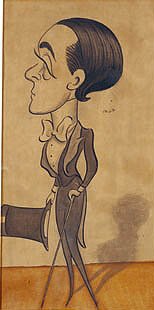
The reader who hasn’t seen Beerbohm’s caricatures must take my word for their quality and appeal. I recommend finding a collection of them at once. Waste no time. (The collection I own is Max Beerbohm Caricatures by N. John Hall, Yale University Press, 1997.)  

[You can also catch glimpses of many of them online. (Image at right is an 1897 self-caricature by Beerbohm.)  ~Rick]

The American writer Edmund Wilson (1895-1972) defined a caricaturist as a “portrayer of personalities,” and that’s exactly Beerbohm’s greatness – once you’ve seen his sketch of George Bernard Shaw (1956-1950) dancing the Highland Fling, or the reviewer William Archer (1856-1924) kissing the toe of the shoe of playwright Henrik Ibsen (1828-1906), or G. K. Chesterton (1874-1936) as an enormous balloon at the dinner table, you know exactly what they were like, and what Beerbohm thought they were like.

One can’t draw a good caricature (his are much better than “good”) without a deep understanding of its subject matter, and the same is true for the writer of parodies, so it’s perhaps not too surprising that Beerbohm excelled in both. Dwight MacDonald (1906-1982), who compiled the splendid volume Parodies: An Anthology from Chaucer to Beerbohm – and After (1960), calls Beerbohm’s A Christmas Garland (1912)

a set of variations on a theme which I am not alone in thinking the best single book of parodies in our language. The chief drawback to it . . . is that about half the eighteen parodees are no longer of interest. And yet even so one gets such a vivid impression of the literary personalities . . . that one is able to reconstruct these extinct forms of life from the single parodic bone thrown to one, and perhaps to enjoy them even more than their contemporaries did.

I would love to quote endlessly from Beerbohm’s parodies, but I will only cite as an example his “P.C., X, 36,” a parody of Rudyard Kipling (1865-1936) that incorporates Kipling’s often-so-masculine tone, his fascination with men in uniform, and his ear for dialects, in a story about a London cop on Christmas Eve who arrests Santa Claus:       

The captive sniveled something about peace on earth, good will toward men.

“Yuss,” said Judlip. “That’s in the Noo Testament, ain’t it? The Noo Testament contains some uncommon nice readin’ for old gents an’ young ladies. But it ain’t included in the librery o’ the Force. We confine ourselves to the Old Testament – O.T., ’ot. An’ ’ot you’ll get it. Hup with that sack, an’ quick march!

Would a gift for caricature and a mastery of parody be useful to a theater reviewer? As it turns out, if the reviewer is Beerbohm, the answer is yes. He became the “critic” for the influential weekly London paper The Saturday Review in 1898, succeeding the brilliant George Bernard Shaw (1856-1950), who was moving on from reviewing to greater things, and who in his last column gave Beerbohm a soubriquet that would stick:

Still, the gaiety of nations must not be eclipsed. The long string of beautiful ladies who are at present in the square without, awaiting, under the supervision of two gallant policemen, their turn at my bedside [he was ill], must be reassured when they protest, as they will, that the light of their life will go out if my dramatic articles cease. To each of them I will present the flower left by her predecessor, and assure her that there are as good fish in the sea as ever came out of it. The younger generation is knocking at the door; and as I open it there steps spritely in the incomparable Max.

For the rest, let Max speak for himself. I am off duty for ever, and am going to sleep.

“The incomparable Max” Beerbohm was then twenty-six years old.

He stayed at The Saturday Review twelve years – four times as long as Shaw. He wrote over five hundred reviews, selected the best of them for a book called Around Theatres in 1930, and a smaller selection of those was published by Simon & Schuster as A Selection from Around Theatres in 1960.

He begins, on May 28, 1898, with a bang, in an essay called “Why I Ought Not To Have Become A Dramatic Critic.”

Frankly, I have none of that instinctive love for the theatre which is the first step towards good criticism of drama. I am not fond of the theatre . . . in drama I take, unfortunately, neither emotional nor intellectual pleasure. I am innocent of any theories on the subject. I shall have to vamp up my first principles as I go along, and they will probably be all wrong and all dull. . . . My self-respect and my ignorance of bygone formulae of drama will prevent me from the otherwise easy task of being an academic critic. . . . In a word, I don’t quite know what to do with the torch that G. B. S. has handed to me.

Immediately one wonders, is this true? He is clearly lowering expectations, but for what reason – out of serious awareness of his own limitations? As part of a game played with the reader? Both? Or can he simply not avoid writing droll and humorous essays – caricaturing, perhaps, himself?

Whatever the answer, he has neatly differentiated himself from his predecessor, Shaw, who had definite and well worked-out opinions about everything:

I have not that well-considered attitude towards life which gave a kind of unity to G.B. S.’s worst inconsistencies about art. In a word, I don’t quite know what to do with the torch that G. B. S. has handed me.

One sees, slyly inserted into that sentence, a very definite attitude toward Shaw. Beerbohm is certainly not as ingenuous as he presents himself. What’s more, in an oblique fashion he establishes his right to craft his reviews in the way he wants, not according to someone else’s pattern. In any case:

I daresay that there are many callings more uncomfortable and dispiriting than that of dramatic critic. To be a porter on the Underground Railway must, I have often thought, be very terrible. Whenever I feel myself sinking under the stress of my labours, I shall say to myself, “I am not a porter on the Underground Railway.”

As I read Beerbohm’s reviews, the first thing I think of, unlikely as it seems, is a passage from the mystery novel The Case of the Amorous Aunt by Erle Stanley Gardner (1889-1970) in which the lawyer Perry Mason tells a junior attorney:

Take him on, Duncan. There’s not very much you can do with him. Don’t generalize. Pounce on the one point that you can emphasize and then let him go.

The last sentence in that quotation summarizes the approach Beerbohm generally takes in writing his reviews: he pounces on one point to emphasize, and the discussion of that one point takes up most of the review. To put it another way, the underlying genre of Beerbohm’s reviews is the essay.

Quite likely this approach would not have worked for him if he were a reviewer on a daily newspaper; the pressure to get an immediate response into print would have made it difficult for him, or anyone, to write a meditative piece, and it is also likely that an ordinary editor might have instructed the reviewer to stick more to the play, and less to his ideas about drama.

Beerbohm’s editor, however, was anything but ordinary. He was Frank Harris (1855-1931), a bull in the china shop of journalism with a shrewd eye for talent. Harris had spotted Shaw and been richly rewarded. To choose Beerbohm as Shaw’s successor had to be more than good luck. Beerbohm’s unusual approach and style made him a “main attraction” well able to follow Shaw.

There are aspects of Beerbohm’s reviews that may strike the reader as irritating. He takes all the time he wants to make his points. Someone looking for “a quick quote” might have to read a long time to find one.

He also has an irritating habit of referring to actors as “mimes” and to characters in plays as “puppets.” As far as I can determine, silence was thoroughly associated with mimes by the time Beerbohm wrote, and actors in plays typically are not silent. Furthermore, the dramatist whose characters come across to the audience as “puppets” is probably not a very good dramatist, “wooden” being another word for such characters.

On the other hand, it is a pleasure to read the work of someone who writes superlatively well – and for a weekly magazine at that! – and although his first column gives the impression that he has no opinions worth writing about, that is actually not the case. Reviewing a play by the novelist Joseph Conrad (1857-1924) he writes that

What I want from art is some kind of emotion. It matters not at all to me whether the emotion be in itself one of pleasure or one of pain. In whatever way I be quickened, I am grateful. I pity the critics who can find no aesthetic pleasure in “One Day More.” They ought to give up criticism.

Further in the same review he writes:

And that, I insist, is the keenest, truest kind of aesthetic emotion to which we can attain – simply to be “bowled over.”

Throughout his twelve years of reviewing, despite his claims to be bewildered by the theater, he expresses numerous definite opinions, although he is not beyond changing them. For example, he finds it almost impossible for a dramatist to put on stage a convincing portrayal of a writer:

The playwrights seem to be almost as hazy as actors in their notion of what literary men are like. I search my memory in vain for one passable presentment of a literary man in modern drama.

(He had not seen the Tony Award winning performance of Christian Borle (b. 1973) as the manically insecure rock star playwright William Shakespeare in the musical Something Rotten! (2015), but that exception, I would say, proves the rule.)

[There are two reports on Something Rotten! on Rick On Theater—one by me, posted on 14 May 2016 and one by Kirk himself, on 11 May 2016.  Both posts have similar praise of Borle as The Bard.  ~Rick]

On principle he is not excited about the 1908 equivalent of what came to be called “kitchen sink” or determinedly realistic drama:

The relation of a playwright to his audience is the same as the relation of any one to the friend whom he button-holes, to tell him something, in a room. The playwright wants to interest his audience, just as I want to interest my friend. The more abnormal the matter of the communication, the likelier is interest to be aroused.

While Shaw and his fellow reviewer William Archer (1852-1924) championed and promoted Ibsen’s plays, Beerbohm, a member of the next generation, is considerably more objective about them:

[Ibsen’s] was a strange mind, this mind into which I have been peering. Posterity, too, I think, will always, from time to time, peer into it, with something of my own awe. Even when time shall have robbed the plays of the sharp savour that for us they have, Ibsen himself will be as dominant a figure as he is for us. Against his lack of love may be set the fact that he loved not even himself… Perhaps it is but another instance of Ibsen’s egoism that he reserved his most vicious kick [in When We Dead Awaken] for himself.

He is extremely skeptical of plays written by actors such as William Gillette (1853-1937), because those plays tend, in the words of Shaw (who agreed with him), to be “a tissue of effects:”

I must find such solace as I can in my prevision of the time when Mr. Gillette will have ceased to write anything but stage directions.

He argues, logically if futilely, for the use of the soliloquy in modern drama:

Though in real life we do not talk to ourselves, we do think to ourselves, and many of these thoughts we could not or would not divulge to any other creature, however dear a friend he might be. Perhaps these incommunicable thoughts are the most important we ever have – the thoughts which, if they were divulged, would best elucidate our characters and our actions.

He scoffs, or claims to scoff, at the label of the “hard-working” actor:

To walk and talk for half an hour in the course of the evening makes no great strain on your physique, even though you have to walk gracefully and to talk in a loud tone. Moreover, the amount of brain-power you require for “studying” the average creation of the average dramatist is – well, not above the average.

He suggests that mornings are the best hours for watching serious drama:

The morning always has been recognized as the time when the functions of the brain and the heart are best performed. In the morning all our faculties are agog. We are fresh from sleep. . . . And just as our emotions are in proper trim, so are our brains. We celebrate clearly, cleanly, assimilating facts, detecting fallacies, at a glance. We are as receptive as tiny children, yet, unlike them, able to reason from our learning. Like the shining day itself, we are young.

Nor is Beerbohm incapable of changing his mind. He jousts with Shaw throughout his twelve years of reviewing, at first speaking of Shaw as a sort of pamphleteer who uses actors. Many have expressed this opinion about Shaw’s plays. It is certainly inaccurate or at least incomplete, as I have tried to describe elsewhere in this blog [see Kirk’s “Bernard Shaw, Pop Culture Critic,” posted on ROT on 5 September 2012; “Eric Bentley on Bernard Shaw,” 3 December 2015; and the 5-part “Re-Reading Shaw,” 3 & 18 July, 8 & 23  August, and 2 September 2016]. Beerbohm at first agrees with the criticism but eventually comes to the understanding that

[the reviewers] still maintain that Mr. Shaw is not a playwright. That theory might have held water in the days before Mr. Shaw’s plays were acted. Indeed, I was in the habit of propounding it myself. . . . I wrote here a special article in which I pointed out that the plays, delightful to the reader, would be quite impossible on the stage. This simply proved that I had not enough theatrical imagination to see the possibilities of a play through reading it in print. . . . To deny that [Shaw] is a dramatist merely because he chooses, for the most part, to get drama out of contrasted types of character and thought, without action, and without appeal to the emotions, seems to me both unjust and absurd. His technique is peculiar because his purpose is peculiar. But it is not the less technique.

Like Shaw he thinks continually, if sometimes fancifully, about the role of the reviewer:

No critic is able to criticize a play rightly after seeing it but once. If he write for a daily paper he has to exhaust himself with the effort to remember every turn of the plot, in order that he may write a clear precis. If he write for a weekly paper, he has to be on the alert for something which will make the basis for a theory – some salient feature on which he can fasten an idea.  . . . Will the critics, I wonder, be swayed by this counsel of perfection? Not I, for one. Few plays deserve to be seen at all; on the other hand, I grow more and more fond of first nights.

It seems to me that the word “incomparable” fits Beerbohm well. Who can we compare him to? In an era when reviews seem, as a matter of style, to be much the same, Beerbohm shows that a great deal more is possible. Of course it helps to be Max Beerbohm.

In 1939 he became Sir Max. I cannot think of any other drama reviewers who have been knighted. That surely must indicate something. 

[Kirk notes that Beerbohm, who was knighted in 1939, was apparently the only theater reviewer to receive that honor from the British Crown.  It’s interesting to note, however, that Beerbohm’s predecessor on the drama desk of the Saturday Review, George Bernard Shaw,  was offered a knighthood  in 1925, but he declined the honor. 


[The year of the offer is somewhat in doubt, apparently, as other sources put it sometime “during the 1930s and 1940s.”  Furthermore, some references say the offer was never formally made, “but that he was sounded out.”  (It almost certainly would have been for his playwriting more than his drama criticism.)  I couldn’t pin this down, but it’s more certain that an offer of an Order of Merit award was considered in 1946, but Shaw let it be known that he wouldn’t accept the honor so it was never officially offered.


[Shaw refused most other honors and awards as well; he basically disparaged such recognition, feeling that it should be left to posterity.  Nonetheless, he’s one of only two people ever awarded both a Nobel Prize and an Academy Award (the other double-winner was Bob Dylan).  Shaw won his Nobel for Literature in 1925 and the Oscar in 1938 for the screenplay adaptation of Pygmalion.  (Dylan's academy award was in 2001 for his song "Things Have Changed" from Wonder Boys; he won the Nobel Prize for Literature, recognizing the poetry of his song lyrics, in 2016.)


[Reportedly, Shaw wanted to refuse his Nobel Prize, too, but his wife urged him to accept it as an honor for Ireland; however, he refused the concomitant monetary award (usually around $1 million or €850,000), requesting that it be used for the English translation of Swedish books.]  


28 October 2020

"Aging & Achieving: Staying Active in the Industry for Decades"


[As long as I’ve been sentient, theater people have been protesting the treatment older people in the profession have received as they age.  This has been especially, though not exclusively, true of actors, and most demonstrably of women actors.  The Actors’ Equity Association, the union that represents professional stage actors and theatrical stage managers, has been trying to address this apparent inequity pretty much since it was formed.  

[The situation may be looking up.  The Winter 2020 issue of Equity News (vol. 105, iss. 1) ran an article on the progress that’s being made in an issue titled “Aging & Achieving.”  I’m posting the article on Rick On Theater as part of my occasional series about issues in the industry.  Here is Gabriela Geselowitz’s “I’m Still Here: Aging and Longevity in the Theatre.”  Geselowitz is Senior Writer and Project Manager at Actors’​ Equity.]

I’M STILL HERE: AGING AND LONGEVITY IN THE THEATRE
by Gabriela Geselowitz 

Marjorie Horne was about 23 when she got her Equity Card. It was for a chorus contract, earning $100 a week in summer stock in Michigan‘s upper peninsula. While rehearsing the third production of the summer, producers ran out of money, and on her very first union contract, they had to use the bond to send her home. Horne was undaunted:

“It was very clear when I was offered my card, there was no going back,” she said. “I just looked totally ahead and was there.”

That year was 1967, and now Horne is a successful stage manager and Equity councilor who has been working in the industry for over fifty years.

Theatre is for all ages, and that’s for audiences and artists alike. For those who have made their careers on or backstage, the industry isn’t just a youthful pursuit, but a lifelong occupation. Despite its reputation to the contrary, successful theatre professionals can achieve career and financial stability. Equity members in particular have access to protections that give them the freedom to age on their own terms, and stay active in the industry as senior citizens. Many actors and stage managers slow down or cease working in later years due to dwindling job opportunities, health necessity or personal desire. But some artists continue working well into their sixties, seventies or beyond.

Why keep working at an age when their peers are retiring? Do decades of experience bring the luxury to choose when and how you participate in theatre, or does the hustle last forever? Equity News spoke with several working members about aging in the theatre, changing opportunities and, for some, how the drive to make art never goes away.

“I have always thought that I wanted to do this until I die,” said actor Anita Hollander, 64.

“Actors don’t retire. Do actors retire? I’m not retiring,” asserted actor Sally Wingert, 62.

The average age of retirement in the United States is 65 for men and 63 for women, thanks in part to Social Security, though that number is likely to rise as Americans have greater difficulty acquiring the resources to stop working. Most would not likely guess that theatre actors could be among those who can choose to retire and live off a nest egg. However, Equity offers a 401(k) plan, and as members reach their 60s, they may start collecting the pension that they have been feeding through union contracts over the course of their career.

Even though Equity affords protections for members as they age, no one spoke of that as a motivation for joining the union. Some members had no idea what Equity was when they joined, and others recalled wanting to earn their card as a sign of prestige, only appreciating later the extent of the practical benefits it would afford.

“I never thought of old age,” said Delphi Harrington, 82. “Who would be called an actor and think about old age?”

“It wasn’t that I was particularly mature or thinking ahead. Certainly I was not thinking about retirement in the way that I should have been,” said Wingert. “The fact is I have told so many young performers that I’m working with currently that it is the complete and utter gift of my union to have a solvent, significant pension, and those are going the way of the dodo bird.”

“As a 62-year-old performer that knows I’m going to be using my pension within the next decade, I could not be more grateful that I joined my union when I did,” she added.

With exceptions, members can usually begin collecting on their pension at 65, and they must by age 70.5. Many Equity members belong to SAG-AFTRA as well, and may be pulling funds from multiple pensions, in addition to Social Security payouts. But finances can be a complicated, frustrating matter, as actor Dale Soules, 73, learned firsthand.

“In the years of the recession things weren’t so jolly,” she recalled. “I went to The Actors Fund and talked with them about what to do. I applied for food stamps and after difficulty reapplying for unemployment, it came through – for $67 a week.

Soules’s fortune improved, first with Hands on a Hardbody (her seventh Broadway show), and then, after a career predominantly onstage, when she became a series regular on Orange is the New Black. And then, in what she described as a “perfect financial storm,” she, by law, had to begin collecting her Equity pension and Social Security, and along with her television work this moved her to a higher tax bracket. She also took a hit from the new tax laws that limited her ability to claim deductions . . . and then got audited. During that process she received a history of her earnings under Equity contracts over 50 years, and it totaled just under $500,000 – an average of $10,000 a year.

“I would not have been able to survive a number of dry patches in my career if it weren’t for the fact I live in a rent-controlled apartment,” she admitted. “The day I can’t make the four flight walk-up things may get a little tricky but for the moment I’m still in shape and it’s like having a free gym!

“Actors often subsidize their own careers, and they subsidize the theatre,” she reflected. “But I do have that pension. And whatever I lost in taxes, even if I were to lose everything I made I would be OK. I could get by because of social security and that pension.”

Some stories are more serene. Stage manager Bob Bennett, 75, began taking his pension when it became available while continuing to work, stage managing fewer shows each season. He doesn’t want to leave the theatre, but the pension allows him to take fewer jobs and pursue other passions in his new spare time.

“It makes it possible for me to do some of the things that I might not be able to do as freely,” said Bennett, who is a long-distance hiker. “It’s one of the great benefits of our union.”

“I think it’s a huge credit to the business that I’ve not felt ageism at all,” he added, “I don’t feel it from my cast; I don’t feel it from my crew. The most I hear is, why am I still working? Because I like to. I don’t know that I’d find that in other businesses.”

Others have not been as fortunate in avoiding discrimination.

“There’s a patronizing attitude people have about aging that in some way you’re diminished,” said Harrington, who moderated an Equity panel on ageism in the theatre this past spring. “I don’t feel diminished. I feel expanded, richer, deeper, more various, stronger! I don’t like people to make assumptions about me.”

Some theatre artists have actually been denied roles based on their age.

“I’ve lost work because I was honest,” says Marjorie Johnson. She recalls an employer asking her age, and when she answered honestly, they told her they thought she was younger, and she lost the part. It is actually prohibited by federal law to discriminate against anyone 40 or older based on their age, and anyone in a similar situation should contact Equity, but Johnson no longer makes her age public.  [Respecting her wishes, I’ll only add that Johnson is in the middle of the range of ages of the Equity members interviewed here.]

“I just thought, ‘Oh, I guess I shouldn’t have said that,' and so from that point on I just don’t,” she said.

“I do think that roles are harder to find for women as we age,” added Greta Lambert, 63. “They’re not impossible, but for example my first season here [at the Alabama Shakespeare Festival] there would have been six to eight shows where I could have had a role as a young leading lady, and now there’s one show, maybe two in a year where there’s an age-appropriate role.”

“Usually directors like to hire young people and make them look older,” said Virginia Wing, 82, noting that even roles written as older characters are no guarantee.

Many professionals, however, have been surprised to find that their golden years are some of their best working ones.

“When I reached my fifties, I entered into probably the most significant decade of work that I’ve had in my life and it seems to be continuing,” said Wingert, who credits ample job opportunities in the Twin Cities, “Any given year I have worked between 35 and 60 actor work weeks.”

“Actors more than stage managers have the option of not retiring,” explained Horne, since at least some plays have characters of advanced ages that are cast appropriately. And yet, she too is still working, both new and recurring gigs like the Tony Awards.

“I’m making more money than I had ever seen in my whole life in a year. It is nuts,” she said. “I’m still putting into my pension because I’m still working on contract a couple of times a year.” 

The land of semi-retirement can be a fertile one, as members work on their own terms. For some, that means declining to take understudy roles, or a refusal to audition. Stepping away from solely acting or stage managing may also mean broadening one’s theatrical horizons, pursuing other technical work, directing, writing or teaching.

Lambert lives in Alabama, and while that meant passing on New York and the opportunities it offers, it also meant that she found an intimate home, where there’s always a way she can participate in the theatre, and where she runs into audience members at the supermarket. She has been part of the same company on and off since 1985, served as faculty for an MFA program and held titles of Director of Education, Director of Fellowship Company and Associate Artistic Director.

“I’ve had to redefine what success means for myself because it’s not about what the business tells me it’s supposed to be about” said Lambert, “For me, it’s been about playing great roles and being part of a community – not only other artists but the community I live in now.”

Lambert has also found that aging publicly, in front of an audience, can be a daunting proposition.

“I don’t know how much longer I’ll be willing to perform because of my own vanity, that I’ll be able to keep letting audiences watching my growth,” she confessed, “I don’t think my struggle is any different than any other person who ages. If it’s difficult it has very little to do with my business. It’s the culture of aging.”

Ernest Abuba is transitioning in the opposite direction; now retired from teaching theatre and in his seventies [he’s 73], he is looking to act more than he did when he was working at Sarah Lawrence College. (He has also worked as a director, playwright and founding member and resident artist of Pan Asian Repertory Theatre.) He thinks he may have more opportunities now, in part because fewer older working actors means less competition, and because he has seen improvements overall for actors of color.

“For many years it was all about stereotypes,” said Abuba, who has worked in the theatre for 50 years. “Now the way I look at it, the system has opened up more, it has been opening up more for the Asian American, in the last ten years or so.” An activist for better representation and an early member of Equity’s Equal Employment Opportunity Committee, Abuba now hopes to enjoy some of the hard-won progress.

Even if the work opportunities are present, other complications arise as Equity members age in the business. For those struggling with health issues, the choice to keep working can be very much a privilege. Some members spoke of actor friends who had to leave the business when they could no longer memorize lines.

“As long as I’m still functioning and my brain is still functioning, I’m in it for the long haul,” said Johnson, “Thank God my memory is still intact.”

Hollander is acutely aware of how to navigate physical wellbeing and an onstage career. When she was 26, she had her leg amputated due to cancer. She was back performing on stage four weeks later, and she spoke about how working with a disability prepared her for aging in the industry.

“I was not only under pressure for how I would make a living, I was now a cancer survivor and an amputee,” she said, “I was definitely not going to ever let anything get in my way. I am aging, and I am noticing, ‘Oh my gosh, this is not easy.’ But I’ve been disabled since my twenties and working in this profession. I didn’t go into this so naïve that it wasn’t going to be difficult and painful and worrisome, but I wasn’t going to give up on that.”

Hollander is one of many members who finds she is working more now than she ever has, in part on the strength of autobiographical solo shows. However, steady work never fully addresses her concerns.

“The results are happening and the irony is, I’m still struggling to get my insurance,” she said, “This industry has been very challenging to navigate as any kind of performer, but particularly a performer with a disability – and add to that an aging performer with a disability.”

Hollander is grateful that in the 1980s she found a home in Manhattan Plaza, a federally subsidized residential complex that takes her medical expenses into account. She is also aware of The Actors Fund Home, a short and long term care facility in New Jersey, as well as other resources.

“I’m just hoping that I can be OK, but I do feel fortunate that The Actors Fund exists,” she said. “I have been working all my life and there may be a time I need help.”

Members agreed that a support network is crucial for survival in the industry long term, not only in terms of health and finances, but professionally and socially. Hollander, for example, directs as well, and she casts her peers who are also aging actors with disabilities. Horne has decades as a stage manager behind her, and that means decades of connections.

“I have good relationships with the people that I work with,” she said. “The new jobs that I’ve gotten have come from other people that I’ve worked with and their recommendations.”

“I have a group of friends that are very, very supportive of each other,” added Johnson. “I have a very strong network of performers in my age category. Even if we have the same audition, we’ll work with each other, including gathering to read opposite one another or record one another for virtual auditions."

By now, members know that a spate of good working years does not mean permanent comfort, and that a dry spell does not spell the end.

“For the last ten years I would say I’m in my retirement mode, and then the next week I’d have a job,” said Johnson, who in 2016 received critical acclaim for a leading Off-Broadway role in Dot, playing an aging woman struggling with Alzheimer’s.

Soules was optimistic, thinking that a general aging population would create a mirroring effect in the arts world. But she knows that all she can do is continue to perform as best and as long as she can.

“You never really know on what criteria you’re being judged,” she noted, “The only thing you have any control over is the work that you put into it.”

“When you love what you do,” said Harrington, “You don’t quit.”

[A note about one of the Equity members interviewed above: Marjorie Horne, the 76-year-old stage manager, is also featured in another Equity News article I posted on ROT: “Get Me to the Stage on Time,” part of “Stage Managers,” posted on 30 January 2017.  “Stage Managers” is an entry in another ad hoc series on ROT, introducing and explaining the work of performing arts jobs theatergoers seldom know much about.]

23 October 2020

Some Plays at the Brooklyn Academy of Music from the Archive


THE TEMPTATION OF ST. ANTHONY
by Robert Wilson
(based on Gustave Flaubert)
2004 Next Wave Festival (BAM)
21 October 2004 

My first show in the Brooklyn Academy of Music’s Next Wave season this year was Robert Wilson’s gospel-inspired version of The Temptation of St. Anthony on 19 October [2004].  Wilson’s piece, presented in BAM’s Howard Gilman Opera House, is based on a Gustave Flaubert (1821-80) novel (La Tentation de Saint Antoine, 1874) of the spiritual torment of Saint Anthony the Great (251-356), but Wilson tells his version virtually without spoken dialogue at all, having turned the story into a gospel-music revival.  

Flaubert’s novel, written in the form of a play script (and itself inspired by a ca. 1557 painting of the same title attributed to Pieter Bruegel the Elder, c. 1525-30 – 1569), details one night in the life of Saint Anthony who begins to question his years of self-imposed solitude and asceticism.  The devil tempts him with both physical pleasures—luscious food, a shower of gold, a beautiful woman (The Queen of Sheba) and man (Adonis)—and many different non-Christian beliefs and philosophies.   

(The painting referenced above as the inspiration for Flaubert’s The Temptation of Saint Anthony was cited in the Wikipedia entry for the novel.  It was originally attributed to Pieter Bruegel the Elder, but has since been ascribed to one of his followers.  

(There were, however, at least two other canvases with the same title by painters in Bruegel’s family, including one painted by his younger son, Jan Brueghel the Elder, 1568-1625, in 1594, and another by his elder son, Pieter Brueghel the Younger, 1564-1638, in ca. 1600.  [After 1559, Pieter the Elder dropped the h from his family name; his relatives continued to use Brueghel.] 

(The French Wikipedia page for the Flaubert attributes the inspiration to the version from Pieter Brueghel the Younger.  Unless Flaubert left something in writing to attest to his stimulus, I don’t know how scholars can be sure.)

Anthony’s desert retreat is visited by a phantasmagorical array of evil characters and visions.  He struggles, but he prevails.  Along the path, he’s questioned and challenged by his disciple, Hilarion. 

In Wilson’s more austere adaptation, gone are the wild delusions of diabolical temptations.  Many are represented by the gospel hymns (gluttony in “Table Is Spread”; lust in “God Is Love”).  The director’s spare style is punctuated by sections of vibrant dance (choreographed by Christalyn Wright) and spiritual Christian revelry.

As usual with Wilson, the piece is short on drama, but long on theatrical spectacle.  The music is glorious of course (more on this later), but the visual images Wilson evoked are stunning, whether enhanced by the movement (the movement coach is Valerie Winborne), set, or costumes (designed by Geoffrey Holder, a certified theatrical genius to be sure). 

I suppose that if you’re susceptible to being touched by the story of Saint Anthony, the hermit saint who went in search of the true faith by living alone in the Egyptian desert, the play (if that’s what you can call Wilson’s piece) may move you—but since I don’t have a dog in this race, I was taken by the spectacle alone.  Over a brief, intermissionless hour and forty minutes, that was enough sustenance.

Since the music is the center of this piece, I should say something about that up front.  In contrast to a musical I saw at the Contemporary American Theatre Festival in Shepherdstown this summer, which was inspired by the clash of musical cultures in Texas (so the playwright/director said) but had no one working on it who had any background in Mexican, Latin, or Tejano music (or country-western, either), Wilson did this absolutely right.  [The play at CATF was The Rose of Corazon by Keith Glover.  I reported on it on Rick On Theater on 8 July 2015.]  

Wilson collaborated with Bernice Johnson Reagon, about as much an expert in gospel music as you can find.  She not only knows the music as an academic who has studied the background and origins, but she just retired from her own gospel group, Sweet Honey in the Rock.  Now, I’m not a great fan of gospel music especially, but the vocal harmonies are gorgeous, and the music—which carried all the verbal element of Temptation—is superb. 

Reagon used existing songs, some of which she adjusted to fit the Saint Anthony story, and composed some original pieces.  All of them are wonderfully executed by Wilson’s cast.  (There’s a tinge of African rhythms in some of the pieces, and some of the costumes also bear African elements, but that may be embedded in the gospel tradition.  In any case, it does nothing but enhance the performance.) 

As I indicated, there’s no real spoken dialogue—except for the songs, the only other words are recitative or chants.  It makes the whole thing seem like a church pageant.  (As you might have imagined, Wilson’s Temptation was compared some to Lee Breuer’s Gospel at ColonusGospel did, by the way, have something of a life after BAM in 1983: it was shown on PBS’s Great Performances in November 1985, which is where I saw it, and went to Broadway in 1988.  It appeared in the repertoires of several regional theaters in the years afterward, too, but it’s popularity may have faded substantially by now.)

The base set, designed and lit by Wilson, is a unit which never changes—a square room with windows on the side walls and arched alcoves in the rear, flanked by doors at right and left.  The floor is essentially bare except for thin, wooden benches parallel to the side walls, one on each side of the stage.  (As usual with Wilson, the floor lights up in various colors, and there are constant washes of light from above that change the color of the set and costumes.) 

The side walls are directly perpendicular to the proscenium so they’re all but invisible from the center of the house, and the alcoves up stage resemble nothing so much as a pair of tablets for the Ten Commandments, making the space remind me of a simple synagogue, the alcoves representing the Torah ark.  This may be Wilson’s intent—to evoke the First Temple in Jerusalem, say—or I may have been the only spectator to find this resemblance.

The set’s occasionally enhanced by movable additions as the narrative calls for them.  These, of course, are seldom realistic.  In the instance that impressed me the most, a mountain flows out and one of the deities Anthony encounters descends. 

The deity first appears as a small puppet at the top of the mountain, rounds the first peak, and disappears briefly between the parts of the mountain.  When the deity emerges around another peak, it’s a larger puppet identical to the first except for its size.  Rounding another peak and disappearing again, it emerges, this time as a live actor, dressed the same as the two puppets.  Accompanied by one of Reagon’s songs, it’s a simple, but effective and delightful effect.

Holder’s costumes are mostly brightly colored and richly decorated robes but often topped by very elaborate (and, to my eyes, African-inspired) headdresses.  The women also have highly styled (and styled high) wigs of different shapes. 

Only Saint Anthony (Carl Hancock Rux) and his student Hilarion (Helga Davis) are individually cast; the rest of the characters are played by members of the ensemble while, for the most part, the rest serve as a chorus.  (According to a note in the program, most of the members of this all-African-American cast have known and worked with each other for years.)  They often weave intricate patterns, moving around the stage as they sing.  The robes are floor length and this makes the actors look like they’re gliding on wheels rather than walking.  It’s wonderfully ethereal. 

Like I said, with Wilson, often the spectacle is all.  In this case, it was enough.  Sometimes, beauty for its own sake is sufficient.

*  *  *  *

A MIDSUMMER NIGHT’S DREAM
by William Shakespeare
Watermill Theatre production by Propeller (London)
17 March 2004 

I saw A Midsummer Night’s Dream last night [Tuesday, 16 March 2004], in the production by Edward Hall’s all-male Propeller company from London, presented in the Brooklyn Academy of Music’s Harvey Theater, the former Majestic which had been recovered for Peter Brook’s Mahabharata back in the ’80s.  I didn’t know the company previously, though they’ve been around for seven years; they’ve done other Shakespeare (Henry V), but I don’t know if they do other writers or periods [apparently not—Shakespeare is their turf]. 

For the first time that I can remember, Diana, my frequent theater partner, liked a show that I didn’t; if we disagree, it’s usually the other way around.  (She said she liked the “energy” of the performers.  That didn’t do it for me, and I didn’t question her because I didn’t want to spoil her enjoyment.) 

I guess the actors do a good enough job (especially the rude mechanicals: Tony Bell as Bottom the Weaver, Vincent Leigh as Snout the Tinker, Jonathan McGuinness as Snug the Joiner, Chris Myles as Peter Quince the Carpenter, and Jules Werner as Flute the Bellows-mender), but I just don’t see the reason to do this with all men.  It struck me as a gimmick—Hamlet on roller skates; if there’s anything more to it, it went past me. 

It’s not really Elizabethan—these actors aren’t boys, they’re men.  They don’t impersonate women, though they wear women’s clothes: there are no wigs, the actors don’t do “female” voices, or otherwise try to present feminine characters.  (Think Jamie Farr’s Klinger from MASH.  I’d add the Ballet Trocadero de Monte Carlo, but that’s a deliberate travesty; this isn’t supposed to be.) 

As far as I can tell, the casting of men in all the roles doesn’t add anything to the play except one more layer of humor—but I don’t see that that addition is appropriate.  There are essentially three kinds of humor in this production: 1) the jokes Shakespeare wrote into the play; 2) the physical comedy added by the director and actors; and 3) humor that arises because men are saying lines intended for female characters.  1) and 2) strike me as perfectly legitimate, but 3) strikes me as gratuitous. 

The laughs don’t come from the writing or the acting—just the casting.  It’s not clever; it’s just opportunistic.  And I don’t see how it illuminates the play or its themes (not that Midsummer’s themes are so deep they need much illuminating). 

In the program, director Hall is quoted as saying that the all-male casting “is about ‘trying to give the plays back to the actors, so that they can really tell the story in a more one-on-one way with the audience.’”  I can’t imagine how that statement even makes sense.  It sounds like he’s saying women actors can’t tell the story or work one-on-one with the audience (if that’s even an important accomplishment). 

The whole thing—which runs two hours and 40 minutes—just didn’t work for me at all.  I thought it was silly—not funny.  It even qualifies as pretentious, considering Hall’s statement.

*  *  *  *

THE WILD DUCK
by Henrik Ibsen
National Theatre of Norway (Oslo)
2006 Next Wave Festival (BAM)
1 November 2006 

My theater companion, Diana, and I went over to the Brooklyn Academy of Music on Thursday evening, 26 October, to see the National Theatre of Norway’s production of Ibsen’s Wild Duck.  Like most non-musical productions at BAM, this was at the Harvey Theater.  I’m always curious to see how the natives interpret their own playwrights.  It always strikes me as sort of like going back to the source. 

Also, those national companies are usually excellent; I don’t believe I’ve seen the Norwegian company before, but I’ve seen the Swedish counterpart (with Bergman often at the helm), and they’re superb.

(I was telling my mother about this show and it made me recall two other national companies I’ve seen in the past decades: the State Theater of Lithuania with a play called The Square by the company’s director, Eimuntas Nekrosius, and the Ivan Vasov National Theatre of Bulgaria, with a Russian play called Retro by Alexander Galin.  I didn’t know either play, of course, and both were performed in the companies’ native languages. 

(And both were magnificent performances—and experiences.  I think The Square, which was at the Joyce Theatre on 8th Avenue in Chelsea in ’91 as part of the short-lived New York International Festival of the Arts—which may have morphed into the Lincoln Center Festival, but I’m not sure—may have had simultaneous translation, but I have always remembered that play as a fascinating and, at the time, unique take on the shift from communism/totalitarianism to freedom/democracy.  Fifteen years later, and I still remember it. 

(Retro, which was part of the Theatre of Nations in Baltimore in ’86 [see my report on this international theater festival, 10 November 2014], didn’t have a translation—just a synopsis in the program—but the acting was so absolutely clear that that was all I needed to decipher what was happening.  The company worked in almost perfect Stanislavsky style for this domestic comedy and every action and intent was entirely clear and comprehensible even though I couldn’t understand a word of the dialogue. 

(Comedies, I think, are the hardest plays to communicate when you don’t understand the language.  A tape of that performance would have been a perfect training film for Stanislavsky acting.  I guess that my remembering these performances 15 and 20 years afterwards says something.)

The Wild Duck isn’t one of Ibsen’s well-known, frequently-staged plays—at least, not in the U.S.; it’s apparently popular and even beloved in Norway—so I’ll give a short synopsis of the plot:

Hjalmar Ekdal (Gard Eidsvold) is a photographer, but he lets his wife, Gina (Agot Sendstad), and daughter, Hedvig (Birgitte Larsen), run his studio while he devotes his time to loftier pursuits: supposedly working on a “great invention,” which he never identifies.  He spends most of his time hunting rabbits in the loft with his elderly father (Kai Remlov)—who’d been imprisoned for corruption and suffers from moral and financial bankruptcy. 

The Ekdals only get by thanks to the wealthy Haaken Werle (Bjorn Skagestad)—Old Ekdal’s former business partner who’d managed to escape the charges that had condemned Old Ekdal.  Without Hjalmar knowing it, Werle has been giving money to Gina. 

One day, Gregers Werle (Eindride Eidsvold), Haaken’s son and Hjalmar’s oldest friend, returns to his hometown following a self-imposed exile.  In his search for the truth about the two families, Gregers makes discoveries that jeopardize the happiness of the entire family and have tragic consequences.

This Wild Duck, an offering of the Brooklyn Academy of Music’s 2006 Next Wave Festival, is a kind of trimmed-down version—not an adaptation, but it only runs two hours (without intermission) and the cast has been cut to just the nine most prominent characters.  The set reflects this slimming process as well: there are only a table and about ten chairs (all Scandinavian-modern design—very stark) and an odd wood-textured wall, about six feet tall, across the back of the space. 

Director Eirik Stubø moved the action up to the late ’50s or early ’60s—at one point Ekdal plays Elvis Presley’s “Love Me Tender” on his flute and spins Gina around as he sings a few bars—though the text isn’t altered as far as I could tell from the supertitles.  (The translation for the titles is credited to Judith Messick and Katherine Hanson, but it looks a lot like the Rolf Fjelde rendition published by Signet that I own.  I looked up a couple of things after I got home, and the wording looks awfully close; I even spotted several exact phrases as I skimmed for what I was looking for.)

It’s an entirely minor quibble, I admit, but the juxtaposition of the 19th-century text (Wild Duck was written in 1884) and the mid-20th-century look is occasionally jarring.  Two instances that I noted in passing include an exchange between Hjalmar Ekdal and his wife regarding cutting the pages of some of his reference books and a mention of “freshly-churned butter.”  Unless Norway was way behind the rest of the Western world in the ’50s and ’60s, we pretty much stopped selling books with uncut pages and getting butter fresh from a churn, as opposed to a grocery store’s fridge, was relegated to farms. 

More of a problem for me is the total ambiguity of the setting—and especially that back wall.  The script says the first act is in the Werle house, and the other four acts are in Ekdal’s photography studio.  In the published translation, the studio is described as completely furnished, not spartan, so Stubø (and his designer Kari Gravklev) are making a stylistic decision beyond the period of the action—to make a Symbolically minimalist environment for the (essentially) Realistic acting.  I can only say that I had a hard time imagining where the people are in real space—and maybe that’s my failing. 

I don’t think it’s my failing, however, that I was bothered by the constant need for the cast to reset the table and chairs, including moving the table on and off stage and adding or subtracting chairs.  (There are only three chairs and no table when we first arrive at Ekdal’s house in act two.  There are no act breaks, except that needed to reset the stage—accomplished by the actors themselves with the lights up.) 

There’s also a lot of action devoted to setting and adjusting the table (which has extension leaves, stored under the table top, that are taken out and put in as the needs of the scene demand).  I remember seeing a production of The Duchess of Malfi (by Cheek by Jowl) at BAM in 1995, and it became a play about moving chairs.  (There was a staging of The Brothers Karamazov—not the acrobatic clowns—at the Jean Cocteau Repertory in 1994 that devolved into the same thing.)  This production almost becomes a play about moving the table!

Now, that wall.  It’s just a plain, blondish wood-pattern expanse that extends from stage right to stage left, about six feet high—just over head height.  It looks to be about six to eight inches wide—wide enough for Hedvig to walk or crawl along.  But, what the hell is it?  I mean, we know that the studio is indoors—it’s described in the text as a loft, suggesting that it’s above ground level.  (I always pictured it as a sort of attic space, in fact.) 

Except for the fact that this looks like wood, it otherwise seems like a garden wall of some kind, and seems, from the action, to separate the “indoor” area (that is, the studio) from the “outdoor” area (where the rabbits Old Ekdal shoots and the wild duck of the title live).  There are no door and no windows in the wall, so when someone goes into the area on the other side (which we can’t see), he climbs over, often using a tall, wooden step ladder he brings from off stage. 

When people look over the wall, they usually climb on chairs (which are either already placed against the wall on “our” side or are moved into position for the purpose of peering over the wall’s top.  As I said, Hedvig walks along the top of the wall once and crawls along it another time.  I’m sorry, but if all this is symbolic, I didn’t get it.  (I cop to not being good with Symbolism.  I guess I’m just too literal-minded.) 

If it isn’t symbolic, I can’t figure out how that wall works (along, of course, with the rest of the space).  I’m going on about this because it occupied my focus so much of the time I was watching, trying to understand what I was looking at, that it became a distraction.  (And, believe me, what with having to look up at the supertitles and then back down at the actors, an additional distraction is totally unnecessary!)   

I’m not sure I can articulate this, but using the chairs that way and carrying an actual ladder from off stage seems to make the wall realit’s an actual wall.  But, then, what’s it doing there?  What kind of space has a tall wooden wall with no doors or windows like that?  If it’s a garden wall, it wouldn’t be wood (unlike, say, a fence).  If it’s a room wall, it’d have windows or doors. 

But if it’s symbolic, not “real,” it seems you shouldn’t have to use real, practical things to negotiate it.  Does that make sense?  Maybe I’m way off—as I said, I’m not good with Symbolism.  If I were designing a symbolic wall, I’d have made it low enough to look over without aids, or I’d make it a scrim or a latticework painted like a wall; I’m sure someone more imaginative than I, especially in stage design, would come up with more and better ideas.  The problem I see with most of my ideas is that if the director of Wild Duck deliberately wanted the area on the other side of the wall to be invisible to the audience, these wouldn’t work.

I’ve said on several occasions that I find trying to turn Ibsen’s Realistic plays into some other style, Symbolism among them, is a usually disastrous directorial decision.  I allow that Wild Duck is partway to Ibsen’s more Symbolistic period at the end of his career—according to director Stubø’s program note, Ibsen wrote his publisher: “This new play has in certain ways its own place in my dramatic production; its dramatic progress is in many ways different from my previous ones”—but it’s not there yet.  Maybe I am too literal minded to buy such a shift.  Maybe I only think it doesn’t work—but in reality, I just don’t like it.  I don’t think that’s the case, but would I know? 

It’s not that I mind a minimalist set, a suggested set without all the 19th-century trappings.  I did that myself in an adaptation of a Chekhov story—and I believe it worked.  I don’t even mind up-dating the look of a play; I did that, too, with an Oscar Wilde play I reset in the 1920s.  But when the director moves into an alien style, then I think the balance gets tipped.  Finally, if I can’t figure out what’s going on, then almost nothing else really matters—it’s just not working.  In my humble opinion, of course.

The acting all seemed fine, except that it was all on a rather even keel for the most part.  There are a few highs and lows—and some long silences while the cast takes care of tasks like setting that table and putting in or taking out leaves (I joked that maybe Stubø is trying to rip off Pinter, but it’s not much of a corollary.) 

I mean, Ibsen’s plays lean toward melodrama by today’s standards—there’s lots of emotion and psychological drama.  These folks are all moderated and even-tempered an awful lot of the time.  Now, maybe that’s a Norwegian character trait, I don’t know, but it struck me as odd, given the circumstances. 

The casting of Hedvig was also a little peculiar.  Ibsen says she’s 14—Juliet’s age—but the actress in this production, Birgitte Larsen, plays in her later teens (and, I’m sure, the actress is actually older than that [it turns out she was 25]).  She’s much more precociously sexual than I figure Hedvig is intended to be, though I’m not convinced Larsen is playing it that way.  She just looks more like a woman than a girl. 

Diana thought she was and that the others actors, especially the men (and her father in particular), were responding.  (Diana felt that Stubø might have been suggesting the daughter is starting to take after her mother.  That might not even be contrary to Ibsen’s creed, which held that the moral corruption of the parent is inherited by the children.  That’s why Nora couldn’t stay with her children or take them with her in Doll House.)  I didn’t get that impression, however—though perhaps I just missed it.

Finally, I’ve decided I don’t like supertitles.  I’ve had a series of bad experiences with this translation device—they’re badly located on the stage so that I can’t read them and watch the actors or they’re too small or distant so I just plain can’t read them.  In this instance, the screen isn’t too high above the actors, and it isn’t too small, but I found myself bobbing my head up and down so much and trying to catch the longer phrases fast enough to get back to the stage before the next text is projected that I was losing far too much of the theater for the logistics. 

When BAM used the infrared earphones, I used to keep the volume down low so I could just hear the translators and still hear the actors’ actual speech, even if I couldn’t understand it.  I didn’t have to bop back and forth between a text and the action—I didn’t have to choose where to look at a given moment—and I didn’t have to worry about reading a line or two of text instead of listening and watching. 

I’m sure paying live translators every night, maintaining the transmission system, and keeping track of those earphones was both more cumbersome and more costly than the projection system, but it was a lot easier on me.

I guess I have to come down on the side of disappointed with this experience.  It isn’t bad—say, like Nora, the German up-date of Doll House a few seasons back at BAM [see my report on ROT, 18 June 2016]—but I didn’t really enjoy it or get much out of it.  It certainly didn’t reveal anything new about Ibsen or the play for me.  Charles Isherwood had a pretty decent review (a “stark but perceptive production”) in the New York Times on Friday, 27 October, the day after we saw the show, but I can’t say I saw the benefits he did.  

18 October 2020

"At this Virginia theater, the show – and the masks – must go on"

 by John Yang, Alison Thoet, and Maea Lenei Buhre

[On 9 October, the Broadway League, the national trade association for the Broadway industry, announced that ticket sales for all Broadway productions in New York City will remain suspended until 30 May 2021.  Touring shows are also affected, and Off-Broadway theaters, even though they’re not bound by Broadway League decisions, have been following the League’s lead on pandemic-related issues.

[Regional theaters, however, are bound to follow local and state mandates, which differ from jurisdiction to jurisdiction, as PBS NewsHour correspondent John Yang found out when he visited the American Shakespeare Center in Staunton, Virginia.  His report, written with Alison Thoet and Maea Lenei Buhre, on how the ASC is handling this situation was broadcast on Thursday, 8 October 2020 on the NewsHour.  The transcript of that report is posted below.

[ROTters may remember that back on 18 and 21 November 2009, I posted a pair of articles on a theater troupe that built themselves a replica of Shakespeare’s Blackfriars Theatre.  I’d taken my mom there for a long weekend in May 2003 (for her birthday and Mother’s Day) and we saw the three shows the company was doing that season.  I wrote up the performances and then did a report on the theater recreation itself. 

[That company was then called Shenandoah Shakespeare, but now (since 2005), it’s the American Shakespeare Center.  Readers may find those earlier posts edifying—or at least interesting,  They’re available at https://rickontheater.blogspot.com/2009/11/shenandoah-shakespeare.html and https://rickontheater.blogspot.com/2009/11/blackfriars-playhouse-in-virginia.html, respectively.]

Seven months into the pandemic, theater companies are still struggling to raise the curtain on live performances. But one regional company in rural Virginia hopes it has found a way for the show to go on — in a way that’s safe. John Yang reports as part of our American Creators series on rural arts and Canvas, our ongoing coverage of arts and culture. 

Judy Woodruff: To be or not to be. Seven months into the coronavirus pandemic, live theaters are struggling to raise the curtain.

John Yang is back to take us to one regional company in rural Virginia that hopes it’s found a way for the show go on, safely.

It’s part of our ongoing American Creators series on rural arts and Canvas, our coverage of arts and culture.

John Yang: Theater audiences have gotten used to admonitions about silencing cell phones, but unusual times call for unusual requests.

Man: We ask that you continue to wear your masks and wear them properly. If you do not wear them properly, we will kill you.

(LAUGHTER)

Man: If this pandemic doesn’t.

John Yang: At the American Shakespeare Center, nestled in Virginia’s Shenandoah Valley, a rare sight, live theater, indoors, with a live audience, alternating performances of “Othello” and “Twelfth Night” through October 18.

Ethan McSweeny: Some of the very large organizations, I think they can afford to kind of run for the hills, wait for the wave to break and then come back and reopen.

John Yang: Artistic director Ethan McSweeny.

Ethan McSweeny: The small and mid-sized like us, our — I guess our solution was to surf the wave and hopefully stay afloat.

John Yang: McSweeny led an appropriately distanced tour of the 32-year-old company’s theater.

Ethan McSweeny: You don’t expect this when you come into the small town of Staunton, Virginia, and you walk into our sort of unprepossessing, rather ordinary lobby, and then you’re in here, in this incredible, world’s-only recreation of Shakespeare’s indoor theater, the Blackfriars Playhouse.

John Yang: Like Shakespeare’s 17th century Blackfriars, there is minimal scenery, no sound amplification, and universal lighting, illuminating both audience and actors.

But unlike the Bard’s theater, even though it operated at the time of the bubonic plague, there are elaborate safety precautions.

Ethan McSweeny: We started creating a series of protocols that we ended up calling SafeStart.

We started with the workplace protocols and also added the audience protocols, many of which are the same and similar. But it was — I mean, obviously, as the name suggests, safety is the primary.

Man: Wonderful first day of rehearsals.

John Yang: For the actors, the plan, developed with medical advice, had an initial two-week quarantine, with rehearsals over Zoom. Next came in-person rehearsals, first with masks, and then gradually without.

Backstage, personnel and management still must wear masks at all times. To let patrons choose the way they’re most comfortable seeing a show, for the first time, the company added outdoor performances on the grounds of the nearby Blackburn Inn and streamed performances on the Internet.

“Othello” is set in Venice at the time of the plague, so some scenes incorporate masks. Infection rates are relatively low in the area, and the company has not had any COVID cases.

The performers have daily symptom checks, live in their own bubble in company-provided housing, and have signed an isolation covenant.

Jessika D. Williams plays the title role in “Othello.”

Jessika D. Williams: You know, this is not risk-free. It’s like we have tightened it up. And I think we have done a great job. And we are all taking care of each other. And it’s been working so far.

John Yang: John Harrell is in his 26th season with the theater.

John Harrell: I think we all know, at this point, the entire enterprise depends on our being responsible to a larger group.

But that is a condition that ensemble actors are used to, whether it’s COVID or other things. We all know — actors are always on time. And we always know our lines.

John Yang: From the stage, cast members keep an eye on whether audiences obey the requirement to keep their masks on. They can stop a performance at any time.

John Harrell: It adds a certain level of anxiety. It’s like, well, she’s taking a deep breath and going to put it right back on. Do I need to stop the show? What’s — you know, what do I do? Do I alert the stage management. Am I — so, there’s — it’s just one more thing to be paying attention to and to be juggling.

But, so far, we haven’t had — everybody’s been really compliant with our rules.

John Yang: Seating capacity in the indoor theater has been cut by more than 50 percent. And the mask requirement for audiences has meant some adjustment for actors.

John Harrell: You’re used to looking, all right, is that person smiling. Is that person on the verge of laughing at this joke? Do they look angry? Do they look bored? All of those cues that we take.

But I have started noticing, you can see those cues anyway. It’s just a little bit — you have to just pay a little bit more attention.

So, it was odd at first. But, like with everything else in this pandemic, it’s gotten easier and more — you just get more used to it.

John Yang: Audience members at a recent indoor matinee of “Othello” said they felt safe.

Ezriona Prioleau and Kara Painter came from nearby Harrisonburg, Virginia.

Ezriona Prioleau: I mean, we were more than six feet away from the closest person. And so knowing that and seeing that makes it feel like they’re doing all they can.

Kara Painter: Yes, and theater is probably about one of the oldest forms of art storytelling. So, like, bringing it back outside or bringing it inside, it’s still just the same core of telling a story, telling people’s points of view and kind of learning and growing with other people.

John Yang: Laura Lattimer and Shobhit Gupta traveled from Charlottesville, Virginia.

Laura Lattimer: I wish I weren’t wearing a mask, but I think they made a good show that, kind of — they even wore their masks on stage, as you saw, at some points.

So, I think recognizing the times is very Shakespeare, too, right? He recognized what was going on in the world and played up to that. So I think it was very fitting, I suppose.

John Yang: Some said attending a live performance for the first time in nearly a year was surprisingly moving.

Karen Marsh of Charlottesville.

Karen Marsh: I didn’t realize how much I missed it.

When the — before the performance started and they came out singing, I started weeping. And that was completely unexpected to me. But it was so powerful just to be in the presence of creative people doing art. It really was moving.

John Yang: The theater hopes it’s found a way to provide more people with that experience during the pandemic, announcing that, in December, it will stage the holiday classic “A Christmas Carol.”

For the “PBS NewsHour,” I’m John Yang in Staunton, Virginia.

Judy Woodruff: The Bard would be pleased. So wonderful that they are doing this in Staunton.

And thank you, John.

[Readers should note that my article on “Shenandoah Shakespeare,” referenced above, explains some of the issues mentioned in passing in John Yang’s report: why a female actor is playing Othello, where that opening admonition fits into the ASC performance text, and other matters.  (“Blackfriars Playhouse in Virginia” describes the design and construction of the theater building itself.)

[A word, now, about ASC’s home town: despite its spelling, Staunton’s name is pronounced STAN-tun, not STAWN-tun.  The small town (population just under 24,000) is the home of Mary Baldwin University, formerly Mary Baldwin College, a women’s college, when I was a student at nearby Washington and Lee University (which, incidentally, started in Staunton as the Augusta Academy—Staunton is the seat of Augusta County—but moved to Lexington, in Rockbridge County, in 1780).

[Coincidentally, the two other Virginia towns mentioned above are also college towns: Harrisonburg is the location of James Madison University (formerly Madison College, another women’s school) and Charlottesville is the site of the University of Virginia.

[John Yang is a correspondent for the PBS NewsHour. He covered the first year of the Trump administration and is currently reporting on major national issues from Washington, D.C., and across the country. Alison Thoet is a writer and online reporter for the PBS NewsHour, covering primarily women’s social and political stories. Maea Lenei Buhre is a production associate for the PBS NewsHour.]