14 November 2024

"How to Survive an Election: Laugh With 'POTUS'"

by Gabriela Furtado Coutinho


[Avid theatergoers are quite familiar with political plays, like Gore Vidal’s 1960 The Best Man (revived on Broadway as Gore Vidal’s The Best Man in 2012; see “Best Man” by Kirk Woodward, 19 July 2012, and “In Memoriam: James Earl Jones (1931-2024), Part 2,” 25 September 2024), which is literally about politics and politicians, or Emily Mann’s Execution of Justice (1983; see “Performing Fact: The Documentary Drama,” 9 October 2009), which examines politically sensitive issues.


[But Gabriela Furtado Coutinho is here considering a play we can look at as therapy—laughter is the best medicine, as the saying goes (from the Book of Proverbs, popularized by Reader's Digest)—for recovering from today’s politics (specifically, 5 November two weeks back).  


[That’s how Furtado Coutinho sees POTUS, the 2022 political farce.  So have many spectators, it seems.


[This article was posted on American Theatre’s website on 28 October 2024.  It didn’t appear in the magazine’s print edition.  (All dates in the article, unless otherwise noted, are 2024.)]


Selina Fillinger’s popular farce about women taking control of the White House hits different this fall.


Selina Fillinger didn’t set out to write a play about electoral politics. But events in the current presidential election have transformed how audiences receive her play POTUS, Or Behind Every Great Dumbass Are Seven Women Trying to Keep Him Alive, a farce about women having to step in for an incapacitated president. Sound familiar? POTUSamong the most-produced plays in the country for the second year running, was scheduled at 11 TCG member theatres well before Vice President Kamala Harris advanced to the top of the Democratic ticket in the aftermath of President Biden’s June debate performance. 


[Theatre Communications Group (TCG), the publisher of American Theatre, is a nonprofit membership service organization that promotes professional nonprofit theater in the United States. Its services and publications focus exclusively on its member theaters, though its publications are available generally.]


Of those productions, 10 are programmed in September and October, before Election Day on Nov. 5. (One brave theatre, Zoetic Stage in Miami, has slated it for Jan. 9-26, 2025.) There are a few tried-and-true ways to cope with election jitters: inhaling ice cream straight from the carton, obsessing over bad TV, piercing the ceiling with existential gaze every morning and night. POTUS has been offering a communal alternative: shared laughter. Said Suzanne Tidwell, house services manager at Trinity Rep ([Trinity Repertory Theatre, Providence, Rhode Island] where POTUS ran Sept. 5-Oct. 27), of reactions to the show, “I’ve heard it repeated over and over: ‘Thank you. We needed that tonight. We really need to laugh.’”


Tidwell recalled the experience of debate night in particular, “They were quick to respond to every joke. They chose to be at the theatre that night instead of watching the debate. It became a sanctuary.”


[The second presidential debate (Donald Trump vs. Kamala Harris) took place in Philadelphia, Pennsylvania, on 10 September at 9:00-10:30 p.m. (EDT).]


Artistic directors and house managers shared with me how this sentiment is ringing true for theatregoers across the country, in spite of the abysmal divides among Americans. The play’s hilarious confrontation of power, patriarchy, and “the pursuit of sanity” already felt timely when it opened on Broadway in 2022 and ran through the overturning of Roe v. Wade. 


[POTUS opened for a limited run at the Shubert Theatre on Broadway on 27 April 2022 after 13 previews starting on 14 April. (For those not familiar with the acronym, 'POTUS' is the common shorthand designation for “President of the United States,” referring to the current executive.) The show closed on 14 August 2022 after 126 regular performances. It was playwright Selina Fillinger’s Broadway début (and only her second play presented in New York City).  


[The production was directed by Susan Stroman (in her non-musical Broadway début), with scenic design by Beowulf Boritt, costume design by Linda Cho, lighting design by Sonoyo Nishikawa, and sound design by Jessica Paz. It starred Lilli Cooper (Chris), Lea DeLaria (Bernadette), Rachel Dratch (Stephanie), Julianne Hough (Dusty), Suzy Nakamura (Jean), Julie White (Harriet), and Vanessa Williams (Margaret).


[POTUS received 2022 Tony nominations for Best Performance by an Actress in a Featured Role in a Play for Rachel Dratch and Julie White and Best Scenic Design of a Play and was also nominated for 2022 Drama League Awards for Outstanding Production of a Play and Distinguished Performance Awards for Dratch and White.


[The show got mixed reviews from the New York Times and the New York Post, but the ensemble cast was generally praised for their comedy work by Variety, the Washington Post, and other outlets. Show-Score, the theater review aggregator, gave POTUS a score of 85%, with 92% positive reviews.


[The U.S. Supreme Court decision in Dobbs v. Jackson Women’s Health Organization that overturned Roe v. Wade (22 January 1973) was issued on 24 June 2022.]


But it feels especially bracing right now to watch an all-femme cast avert disaster at the White House.


Take Trinity Rep’s first impulse toward the script: As artistic director Curt Columbus put it, they “picked it as an antidote to two old white men talking at each other. Then two weeks before rehearsal, one of the old white men dropped out and the world changed. It was such a different environment in the rehearsal room.”


At [Baltimore] Maryland’s Everyman Theatre, where the play ran Sept. 1-29, associate artistic director and POTUS actor Tuyết Thị Phạm said her rehearsal room also buzzed with “a shot of adrenaline” when it became clear that [Vice President Kamala] Harris would be the Democratic nominee.


The day that news broke, Curious Theatre Company [Denver] artistic director Jada Suzanne Dixon drove through picturesque Colorado to rehearsals for POTUS, which would play Sept. 7-Oct. 13. She wondered, “Do we need to do anything different? That was the question I was mulling over. By the time I got into the rehearsal room, there was this buzz and energy in the room. I said to everyone, ‘The beautiful thing about this play is it’s already on the page. Yes, the world is doing something different. Yet we don’t have to do anything different with our storytelling, because it is already here: women’s rights, feminism, and intersectionality.’”


Some productions responded to the historical significance of Harris’s campaign with subtle nods, adding Beyoncé’s “Freedom” [2016; from Lemonade] to the bow music or to the “Bitch Beats” playlist referenced in the show. Tracking such changes was self-professed theatre enthusiast Broadway Bekah” Walsh, who has traveled around the country since the play premiered on Broadway to catch as many productions as possible. So far she’s seen POTUS 34 times at 20 theatres.


[A musical bow is an ancient musical instrument that can be picked, struck, or bowed to create sound.


[On her website, Susan Stroman notes: “As part of the plot, Harriet encourages Stephanie to listen to a playlist called ‘Bitch Beats’ – a compilation of songs that are the quintessence of female power, like Rihanna’s ‘Breakin’ Dishes’ or Bikini Kill’s ‘Rebel Girl’. She motivates Stephanie to find her confidence by dancing out a series of Power Poses.”


[Bekah Walsh, who describes herself as “theater obsessed,” is a theater writer and influencer from Baltimore, Maryland. In August 2023, after having seen POTUS twice on Broadway (see above) before its limited run ended, took off on what she dubbed the “POTUS Trail,” during which she traveled around the U.S. and Canada to see as many regional productions as she could. Starting at the Laboratory Theater of Florida in Fort Myers (4-19 August 2023), she posted her experiences online on several different websites, ending her trail in May 2024 with the production at the Sylvan Adams Theatre of the Segal Centre for Performing Arts in Montreal, Quebec, Canada (12 May-2 June 2024).]


Walsh said she’s watched the tone of the play go “from a place of commiseration, laughing about being stuck represented by men, to suddenly having hope, to having the potential of a woman in this position.” Few things hit the same, she said, in every production: Some have leaned more into the ending’s dramatic edge, while some went further with the farce throughout. Many were staged in thrust, Arena‘s [Washington, D.C.’s Arena Stage; 13 October-12 November 2023] was in the round, and Everyman’s had actors running through the audience (while they improved clever DMV-specific references). 


[“DMV” is a local appellation which stands for the “District of Columbia, Maryland, Virginia.”]


But across all the productions she’s seen since July, one line has jumped out: “Why isn’t she president?”


Fillinger anticipated these nuances but worked to ensure that the script would remain evergreen. The dynamics in the play, she said, “translate to any institution, office, or household.” At any moment, she said, “People are going to project it onto whatever the electoral moment is.” There’s been a “breadth of interpretation.” At one opening, she was especially caught off guard when, at the end, an audience member exclaimed, “Nikki Haley for President!” Laughing at the memory, she said, “But I hope that people can also see what’s happening underneath, because that’s where the real work begins.”


“Whoever is president, it is going to be on us, on the people, to make our voices clear, and that will always be the case. Patriarchy and white supremacy exist across parties, and there are fundamental issues with our democracy,” Fillinger concluded.


All the theatremakers I interviewed about POTUS said it brought in new audiences and fuller houses than expected. Even in Tampa [Florida], where audiences are more conservative than in other cities where the show has played, the turnout “cracked our all-time Top 10 list. The community really embraced it,” said David M. Jenkins, artistic director of Jobsite Theater, where it ran Sept. 4-29.


Indeed, the nonpartisan play has proven its expansive resonance not only in the number of U.S. productions over the past year, but also in how well it translated abroad. Back in April, the Deutsches Schauspielhaus production in Hamburg, Germany played with a compelling postmodern take.


[The German translation of POTUS by Nico Rabenald (Die Schattenpräsidentinnen – “The shadow presidents”; nb: the word Präsidentin in German means a female president), directed by Claudia Bauer, premièred at the Deutsches Schauspielhaus (German Playhouse) on 12 April. It ran until 31 May.]


Still, Curt Colombus of Trinity Rep reminded me of a sobering U.S. reality: “It might be harder to laugh after Nov. 5.” That’s why he—and presumably most other theatres—steered clear of programming the play post-election.


Zoetic Stage will chart that great unknown as the team revs up to tell the story around Inauguration Day, regardless of the election outcome. Instead of a POTUS fall slot, they went with Martin McDonagh’s [2003; Broadway: 2005] The Pillowman [24 October-10 November] for spooky season, which “Miamians really get into,” said stage manager Vanessa McCloskey. But it’s not all innocent thrills: She and Zoetic artistic director Stuart Meltzer shared they were excited about Pillowman’s cautionary, unfortunately relevant depiction of a totalitarian government.


“Miami gets a lot of election exhaustion,” said McCloskey. As a former resident, I can vouch for this: I’ve personally witnessed political tension rift even the closest of Latine families living in South Florida. The political proves personal, with trauma from citizens’ original homelands informing voting decisions in this heavily immigrant and first-generation-American community.


Meltzer elaborated, “In our community, we weren’t sure how POTUS would be received amid that tension” in the run-up to Election Day. But by the time January comes around, they reasoned, “The decision will have been made,” as McCloskey put it, “and there will be more space to laugh together.”


Creatives hold their breath to see not only how the election will turn out, but how the play will feel as a result. 


While artists may swing the energetic pendulum of public discourse and crave revolution, they still live in context, the Florida productions reminded me. Jobsite’s Jenkins employed intentionality similar to Zoetic’s with a politically diverse city. The goal in Tampa, Jenkins said, was not to alienate audiences before they even came into the theatre.


Other theatres around the country, meanwhile, marketed the material’s edgy side, from language and slur reclamation to protest. At Chicago’s Steppenwolf [Theatre Company; 26 October-3 December 2023] last November, for instance, the dramatic final moment saw Harriet (played by force of nature Sandra Marquez) flicking a cigarette butt onto the American flag, which went up in smoke. Tampa had to tread in the opposite direction.


“We truly avoided even using the term ‘feminist farce,’” said Jenkins. “It’s a trigger, and the work does speak for itself. Sometimes a theatre might want to prescribe a reaction—we feel a need to stress the importance of what we’re doing. But sometimes it’s not conducive to bringing in an audience. So we relied on the experience; we talked about ‘girls night out’ and levity.” A few patrons, he said, sent angry emails after seeing the show, but they were a minority. Cheers were heard at key lines most nights. But when it came to Dusty’s, “Affordable, safe reproductive health care is a basic human right,” at a time wherein Amendment 4, Right to Abortion Initiative is on the ballot, the room pulsated with a different kind of energy. 


Observed Jenkins, “You could feel that people wanted to respond in a positive way, but at the same time, they weren’t laughing or applauding; there was some alternate energy. As if that moment crosses the line too much into our reality. As a producer and theatremaker, I appreciated that, having this mixed company sit in discomfort together.”


Surprisingly, Bekah Walsh said, at performances she attended around the country she noticed the most intermission walkouts not in Florida, Texas, or Tennessee, but in California. “You could see some seats were emptier at this one performance, which I thought was funny, being in a liberal area,” she recalled. “Maybe it was just the audience that day. You never know.” 


You really never know. “Maybe personally I had some nervousness around how the audience might receive it,” said Jada Suzanne Dixon, even at edgy Curious Theatre Company in Denver [7 September-13 October]. “But then there were stories—like, someone came with a friend who lives in the neighborhood, blocks away, and had never been to our theatre. And they shared, ‘I’m going to become a subscriber.’ This play opened up doors for us.”


Each theatre had its own wraparound programming, from voting information to pantsuit nights, but one that stood out to me was Trinity Rep’s “Femme Night” [11 October]. That iteration opened up dialogue about the rarity of femme-centered professional spaces. Suzanne Tidwell, Trinity Rep house services manager, shared with me how impactful it was to her, working the event.


“I’m usually busy and focused on logistics,” she said. “But I looked around at the lobby with the pre-show reception and realized I was in a space entirely filled with femme-identifying audience members, board members, and staff members. I saw this beautiful space to feel seen. As a woman of a certain age, when I started doing theatre, I was the first female to have been on the technical crew at my university. To be able to look around at the femme-identifying lighting ops and sound ops and run crew and know we’re doing the work of reclaiming our language and vocabulary and space has been a really moving experience for me.”


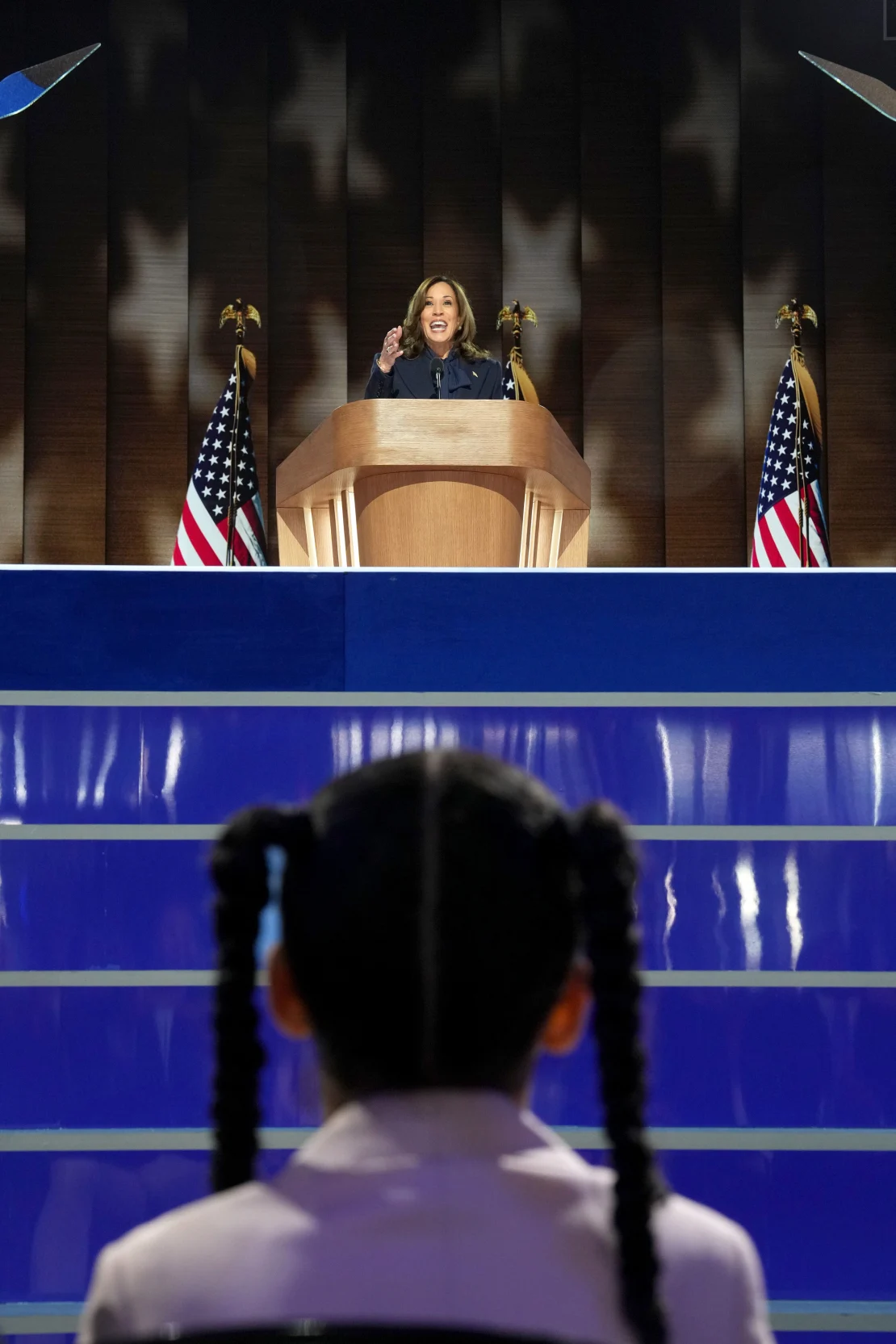
Earlier this year, I wrote a piece that extrapolated on my complicated relationship with mirrors, with looking on my femme and Latine body. As each staff member involved with POTUS productions described mothers bringing their daughters and daughters bringing their mothers to this show, I heard their glimmering hope. The image of Kamala Harris’s niece looking up at her during the DNC came to mind.


[The first link above takes readers to an article, “Tomorrow’s Tamoras and Titanias” by Furtado Coutinho, the author of “How to Survive an Election.” It’s posted on this blog in “Theater Education & Training, Part 3” (9 October 2024).]


The women depicted in this play are complicated, imperfect, messy, and complicit, and the fact that they’re allowed to be so gives me hope that we as a country can have more complicated, imperfect, messy conversations with one another about our systems of power. One by one, mirrors transform and small glass ceilings break, as femmes of every age watch POTUS’s women live large. We recognize the largest parts of ourselves. Dark, decisive, daring.


Fillinger has said that conservatives think the POTUS in question is Clinton, and liberals think it’s Trump. But that offstage body was never the invisible matter that mattered. Close your eyes and see it: Across the country, across many lines of division, we are all laughing at the same play. Fillinger might have given us the one POTUS we can all agree on. I consider it a win.


[Originally from Rio de Janeiro, Brazil, and raised in the vibrant immigrant community of South Florida, Gabriela Furtado Coutinho is a U.S.-based actor, writer, director, cultural strategist, and graduate of Northwestern University (Theatre/English Creative Writing BA).  In addition to now guest lecturing at Northwestern, she serves as Chicago Associate Editor of the Theatre Communications Group’s American Theatre magazine.  


[In addition to previous work with various Chicago collectives, as well as The Kennedy Center in their theater education/TYA division and Emmys/Television Academy in development of new kids’ TV, Furtado Coutinho has experience in developing new work, curating tangible care practices, writing in lyrical verse, and embodying power classical roles.


[On ROT, Coutinho’s writing appears in “Tomorrow’s Tamoras and Titanias” as referenced above and “‘Wish You Were Here: A Radical Access Roundtable,’” 6 July 2024.


[Born in Berkeley, California, in 1994, Salina Fillinger grew up in Eugene, Oregon.  Working one summer at Ashland’s Oregon Shakespeare Festival, she saw a production of Julius Caesar and started to envision a life in the arts.


[She left Eugene to study acting at Northwestern University in Chicago and took her first playwriting class in her sophomore year.  Her teacher encouraged her to enter the university’s Agnes Nixon Festival, established by the creator of the classic soap operas One Life to Live and All My Children.  Fillinger’s play, inspired by a headline about a man who walked into a bar and swallowed a pickled human toe used as a gimmick in drinks, was selected.


[The student dramatist went on to win the 2015 national Judith Barlow Prize for an original one-act play that was inspired by the work of a historic woman playwright.  In Fillinger’s case, it was 1928’s Machinal by Sophie Treadwell (1885-1970) and Fillinger’s play was Three Landings and a Fire Escape, about three women who become improbable friends and help one another through difficulties, one of whom summons the fortitude to take on the troubles.


[Fillinger morphed from a would-be actor to a writer, and in 2016, she heard the broadcast of presidential candidate Donald Trump “bragging about grabbing women by their genitals.  I, in turn, sat down to write a farce.”  By 2017, she had written POTUS, Or Behind Every Great Dumbass Are Seven Women Trying to Keep Him Alive, a farce in which the President of the United States inadvertently spins a verbal gaffe into a worldwide crisis and seven brilliant and stressed-out women on whom he relies risk everything, including their sanity, to keep him out of trouble.


[“The play is highly political, but it is not partisan. Republicans think it’s about Bill Clinton, Democrats think it’s about Donald Trump,” says the playwright.  Nevertheless, she had some difficulty selling the script—but “in 2022, well into Biden’s first term, POTUS premiered on Broadway.”  It became the third most-produced play of 2023—and remained on the list in 2024 at number seven.]


09 November 2024

The 24 Hour Plays


[On 6 February 2000, Kerry Eielson, a freelance writer who wrote about the Off-Off-Broadway theater for the New York Times, published the following description:

By 10 o’clock on the night of Jan. 22, 47 people had gathered at the Chopin Theater in Chicago.  A fireman, a lawyer, a journalist and a candy store clerk were among them.  Each had brought a prop and costume, knowing that in less than 24 hours he would be performing before an audience that had paid $10 apiece to see theater.  Some of those present had never been on a stage before.  No one had learned his lines.  No one knew what part he was to play.  As a matter of fact, none of the roles had been created.  The plays had yet to be written.

No, this wasn’t Ionesco or a nightmare.  It was preparation for what are called “The 24-Hour Plays.”  Actually, it takes 24 hours to create, cast and rehearse them; performances last 90 minutes or so.

[This is The 24 Hour Plays seen from the ground level.  (The official, trademarked name of the company has no hyphen.)  This event took place in Chicago, but it’s the same process in New York City, Little Rock, Dublin, London, at a high school in Portland, Oregon, or a resident theater in Hoboken, New Jersey. 

[It sounds hectic and haphazard—and it is.  “‘I have participated in the 24 Hour Plays three times as a writer,’ said one of the participants [at the Mile Square Theatre in Hoboken], Susie Felber, this week.  ‘It is scary, stressful, and so wonderful I would do it every day of my life if I could.’  She summed up the experience: “The 24 Hour Plays is 100 percent high wire act."

[The concept, borrowed by The 24 Hour Plays founder Tina Fallon from an idea cartoonist and comic book-maker Scott McCloud came up with, is meant to stimulate creativity without the self-censorship or -editing of over-thinking.  As playwright Warren Leight, author of 11 24 Hour Plays since 2001, put it: “The beauty of having to create something overnight is even if, like, say, hypothetically, you procrastinate . . . you have to come up with something.”

[As the tech director of my college theater liked to say, “Necessity is a mother.”

[The performances are usually a little rough and raw, and the plays often don’t come out quite the way the writers imagined.  Lee Sutton, a young playwright at a 24 Hour Plays event at London’s Old Vic, recounted:

"Looking back," he says the next morning, surprisingly together, "I can see so many little mistakes and decisions I'd avoid if I did it all again.  This is by far the strangest, most chaotic, random piece of work I've ever written, but I wouldn't change a second of it."

[This year’s 24 Hour Plays on Broadway was just last 21 October.  The phenomenon intrigued me, so I thought I’d read up on it.  Here’s the result of that reading.]

The 24 Hour Plays is a New York City-based organization that brings together artists to create plays and musicals within a 24-hour timeframe.  The 24 Hour Plays was founded in 1995 on the Lower East Side of Manhattan by Tina Fallon (b. 1969), an independent theater producer who resides in Brooklyn. 

Fallon served as the Executive Director of Creative Affairs for the Dramatists Guild of America from 2016 to 2020.  She’s been a presenter at the Kennedy Center American College Theater Festival and The Association for Theatre in Higher Education, a judge for the KCACTF Irene Ryan Awards (which presents scholarships to outstanding actors who participate in the Festival), and a teaching artist at the Educational Theatre Association conference. 

Fallon stepped down as Artistic Director of 24 Hour Plays after almost 10 tears of guiding the company’s operations.  She remains on the board, succeeded as the organization’s head by the current AD, Mark Armstrong, who’s had a long history with 24HP, starting in 2003 as a frequent director of productions.

Fallon’s tale of how the concept of The 24 Hour Plays came about starts when she graduated from Eugene Lang College, the undergraduate, liberal arts college of The New School in Manhattan’s Greenwich Village.  That was at the beginning of the 1990s and she kicked around the Off-Off-Broadway theaters trying to get someone to hire her to direct plays. 

As anyone who’s started out in that arena knows, that’s a hard thing to do; it’s the same for directors, actors, designers, and even dramatists (good plays are always in demand—but there are a lot of wannabe writers sending in scripts). 

(Just about the only theater worker who can get a gig for the asking, I’d guess, is the stage manager.  The need’s so great for a good one who’s willing to work Off-Off-Broadway, that when a theater manager or director finds one, she’s snapped up faster than a New York minute.  The only problem is keeping her.)

So, Fallon did what a lot of self-starters do: she started her own company.  She produced plays in whatever spaces she could find and even did some of her productions in Los Angeles.  On either coast, that meant, even as producer, she sold refreshments at intermission and served as a stage hand.

Back in New York City, she was directing one of her OOB shows and her leading man dropped out a week before opening.  She doesn’t say why, but it’s a frequent occurrence when there’s no contract and an actor gets a paying job.  You can’t hold him; it’s part of the ethic.

Fallon says she took a lesson from comic book-writer and graphic novelist Scott McCloud (Zot!, 1982-94; The Sculptor, 2015), who came up with the notion “[t]o create a complete 24 page comic book in 24 continuous hours.”  McCloud’s idea was: “The less you plan, the less likely you are to get frustrated.”

(McCloud also wrote a series of books about the comic medium and business in comic-book form: Understanding Comics [Tundra Publishing, 1993], Reinventing Comics [William Morrow Paperbacks, 2000], and Making Comics [William Morrow Paperbacks, 2006].)

As applied to theater, Fallon’s version of the lesson was: “Too much time and money is wasted.  This is a production manager's dream.”  It took her a few years to work out the practice, she says.

24HP‘s first showcase was mounted at the La Tea Theater on the Lower East Side in 1995.  Fallon’s intention was to do a one-time event, but the idea caught on, and what became the nonprofit 24 Hour Plays had an unsalaried staff, all friends of Fallon’s who liked her idea, no office, and no actual infrastructure.

The resulting performance company consisted of 45 unknowns and they charged $45 admission.  In 2001, 24HP was still operating and the participants were . . . well, better known.  As the New York Times reported Fallon’s account:

Billy Crudup committed first, then enlisted his girlfriend, Mary-Louise Parker, who brought in Rosie Perez, who suggested a charity, Working Playground [now Urban Arts Partnership; an organization that brings arts education into New York City classrooms], to benefit from the event, and recruited Marisa Tomei.  Factor in Liev Schreiber, Brooke Shields and Philip Seymour Hoffman (he attended the same upstate high school as Ms. Fallon), and The 24 Hour Plays annual benefit achieved sufficient cachet to move to Broadway.  Bloomingdale's and Details magazine are picking up the tab and throwing the post-show bash; but the creative process remains, she swears, unsullied by sponsors (Robin Finn, “PUBLIC LIVES; A Broadway Baby Without a Minute to Spare,” 10 September 2003, Section B [“The Metro Section”]: 2; link above).

Since 1997, the 24HP concept is being licensed to schools and community theaters around the country and theaters abroad have taken up the program.  Today 24HP events have taken place in the United States in Los Angeles, Minneapolis, Chicago, and San Francisco, among other cities.  Abroad, theaters in cities such as London, Dublin, Athens, Mexico City, and Florence have mounted 24 Hour Plays programs, as have venues in Germany, Finland, and Denmark.

Two books of material from The 24 Hour Plays have been published: 24 by 24: The 24 Hour Plays Anthology, edited by Mark Armstrong and Sarah Bisman (Playscripts, 2009), includes the work of celebrated theatrical voices such as Tony Award-winner Terrence McNally, Adam Rapp, Tina Howe, Will Eno, David Ives, and Theresa Rebeck, collected from performances of 24HP, and The 24 Hour Plays: Viral Monologues, edited by Howard Sherman (Methuen Drama, 2020), features a collection of over 50 original monologues by writers such as Pulitzer Prize-winner David Lindsay-Abaire, Stephen Adly Guirgis, and Jesse Eisenberg created during the coronavirus pandemic.

The 2003 New York Times profile of Tina Fallon cited above refers to a “TV pilot,” a “24 Hour short film,” and a “24 Hour music video,” but I wasn’t able to identify any of those projects.  There were, however, two TV segments that aired in New York City.  The first was “‘The 24-Hour Plays’ and The Agony & Ecstasy of Writing Negative Reviews,” an episode of the interview show Theater Talk which was broadcast on WNET, the New York City Public Broadcasting Service outlet (channel 13), on 6 April 2018 (and was syndicated nationally in PBS stations). 

The second part of the episode title is an unrelated story, but in the relevant segment, actors Richard Kind and Gideon Glick join Roundabout Underground Artistic Producer Jill Rafson to talk about the 2018 edition of The 24 Hour Plays she produced that spring.  (Roundabout Underground is the Roundabout Theatre Company’s home for new plays by emerging writers.  It’s housed in the Black Box Theatre in the basement of the Harold and Miriam Steinberg Center for Theatre, the former American Place Theatre.)  Theater reviewer Elisabeth Vincentelli, former New York Post review-writer (and current New York Times contributor), guest co-hosts with Susan Haskins. (The video is available on YouTube.)

The second TV show was “The 24 Hour Plays Viral Monologues,” broadcast on Working in the Theatre, the American Theatre Wing’s documentary series, shown on CUNY-TV, the cable outlet of the City University of New York, on 24 September 2020.  The segment showed members of The 24 Hour Plays cohort sharing how the Viral Monologues came to be, how their development shares many similarities to 24HP’s previous programming, and what challenges and changes they've experienced.  (A video is available on the American Theatre Wing site.)

The format for The 24 Hour Plays is pretty simple.  The process beaks down into six steps.  The performances are usually on a Sunday evening, so the process starts at about 10 o’clock on a Saturday night.

First, the participants meet for an introduction session.  There are six playwrights, 24 actors, and six directors.  The 24HP artistic director has selected the writers and directors as well as the pool of actors.  

   The actors are photographed and then introduce themselves, accoutered with what American Theatre senior editor Allison Considine called “preposterous props and costume pieces” that they brought with them, and explain their special abilities and artistic wishes.  

   When the introductions are done, the costume bits and hand props are tossed into a pile in the middle of the space so anyone can use them for inspiration.  It sounds a lot like an acting exercise of Michael Chekhov’s that I described as “instant character.”

   Artistic director Armstrong sees this as a reversal of the usual casting approach: “Rather than the traditional formulation, where writers—and directors like me—proclaim to the actor, “Here’s what we’re looking for, can you do that?,” this approach asks the actor to declare to the writer, “Here’s what I can do and here’s what I dream of doing—what can you do with that?”

Second, the participants sit down and brainstorm ideas for the plays, informed by what the director and playwright have learned about their potential cast.  The actors and directors go home.

Third, in what seems like a sports draft, the AD divvies up the actors, using the photos (they were Polaroids back in the early years), among the directors.  If a director wasn’t assigned an actor she or he had wanted, the pix are traded like baseball cards.  

Fourth, the writers stay up all night to compose the plays.  (The venue becomes a writers’ room.)  They write for the actors in their casts, which fits in exactly with Mark Armstrong’s comment.

Some playwrights work through the night, but like some others, Warren Leight, the veteran of many 24-hour plays since 2001, says that last year, he slept until 6 a.m., wrote his play in an hour, went back to sleep, and then “tried to tighten it up later in the day.”

Fifth, at 6 the next morning, the writers return with their scripts and the directors vote on the three plays they’d like to stage.  The AD makes the assignments, trying to accommodate the directors’ wishes.  The playwrights go home.

   In the afternoon, the actors return and each cast rehearses in the performance venue.  At the end, each cast get 15 minutes to rehearse the tech.  No delays or extra time.

Sixth, the performances of six 8- to 10-minute plays are presented, starting at 8 p.m.  The plays must be acted as written (no improvising).  

   Mistakes will happen, of course, and the participants just have to roll with the punches.  Playwright David Lindsay-Abaire, veteran of 13 years of 24 Hour Plays, recounted a mishap when one of the actors forgot a line, “and each of the actors onstage thought it was the other person’s line. ‘From the audience, I yelled out the line, and got the biggest laugh of the night!’ said Lindsay-Abaire.

   All the plays must be performed regardless of how the cast or director feels about the result (no drop-outs).  Actors in the casting pool may be cast in more than one play, but may only have a major speaking role in one.

There are variations on this schema when The 24 Hour Plays are presented in different locations.  At London’s Old Vic in 2011, for instance, there were seven plays and 52 participants, and the performances started at 7:30 instead of 8 p.m.  The rest of the procedure was the same there as in New York City.  

At the Arkansas Repertory Theatre in Little Rock, the performances started at 7.  Jesuit High School in Portland, Oregon, a participant in The 24 Hour Plays since 2016, gave their performances on Saturday rather than Sunday.

The 24 Hour Plays, which started as an Off-Off-Broadway event in venues like the La Tea Theater on the Lower East Side, the New School University (now just called The New School) in Greenwich Village, P.S. 122 (now known as Performance Space New York) in the East Village, and the Present Company Theatorium, also on the Lower East Side, soon branched out into a multi-faceted operation. 

In 1997, The 24-Hour Plays ran around the clock for 10 days in a row (“The 240-Hour Plays”) at the New York International Fringe Festival (13-24 August; the inaugural festival) and 53 new plays were created in 10 days.  Fallon acknowledged that the effort was too much, both emotionally and physically, so it was not attempted again.

Since that year, as I mentioned earlier, 24HP franchised the program and licensed it to schools, colleges, and community groups worldwide.  The company has laid out both the rationale for producing The 24 Hour Plays in one’s community and the procedure for obtaining a license on its website.

But there have also been other developments and expansions of the franchise.

Within a year or two of initiating the licensing venture, the company began working with organizations of all kinds, such as professional theaters, arts organizations, and community groups, to produce The 24 Hour Plays in theaters all around the world.  These partners have brought together local arts communities from London to Los Angeles, Dublin to Minneapolis, Finland to Mexico, and more for a 24 Hour Plays event.  

Some of these partners include: 

New Victory Theatre: The Broadway house on 42nd Street which operates as a children’s theater collaborates with The 24 Hour Plays to include families and young people in their efforts.  New Victory presents seven young playwrights, New York City students in grades 5-12, as they collaborate with professional actors and directors to stage their own original works, written and rehearsed over a single day and night, live.

The Sands College of Performing Arts at Pace University: Steps from City Hall to its north, the downtown college, one of the top 10 most represented colleges on Broadway, partners with The 24 Hour Plays to produce The 24 Hour Plays: Nationals (see below).

Broadway Advocacy Coalition: A Tony Award-winning (2021 Special Tony Award for providing a platform for underrepresented members of the theater community), nonprofit arts-based advocacy organization dedicated to the use of arts and storytelling to build a more equitable society, BAC is a partner of The 24 Hour Plays.

Dublin Youth Theatre: Committed to producing theater at a high artistic standard that’s relevant to the lives of young people, DYT is a partner of The 24 Hour Plays.

The University of Minnesota - Duluth: Mark Armstrong, Artistic Director of The 24 Hour Plays, was raised in Duluth and is a theater alumnus of UMD, a partner of 24HP.

Savannah Repertory Theatre: South Georgia’s “flagship regional theater” is a partner of The 24 Hour Plays and declares that it “intentionally produces vibrant works of modern theater and is compelled to create space for a new generation of storytellers.”

Cincinnati Shakespeare Company: “Cincy Shakes,” a partner of The 24 Hour Plays, asserts that it participates “in the global dialogue by producing the classic canon, commissioning the next generation of classics, and engaging the artists, schools,” and its community.

Other partners include the Lymphatic Education & Research Network (New York City), The Lillys (NYC), InterACT Theatre Company (Philadelphia, Pennsylvania), Communities United for Police Reform (NYC), The Fled Collective (NYC), Asian-American Justice Center (Washington, D.C.), Nicosia International Festival (Nicosia, Cyprus), Gilda’s Club (NYC), Developing Artists (NYC), Biennington College (Bennington, Vermont), National Queer Theater (Brooklyn, NY), New Sanctuary Coalition (NYC), INTAR Theatre (NYC), STLFringe (St. Louis, Missouri), Atlantic Theater Company (NYC), New 42 (NYC), The Dramatists Guild (NYC), The Rockefeller Foundation (NYC), and many more.

In 2001, The 24 Hour Plays on Broadway began with the writing of plays at Town Hall the night before the annual gala.  The last iteration was on 21 October 2024, when stars from Broadway, film, and TV gathered to write, rehearse, and perform six new plays. 

Past participants in The 24 Hour Plays on Broadway have included Jennifer Aniston, Jason Biggs, Wayne Brady, Anna Chlumsky, Michael Cerveris, Billy Crudup, Alan Cumming, Hugh Dancy, Peter Dinklage, Rachel Dratch, Jesse Eisenberg, Gloria Estefan, Edie Falco, America Ferrera, Greta Gerwig, Aasif Mandvi, Tracy Morgan, John Mulaney, Cynthia Nixon, Lynn Nottage, Anna Paquin, Amanda Peet, Rosie Perez, Chris Rock, Sam Rockwell, Wallace Shawn, Jamie-Lynn Sigler, Sarah Silverman, Marisa Tomei, Naomi Watts, Vanessa Williams, and many more.

Tickets for the 2024 edition of The 24 Hour Plays on Broadway began at $50, plus a voluntary donation if desired.  Proceeds support 24HP’s non-profit activities, including education programming with students from middle school to college and professional development for emerging artists.

The 24 Hour Musicals began in 2006.  Artists—actors, directors, writers, composers, choreographers, and a live band—create and perform four 15- to 20 minute musicals in one day, “a feat of artistic agility,” says Playbill. The event takes place at the Lynn F. Angelson Theater, the East Village home of the Classic Stage Company (CSC) on East 13th Street in Manhattan. 

This year’s edition was held on 10 June 2024.  The process is essentially the same as for The 24 Hour Plays, except, obviously, instead of a lone playwright, there’s a dramatist-composer team, and the director is paired with a choreographer.  There are only four musicals instead of six for the straight plays—because the musicals are about twice as long.

This year’s artists included Angelique Cabral (actor; Life in Pieces [sitcom]), Will Frears (director and scriptwriter; Misery [Broadway play]), Kirsten Guenther (musical librettist; Benny & Joon [regional musical]), Dylan Guerra (writer; The Other Two [sitcom]), Jakeim Hart (actor; Hell’s Kitchen [Broadway musical]), Leigh Ann Larkin (actor; Gypsy [Broadway musical]), Ryan Scott Oliver (composer and lyricist; 35MM [Los Angeles musica]), Carolyn Cantor (director; Sell/Buy/Date [Off-Broadway musical]), Jesse Eisenberg (playwright; Happy Talk [Off-Broadway play]actor; The Social Network [film]), Kathryn Gallagher (actor; Jagged Little Pill [Broadway musical]), Josh Koenigsberg (writer; Orange Is the New Black [TV comedy-drama]), Gabrielle Ruiz (actor; Crazy Ex-Girlfriend [TV musical comedy-drama]), Heath Saunders (actor; Natasha, Pierre & the Great Comet of 1812 [Broadway musical]), George Abud (actor; Lempicka [Broadway musical]), Sherz Aletaha (actor; Merrily We Roll Along [Broadway musical]), John Carrafa (choreographer; Urinetown [Broadway musical]), Kayla Davion (actor; Tina: The Tina Turner Musical [Broadway musical]), Olli Haaskivi (actor; Oppenheimer [film]), Emily Xu Hall (composer and lyricist; Lyle, Lyle, Crocodile [film]), Andrew Leeds (actor; Zoe’s Extraordinary Playlist [TV musical comedy-drama]), Ryan Jamaal Swain (actor and dancer; Pose [TV drama]), Will Swenson (actor and singer; A Beautiful Noise [Broadway musical]), and Natalie Walker (actor; White Girl in Danger [Off-Broadway musical]). 

The 24 Hour Musicals also partnered with Tony-winning designer David Rockwell and the Rockwell Group for scenic and video design.  The creative team also included sound coordinator Kai Harada, lighting designer Elizabeth M. Stewart, costume designer Katja Andreiev, and props design by Courtney Kupferschmidt.

There’s a documentary film from 2011 (eight years after the New York Times article that mentions the other media products).  Directed by Trish Dalton and Elisabeth Sperling, One Night Stand records the 2009 24 Hour Musicals event that featured the creation of four musicals in a 24-hour period.  The stressful undertaking of the creation of the four mini-musicals is captured in the 73-minute behind-the-scenes documentary.  (Viewer reviews appear on IMDb and the blog J.B. Spins.)

The film had its World Premiere on 24 July 2011 at the NewFest, New York’s LGBT Film Festival (21-28 July 2011, Film Society of Lincoln Center) and features Cheyenne Jackson, Mandy Gonzalez, Roger Bart, Rachel Dratch, Alicia Witt, Richard Kind, and Jesse Tyler Ferguson, among others.  One Night Stand won the Audience Award for Best Documentary Feature.  (A video is available on YouTube.)

The 24 Hour Plays: Nationals—the program for artists 25 and under—has been cultivating the future of theatrical talent since 2013. 

Each summer, 24HP brings together a group of talented early-career theater artists for a free professional intensive in partnership with New York City’s Pace University.  Participants, who also receive a $200 participation stipend, are invited into a weeklong experience in the City featuring workshops, master classes, panel discussions, career development, community building, and more.  The program culminates in a production of the resulting 24 Hour Plays in an Off-Broadway theater.

This year’s Nationals ran on 15-22 July 2024, with the performance night at 7:30 p.m. on 22 July at the CSC’s Lynn F. Angelson Theater.

Alumni of The 24 Hour Plays: Nationals are employed in the entertainment industry from on and off Broadway, to television and film, and in the leadership of theaters here and abroad.  Past participants include playwrights Bekah Brunstetter, Ken Greller, Laura Jacqmin, Mike Lew, Liliana Padilla, Andrew Rincón and Celine Song; actors Pico Alexander, Satya Babha, Elizabeth Lail, Naomi Lorrain, Bobby Moreno, Ebonee Noel, Coral Peña, Brandon Scott, Chris Smith, and Natalie Walker; producers Shariffa Ali, Kelcie Beene, Carly Hugo and Patrick Anthony Surillo; and directors Jake Beckhard, Miranda Cornell, Ryan Dobrin, Colette Robert, and James Dacre.

The 24 Hour Plays: Viral Monologues were created during the onset of the coronavirus pandemic in March of 2020.  To keep theater alive during the shut-down, the 24HP community of artists connected through safe, socially-distanced, new collaborations, the company gathered artists virtually to create monologues in 24 hours.

24HP returned to in-person programming in 2022, two years after ceasing live events.  The Viral Monologues continued, however, and are accessible on line.  On the designated day of the performances, one video is released every 15 minutes on Instagram and YouTube starting at 6 p.m. (Eastern Time).  There’s an archive of all past monologues on The 24 Hour Plays website. 

The latest episode of The 24 Hour Plays: Viral Monologues ran on 23 May 2023 in support of the Writers Guild of America’s strike against the Alliance of Motion Picture and Television Producers (2 May-27 September 2023).


04 November 2024

Two Restorations


 CONSERVATORS SHINE NEW LIGHT ON IRREPLACEABLE ART
by Jared Bowen

[This segment was broadcast on PBS NewsHour [now PBS News Hour] on 26 December 2014.  A series of paintings created by Mark Rothko for Harvard University was thought irreparably damaged by years of sun exposure and removed from view.  Thirty-five years later, the paintings have returned, thanks to art historians and curators using digital projection, which offers viewers the appearance of restoration for works too fragile to touch. The segment was produced by Boston’s WGBH.] 

JUDY WOODRUFF: Now: an art restoration breakthrough.

An international team of art historians and curators have developed a new technique to restore works of art without ever touching them. It’s being used for the first time on a Mark Rothko mural.

Jared Bowen from WGBH in Boston has this report.

JARED BOWEN: Even in 1960, it was a coup, when Harvard University landed Mark Rothko [1903-70; born in Dvinsk, Russian Empire, now part of Latvia] to paint a series of murals for its new penthouse dining room. Rothko was already considered one of the country’s greatest artist[s], and this was to be among his biggest commissions.

NARAYAN KHANDEKAR, Senior Conservation Scientist, Harvard Art Museums: He really wanted you to be up close and surrounded by his work so that you could feel the — feel the painting.

JARED BOWEN: Rothko paint[ed] panels to envelop the space. They and the studies and sketches he produced in planning them are now on view in the newly renovated Harvard Art Museum’s first special exhibition [16 November 2014-26 July 2015, Special Exhibitions Gallery].

They were robustly read [red?], says curator Mary Schneider Enriquez.

MARY SCHNEIDER ENRIQUEZ, Associate Curator, Harvard Art Museum: He had been focusing on these kind[s] of purples and crimson, as we like to say, of course, at Harvard. [Harvard’s school color is crimson and it is also the university’s frequent nickname.]

The ground of crimson or purple is then set off with these extraordinary contrasts of this red that is just incredible. As you look at any of his paintings, the play of color and contrast blending and then working against and with each other has always been essential to his work.

JARED BOWEN: The panels were officially installed in 1964, but were in steep competition with the room’s Harvard Yard views. The penthouse shades were rarely drawn and the light-sensitive murals suffered substantial damage.

NARAYAN KHANDEKAR: As the sun would traverse the sky, the paintings became faded, and in an uneven way because of the geometry of the room, so some parts were shadowed. Some parts received more sunlight. The paintings changed. And so what started off as a unified whole slowly drifted apart.

JARED BOWEN: By 1979, Harvard realized the murals were irreparably damaged and removed them from their dining room perch. And the series, one of only three ever painted by Rothko, was placed into storage and, aside from a few exhibitions, had largely disappeared from public view and memory.

MARY SCHNEIDER ENRIQUEZ: It’s been an extremely sad thing that this extraordinary work of art has not been included in the art history of Rothko. So it’s been a real priority for all of us to bring these works back to our — back to a place in which we can study them and recognize the achievement in th[ese] extraordinary paintings.

JARED BOWEN: Thirty-five years after removal, Rothko’s murals are once again on view, hung in the same configuration in a room with the same dimensions and against walls painted the same olive mustard Rothko himself chose.

MARY SCHNEIDER ENRIQUEZ: This really brings them back and puts them in the middle of his entire history in a major way.

JARED BOWEN: But they had to be hung without touching the canvasses, says conservation scientist Narayan Khandekar. It turns out Rothko mixed his own paint, which inadvertently left the canvases overly susceptible to ruin and far too fragile for physical touch-ups. [See my post “Conserving Modern Art,” 11 December 2018, on Rick On Theater.]

NARAYAN KHANDEKAR: Rothko used this binding medium, glue-size, which is — gives a very porous surface. And if you put any kind of isolating varnish over that, it would saturate the paint. It would change the color relationships. Everything that we do as a conservation approach also has to be reversible.

JARED BOWEN: How to restore the Rothkos to their original glory without ever touching them? To achieve that, Harvard collaborated with art historians and conservation teams from MIT and the University of Basel in Switzerland. They devised a software program that replicates Rothko’s original paintings pixel by pixel, color by color.

NARAYAN KHANDEKAR: We were able to have access to an alternate panel that had been shipped up to Cambridge, but not installed, and which had unfaded sections on it, and were able to use those to make the final adjustments on the digital image of what the paintings looked like.

JARED BOWEN: The digital recreation is projected with nonthreatening low light onto the canvas.

NARAYAN KHANDEKAR: It’s about 2.07 million pixels. So, we have to calculate the color and the intensity for each of these pixels and then shine it in exactly the right spot.

The color that’s on the painting, plus the compensation image, gives the viewer the impression of what the paintings looked like in 1964. We’re very, very confident that we’re as close as can be for this project.

JARED BOWEN: The technology is a game-changer, museum officials say, but it also raises questions about whether conservation in the digital age fundamentally changes the art. Rothko’s color is back, but no longer by his own hand.

MARY SCHNEIDER ENRIQUEZ: One of the key questions is, where is the line between what is the original work of art and the art that has the projection system on it? I mean, have we changed what he has done? No, we haven’t changed his canvases.

JARED BOWEN: But they have changed the possibility that damaged masterpieces the world over can once again see the light of day with the elaborately configured light of a projector.

I’m Jared Bowen for the “NewsHour” in Boston.

[Jared Bowen is the Host and Executive Arts Editor at public media company GBH.  (GBH is the trade name of the WGBH Educational Foundation, a public broadcasting group based in Boston, Massachusetts, and some of its public media outlets)  

[He is host of the daily radio program/podcast The Culture Show, is a regular guest host on Boston Public Radio, and a special correspondent for the PBS NewsHour.  He’s also the moderator of the sold-out Boston Speakers Series at Symphony Hall.]

*  *  *  *
HITCHCOCK’S FASCINATION WITH DANCE
by Sarah Kaufman 

[Sarah Kaufman’s report on the restoration of Hitchcock’s first known directorial work on a feature film ran in the Washington Post on 4 August 2013 (sec. E [“Arts”]).]

Of Alfred Hitchcock’s cinematic obsessions, the moving body is one of the most remarkable. He lingered on bodies in motion with a choreographer’s eye to show us panic, passion and the fragile nature of sanity. Now, in a newly restored version of Hitchcock’s first film, a 1925 silent movie called “The Pleasure Garden,” we can see the roots of that fascination. It all started with dancers.

“The Pleasure Garden,” which will be screened Sunday [4 August 2013] at the National Gallery of Art, is a tale of greed, betrayal and murder centered on a pair of chorus girls. One remains a backup dancer but the other becomes a star, because she shows more leg. Their friendship frays as Jill [Carmelita Geraghty (1901-66)], the starlet, throws off her fiance to be a prince’s mistress, while hard-working, naive Patsy [Virginia Valli (1896-1968)] marries a schemer with loose morals and a looser grip on reality.

The action sweeps from London to Lake Como and on to Dakar, where Patsy finds herself in a battle for her life that had me holding my breath. I think I was gasping. And I was just watching a press screener on my computer, with no music. (The National Gallery will have live accompaniment [a new score was commissioned for the restoration by British composer Daniel Patrick Cohen (b. 1988)].)

Hitchcock [1899-1980], master of suspense — even in the infancy of his career.

On top of that, he delivers the sisterly camaraderie, ephemeral glamour, drudgery and creepiness of London’s nightclub scene — and the strong backbone surviving in it demands, as seen in the film’s plucky heroine — with verve and a surprising depth of insight.

“What every chorus girl knows,” reads one of the inter-titles, and next we see a dancer elbow-deep in soapsuds, washing her tights.

Yet it shouldn’t come as a surprise that the British filmmaker had a soft spot for dancers. Think of his nonverbal finesse, his precise and fluid way of blocking scenes and isolating gestures, as in a work of dance-theater. He put his actors in motion with a kinetic charge that was simple, direct and emotionally powerful — Cary Grant running for his life in “North by Northwest” [1959], and earlier in the film, striding down a hall in a way that told us what kind of man he was. And recall the dizzying grace of Grant and Ingrid Bergman’s slow-dance kiss in “Notorious” [1946] as the camera swirls around them.

“The Pleasure Garden” was restored by the British Film Institute National Archive in a three-year project to refurbish the nine silent Hitchcock movies that still exist. Produced between 1925 and 1929, they suffered varying degrees of damage over the years. Now cleaned and pieced back to near-original form, the films have been on an international tour. “The Hitchcock 9” has been presented here by the AFI Silver Theatre [Silver Spring, Maryland] and the National Gallery. “The Pleasure Garden” is last in the series.

Of the nine, “The Pleasure Garden” has a double significance. It proves, astonishingly, that the seeds of many Hitchcockisms were planted at the start: his love of motion, but also his fondness for voyeurism, staircases, binoculars, ominous beverages and dirty jokes. Here, right off the bat, Hitchcock is Hitchcock, almost fully formed. At 26.

The very fact that we can marvel at the director’s early ease is a result of “The Pleasure Garden’s” second point of interest: This film was in the worst shape, and is now the crowning glory of the restoration project.

It is “the standout example of how restoration can affect the viewing of the film,” Kieron Webb, the BFI’s film conservation manager, said in a recent phone interview. The film had previously been known only in incomplete copies, with what appeared to be two different versions in circulation, Webb said, and both were missing footage. With the restoration, an extra 20 minutes was added. Missing bits of one section were found on a Dutch print; a lost scene was added from an original nitrate print preserved at Southern Methodist University [University Park, Texas]. The tints and tones were corrected to better match the setting and mood. Finally, the film was cleaned of dirt and mold, and scratches and tears were digitally repaired.

If you see “The Pleasure Garden,” though, you won’t be thinking about the hundreds of hours technicians spent sprucing it up. You’ll be making mental notes of the symbols and images that Hitchcock returned to later in his career. The film opens with a snaking line of dancers clattering down a spiral staircase (“Vertigo” [1958] alert!) into the bowels of the theater, taking us down to an underworld where it’s not artistry that counts, but how much skin you show.

Hitchcock may have been thinking of [Edgar] Degas [French Impressionist painter and sculptor; 1834-1917], whose top-hatted dandies peering at ballerinas didn’t have art on their minds either. The next scene is like something out of a Degas painting: A long tracking shot takes us across a row of finely dressed gentlemen in the audience leering at the dancers with predatory enthusiasm. One gent is peering through binoculars, and we see, “Rear Window”-style [1954], exactly the extent of the flesh he’s ogling.

At one point, Patsy is having tea, and the camera zooms in on her cup, where a couple of tea leaves are floating. It calls to mind that eerie glass of milk, glowing supernaturally in Cary Grant’s hand as he carried it up to Joan Fontaine in “Suspicion” [1941], and the frame-filling shot of the coffee cup that is poisoning Bergman in “Notorious.”

But what’s so special about the tea? Webb explains it’s a Britishism that would have resonated with audiences at the time. The leaves represent “an omen about a stranger approaching,” he said, and at that moment Patsy meets the handsome villain who will talk her into marrying him.

Thanks to the BFI’s restoration, we’re treated to a sly little shot pertaining to that marriage that had been lost. It was discovered at SMU, and it offers a telling bit of Hitchcock’s humor. Remember, this is a man who liked to punctuate a love scene with a bawdy punch line — the train entering a tunnel after a kiss in “North by Northwest,” fireworks exploding after a cuddle in “To Catch a Thief” [1955]. So as the pretty young dancer wakes up from her wedding night, beaming, the director gives us a close-up of a bitten apple.

Not subtle, but then again, kid Hitchcock was scarcely out of his teens.

[Sarah Kaufman is a Pulitzer Prize-winning critic, author, journalist, and educator.  For more than 30 years, she has focused on the union of art and everyday living.  As the chief dance critic and senior arts writer of the Washington Post from 1996-2022, she wrote about the performing arts, pop culture, sports, science and personal expression.

[Kaufman’s work has been featured on national radio and television, including NBC News, CNBC, the PBS NewsHour, and On Point with Tom Ashbrook.  

[The screenplay for The Pleasure Garden was written by Eliot Stannard (1888-1944), based on the 1925 novel of the same name by Oliver Sandys (pseudonym of Marguerite Florence Laura Jarvis; 1886-1964).  The movie was a British-German production, shot in Italy and Germany in 1925.  It was released briefly in the United Kingdom in 1926, but withdrawn and rereleased officially in 1927, becoming a huge hit.

[The restored Pleasure Garden, with the new score, has not been released on video due to a lack of funding to record it adequately.  Available DVD releases contain a poor quality and badly edited version of the film, and there are bootlegged copies on the market as well.  As of 2021, The Pleasure Garden has become the first Hitchcock film to enter the public domain.

[“The Hitchcock 9” restoration was started in 2012 and took three years to complete.  The other eight films were: Blackmail (1929), Champagne (1928), Downhill (1927), Easy Virtue (1927), The Farmer’s Wife (1927), The Lodger (1927), The Manxman (1929), and The Ring (1927).]