Showing posts with label Local 802. Show all posts

23 October 2019

"Winning On Stage: The secret weapon for winning auditions: 'Periodization'"

by Dr. Don Greene

[On 6 May, I republished an article from  Allegro, the member’s magazine of Local 802 of the American Federation of Musicians, called “Eight Strategies for Breaking Out of a Performance Slump” by Dr. Noa Kageyama, a sports psychologist and musician.  As the title states, it lays out some strategies for musicians to break out of a streak of poor performances.  Reading the article, I realized that Dr. Kageyama’s advice is valid for all performers, including actors.  So I posted her advice with inserted commentary concerning my own experience as an actor or stories I heard from colleagues in the biz.

[In the October 2019 issue of Allegro (vol. 19, no. 9), Dr. Don Greene, sports psychologist and stress coach, published an article with tips on succeeding at auditions.  Once again, the author is writing for and about musicians—Allegro is a musicians’ magazine, after all—but I can see that it’s applicable to actors, dancers, and singers.  (Dr. Greene’s bio indicates that he’s worked with Olympic athletes as well as musicians.)  So I’m posting “The Secret Weapon for Winning Auditions” on Rick On Theater for actors (and other performers) to consider.  We can all use help getting through auditions and, as Dr. Greene puts it, “winning” them.]


Do you ever find yourself peaking for your audition too early or too late? Do you feel yourself drained of energy before you even get to the audition? Or are you feeling so mentally and physically fatigued that you aren’t even motivated to prepare?

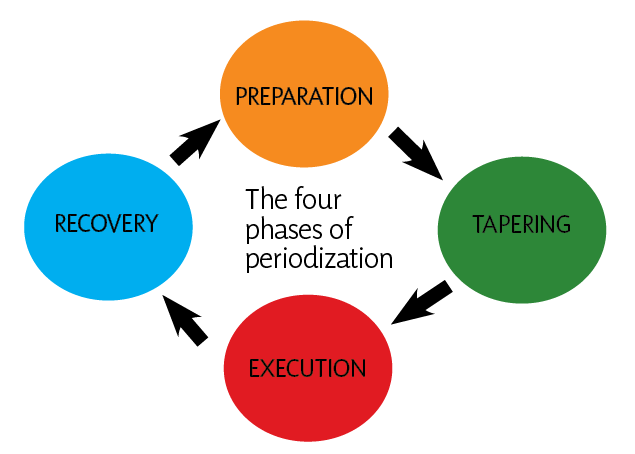
If so, you are reading the right article! There is a secret weapon that I teach called periodization, and it has been a game changer for all of my audition-winning clients. This periodization process involves training cycles with four distinct phases: preparation, tapering, execution and recovery. Periodization is designed to peak the performer’s energy at just the right time (like during the finals) in order to win.

Preparation phase

There is a lot of great information on the internet about various approaches to winning auditions. Most of the websites and blogs are by musicians who have won orchestral auditions themselves. These authors are emphasizing the physical, technical, organizational, and musical aspects of the audition preparation and actual audition performance. They usually address only the first phase of the periodization process: preparation.

Preparation involves both physical and mental work. The physical includes the organization of practice, technical work, listening, score study, mock-auditions, etc. The mental preparation includes centering practice, mental rehearsal or visualization, and concentration exercises. Long before their auditions, I have my clients complete a thorough assessment of their mental performance skills. We measure their abilities in five main areas: performance energy, confidence, courage, focus and resilience. After determining their individual mental strengths and weaknesses they can begin working specifically in the area(s) where they will make the most improvement in the least amount of time.

The mental training, which can replace some of the physical practice time, involves the centering process and positive affirmations. Centering helps control and channel performance energy before and during the audition process. The affirmations help to build self-confidence. Concentration exercises help musicians to focus past distractions and quiet the mind. They also learn how to become mentally tough and to recover quickly from inevitable mistakes. I don’t believe in perfectionism, especially at auditions. The idea is to continually strive for excellence which means doing your best under any circumstance.

Tapering phase

A few days prior to an audition, it is time to begin the second phase of the training cycle, which is the all-important tapering process. At this point you need to spend less time physically practicing as you increase your mental training even more, and begin to get more sleep and rest. In the last week before the audition it’s too late to cram (although many musicians do). If you don’t have all the excerpts or technical skills down by now you’re probably not going to master them in the next few days. If you try to do so, it will be counter-productive.

Instead of fretting over musical things or playing through the excerpt list one more time, there are better things to do. Believe it or not, I often recommend sleeping in, taking short power naps (20 minutes), watching comedy, doing a mental rehearsal session, or having lunch with a good friend (either a non-musician or a friend who promises there will be no audition talk!). In the last few days, the idea is to stay positive and mellow as you bide your time wisely and build up your energy. This is not easy for most musicians who are used to years of constant physical practice. Although you cannot win in the days leading up to an audition, you can lose!

In addition to maintaining the right mindset and conserving energy, it’s important that you carefully manage your heightened emotions in the final days before the audition. Due to the extra stress, many performers’ nerves get raw and they become testy or prickly, especially – and unfortunately – with those closest to them. For many musicians, the looming audition can feel as important as a matter of life or death. Keeping perspective and a sense of humor can be an immense help. Remember that your audition performance is too important to take too seriously.

The most important night of sleep is two nights before the audition. In terms of energy, there’s a one-day delay with the effects of sleep. So if the audition is on Saturday, you want to get a great night’s sleep on Thursday. Try your best to go to bed early, or sleep in, or both. If you feel very tired Friday afternoon, take a very short nap (10 to 15 minutes). After waking up I recommend that you get up, move around and get some fresh air.

The night before the audition, try to schedule dinner in the late afternoon or early evening. It’s wise to eat something that’s easy to digest, without a lot of spices. Wind down before going to bed (no exciting action movies, musical events or recordings). Turn off all musical thoughts in your head and get to bed at a reasonable time. Darken the room, lower the temperature, get into bed and find a comfortable position. If sleep doesn’t arrive within a few minutes, don’t worry. Just lie there and relax. Simply lying still provides 70 percent of the rest benefit of sleeping. Hopefully you will have been getting extra rest, naps, and had a good night’s sleep the previous night. That’s the energy you’ll be using tomorrow at the audition.

Execution phase

The third phase in the cycle is the execution phase. The first thing to do is to get up with plenty of time to get ready to do your best. I recommend arriving at the audition site early, keeping your mind on the process of what you need to do to execute a peak performance. Avoid thinking about all the possible outcomes. When they come up, just imagine your audition going well. Before walking in, summon up your courage, stay in the moment, and focus only on the task at hand. Follow your performance routine. (I have watched many clients throw their performance routine out the window the day of the audition.) Trust the process and all of your hard work, talent and training. Then go for it with everything you have!

Although many musicians try in vain to relax at auditions, I train my clients to channel that extra energy to blow away their competitors as well as the audition panel. In this process, they use a variety of peak performance skills like centering and mental rehearsal techniques. These help them do better in auditions because of the extra pressure and energy, not in spite of it. While most of their fellow musicians are trying to calm down I want my clients to get their energy up. My training teaches them how to control, channel, and peak that powerful performance energy when it really counts.

Recovery phase

After the audition, the final phase is recovery. Take some much-needed physical and mental rest away from the instrument and repertoire before you begin preparing for the next big performance or audition. Make sure that you feel fresh, rested and recovered before starting your next training cycle. Regardless of the final outcome, you need to reward yourself for the efforts you put in and the improvements that have resulted from those efforts. I suggest something tangible and permanent as a symbolic reminder of your progress.

After you recover and want to get ready for an even better performance, make good use of this four-phase cycle again. These four phases are indeed the secret weapon that I call periodization. Begin the cycle again with all the physical and mental work that needs to be done to prepare for the audition or concert. This is followed by tapering in the last days before the important event. Back off from the high level of training in order to build your energy so that you reach a peak in the execution phase at the audition or concert. Once again, you’ll deserve a few days off so you can recover – as well as another reward.

Remember to ask yourself this question: which phase of periodization do you struggle with the most when you’re getting ready for an audition or important concert? Be honest. Remember, all of the four phases affect each other and the final result. Tapering and recovery are just as important as preparation and execution!

For your next training cycle before a big performance, plan out your calendar, so you can schedule the four periodization phases.

Repeat the four phases until you begin to feel like each cycle of the periodization process has improved, as well as the results. Go for it!

[Dr. Don Greene, a peak performance psychologist, has taught his comprehensive approach to peak performance mastery at New York City’s Juilliard School; Colburn School in Los Angeles; New World Symphony in Miami Beach; Los Angeles Opera Young Artists Program; Vail Ski School; Perlman Music Program in Shelter Island; New York; and the U.S. Olympic Training Center in Colorado Springs, Colorado, and Lake Placid, New York.  During his 32-year career, he has coached more than 1,000 performers to win professional auditions and has guided countless solo performers to successful careers.  

[Some of the performing artists with whom Dr. Greene has worked have won jobs with the Metropolitan Opera Orchestra, Concertgebouw Orchestra in Amsterdam, New York Philharmonic, Chicago Symphony, San Francisco Opera, Montreal Symphony, Pittsburgh Symphony, National Symphony, Cincinnati Symphony, Pacific Northwest Ballet in Seattle, and the Dance Theatre of Harlem, to name just a few.  

[Of the Olympic track and field athletes he worked with up until and through the 2016 games in Rio, 14 won medals, including five gold.  Dr. Greene has authored 10 books including Audition Success, Fight Your Fear & Win, Performance Success, and most recently College Prep for Musicians.  In 2017, Dr. Greene was named a TED Educator and collaborated with musician Dr. Annie Bosler to produce the TED-Ed talk “How to practice effectively . . . for just about anything.”  The video went viral and received over 25 million views across Facebook and YouTube.  For more information, visit winningonstage.com, winninginsports.com, and collegeprepformusicians.com.]

06 May 2019

"Eight Strategies for Breaking Out of a Performance Slump"

by Noa Kageyama, Ph.D

[Last month, Allegro, the member magazine of Local 802 of the American Federation of Musicians (vol. 119, no. 4 [April 2019], https://www.local802afm.org/allegro/articles/eight-strategies-for-breaking-out-of-a-performance-slump/), republished an article by a musician- psychologist, Dr. Noa Kageyama, who applies sports psychology to the work of musicians.  Here, he’s providing guidance for defeating the debilitating sense of being in a performance slump.

[Dr. Kageyama uses the strategies described by cricketers—you can think baseball for this article; it fits well enough!—as a model for ways musicians can overcome the same problems.  I maintain that the strategies he passes on here are just as applicable to actors going through the same feelings—not moving up in the auditioning process—and, I daresay, probably dancers as well.  I’ll insert comments within Dr. Kageyama’s article below to draw analogies between his advice to musicians and equivalent situations auditioning actors may face.

[Truth be told, I’ve experienced the doubts and questions myself in my brief attempt to become a working actor, and I can tell you that it’s a discouraging experience.  The thoughts and fears Dr. Kageyama and the athletes he quotes describe also occurred to me after a spate of unsuccessful auditions.  So I’m passing along Dr. Kageyama’s advice to readers of Rick On Theater in the hope some of you will find the thoughts useful.]

Whether you’re watching basketball, baseball, or, say, cricket, broadcasters will often say that an underperforming athlete is in a “slump.”

I don’t know that I’ve ever thought of this phenomenon in a musical context, so my ears perked up a bit when I recently heard a few musicians use this term. Not like, “Oh, I’ve had a few subpar studio classes in a row; I think I’m in a slump.” But more in the context of orchestral auditions, where you might go through a few consecutive auditions where things don’t click, and you don’t advance.

Slumps can be really discouraging. They can make you start questioning your ability. And worry that perhaps you’ve hit your ceiling. Or lead you to start “pressing” and trying too hard. None of which is especially productive, and often just makes the slump last even longer.

[rick: I don’t recall hearing any actor friends using the word ‘slump’ and I’m not aware of ever having thought it myself, but I can attest, both from my own experience in auditions and from anecdotes by my friends and colleagues in the business, that most of us have had the experience of attending audition after audition and not getting called back.  Even harder on the delicate psyche of the actor, tyro or vet, is going to interviews and not even being asked to show our stuff.  A string of these experiences can be very debilitating.]

So how do elite athletes get out of slumps? Are there any specific techniques or strategies they rely on to stay in a good headspace and bounce back to their normal level of performance?

Cricket!

In a recent British study, 10 professional cricket players were interviewed to learn more about their experience of slumps, and what strategies or techniques athletes at this level might use to manage these dips in performance (Brown, Butt, & Sarkar, 2019 – see reference at this end of this article).

Different athletes emphasized different things, but there were a few key themes that emerged. And all in all, there were eight specific slump-busting strategies that seemed pretty relevant to performance slumps in the music world too.

THEME #1: HOW TO INTERPRET THE SLUMP

The first set of strategies relates to how you interpret the slump. Which I know sounds pretty abstract, but staying in a productive headspace is an important part of maintaining the motivation to work your way through a slump.

1) Explanatory style

Let’s say you advanced in your first few auditions while you were in school, but after graduation, experience a string of auditions where you don’t advance out of prelims. Your inner critic might try to explain this by telling you that you must have just been lucky before. And that you don’t have what it takes to do any betters.

[When I was working on my MFA in acting, my graduate acting classmates and I got cast in every show for which we chose to audition.  (I even had a special advantage: I was nearly 30—I did a stint in the army before grad school—so I was in demand as the “old man” any time one was needed in the cast.  Directors often asked me to read for their productions!)  

[After my first year in the program, I began to wonder if I could get cast by directors who didn’t know me.  So that summer, I started making the rounds in New York City and was cast in a (non-singing) role in a little Off-Off-Broadway musical.  

[I returned to school for the second year of the MFA program and after graduating and participating in a semi-pro summer rep the university produced, mixing grad students and Equity pros, I went out into the world of New York theater with confidence.  I soon faced the disheartening awakening Dr. Kageyama describes above.]

This is called a pessimistic “explanatory style.” And it’s the kind of story that could prolong the slump, because it provides an internal and stable (i.e. fixed and unchanging) explanation for why you’re not advancing. Because if failing to advance is a talent issue (internal), and talent can’t be changed (stable), how motivated will you be to work harder or try new things?

Conversely, an optimistic explanatory style is where you might say to yourself that performance is cyclical. That there are natural ups and downs from one audition or performance to the next (unstable), and that slumps will happen through no fault of your own (external). External and unstable explanations like this are less discouraging, and can help you stay confident and motivated in the face of disappointing results.

Of course, the danger here is that if you take this too far, you could find yourself making excuses and explaining away everything instead of taking ownership of the adjustments you could make to your preparation.

Which is where the growth mindset kicks in.

2) Growth mindset

Some of the athletes noted that slumps represent an opportunity to grow, learn, and become an even better player. Or at least, get better at handling inevitable future slumps. As one athlete noted:

“Rough patches are just as good as your better patches in a way, because it’s teaching you the game . . . because you’re not thinking about your game when you’re doing well.”

I love that last sentence. Indeed, when things are going well, we’re less inclined to pick apart our weaknesses and work as diligently at getting better. But the feedback we get when we run into problems can be invaluable, and make it much easier to pinpoint those sneaky hidden things that we most need to work on. 

[One of my acting teachers admonished us that we learn more from our failures than we do from our successes.  As Dr. Kageyama observes of musicians, actors seldom examine what we did when a performance goes well.  Sometimes we’re just satisfied with the positive outcome (and, when it comes, the reception) and don’t think about it further.  Other times, we don’t want to mess with the magic by analyzing it to look at how the parts worked.  When a scene, a gesture, or a line doesn’t work—then we pull apart the performance to try to see why.

[In a late rehearsal for a Revolutionary War play—one of the final dress run-throughs at which there was an invited audience—I nailed a moment when my character is mortally wounded in a battle scene.  It’s virtually a death scene—except that the character comes back briefly as a dying captive—and he’s shot, his sword drawn and raised in the air, in the midst of rallying his soldiers. 

[I was high above the audience on a bridge spanning the auditorium and the spectators burst into thunderous applause at the moment I fell to my knees, my sword falling from my hand.  It was a heady experience and everyone, including the other member of the large cast, was astonished.  ‘I got this scene.’ I assured myself.  ‘I killed it!’  Opening night—nothing.  ‘What  did I do wrong?’ I wondered, crestfallen.  I tried and tried to figure out what I did at that rehearsal that I failed to do later: timing, line reading, gesture, substitution, endowment, inner object, or some other overlooked technique?  I kept trying, analyzing—but I never got back that moment.]

THEME #2: MAINTAINING A POSITIVE MENTAL STATE DURING COMPETITION

Looking at our slumps in the larger context of lifelong growth and development can help us maintain the motivation we need to keep putting in the work.

But a slump can affect our experience during performances as well. Because sometimes a string of subpar performances can lead to more doubts and negative internal chatter when we’re on stage. Or, we might feel additional pressure to prove ourselves, and end up trying too hard to avoid mistakes, which paradoxically, can lead to more mistakes.

So how did these athletes stay in a good headspace during their slumps?

3) “Best performance” imagery

Under pressure, our thoughts can easily veer towards memories of times when we cracked a note, or when our bow shook in a quiet exposed passage. Or, we might start worrying about having a memory slip, as we sit and stew backstage.

To combat this, some of the athletes engaged in “best performance” imagery. Meaning, they made an effort to visualize times in the past when they were playing at their best. Which sounds straightforward enough, but here’s a quick test – how many specific auditions or performances can you think of, right now, off the top of your head, when you were having one of those awesome days where everything works?

Maybe 1? 2? Perhaps none? It often takes a couple minutes (if not much longer!) to recall performances like this from your past. But if you can’t see them vividly in your head now, imagine how much tougher it’ll be under pressure!

Not to worry though, because if you practice remembering these moments and visualizing them a tiny bit every day, these will be much more “top of mind” when you need something to shield you from those little doubts and fears that start creeping in on audition day.

[The parallels with an actor’s situation are obvious here.  Every actor has “gone up” on a line, missed an entrance cue, or reached for a prop that wasn’t there.  Those are the pitfalls of live performance as all performing artists know.  I’m sure it’s the same for dancers and musicians, but actors know they are the ones out there under a spotlight and when they screw up, it’s in front of God and everybody.  The psychological repercussions are huge, and hard to shake—especially when that particular moment comes around again. 

[Dr. Kageyama’s probably right, though I’ve never tried it: flash on one of the good moments you’ve had.  One of my best came in a scene-study class.  I’d been working for a while but decided I needed to go back to class (for reasons I’ll mention later).  This was an audition class, practice for cold readings.  I was assigned a scene from Tennessee Williams’s The Rose Tattoo, a scene between a young man and a young girl whom he loves with a very protective mother. 

[In the reading, I instinctively reached to caress the actress’s arm—but I stopped short and pulled back, afraid to be too forward.  The class actually gasped.  I don’t even remember what the teacher said to me in his critique—I was still lost in that moment that seemed so perfectly right.  I don’t think I could ever have created that moment if I’d planned it, and I doubt I could have repeated it if I did that scene again.  But at that reading, in that moment, I got it.  And obviously, I haven’t forgotten it even after . . . well, a lot of years.  I still take pleasure in reliving that brief moment in class; it can make up for a lot of mistakes.]

4) Attention control

Another strategy the athletes relied on was attention control. And the ability to focus only on what was in front of them in the moment. As one athlete said:

“You break it down to each ball, and each ball you say I’m going to deliver my skills here, just concentrate on every ball and just compete, just compete and think what does this team need right now, that’s the most important thing.”

For a musician, this might involve focusing on maintaining an internal pulse, shaping each phrase, or hearing the sound you want in your head as you play, instead of looking ahead, critiquing what just happened, or worrying about what people will think.

[Actors often refer to this as ‘being in the moment.’  It means believing in the circumstances of the scene you’re in and accepting it all as real and not concerning yourself with what happened during the performance of the  previous scenes or worrying about what’s coming up.  It also means playing your role and responding to the other actors on stage with you and not thinking about how your costume or hair looks or that guy in the second row having a coughing jag.

[I once thought I was fully engaged in a scene, sitting at a small table down front with a young woman, when I was pulled out because I heard snoring.  I thought an audience member in the front row had fallen asleep and was sawing away at a log!  I was actually at the point of saying something when I realized just in time that it was my scene partner, whose character had dozed off.  Never mind that she’d never done that before (that I’d noticed), but I was obviously not really in the scene or I’d have seen my “lady friend” nod off.]

5) Regulating arousal

Most of the athletes also noted the importance of learning how to stay calm and slow things down, instead of getting overexcited and magnifying the importance of every play.

This is easier said than done, but learning how to regulate your physical state is a skill that we can get better at with practice. How? Well, techniques like diaphragmatic breathing can give us more control over the physical part of our stress response (even though yes, telling people to breathe when they’re stressed is a total cliche).

The only problem, of course, is that this is a skill, and requires practice, just like anything else (you can learn more about how this kind of breathing affects us, and how do it correctly at bulletproofmusician.com.)

THEME #3: PROTECTIVE FACTORS

Lastly, the researchers described several “protective factors” that seemed to help athletes deal with the stress of poor performances and bounce back more effectively.

6) Enjoyment

Remembering that they enjoyed playing cricket, despite it also being their livelihood, was one protective factor.

“I just enjoy playing cricket, it’s something I’ve been brought up on and it’s something I would like to be involved in for as long as possible. If that means dragging myself down the nets or improving my fitness to get me through a bad run, then so be it.”

When was the last time you took a piece out of your music drawer, just to play through for fun? I’m not sure why that seems like such an unusual thing to do, but sometimes putting your audition repertoire aside for a moment, and taking a few minutes to play something you enjoy (a.k.a. “deliberate play”), might be an absolutely worthwhile use of your time. Especially if it helps you reconnect to the reason why you’re practicing and working so hard in the first place.

[This is one of the instances in Dr. Kageyama’s thesis that is different for musicians and actors.  A musician can pull out her instrument and a sheet of music and play for her own pleasure.  An actor can’t really just do a little acting in his living room.  (It’s one reason many actors keep taking classes all through their careers, even after they’ve become established—so they can keep their acting muscles limber between shows and movies and work on material they don’t get to do otherwise.)  

[But some actors do put together or join play-reading groups so they can get together with other actors and read scripts they love, especially plays or parts they don’t get to do in their professional lives.  It’s recreational and voluntary, not something that they have to do to make a living or advance their careers.  It’s not as easy for an actor to do this as it is for a musician, but the benefit is the same: you’re doing what makes you love your profession.]

7) Linking confidence to effort, not performance

One of the more intriguing observations was how many of the athletes deliberately worked to separate confidence from performance.

“I try to link my confidence to my effort, not my performance. So I’m doing everything I can to give myself the best chance of performing, and effort being the measure of your confidence level would give you more stability, because with the best will in the world, if you just base your confidence on your performance, it’s just the nature of the game, you could be in the best “nick” [form] of your life and still get nought if you get a good ball.”

Indeed, you can play a great audition and get cut. Conversely, you can play a mediocre round and still advance. Getting too caught up in results can therefore not only be pretty confusing, but is a rather unstable way to build confidence.

Meanwhile, the one thing you do have complete control over is your preparation. And so if you feel really good about the quality of your daily practice, and know you’ve thoughtfully incorporated run-throughs, recordings, and mocks into your process, etc., etc., it’s easier to trust and take confidence from the work you’ve put in, and stay in a good headspace on audition day. 

[This is another reason actors continue to take classes or work with a coach.  We don’t do “daily practice” like musicians and dancers.  (Although Uta Hagen did invent her “Object Exercises” for this purpose.)  It’s also a way to keep abreast of your technique, which, if taken for granted, can evaporate just when you need it in a performance or an audition. 

[The ultimate result of practicing an acting technique, whosever system you follow, is that it becomes an autonomic response to an acting situation, no longer a conscious effort that an actor has to contemplate separate from her or his inspiration.  But every now and then, it needs to be exercised willfully just to remind you that it’s there, waiting to be used.  Once you learn to trust it, have confidence in it, however, it becomes part of you, part of your art.

[But Dr. Kageyama is right as far as actors are concerned as well when he advises the they use all the available resources to backstop their prep for a performance or an audition.  One of my acting teachers recommended, among other, more obvious materials, plays of the era in which the one you’re preparing is set and portraits—yes, in art museums—of people from the period, locale, and class from which your character comes.  He also suggested songs and dances of the period as useful clues.]

[Editorial note: I wasn’t sure what “mocks” means in Dr. Kageyama’s use here, and trying to look it up led nowhere.  The closest I came on my own was “mockery,” meaning a parody of a piece of music, but when I turned to my friend  Kirk Woodward, who’s my go-to guy for most things musical, he suggested that Kageyama means “mock-up,” which he defines as “a preliminary recording, not for release but kind of a ‘proof of concept’—kind of like a ‘demo tape’ or ‘demo recording,’ but for internal use, so they can listen to it and figure out what the real recording will need.” 

[Kirk added that “if I’m correct, the article is saying that one way you’d prepare for a musical audition or a musical job interview is to do a recording more or less the way you’d do it for real, but not worrying about production quality, etc.—just on getting the basics down, so you have confidence in what you’ll be doing later for real.  (If anyone has a different idea what “mocks” means in this context, please let me know.  ~Rick)]

8) Support

Nearly all of the athletes also noted the importance of having a supportive, trusting relationship in their lives, that helped them maintain perspective during the difficult times. Sometimes it was a coach or more experienced teammate, but often, it was someone outside of cricket, who helped to remind them that they weren’t just a cricket player, but a son, a friend, and a human being with value and worth regardless of what happened in their last match.

“If I’m not performing well, then I speak to my father, family time. It doesn’t have to be cricket related . . . I will just go and speak to my dad just about life or other things…It’s important to have someone you can go to when you are going through bad form, whether that’s a family member, a friend, someone that you are very close to that you trust . . . My dad will just talk to me and give me a lot of confidence . . . he just says to me you know “keep going,” “you’re good enough,” . . . it gives me that inner confidence because he knows me, he’s known me all my life.”

[There came a time, after I’d been chasing the rainbow’s end for several years, when I was so discouraged that I was ready to quit.  My parents had been very supportive from the moment I started down the road in pursuit of a life in the theater.  (They came up to New York from Washington, D.C., to see everything I did, including plays I directed with middle-schoolers in Brooklyn and high-schoolers in New Jersey!)  

[When I told my folks what I was contemplating—I had gotten my MFA in acting and by this time had joined Actors’ Equity, SAG, and AFTRA, the principal actors’ unions—my dad said something that I will never forget: “Don’t quit.  You’re too good.  Give it more time.”  It was what I needed someone to say to me at that time.]

Takeaways

Every slump is probably a little different, of course. And sometimes one strategy might be more relevant and useful than another.

But many of these strategies and mindset tweaks sound like pretty healthy habits to adopt anyway, whether you’re experiencing a slump or not. And I’d like to think that in the same way that eating your veggies, sleeping well, and washing your hands after you’ve been in the subway can help protect you from the flu, maybe cultivating these habits could help you become more slump-resistant too!

Reference

Christopher J. Brown, Joanne Butt, and Mustafa Sarkar, “Overcoming Performance Slumps: Psychological Resilience in Expert Cricket Batsmen,” Journal of Applied Sport Psychology 2019, 1-20.

[Performance psychologist Dr. Noa Kageyama serves on the faculty of the Juilliard School and the New World Symphony, where he specializes in teaching performing artists how to utilize sport psychology principles to perform up to their abilities under pressure. Also a conservatory-trained violinist with degrees from Juilliard and Oberlin College, Dr. Kageyama’s understanding of performance pressure and excellence come from his own experiences on the concert stage from the age of two.

[Through 23 years of training, complete with television and radio appearances, solo performances with orchestra, and international competitions, he experienced first-hand the discipline, hard work, and perseverance it takes to reach an expert level of performance—as well as the frustration of performing poorly at the worst possible moments. Dr. Kageyama’s writing has been featured in media outlets ranging from the Wall Street Journal to Lifehacker, and he has provided seminars for institutions and organizations such as the New England Conservatory of Music, U.S. Armed Forces School of Music, Perlman Music Program, Starling-Delay Symposium, Music Teachers’ National Association, and the National Association for Teachers of Singing.

[Send feedback to Dr. Kageyama at bulletproofmusician.com, where this piece originated. Reprinted in Allegro with permission from the author.]
18 July 2018

Two on Musicals from 'Allegro'


[I’ve frequently republished articles about musical theater from Allegro, the member magazine of Local 802 of the American Federation of Musicians.  Local 802 is the union chapter that represents the people in the orchestra pits of Broadway and (some) Off-Broadway theaters (among other New York City musical venues) and their issues and interests are often central to musical theater in general, from the singers and dancers to theatergoers.  Here are two articles about experiences in musical theater from the inside, one from a composer who chronicles his experience getting his original Off-Broadway musical onto the boards and the other about a program the union sponsors that gives children an inside look at how a professional musical play works in production.]

MEMBER TO MEMBER: FROM PAGE TO STAGE: THE MAKING OF A MUSICAL
by Dan Manjovi

[Dan Manjovi’s account of the work of seeing his musical play, I Am, I Will, I Do, produced appeared in Allegro, volume 117, number 10 (October, 2017).]

Creating and writing an original musical and bringing it to successful production is a time-consuming – and often arduous – labor of love. Local 802 member Dan Manjovi, a keyboardist, composer and arranger, debuted his original musical, “I Am, I Will, I Do,” last month at the 2017 New York Musical Festival. He wrote the following essay for Allegro about the process of navigating an original musical from the page to the stage. Manjovi has had a wide-ranging and interesting career as a musician, vocalist, actor, composer and teacher. His song “Somethin’s Comin’ My Way” appeared in the 2009 Oscar-winning film “Precious” (and its soundtrack recording). He’s also recorded several solo releases, and his credits in theatre include numerous regional and Off Broadway productions. Dan is a proud longtime member of Local 802, Actors’ Equity, and the Dramatists Guild, and is especially proud that the first New York production of “I Am, I Will, I Do” was all union. Manjovi was also thrilled to utilize Local 802’s Referral Service in recruiting the band personnel for the show.

How does a musical get born? Before I had ever thought about writing one, I had served in many productions as either a performer or musical director – or both, in a few cases. But my first foray as a musical theatre writer began in the early 2000s. I was approached by a small theatre company to write a musical revue and some scenes built around a few of my existing songs. I came up a loose plotline and three characters: a gay musician  and his two best friends, who were boyfriend and girlfriend. We performed it once, but the company folded and the show went nowhere. But writing was fun and intriguing for me. I enjoyed creating characters, developing and writing scenes and songs, and combining elements of drama, comedy, lyrics and music.

Afterward, I spent the next few years on the road, musically directing or performing in various productions throughout the country, among them “Master Class” by Terrence McNally, and “Gunmetal Blues,” by Craig Bohmler. I also performed in staged readings of new works, including a 2006 workshop of a musical revue called “The End,” by George Furth (“Company,” “Merrily We Roll Along”), and Local 802 member Doug Katsaros. I credit those productions, and the directors and writers with whom I worked, with giving me the training ground, guidance, and valuable lessons in how a show is honed, staged and produced.

In 2010, back home performing, teaching, and recording in New York City, the initial creative impulse for what eventually became “I Am, I Will, I Do” came to me, ironically, through my work in the single engagement club date field.

Working, teaching, and doing occasional single engagement club dates, I found irony, poignancy, and humor in seeing so many LGBT people (myself included) who were part of the wedding business, but legally unable to get married. I also drew from my experience of how people of all ages, ethnicities, sexual orientations, and walks of life seek the same things: love and fulfillment. I created a plot line that tracked the lives and struggles of a diverse group of friends, all connected to each other in some way, all at that pivotal age of 29 to 35, and all not quite where they had expected to be in life in one way or another. The ongoing national conversation about same-sex marriage was also part of the plot. I envisioned a romantic musical comedy about the ups and downs of 21st century relationships, not from a political, polemical standpoint, but from a human one.

Writing continued over the next few years, with continued character, plot, and score development. Rewrites were also required as the legal battle over same-sex marriage worked its way through the court system.

The three initial characters now became Dave Abbott (the musician) and  Nancie and Richard Peterson (now married and Dave’s business partners in a wedding planning business). Dave is perpetually disappointed in his search for true love, and frustrated with his stalled composing career. Nancie and Richard, married ten years, are facing unresolved strains in their marriage around money, career and family planning. Valerie and Tony, a bickering couple whose imminent wedding is being planned by the three, are taking their second trip down the aisle due to commitment issues. The best man, Harris Barnsworth, an African-American human rights attorney, and would-be singer is not living his own life. And Dr. Lara, a minister, and Oprah wanna-be, is a 40ish single woman, whose dreams of success have been dashed. When Dave and Harris are suddenly thrown together to rehearse Dave’s song “I Am, I Will, I Do” for Valerie and Tony’s wedding, the two men are forced to confront each other and their foibles. Simultaneously, the different yet related struggles of the other two couples and Dr. Lara emerge. For the NYMF production, a small feature role was added for Grace Hightower DeNiro, who plays an elegant night club singer at the Bijou, the local Karaoke bar.

By 2015, having completed a script and score draft, I set about finding a theatre to stage a reading, and eventually found a developmental home at Amas Musical Theatre. Amas has developed many shows to successful fruition over 49 years. With their help and expertise, we mounted two developmental readings of the show in 2015. Extensive book, music and lyrics exploration and revisions were made, with songs and scenes edited, revised, re-written or replaced. That development process is so necessary for a show to move forward.

In 2016, I pursued every opportunity to move the show forward. Then, unexpectedly, in January 2017, I was invited by the New York Musical Festival to stage “I Am, I Will, I Do” as part of their Beta Series. The Beta series focuses on shows that are further along in their development, and the production focuses on one or two elements. I quickly accepted, and decided to focus on the elements of staging/choreography, and implementing the full orchestrations, which I had written during the course of the show’s development.

“I Am, I Will, I Do” is scored for a four-piece band: keys, guitar, bass and drums. As an 802 member, I felt it was important that our musicians and creative team be union, because union talent is simply the most professional and the best. I recommended David White (bass) and Brian Radock (drums) for the project. They had worked together on another show, “The Illusionists,” at the Palace, during its Broadway run.

The guitar chair was still unfilled, however. I was very committed to equal opportunity and diverse hiring at every level of our team, and I conveyed that to the music director, who contacted 802’s Referral Service. The union recommended the wonderful Ron Jackson to us, and we were all set!

From May to July, the various elements that go into putting a show on its feet began to take shape. The arrangements were an important part of the show, and I took a lot of care in rehearsing them with the band. We ran down each arrangement, and the musicians contributed 100 percent in making the charts sound their best – they were terrific! In July, during our final week of rehearsal, when we finally brought the band and the cast together, everyone was really excited and energized.

David White told me, “It’s always a pleasure to work on shows in development and be able to have one-on-one interaction with the composer and creative team to be able to really help craft the show. ‘I Am, I Will, I Do’ was no exception. Local 802 has been making such outstanding headway in the NYMF festival and I look forward to see what the show has to offer going forward!”

Guitarist Ron Jackson said, “I was really happy to be recommended by the Local 802 Referral Service! I got to meet such great talent!”

“I Am, I Will, I Do” ran at the NYMF Festival for three performances this year. All were sold out, and enthusiastically received with standing ovations. In attendance were luminaries such as composer (and 802 member) Alan Menken, and actors Robert DeNiro and Judith Light, among others. Seeing and hearing the show performed onstage by a wonderful cast, and the score played by excellent musicians, with everyone giving their best, is thrilling. And big thanks to 802 for creating a positive work environment for its members, so that new shows can be developed and produced.

[Dan Manjovi is a longtime member of Local 802. If you are a Local 802 member with a story idea for our “Member to Member” column, send an e-mail to allegro@local802afm.org.  His musical I Am, I Will, I Do was presented at the 2017 New York Musical Festival (10 July-6 August) at the Peter Jay Sharp Theater on Theatre Row on 27-29 July 2017.]

*  *  *  *
THOUSANDS OF KIDS LEARN ABOUT BROADWAY DURING THREE JAM-PACKED SESSIONS
by Bettina Covo

[This article about Local 802’s Creating the Magic by Bettina Covo was published in Allegro, volume 117, number 8, in September 2017.  This program, which Local 802 supports for obvious reasons (the kids will be their audiences in years to come), is called Creating the Magic because that’s what happens when drama, music, singing, and dancing all come together in a theater.]

The end of the 2017 school year was a busy time for Nick Sala, creator and producer of Inside Broadway’s successful Creating the Magic programs. Per usual, three Creating the Magic events were scheduled for the school year. These educational and entertaining presentations are the highlight of the season for the public school students invited to this unique behind-the-scenes look at a Broadway show. But this year, due to scheduling difficulties, the last two presentations fell within one week of each other, making for a whirlwind tour-de-force season finale.

In spring, 1,600 excited public school students stepped behind the curtain of the classic John Kander and Fred Ebb musical “Chicago” at the Ambassador Theater. “Chicago” is unique on Broadway partly because the orchestra performs on stage for the entire show. The students, most of whom have never experienced a Broadway production, were able to experience the synergy of musicians and actors simultaneously interacting live on stage. That alone made this presentation exceptional.

The actor who currently plays the character Roxie, Mexican-born Bianca Marroquín, kicked off the event with her character’s namesake song. Marroquín  proudly reminded the audience that she is the first person from Mexico who has been cast in a lead role on Broadway. The character Velma, played by South African-born Amra-Faye Wright, smiled wryly as she spoke to the students about the power of immigrants in the theatre. The two ladies made a formidable duo.

Local 802 members Scott Cady (piano), Ray Cetta (bass/tuba) and Tony Tedesco (drums) accompanied the actors, led by conductor /music director Leslie Stifelman. Stifelman spoke to the students about the colorful use of ragtime that helps maintain the decisively vaudeville flavor of the show. When asked about her role as conductor, Stifleman was emphatic: “I like being the boss and I like being the boss of the musicians.” To help demonstrate that point, she raised her hands, cued the students to start applauding and then gave them a clear cut off as the house went silent. Such is the power of the conductor.

The dance captain and others from the backstage crew came out to talk about the choreography, lighting, sound, and other stagecraft for this singularly minimalist production. The students observed firsthand how something that appears so simple requires a carefully coordinated team of extremely talented and skilled people on and off stage who endeavor to present a flawless performance each and every show.

Creating the Magic events take a great deal of planning and coordination, so producing two within a week of each other is no simple feat. Yet, without skipping a beat, Sala and team launched their final show without a hitch at the Majestic Theatre, for Andrew Lloyd Webber’s iconic musical “Phantom of the Opera.”

In stark contrast to the minimalist approach of “Chicago,” the cast and crew of “Phantom” transported 2,500 students on a captivating tour of some of the production’s complex props and stage sets replete with candelabras that magically appear out of the floor, floating gondolas that sail across the stage and, of course, the famous chandelier that soars up to the ceiling.

Creating the Magic usually employs a rhythm section of piano, bass and drums for these educational events. Luckily for this group of students, the producers felt it was important to maintain the show’s sweeping operatic style. So, of the 27 musicians who play “Phantom” nightly, Local 802 members Joyce Hammann (violin), Karl Bennion (cello), Daivd Lai (piano) and conductor Richard Carsey were on hand to accompany the actors. Adding the strings was a pleasant change.

It is has become customary for the music director or conductor to address the audience on behalf of Local 802 and the musicians. But this time, all four musicians were invited up on stage for a brief discussion about the role of the orchestra and the conductor. Hammann introduced herself, holding up her instrument to ask if anyone in the audience knew what she held in her hand. A large number of students proudly and rather loudly proclaimed, “A violin!”

Inside Broadway understands that this kind of interaction with the musicians themselves reinforces the connection between musician and musical. Hopefully, it will be the start of a new paradigm for these events.

Inside Broadway’s Executive Director, Michael Presser served as MC for both shows, deftly guiding the audience on a grand tour behind the curtain to explore and discover the multiple aspects of producing a Broadway show. Together with the actors, musicians, stage managers and the various crew members, the students were happily swept up in the whirlwind that is live Broadway. Bravo to everyone at Inside Broadway!

[Bettina Covo is a member of the Local 802 Executive Board and the chair of the union’s Education Subcommittee.]

27 February 2013

The Strength of Union and the Arts


[As readers of ROT will probably have discerned by now, I am a supporter of unions for the most part.  The recent spate of union-busting by political and business leaders has generated several articles in Allegro, the news magazine of Local 802 of the American Federation of Musicians.  (Local 802 represents the musicians who play in the pits of Broadway and Off-Broadway theater here in New York City.)  I’ve collected three articles and editorials, two on the value of unions and the third on the importance of support for the arts (another topic on which I’ve sounded off on this blog), from the January 2013 edition of Allegro (Volume 113, No. 1), starting with this report by Local 802 president, Tino Gagliardi.]

*  *  *  *
“UNION BUSTING AFFECTS US ALL”
President's Report
by Tino Gagliardi 

Say no to union-busting laws that hurt musicians and other workers! George Troia, president of AFM Local 5 (Detroit) was one of the many union members and supporters who protested Michigan’s recent right-to-work legislation.

These days, It seems to be fashionable to bust unions. As many of you know, Michigan recently became the 24th so-called right-to-work state in this country. I say “so-called” because the label “right to work” was invented by union busters to disguise the true purpose of this legislation. But these laws aren’t about any right to work. What we’re really talking about is unions under attack – again! To their credit, those who opposed this law in Michigan did their best to have their voices heard at the capitol, and Democratic lawmakers stalled the bills as much as legally possible. But, in the end, the Republican majority pushed through the legislation. The United States is now only one state short of a nightmare scenario where workers in half of the states are forced to live under such
union-busting laws.

We’ve had wake-up calls before, but if Michigan – where unions have such a strong, proud history – can be attacked like this, workers aren’t safe anywhere.

We must protect the gains that workers have made over the past 70 years. We must honor and preserve the hard work of those labor leaders who came before us. Remember, there are plenty of powerful interests who would like to take back what we’ve gained.

For instance, this past Labor Day, the House majority leader, Republican Eric Cantor, sent out a tweet that said, “Today, we celebrate those who have taken a risk, worked hard, built a business and earned their own success.” It was cruelly ironic that on Labor Day – a day to praise and remember workers – Cantor instead honored bosses.

Also, when Mitt Romney made his famous clandestine speech about the “47 percent” of Americans earlier this fall, he referred to them as those “who believe that they are victims, who believe the government has a responsibility to care for them, who believe that they are entitled to health care, to food, to housing, to you-name-it.”

Criticizing working people who have union protections as being “victims” and “takers” is nothing new. What is new is that big business has managed to bring this criticism of unionized workers closer and closer into the mainstream so that people start believing the rhetoric and voting for union-busting politicians.

President Obama, visiting a Michigan truck factory, put it this way: “You know, these so-called right-to-work laws, they don’t have anything to do with economics . . . . They have everything to do with politics. What they’re really talking about is giving you the right to work for less money.”

Once again, to those who say that politics don’t matter and that the union should stay away from political work, I respond that we don’t have that luxury. We must continue our advocacy to make sure that we have political leaders and laws that are union friendly. Not just in New York, New Jersey and Connecticut, but all over the country. To get involved in our political work, contact my assistant K. C. Boyle at Kboyle@Local802afm.org or (212) 245-4802, ext. 176.

*  *  *  *
“THE YELLOW BRICK ROAD TO HELL”
by Mark Mulé 

A musician accepts a non-union tour of “The Wizard of Oz” and learns what exploitation is really like

The yellow brick road to hell started last year when I was forced through my financial circumstances to play drums and percussion on a non-union tour of “The Wizard of Oz.” The tour gave me an old-fashioned schooling on what union membership is truly about. It turns out that wages and benefits are just the tip of the iceberg of what the union does for us.

First things first – the money. The pay for this non-union tour was about a third of what I had always made on the union touring contract (called “Pamphlet B,” for those in the know.) Also, on a non-union tour, there’s no overtime pay. And no rehearsal pay. It’s just a straight, flat salary.

Let me put this into perspective. On tech rehearsal days, we had to play “10 out of 12,” meaning 10 hours of playing with two hours to forage for grub.

But it wasn’t just about the hours. It was about the days. There was a period on this tour when we played 13 towns in 14 days while traveling thousands of miles.

The last five weeks of the tour consisted of a string of consecutive 4 a.m. bus calls, 10 to 14 hour bus rides straight to the venue (often a freezing hockey stadium), followed by five hours’ rest in a hotel
room.

The grueling, no-sleep schedule included our bus driver, by the way. I spoke to him about this after he nearly went head-on into a highway divider at more than 60 miles per hour one morning. “Aren’t you entitled to more down time?” I asked. His answer was that not only was he entitled to it, but required by federal law to have more rest. The producer’s insane schedule was literally putting his employees’ lives at risk.

During this farce of a tour, I was living under a so-called contract that basically said I had no rights.

Now, most of you know that union contracts are rock-solid. If a producer violates a union contract, the union will back you up 100 percent.

A non-union contract is a totally different animal. It’s more like indentured servitude. Here is some actual language from my “agreement”:

MUSICIAN agrees that Employer shall be entitled to MUSICIAN’s services exclusively hereunder for the entire Period, excluding breaks, and MUSICIAN shall not render performing services for any party other than the Employer during such period without Employer’s prior written consent. Execution of this contract hereby commits MUSICIAN to the entire time period outlined in Paragraph 1 above.

It’s the last sentence that got me. The tour was scheduled for five-and-a-half months. This sort of bondage was what one might find on a contract between a ship’s captain and a destitute passenger desperate to book passage to the New World in 1697.

Then there was this:

It is agreed that the attached MUSICIAN Handbook will be an integral part of this contract.

Huh? What “handbook?” Nobody said anything about a “handbook.” What’s in this “handbook”? What if there’s a “musician must clean the bus latrine every Wednesday” clause in the “handbook?” It turns out there actually was no handbook – or at least, I never saw one.

The whole contract went on like this. Instead of signing it as is, I took matters into my own hands and pencilled in some revisions. No one cared and it made no difference anyway.

All of this was perverse, but the really insane part was that the tour was a nearly endless stream of one-nighters with no scheduled day off. O.K., I’m lying. There was exactly one scheduled day off, that being
Christmas.

Compare that with the standard union tour agreement, which requires that musicians be given two “golden days” off (no travel, no show) and two additional days off (no show, travel allowed), per month.

“These non-union guys are literally going to put me on a bus for five-and-a-half months straight,” I thought to myself. And they did. Five-and-a-half months and 29,531 miles with no scheduled day off except Christmas. And had there been a theatre (or hockey stadium) available on Christmas, you can bet that day off would have been snatched away like candy from a baby.

Luckily, we did scrimp a few unplanned days off from time to time. One time we couldn’t get to the venue because of iced over and closed Canadian mountain roads. (The crew was marooned on the side of the road for many hours and the decision was made for us not to attempt the trip.) We also manufactured
several days off by altering the travel schedule. Sometimes we elected to pack up and travel the same night after performing one or two shows, just so we could create a day off the next day.

Now let’s talk about respect. I overheard some producers refer to the performers as “the dogs.” No kidding. But the actual dogs on this show (the ones who played Dorothy’s dog Toto) actually had better contracts than the humans. Those dogs travelled by airplane whenever the distance was more than a few hundred miles between venues. And I would bet that they made more money too.

But perhaps the greatest evil and the most egregious crime perpetrated against the actors, musicians, and most importantly, the audience, was the use of the virtual orchestra machine.

Non-union producers of musical theatre are absolutely in love with this mechanical monstrosity.

Our orchestra consisted of one keyboard (that came with an optional conductor), one drummer/percussionist (nearly optional), one trumpet player (totally optional and only present because he was married to an excellent stage manager who absolutely would not go on this tour without her husband – bless her) and a “tapper.”

As some of you may know, the virtual orchestra machine is operated by tapping a single key on a miniature keyboard which triggers a computer simulated “orchestra.”

Thus the title of “tapper” is given to the operator of this crime against humanity masquerading as “musical accompaniment” for a so-called “Broadway tour.”

The thing sounded like crap, broke down several times per week (even nightly for a while), and sounded like crap (yes, I realize I wrote that twice).

Forcing a musician to play with a virtual orchestra machine is perhaps the most grievous form of torture one can imagine. No matter how good technology gets, nothing can replace the real thing. Playing with that thing crushed my soul. It made me fall out of love with music for the tour.

All of this did not go entirely unnoticed by perhaps the biggest loser when it comes to a non-union tour: the audience.

Our audiences paid top dollar to see what was advertised as a Broadway show (it was nothing of the sort). But they were not fooled. In Hartford, an audience member looked down into the pit and saw our entire ensemble, which consisted of the virtual orchestra monstrosity, two trumpets, a flugelhorn, and my drums. That was all of us: four live musicians and a computer. And he exclaimed, somewhere between sarcasm and anger, “Wow, the ‘orchestra’ sounded perfect!”

There was more. The main backdrop used in the show had gigantic, visible tears in it that were never fixed. And there were some of the rattiest costumes I’ve ever seen. One critic observed that Glinda’s dress looked like it had been balled up and thrown in a closet for years.

In short, the production values of this tour were the lowest of any show I have ever been a part of.

Yet the ticket prices were as high as those for a first-run Broadway tour, in some cases as much as $120. I calculated the ticket sales for an average week of the tour, and the number I came up with was $850,000. And that was just an average week. A sold-out weekend in St. Louis at the Fox Theater, for example, could have had our producers taking in as much as $1.4 million according to my calculations.

How much profit were our producers really making? I asked our company manager about that. He told me that the weekly overhead (or “nut”) for the show was under $100,000. So we’re talking profits that could approach $1 million in a good week.

This tour was not about good business. It was about business conducted unethically in order to make a killing. It was about greed, pure and simple.

Producers will tell you that there’s a new business model for touring musical theatre productions. They will tell you that they simply can’t afford the over-the-top “lavish” demands of the unions (like a per diem high enough to pay for a couple of decent meals per week instead of the endless fast food norm). I don’t believe them. Nor should you. Nor should audiences.

I believe you should get what you pay for. Always. I believe in ethical business practices. There is plenty of money to be made in an ethical manner. A producer does not have to pay sweatshop wages and maintain sub-standard production values to make money. There simply is no need or place for the obscene greed that has become so pervasive in this industry and business in general.

That is what a union is all about: maintaining high standards. Sure, a union negotiates the best possible compensation package for its members. That is certainly an important reason for the existence of unions. But a union agreement also helps ensure that the product is the best that it can be. It helps assure a consumer that the product they consume is created by people who give their heart and soul to their life’s work.

Too often, employers and right-wing talking heads bombard us with anti-union sentiment based on the false assumption that unions and their members are greedy, lazy and overpaid. I think when those folks make those accusations, they should take a good look in the mirror.

It’s all about ethics. A lack of ethics creates a lack of excellence. And in my business I see an alarming number of ethically challenged employers excusing their ethically challenged behavior in order to squeeze more profit from less product. In my opinion, this is the definition of greed.

[Mark Mulé first joined Local 802 in 1992. A drummer and percussionist, he has played for musical theater, including Broadway’s Annie in 1997, his whole life. He’s the author of numerous books on drumming, and his e-book, “WOZ A View From the Pit,” is available from Amazon.com. For more background, see www.local802afm.org.]

*  *  *  *
“THE ARTS AREN’T RED OR BLUE”
Guest Commentary
by Robert L. Lynch

Every four years America gets another chance to make its voice heard. And every four years the American arts community, in a way, gets a bit of a fiscal makeover.

How is that? Well, it has to do with how the nonprofit arts in America are funded and how policy affects those funding sources. And every four years, no matter who wins elections across our country, there are new policymakers in town. Roughly 10 percent of the $61 billion aggregate budgets of the nonprofit arts in America comes from government – mostly local and then state government and finally federal sources. Yes, this is a tiny portion of the whole, and it is actually a lot smaller than many people, including many politicians, think. This 10 percent is indeed a small amount compared to the 30 percent the private sector – (mostly) individuals – chips in and the 60 percent that comes from earned and investment income.

But that 10 percent is critical in what is a very conservative funding model for arts in our country. I call this model conservative because a very modest government investment leverages more than 60 times as much private and earned revenue to create a whole industry and support millions of jobs. How? A $146 million investment from the federal government directly leverages close to $5 billion more in local and state government investment, which in turn helps leverage another $50 billion to create the $61 billion nonprofit arts industry in America.

This model has helped grow an industry from a handful of organizations in 1965 – when the federal cultural funding agencies like National Endowment for the Arts (NEA) and National Endowment for the Humanities (NEH) came into being – to more than 110,000 arts businesses today. And that core of nonprofit organizations has served as the catalyst and R and D engine if you will, that has helped spawn 800,000 additional for-profit arts-centric business like the local music store or dance studio or Hollywood or Broadway, collectively 4.2 percent of all American businesses.

Does a new president, or a new term for a president, make any difference for the nonprofit art industry?

When Kennedy took office, he envisioned a bigger role for the arts in America and set a series of initiatives into motion. Johnson actualized the initiatives and created the federal funding agencies and incentives to create 50 state arts funding agencies. Nixon saw the potential of the arts and the agencies and built up the funding capacity of the NEA and NEH. Under Reagan, federal money was used to leverage significant new amounts of local government investment and even larger private matching dollars. And now that the election is over, we have a new start.

Under Presidents Clinton, Bush and Obama, we began to see the arts engaged more and more as part of the solution to America’s social problems: youth-at-risk, crime reduction, healing of wounded warriors and rebuilding of challenged communities. And agencies beyond the arts and humanities like HUD, Justice, Transportation, Commerce, DOE and Defense slowly began to become partners in using the power of the arts to make America not only a more beautiful but also a better place.

Nice . . . but too costly? During the presidential campaign of 2012, it was argued that the arts are valuable but unaffordable in our challenged economy. Understandable perhaps but uninformed. There is good news here. The $61 billion nonprofit arts industry and the $74 billion in related audience spending create an economic impact of $135 billion and produce 4.1 million full-time equivalent jobs that return about $10 billion to the federal treasury each year. The federal investment in the arts – the tiny $146 million to the NEA – plus the Smithsonian, the Kennedy Center and every other related arts expenditure equals close to $2 billion. And even then we still have a huge return on investment. Two billion spent on the arts returns $10 billion in federal taxes. Add state and local tax revenues, and that figure jumps to $22 billion.

The arts are so much more than all these numbers I have cited. The arts are making communities everywhere more creative and competitive places. The arts are helping to make classrooms throughout the country more exciting places to learn subjects like science, technology, engineering and math. The arts are helping to make 21st century workers and businesses more innovative and competitive in the global marketplace. But isn’t it nice for our administration, our president and our Congress to know that the arts are also helping to solve America’s core problems while not only paying their own way, but also contributing a tidy profit to our nation’s balance sheet.

[Robert L. Lynch is President and CEO of Americans for the Arts. A version of his essay first appeared in the Huffington Post on 17 November 2012.]