Showing posts with label counterespionage. Show all posts

13 May 2022

FSB: Field Station Berlin


[Frequent readers of Rick On Theater will know that I was a Military Intelligence Special Agent in the army and was stationed in Berlin from July 1971 to February 1974.  I was a nine-triple-six (my Military Occupation Specialty was 9666, Counterintelligence Officer; the enlisted agents were 97B’s), and assigned to Berlin Station of the 66th Military Intelligence Group, a unit of the U.S. Army, Europe.  

[Our offices were in the main Berlin Brigade compound on Clayallee in Zehlendorf, the same compound where the U.S. Commander, Berlin, a two-star general, and the Commanding Officer of the Berlin Brigade, a one-star general, both had their headquarters.  Also in the former Luftwaffe headquarters complex was the U.S. Mission to Berlin, the post of the highest-ranking American diplomat in the occupied city.

[On the first day I reported to Berlin Station, I noticed two black Russian sedans, Volgas or Moskviches, parked, one by each exit from the compound.  Aside from being black, the Soviet vehicles were very recognizable because they looked like stylistic throw-backs to the early ’50s. 

[I asked about them, and the agent who was assigned to help me get acclimated told me that the cars with their GRU-agent occupants (Glavnoye Razvedyvatelnoye Upravleniye – Главное Разведывательное Управление; Main Intelligence Directorate, the Soviet Union’s military intelligence agency) were almost always there, just watching, taking notes, and probably photos—and that within an hour of my arrival, the Soviets knew my name, rank, and assignment.   

[Berlin Station’s offices, low profile but not covert, were right at the front of the main building.  Next to us, in an unmarked office, was the positive intelligence unit, the agents who ran intelligence-gathering operations.  It was staffed by officers with the MOS of 9668, Area Intelligence Officer, and the enlisted counterpart, 97C.  They were covert; we could communicate, when we had to talk face-to-face, via a locked iron gate between the two 66 MI sections located in the basement.

[We were both spooks, trip-sixes and six-eights.  That’s what we and others called those of us in the intelligence racket.

[Berlin was also home to another facility of the military intelligence field.  This post is about that strange and super-spooky place.  It was not a facility about which much was known, even to other intel personnel like me, but pretty much everyone knew of its existence because . . . well, it was impossible not to.  I’ll let you read why that was so.

[And remember: everything you’re about to read is the emes, the truth—to the best of my knowledge.  I’m not joking and I’m not trying to spoof you.

[Now, a quick précis of pertinent history.  World War II in Europe ended with Germany’s surrender on 8 May 1945 (Victory in Europe, or VE, Day).  Combat changed to occupation and the three wartime allies, Britain, the United States, and the Soviet Union, became the administrators of what had been the Third Reich.

[Agreements made among the three national leaders at the Yalta Conference (4-11 February 1945), attended by Prime Minister Winston Churchill (1874-1965), President Franklin Roosevelt (1882-1945), and General Secretary Joseph Stalin (1878-1953), and at the Potsdam Conference (17 July-2 August 1945), with Churchill, Stalin, and President Harry Truman (1884-1972), who succeeded Roosevelt upon the latter’s sudden death in April, divided Germany into three occupation zones and made special provisions for Berlin (geographically inside the Soviet Zone of Occupied Germany) to be administered separately by the three victors.

[At the conferences, the Soviets had rejected an equal share in the Occupation for France, so the U.S. and Britain agreed that French zones of Germany and Berlin would be ceded from their zones.  Berlin was therefore divided into four occupation sectors: the Soviet Sector, commonly known as East Berlin, was approximately one-third of the former German capital city, with about a million inhabitants, and the British, U.S., and French Sectors, consolidated as West Berlin, together were about two-thirds of the city with approximately 2½ million people. 

[Because there hadn’t been a peace treaty to end World War II, Berlin was still under occupation until 1990, when a formal peace was finally negotiated.  While the Western Allies had relinquished political responsibility for what became the Federal Republic of Germany, or West Germany, in 1949, Berlin remained occupied territory. 

[The Federal Republic was declared on 23 May 1949 and the Soviets followed with the declaration of the German Democratic Republic on 7 October.  The East Germans established East Berlin as their capital (West Germany made Bonn its provisional capital, pending the return of Berlin to freedom), but the city remained occupied territory for 45 years. 

[The British, American, and French forces turned the civil administration of the city over to the Berliners and there was a functioning elected municipal government, but the three sector commanders—a major general in the case of the U.S. Commander, Berlin (USCOB)—still had almost unchecked authority of not only the military and official civilian personnel under their control, but the ordinary civilians who lived in or visited Berlin.  When push came to shove, what the generals wanted, they got.

[The Berlin Wall that divided the city for 28 years appeared early on 13 August 1961 when the GDR threw up a temporary barrier of barbed wire and trenches along the boundary between the Soviet Sector and the three Western sectors and around the western border with East Germany.  For about a year from 18 August, the GDR constructed a permanent wall of concrete blocks, topped with barbed wire.  The Wall was pulled down by energized Berliners starting on 9 November 1989 (see “Berlin Wall,” 29 November 2009).

[I’ve written frequently on ROT about my life in MI and West Berlin, Spy Central in Europe during the Cold War.  Among the posts touching on or derived from that experience are “Berlin Station,” 19 and 22 July 2009; “Berlin Wall,” 29 November 2009, “Top Secret America,” 17 September 2010; “Berlin Memoir,” 16 December 2016, 20 January, 9 and 19 February, 11 and 29 March, and 13 April 2017; “Who’s Who in CIA: A Cold War Relic,” 8 May 2018, “‘Ritchie Boys: The Secret U.S. Unit Bolstered by German-Born Jews that Helped the Allies Beat Hitler’” reported by Jon Wertheim, 19 May 2021, and “Open source intelligence combats disinformation on Russia’s war against Ukraine” by Miles O'Brien and Will Toubman, 17 April 2022.]

In the 1950 Twentieth Century-Fox movie The Big Lift (see my post on Rick On Theater, 31 August 2017), there are several scenes of Berliners shoveling debris into wheelbarrows.  The movie was made on location in Berlin starting in May 1949, just after the end of the Soviet blockade (June 1948 to May 1949) and only five years after the end of World War II in Europe. 

The wartime destruction had to be cleared by hand because the deprivations of Germany after the war, especially in Berlin due to the blockade, made gasoline-powered machinery unavailable.  In addition, the post-war unemployment was so great that hiring out-of-work Berliners to clear the rubble served a benefit.  

With the male population decimated by the war, it was Berlin’s women (such as the war widow in The Big Lift played by Cornell Borchers with whom Montgomery Clift’s character falls in love) who cleaned up the rubble.  These debris-collectors were called Trümmerfrauen or ‘rubble women.’

What the movie doesn’t show is that most of that debris was taken to a site in the borough of Wilmersdorf in the southwest of the city, near the Grunewald (‘greenwood’), Berlin’s forested “Central Park.”  The debris was piled into a mountain named Teufelsberg (‘devil’s mountain’), the highest spot in the city at about 365 feet above sea level (and 265 feet above the surrounding terrain).              

Undated photograph (ca. 1950s) of trucks dumping wartime rubble on 

the growing Teufelsberg in Wilmersdorf, West Berlin. Ullstein Bild


Teufelsberg—the name was taken from the mound’s proximity (about a half mile south) to a small lake in the Grunewald called Teufelssee (‘devil’s lake’), a place of legend and folklore since ancient times—was used as a dump site for debris through the 1950s and was finally landscaped in 1972.  Some 98 million cubic yards of debris from West Berlin—the Soviets disposed of the rubble in their sector in their own way, much of it deposited outside the city—was collected to create the artificial mountain.  That’s the approximate equivalent of the remains of 400,000 bombed buildings. 

In February 1955, a 79-foot-long ski jump opened on the mound, then a larger one opened in March 1962, with room for 5,000 spectators.  Ski jumping stopped in 1969 because the civilian recreation was incompatible with the super-secret military activities going on above.  The jumps fell into decay from lack of maintenance and were removed in 1999 because they allegedly interfered with that activity (discussion of which is coming up).

For a brief time in the ’70s and ’80s, the district of Wilmersdorf produced wine on the southern slope of mountain.  Up to 120 liters (a little less than 32 gallons) of Wilmersdorfer Teufelströpfchen (Wilmersdorf devil’s droplets) were bottled per year.

It wasn’t just what the mountain was made of or how it was created that’s a curiosity. however; there were many such artificial mounds in bomb-damaged cities all over Germany and much of Europe after the war.  It was what was under the mountain.

Buried beneath Teufelsberg are the remains of a uncompleted Nazi military-technical college designed by Hitler’s chief architect, Albert Speer (1905-81).  Only the shell of the compound was finished, but the construction was so sturdy that all the Allies’ attempts to demolish it, even with aid of explosives, failed.  

The Occupation forces decided, therefore, to entomb it under war debris instead.  The Wehrtechnische Fakultät (faculty of defense technology), planned as a department of the reconceived Technical University in Berlin, is down there still today, buried under about 63 million tons of rubble.

 

Teufelsberg Cross-Section (2013) by Brendan Jamison, coloured plastic blocks, 50 x 67 x 2 cms. The grey structure at the bottom represents the buried Faculty of Defense Technology. Photography: © Tony Corey for Jamison Sculpture Studio.

At the peak of Teufelsberg, the U.S. Army Security Agency, the military counterpart to the National Security Agency formed in 1945, built an elaborate “listening station” called Field Station Berlin, the most secret place in Berlin.  FSB was one of the West’s largest spy stations, arguably the most important of the Cold War era. 

The military unit of the ASA to which personnel who staffed FSB were assigned changed designations a few times over the lifetime of the listening station.  (The NSA had some of its own analysts, researchers, and linguists based at Teufelsberg.)  In 1976, two years after I left Berlin, USASA was folded into the U.S. Army Military Intelligence Branch, the combat support branch in which I was commissioned, to form the U.S. Army Intelligence and Security Command (INSCOM).

Construction of FSB was begun in 1963 (a mobile listening station was installed on Teufelsberg in 1961, the year the Berlin Wall went up, restricting access to East Berlin), so it didn’t exist when The Big Lift was filmed.  Even if it did, the filmmakers probably wouldn’t have been allowed to mention that that’s where all the rubble was heading.  Now, of course, Teufelsberg’s all over the ’Net—a sci-fi ghost town!

Usually just called Teufelsberg by Berliners, the listening facility, known to insiders simply as “The Hill” (and as “America’s Big Ear” to the East Germans and Soviets) was located in the occupied city’s British Sector even though it was a U.S. site.  The Brits had one building on the spy site, but essentially we just shared whatever poop we got with them and the French.

Everyone knew FSB was there—you could see the bulbous towers and antennas, resembling some futuristic city, from many parts of Berlin; with the facility’s large and distinctive structures, and the huge antenna field, low visibility was just not possible or practical.  

The listening station had three immense globes, two radomes (radar domes) perched on top of three-story-high towers and another soaring six stories higher.  Each radome globe contained huge, 40-foot satellite antennas and the most up-to-date listening technology, allowing the U.S. and its allies to intercept satellite signals, radio waves, microwave links, and other transmissions before translating, interpreting, and analyzing the findings.
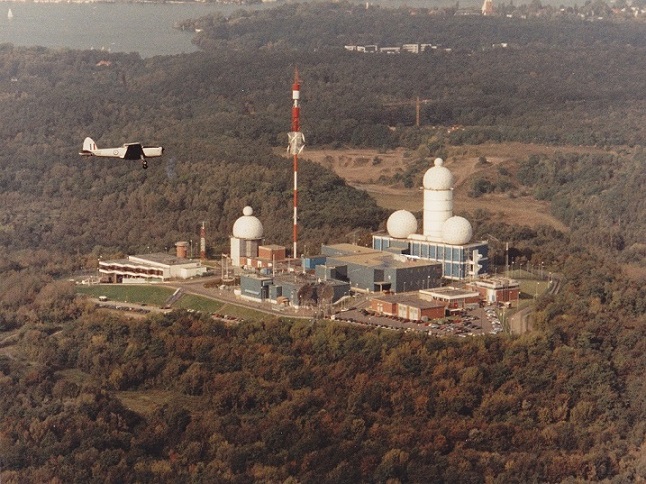
                    Teufelsberg Field Station Berlin, ca 1985. Photograph courtesy of John Evans.

The radomes, which look like gigantic, teed-up golf balls, had no radar equipment despite their name.  The Allied forces already had radar surveillance covered with installations at Berlin’s airports: Tempelhof in the American sector, Tegel in the French sector, and Gatow in the British sector.  (Teufelsberg was used briefly for air traffic control on civilian flights in 1994.)

The people who worked at The Hill had a saying, very popular apparently—a sort of unofficial motto: “In God we trust, all others we monitor.”

Very few who didn’t work there, however, knew what went on.  I knew about FSB, of course, but even as an intel officer, I was never on the site in my 2½ years in West Berlin.  I was my unit’s resident Russian linguist, so I got info copies of transcripts of telephone conversations from the Soviet military headquarters in Potsdam; they came from FSB.  The “Big Ear” was a major target of Soviet espionage both because of its extreme sensitivity and because it was aimed at them.

As a Military Intelligence Special Agent, I had security clearances for which you’d need clearances just to know what the initials stood for.  (That’s not a joke or hyperbole.)  One of my former classmates from the Russian language program was assigned to FSB’s sister listening station in Helmstedt, on the border between the Federal Republic and the German Democratic Republic. 

I took the Duty Train over from Berlin one weekend to visit him, and despite my clearances, he couldn’t tell me what he did, aside from the obvious: listening in on (and, should hostilities break out, disrupting) Russian, East German, and Warsaw Pact communications. 

Even today, 20 years after FSB ceased operations, many of its operations are still classified and former staffers are prohibited from talking about what they did there.  Documents pertaining to the spy site that are still secret are due for declassification soon; some, in fact, may have been released in the past couple of years.

I was a counterintelligence officer, engaged in “human intelligence,” or HUMINT—that’s spies and counterspies, “sources,” and “subjects”—and “electronic intelligence,” or ELINT, more familiar as bugs, taps, and electronic eavesdropping.  

Since I was in counterintelligence, my responsibility was the defense against these things, rather than gathering actionable intelligence to use against our opponents.  FSB had a positive intelligence mission—as did our sister unit whose covert base was next door to our “low profile” offices.  We trip-sixes had a brass sign at the front door and a number—just one, though (it was 9666, the same number as our CO’s staff car license plate)—listed in the Berlin Brigade phone book. 

We got “phone-ins” and “walk-ins”—people, mostly Germans, who presented themselves to the German Labor Force guards at the compound’s front gate and asked for the OSS or CIC (Office of Strategic Services, World War II forerunner of the Central Intelligence Agency, or the Counter Intelligence Corps, WWII predecessor of the army’s MI Branch) if they were old enough, or the CIA, if they were younger. 

The guards would call us and we’d send an agent out to escort them to our interview room and hear their stories (some of which I recount in “Berlin Station, Part 2,” posted on 22 July 2009, “Berlin Memoir, Part 3,” 20 January 2017, and “Berlin Memoir, Part 4,” 9 February 2017).

The six-eights next door had none of that; you wouldn’t know they were there unless you were supposed to.

ELINT and SIGINT, or “signals intelligence,” intercepting over-air communications like radio, microwave, and now wifi, was the bailiwick of the ASA and, therefore, FSB.  As you might imagine, Berlin was an especially important location for a listening post during the Cold War, situated, as it was, 110 miles east of the Iron Curtain inside Warsaw Pact territory.

Being up on Teufelsberg gave the listening station clear reception for a large swath of Soviet controlled Eastern Europe.  The State of Brandenburg, which includes Berlin, is extremely flat terrain so there are few obstructions to interfere with radio and microwave transmissions.

Bristling with antennas, domes, spheres, and silos, The Hill looked like a set from the space opera Star Trek (or Raumschiff Enterprise, as it was entitled on German TV).  There were enough microwave transmitters and receivers on top of the complex to zap all the “Grunie pigs,” the wild boar that roamed the Grunewald, into roast pork!

The power of the tech at FSB convinced most Berliners and many East Germans that all the microwave communications inside the GDR were probably recorded.  Satellite transmissions and radio communications were all intercepted and analyzed.  Wireless communication systems in West Berlin were also monitored, and the wire-based communication were tapped by other installations.  

Everyone believed that even small radio-transmitted bugs installed in any room in the city were picked up by FSB’s state-of-the-art antenna systems.  Some of this was true—probably unbeknownst to the rumor-mongers—but much of it was just uninformed scuttlebutt.

There were always rumors about this super-secret place.  Most of them were ridiculous, but sometimes, odd things did occur.  A couple of the false rumors concerned a tunnel Berliners believed the ASA GI’s dug into the mound and all the way down to the Wehrtechnische Fakultät.  Two reasons for the tunnel were proposed: one was that it was an escape route in case of emergency; the other was that it was a means of access to a secret subterranean submarine base beneath the mountain.

No tunnel has ever been found, but there’s one story that was actually true: every year in late July and early August, the reception of radio signals from stations far to the east were stronger than during the rest of the year.  No one could figure out why at first, until someone noticed that the heightened reception coincided with the annual German-American Folk Festival in Zehlendorf, the district where the U.S. Army headquarters was (and, incidentally, where my quarters were).  

Every year at the end of July and the beginning of August, the American forces sponsored the German-American Volksfest on a vacant plot behind the main PX on Clayallee (which was right across the street from my Berlin Station).  Each year, the festival spotlighted some aspect of American culture; in the three Volksfests I attended, it was The Wild West, Hawaii, and Las Vegas.

The Volksfest had entertainment drawn from the talents of GI’s from all over USAREUR, street-fair food and games, a beer tent (natch), and carnival rides.  (We had a Hawaiian noncom in the unit when I arrived, and when the 1972 Volksfest came around, he taught us some Hawaiian words and expressions.  One was “Suck ’em up!” which isn’t actually Hawaiian, but it’s the island version of “Down the hatch!”  Another was the Hawaiian word for ice cream, which was being sold all over the fairgrounds: aikalima.)  

The signal-booster, it turned out, was the Ferris wheel.  So, every year after determining that, the Berlin Brigade commander held the wheel over for a few extra weeks after the Volksfest closed.

No escape tunnel was ever found after the FSB site was vacated by the ASA and explored by urban explorers and the construction workers of the new private owners.  Something else wasn’t found on the grounds of the listening station: a protective bunker for the GI’s and civilian spooks assigned there. 

It’s curious that at a place in the sights of all the missile-guidance systems of the Soviet Union, there was no bunker.  The spooks on The Hill had all the materiel needed to destroy classified documents and tech, plus some small arms, but no place to take refuge.  Explanation: they were expendable—and they knew it.

No bunker could withstand the type of targeted attack the Soviets would have launched at FSB, something they’d have been planning for since the place was built.  It would have been a waste of time and money to build one, the FSB analysts understood.  The Soviet tanks would overrun the city within hours of a conventional attack, and The Hill would have been a priority target.

This was something the spooks at Berlin Station also contemplated.  Think about this: West Berlin, with an American military force amounting to an oversized brigade with maybe a score of tanks (an enhanced company), a smaller contingent of British and French soldiers, no German troops (except for the police, who received infantry training), was surrounded by a Soviet tank army.  That’s about 300,000 soldiers and anywhere from 500 to 1,000 tanks.  

And that doesn’t count the East German forces, or any other Warsaw Pact troops stationed in the GDR. What the hell were we going to do if the Soviets decided to launch the balloon?  Fight?  Whom?  All the Russians would have to do, we reminded ourselves, was roll up to Checkpoints Charlie and Bravo, post a few guards—we were already surrounded by a wall—and put up a sign, “Berlin POW Camp,” and then go around the city without firing a shot—though they’d probably want to lob a few rounds at The Hill. 

The ASA soldiers on The Hill knew this, too.  They had another saying: “First to know, first to glow.”  (They anticipated a nuclear attack, we didn’t.)

With the fall of the Soviet Union and the subsequent reunification of Germany, FSB became obsolete; it was decommissioned in 1992 and stripped of its sensitive equipment.  There didn’t seem to be anyone to listen to anymore—though I suspect that since Vladimir Putin and his kleptocrats and oligarchs came to power in Russia, some in the Pentagon and at Fort Meade wish they’d had the foresight to hold onto it against that eventuality. 

The 11½-acre site was turned over to the city of Berlin, then sold to private developers in 1996.  The firm, which paid 5.2 million Deutschmarks (about $350,000 then, about $640,000 today) for the former FSB, wanted to build luxury apartments, a hotel and restaurant, and a spy museum on the grounds.  Costs soared beyond profitability, however, and the plans were abandoned.

Struggles over what to do with it stalled other development plans, and then a building boom after the reunification made the plans redundant and unprofitable.  The site’s now covered with graffiti (among the most popular words scrawled on the buildings are, unsurprisingly, ‘ALIEN’ or ‘ALIENS’) and street art, and is disintegrating into ruin, but it’s still a draw for lookie-loos, urban explorers, graffiti artists, and adrenalin junkies even though it’s under 24-hour guard. 
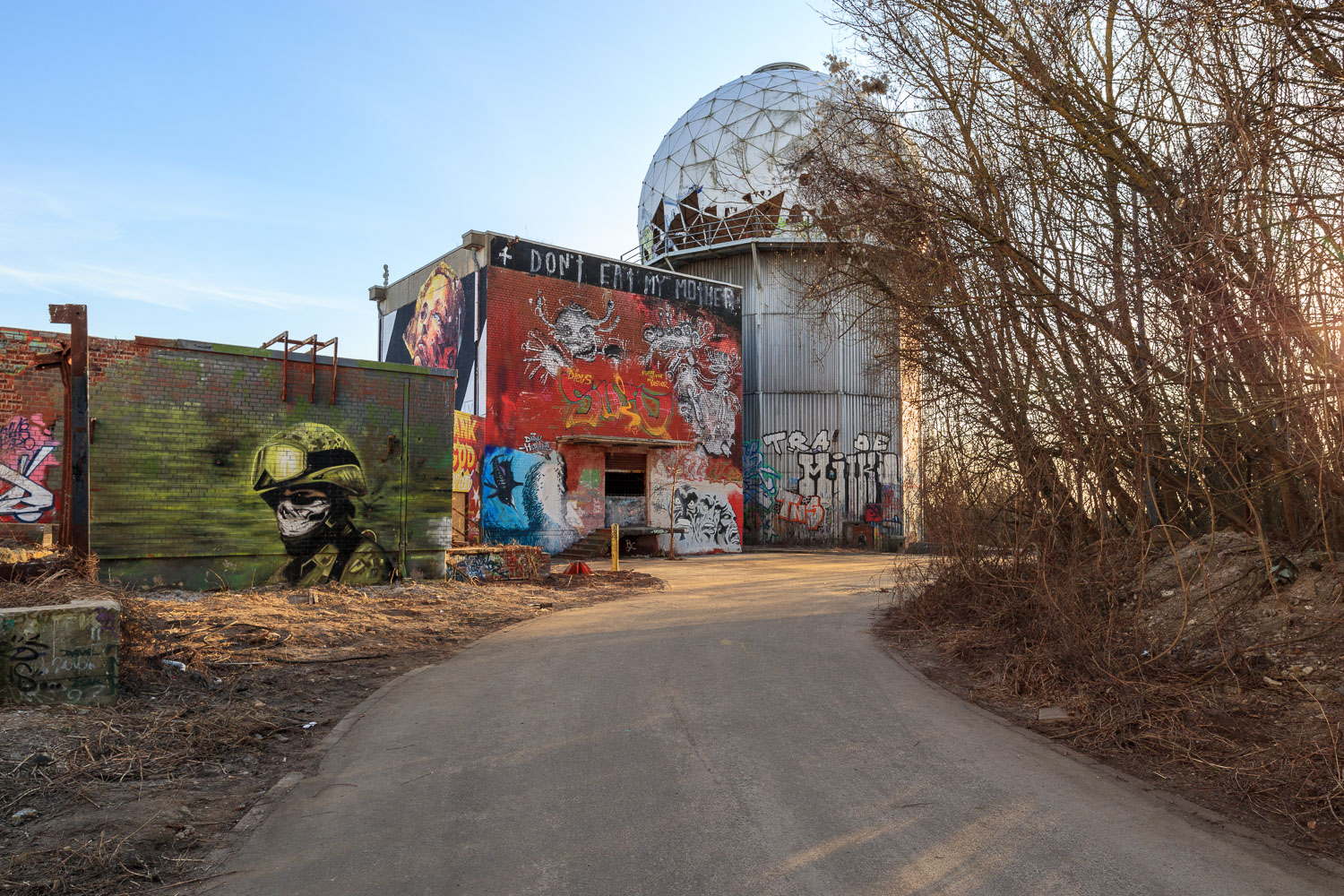
     2018 photos showing current state of the former FSB at Teufelsberg.  
        Photo by Michael Hodgson.
                         

The spy complex was an immediate attraction for tourists looking for an off-beat place to explore as soon as it closed and the ASA left the building.  At first it was by surreptitious entry—there weren’t any security guards at first, just a fence—but then the new owners hired sentries and started charging for tours (or, for a lower fee, simple admission if you just wanted to wander around on your own).  This isn’t officially available anymore, but people still come to see the weirdest ghost town on Earth.

There’s no electricity or running water; at least one multi-story elevator shaft is open and empty, a real safety hazard; there’s little light in some locations; the whole place is littered with construction debris, broken glass, rusty metal, spent spray cans, abandoned (and heavily graffitied) cars, and garbage.  And yet the urban spelunkers come.

It’s “spooky” in two ways now: one, because it’s where spooks—intel agents like me—used to work: and two, because it’s silent, empty, and decaying, like a non-lethal Chernobyl.

The site’s prospects are in limbo; no one seems to know what to do with it.  Plans have been proposed, including the repurchase of the former spy station by the city of Berlin, but none have gone beyond the talking stage, often due to cost. 

One proposed deal in 2008, involving filmmaker David Lynch, was for building something called a “Vedic Peace University,” focusing on yoga and transcendental meditation and featuring a 12-story, 164-foot-high “Tower of Invincibility” to house 1,000 students. The city turned down the proposal.

Over the years since The Hill closed as a USASA station, Teufelsberg has been a location for several movies and television programs, including one espionage cable series, Berlin Station, that aired on Epix from 2016 to 2019.  Berlin Station was the name of my actual CI unit of the 66th MI Group (part of U.S. Army, Europe) from 1971 to 1974.

FSB had also been the subject or setting for many books, both memoirs and novels.  Two of the latter are Voices Under Berlin: The Tale of a Monterey Mary (CreateSpace Independent Publishing Platform, 2008) and Reunification: A Monterey Mary Returns to Berlin (CreateSpace Independent Publishing Platform, 2013).  Both books are by T. H. E. Hill, which is a pseudonym (get it?) for a 74-year-old retired ASA linguist who served at FSB in the mid-‘70s.  (A “Monterey Mary” is a graduate of the Defense Language Institute in Monterey, California.  I went there in 1970 and ’71 and, curiously, I never heard the term before.)

There’s a movement, especially among the Teufelsberg veterans, to preserve FSB as a memorial.  In 2006, the area was legally declared woodland, ending any development plans, and in 2018, it was given Denkmalschutz (‘monument protection’), a designation similar to landmark status in the U.S., for its historical importance as a Cold War site.  This designation eliminated the possibility of new building on the site.

Today, guided tours and paid admission to the late FSB or not, Teufelsberg is popular with mountain bikers, hikers, and paragliders.  In the summer, visitors can enjoy 360-degree panoramic views of the whole city and beautiful sunsets there, and in the winter, the mountain’s small ski slope and the cross-country ski trail are popular.

But what to do with the abandoned FSB is still a conundrum.


22 July 2009

Berlin Station, Part 2


[In Part 1 (Sunday 19 July 2009), I laid out the background for the story I want to tell you and now, here’s the exciting conclusion . . . . “Secret agent man, secret agent man. They've given you a number and taken away your name.”]

The events of this story, which only took a few hours, were actually set in motion months earlier. Sometime in late 1971 or early 1972, an ex-GI named “Red” Kappel (I think his actual given name was Martin, but everyone called him Red anyway), now working in Berlin at the PX warehouse, got caught on the East German Autobahn between Berlin and West Germany with a car full of “refugees.” To complicate matters, he was driving his boss’s Caddy, and it turned out Kappel had paid him $500 dollars for the use of the car, implicating this high-ranking Civil Servant--he was a GS-12 or something, the equivalent of a major--in the mess. The Vopos turned Kappel over to the Soviets--the U.S. hadn’t yet recognized East Germany, so Americans, especially if they had some kind of official status, were not supposed to deal with officials of the GDR. The East Germans loved to ignore this just to tweak the Americans and force us to deal with them. In fact, after the Soviets took Kappel to Potsdam, their military headquarters in Germany, for a few days, they returned him to East German custody and he ended up in jail in East Berlin.

Military Intelligence interest began in this case because when Kappel had been a GI he had had a security clearance and when he first came to Berlin after he got out of the Army, he delivered pizza for a local restaurant, and one of his regular delivery stops was Field Station Berlin, a super-secret, mountain-top ASA electronic surveillance site. We eventually determined that he didn’t really have any info that the Soviets didn’t already have, but at the beginning we didn’t know that. Security questions set aside, the case became part of the tangle of diplomatic-military-political issues that made up the Cold War. An American had committed a crime on Soviet-controlled ground, and they were going to make as big a deal out of it as they could. My job was to find out who else was involved and how far the participation of any official Americans, GI and civilian, went. Remember, the people running this business were about as nasty as anyone could be and the generals didn’t want any of their people in bed with them. And smuggling people across the East-West border by people associated with the U.S. government was clearly a provocation to the Russians at a time when that was a dangerous button to push.

We already knew about Kappel’s boss, the warehouse manager. To find out if anyone else was involved we monitored the mail at Kappel’s home and had his phone tapped. (The rules for this were a lot easier in Germany, and within the military community--and in occupied Berlin, that included civilian employees like Kappel anyway--it was at the discretion of the USCOB. In Berlin, the three Western generals had supreme authority, though they seldom exercised it over Germans or Americans with no official connection.) Now, Kappel, like many GI’s, had married a German woman. Beside the fact that she wasn’t a U.S. citizen, a circumstance always considered a potential security risk, nearly every West German had family in East Germany. Family in the East was a pressure point the East Germans and Soviets were never reluctant to use. Helene Kappel was very vulnerable now, with no income and her connection to the American community and its safety net severed; there was no telling what she might do. In addition, before her marriage to Red, Helene Kappel had been a prostitute. I can tell you, I learned some interesting German from her mail and the phone tap because when she ran out of money, she went back to her old profession. She also made contact with the people who had hired her husband to drive the refugees to West Germany (actually they contacted her) and she began to recruit more drivers and car-owners for the organization. As a result of our operation, we pulled the lid so tight on the exfiltrators that the use of a car went up from $500 to several thousand, and drivers were getting $10,000 and more; Helene Kappel herself was promised a Mercedes for just recruiting people.

While all this was going on, though, Kappel was just sitting in an East Berlin jail. I was on 24-hour call and couldn’t leave my BOQ without telling the Duty Agent in the office where to reach me and calling in every hour or so. (Remember: no cell phones in the 1970s.) My parents came to Berlin for a visit during this time, and they were very impressed at how important I seemed to be because while we were out wandering around the city, I kept ducking into Stubes and bars to use the phone. Of course, I couldn’t tell them what was going on, but they were very impressed nevertheless.

All this time, of course, I was writing reports on everything we were learning about the exfiltrators and their operations, as well as the contacts Helene Kappel was making and everything else related even remotely to the investigation. I attended high-level briefings with colonels and generals and ministers (the foreign service rank just below ambassador). I was generally the only junior officer in the room. I’d have been impressed myself, if I hadn’t been so scared of making a mistake. I’d previously had a run-in with the Deputy Chief of Staff for Intelligence, a bird colonel, over another incident I hadn’t handled the way he wanted me to. (I wasn’t in his chain of command, fortunately, and even more fortunately, I had been right, and my CO backed me up. Still, the DCSI didn’t like me, and we both knew it.) I learned at these briefings that my reports were going to the State Department and being read by Henry Kissinger, Secretary of State at the time. I even had intimations that some of my stuff was going to the White House. This was a really big deal, and I was the point man.

Many of these meetings, by the way took place in a secret room at USCOB. Do you remember Get Smart, the spy-spoof sit-com starring Don Adams? (The TV show, not the later movie spin-off.) Do you remember the Cone of Silence? Well, this room was the real-life Cone of Silence. It was a room suspended inside another room, designed to thwart bugging. After I finished being impressed, I couldn’t stop thinking of Maxwell Smart, Agent 99, and Control under that big plastic cone, shouting at each other. It was sometimes all I could do not to giggle. Trust me, a lieutenant doesn’t giggle in a briefing with colonels and generals. It’s a breach of military etiquette.

Obviously, at one point there ceased to be much more we could do. Kappel had been caught red-handed (pardon the expression), so there was no denying his guilt. Except for trying to roll up the exfiltration operations, which we eventually pretty much did, there wasn’t anything left to investigate. Getting Kappel released became a diplomatic function, so the case went cold except for monitoring sources for word of his whereabouts and potential release. Everything pretty much went back to normal (which at Berlin Station was frequently hectic and crazy anyway). I went back to my regular duties and was no longer on 24-hour call except when I was my section’s duty officer in the regular rotation. And that’s when it happened.

I was on call one evening, and I was just hanging out at my BOQ. Sometime around 7 in the evening, the Duty Agent, who spends the night in the Station to take calls and answer the alert phone, phoned me at home to come in and take a call. My unit was not covert; we were low-profile and wore civilian clothes so others couldn’t distinguish the officers from the NCO’s, since as Special Agents we all were supposed to have the same authority in the field, but we didn’t disguise who and what we were. For this reason, we were the first contact anyone gets when they come looking to get in touch with American intelligence. (The older, World War II generation often asked for the OSS or the CIC; the younger guys wanted the CIA. They all got us.) As a result, we often got nuts calling or walking in with all manner of strange reports to make. (One guy told me in all seriousness that the Soviets had agents on the moon and that he was in “eye television”--Augenfernseh--contact with them, so he could tell us what they were up to. Another said that the Soviets were leaving poisoned cigarette butts on the streets so that GI’s would pick them up, smoke them, and get sick. To prove this, he had brought little bottles of his own blood, which he carried around with him in a tote bag.) This call was one of these--a guy who thought that a recent photo of a wanted Baader-Meinhof member in the newspaper looked like his wife’s brother-in-law (or something). I talked the guy down, thanked him, and got rid of him. But as I was preparing to go back home, the phone rang again and the Duty Agent passed it on to me. The man on the other end said he was Red Kappel, that he had been released in West Berlin, and he wanted to meet someone. Well, this didn’t sound kosher. Our latest information was that Kappel was still in the East Berlin lock-up, and while it was possible that the East Germans might release him suddenly and without notice, it was highly unlikely. They were all making too much hay out of holding him. (Kappel’s eventual release was almost certainly a direct result of President Nixon’s trip to Moscow [summit meeting with General Secretary Leonid Brezhnev, 22-30 May 1972].). If they were working at that level, letting him go unannounced, with no bargaining or propaganda, would be pretty silly on their part.) And even if he had been released that way, why would he call Military Intelligence? Not his wife, not his boss, not the guys who hired him (and probably hadn’t paid him yet), not some friends. Still, I couldn’t just ignore the call. I arranged to meet “Kappel” at the PX snack bar across the street. It was about 8 p.m. now, and the place closed at 9, so it would be neutral, safe, but somewhat private. We made a date for a short time later.

Now, because this case fell between all the floorboards of military investigations--it wasn’t a security matter, it wasn’t a military crime, and since none of the people involved were GI’s, it wasn’t even a breach of military regs--we shared the case with the military detectives, the CID. I had a CID counterpart, Karl-Heinz Wiedermeyer, a German-born, naturalized American. A warrant officer (not quite an officer, no longer a non-com), Wiedermeyer didn’t want to be on this case any more than I did. He also shared with his CID and MP colleagues a tendency to overreact whenever something got a little spooky. One whiff of spy stuff, and military cops sometimes went off half-cocked. Not that I was so cool, with my vast experience in counterespionage. (I once got into some trouble with my CO because I lost my cool when I got stuck with an inoperable radio when I was doing security for Gen. Westmoreland. I started cursing over what I thought was a dead radio, but it was only broken at my end. They could hear me perfectly well back at base, and cursing on the air is a major RTO no-no. So much for cool under pressure.) I was, however, at least trained for this stuff. Wiedermeyer wasn’t. He was a cop, not a spook--intelligence agents are spooks; I was a spook. Anyway, I called Wiedermeyer and, because his office was at Andrews Barracks, a compound in the Berlin borough of Lichterfelde, we decided that I’d go meet “Kappel” and my partner would join us later. So I went on across Clayallee to the PX complex, and went into the snack bar.

The PX snack bar was a cafeteria. This one was nearly all glass, with windows all around the two exterior walls, and the entrance from the corridor in a completely glass wall. (The fourth side was the food counter and the kitchen.) At 8 o’clock in the evening, an hour before closing, there’s virtually no one there except the workers closing up. As I entered, I saw one lone guy sitting at the opposite end of the room. He was at a table, with his hat pulled down sort of ’40s style, and he was buried in the brigade Daily Bulletin. Every military post puts this out, with all the announcements, official and unofficial, and its a couple of pages long, printed--mimeographed in those days--on legal-sized paper. A guy in a slouch hat, poring over the DB looks pretty silly, believe me. The only other people in the snack bar were the cooks and servers cleaning up behind the counter and one teenager turning the chairs up onto the tables in the main part of the room. Obviously, the guy with the DB was my guy--but he wasn’t Red Kappel. I’d seen enough pix of him over the months of investigation to know what he looked like, and this guy was ten years too old, ten pounds too heavy, and a good six inches too sort. And even with the hat, I could see that his hair was not red (Kappel didn’t get his nickname for nothing). I had to talk to the guy in any case. Even with all the deception, he might actual know something we should know. I doubted that, but I had to make a report anyway, so I had to find out what he wanted.

I crossed the room and went up to the guy’s table. I stood across from him, but he didn’t look up from the DB. Christ, I thought, the guy’s gonna play Sam Spade or something.

“Are you looking to talk to someone?” I said.

“You CIA?”

“No.”

“You got ID?” He still hadn’t looked up.

“No. Do you want to talk, or not?”

“OK.” I sat across from him. “I hear the Reds got one of our guys.”

Oh, God. He’s a John Bircher or something. Where’s this gonna go? “Where’d you hear that?”

“Around. I work in the EES beverage shop. The word's out.” He meant the European Exchange System, the parent organization for the BX’s, PX’s, and other retail outlets in Europe. The warehouse where Kappel worked was part of this same system.

“OK. Why’d you want to see us?”

“I got a brother-in-law--well, my wife’s brother-in-law--in the East. He’s a party member, but he don’t like it there. I can go over and get him to find out where they’re holding Red.”

“Ah, no, that wouldn’t be a good idea. We really know where Red is, anyway. But thanks for offering.”

Somewhere about here, I saw Wiedermeyer, the CID investigator, look in through the glass doors across the room. It was near closing now, and all the activity in the snack bar had pretty much ceased. There was only our James Bond wannabe and me in the room, and that teen mopping the floor. But Wiedermeyer looked around, didn’t come in, and left. What the hell, I figured, this isn’t important and I’ll just fill him in later, after I talk this guy down and send him home. I was a little afraid, considering how ditzy the guy was, that he might be armed and if I signaled Wiedermeyer across the room, the guy might lose it or something. It wasn’t worth the chance under the circumstances. I let Wiedermeyer go without making a move or saying anything.

“Well, what if I go over and get my wife’s brother-in-law to help me break Red out. We could go over and get him before anybody knew. My wife’s brother-in-law”--he never used the man’s name, it was always “my wife’s brother-in-law”--”has clearances. He knows stuff, and he can find out things.”

“Fine. But don’t do anything until we get back to you. I have to report to my superiors, you know, and they’ll let you know. Promise me you’ll wait until you hear from me.”

“Sure. But I want to help. We can’t just let them get one of our guys like that.”

Jesus, this guy’s gonna do something dumb, I know it. He’s seen too many spy flicks. “Of course not. We’re doing things right now, don’t you worry. Believe me, we’re not just sitting on our hands here. Just don’t do anything without hearing from us. You might get in the way of another operation, you know. Don’t even talk to your wife’s brother-in-law yet. Just wait.”

“Sure. I understand. But you’ll get back to me. I’m ready to do something. I know I can trust my wife’s brother-in-law.”

I stood up then, and pointed out that the snack bar was closing up. I walked him out and across the street. We stopped in front of the entrance gate to the compound. “Now, remember, you promised not to do anything until you hear from us. Right? Don’t even go to the East until then.”

“Right. I gotcha. I’ll wait to hear from you.” He walked away toward the small compound nearby where the EES beverage store was, and where I imagined his car was parked. I watched him go until he turned the corner, then went into the headquarters compound and into Berlin Station. When I entered the Station, there were three people in the Duty Agent’s little office and the phones were all ringing. The DA was there, Wiedermeyer, and another agent from the Station who, it turned out, just happened along and got drafted. “Wiedermeyer, where the hell did you go? Why didn’t you come into the snack-bar? I saw you look in, but you left right away.”

“I, uhh . . . . What the hell are you doing here?”

“I work here! What’s going on?”

“Where were you?” asked the DA.

“Right where I said I was going to be. What’s this all about?”

“Wait a minute, let me call off the dogs,” said Wiedermeyer. (This dialogue is reconstructed from my fading memory, and a lot of it is paraphrased. But not this line. Those words I remember as clear as day.)

After a second’s hesitation, the three started dialing and talking again, very frantically.

"What do you mean, ‘Call off the dogs’?”

“I didn’t see you in the snack-bar. I thought you got grabbed. We’ve called your CO, my CO”--that’s the Provost Marshal, the chief of police on a military base--“the USCOB, the Brigade Commander, and the DCSI. We’ve put out APB’s on you, Kappel, your car, and the Caddy Kappel was driving. They’re shutting the whole city down.”

“Jesus, Wiedermeyer, did you overreact! I was right where I said I’d be. The only thing was, when I got there, I found out it wasn’t Kappel at all, of course. It was just some nut from the EES. He heard through the grapevine that Kappel got picked up in East Germany, and he wanted to go over and bust him out. He was a little hinky, so when I saw you peek in, I didn’t want to signal. Since it wasn’t Kappel or anyone important to the case, I figured I’d tell you later.”

“Well, I wasn’t looking for you, actually; I was looking for Kappel. When I didn’t see him, I just naturally assumed . . . .”

At this moment, Col. Collins arrived. He had already been on his way when the DA called to head him off. Besides, with the DCSI and two generals informed that I’d been kidnaped, he figured he’d better be in the Station to settle the flap. Unfortunately for me, the DCSI was also on his way in. The generals, at least, had been caught in time.

Col. Collins picked up a phone and made several calls. I was still watching this whole scene in amusement and disbelief. After all, I hadn’t done anything. Was it my fault that Wiedermeyer had jumped to conclusions and overreacted?

“Well, the shit’s gonna hit,” said Collins. “The DCSI wants to see us in his office at USCOB. The PM’s closed the checkpoints and stopped the military train. The military part of Tempelhof’s been closed, too.” That was the Berlin airport (since closed), part of which was a U.S. Air Force Base. “They got the French and the Brits to lock down their sectors also, and the PM’s been on to the German agencies to shut down the civilian crossing points and exits as well. It took about half an hour to shut the city down. It’ll take hours to open it all up again. The DCSI’s gonna be pissed.” (Did I mention, the DCSI didn’t like me?)

“But why at me, Sir? I was right where I said I’d be, doing just what I was supposed to do.” I knew the DCSI was just looking for a reason to chew my tail again. Would Col. Collins back me again this time?

Well, the DCSI did light into me. At least he started to. And Col. Collins pointed out right away that the flap had not been caused by anything I had done. The DCSI backed off, but he was clearly not happy about that.

As we left the DCSI’s office, Col. Collins told me, “When I first heard that you were kidnaped, my first fear was that you had your creds with you.” Those were our MI badges and ID cards. “Then I wondered if you had a weapon.” I looked at him a moment. He was really more worried about my boxtops and my .38 than about my safety. How comforting.

As far as I know, the city untangled itself and was back to normal by morning. I doubt anyone outside the Station, the Provost Marshall’s Office (the military cop shop), and USCOB really knew what had happened. Probably some travelers had been inconvenienced--mostly military ones, since the civilian stuff probably never got closed before the all-clear came down--but they probably never learned why. Anyway, I’m the only person I know who’s had a city shut down for him. Kinda makes me proud to be an American.

On the other hand, did you ever hear how the mayor of Philadelphia threw my father out of town? Well, that’s another story for another time.

19 July 2009

Berlin Station, Part 1


A short time ago, I wrote about an old German TV miniseries, Der Illegale. At the beginning, I mentioned that I was posted to West Berlin as an Army counterintel officer in the early ‘70s. About four years ago, I put together a somewhat haphazard--that is, stream-of-consciousness--memoir of the two-and-a-half years I spent as a Military Intelligence officer in Berlin at the height of the Cold War. Here is an account of one incident at the center of which I found myself.

First, a little background.

Berlin in the 1970’s was the hub of every espionage enterprise in the Cold War world. In Berlin, like Lisbon in the World War II movies, everyone was spying on everyone else. There were easily thousands of espionage operatives of one kind or another in the city, on either side of the Wall; the U.S. alone probably had 2000 people posted there in some intel capacity. Assigned to the Military Intelligence station in Berlin as a counterespionage officer, I knew of incidents in which the Bulgarians were caught spying on the Czechs in East Berlin. (The Warsaw Pact wasn’t alone in this activity: we spied on our allies, too, and they on us. All those spies had to do something with their time!) Even the Chinese--the Chinese, for Pete’s sake--had agents in Berlin! It was like living in Casablanca. Not the city--the movie.

Joking aside, there was real danger. Fighting the Cold War could sometimes be as scary as the hot one going on in Vietnam. The ’70s was the height of the U.S.-Soviet antagonism, with Brezhnev and Nixon eying each other suspiciously over the border dividing the two Germanys. Minor incidents, especially along the Berlin Wall or at Checkpoint Charlie, the official military crossing point between the two halves of the city, were frequent, and minor incidents could escalate--an appropriate term liberated from the shootin’ war in Southeast Asia--into major ones with Kafkaesque suddenness. GI’s touring East Berlin--a practice encouraged by the Army as a way of “showing the flag” in the still-occupied city--could be arrested for supposed infractions and whisked off to Potsdam, the Soviet military headquarters, just to provoke a response. Supply trains crossing East Germany to provision the military stores of West Berlin, which many people never realized was an island 110 miles inside the German Democratic Republic, were arbitrarily stopped and held for anywhere from hours to days. Shots were fired at or near Checkpoints Charlie or Bravo (the crossing point between West Berlin and the GDR, on the city’s western border) several times a month.

At the same time, this was a period of fierce anti-Americanism and anti-capitalism all over Western Europe. Anarchists like “Red” Rudi Dutschke and the infamous Baader-Meinhof gang, formally known as the Red Army Faction (or, ironically, the RAF), were planting bombs and kidnapping German businessmen at an alarming rate. A man I had met, a U.S. Army captain stationed in Frankfurt, was killed by one of these bombs, leaving behind a wife and two pre-teen daughters. Paranoia was so high that all cars entering the Berlin Brigade headquarters compound, a former facility of the Luftwaffe on Clayallee, were thoroughly searched, with huge wheeled mirrors shoved under the chassis to examine the undercarriage for explosives. During one surveillance operation to which I was assigned, I pulled the graveyard shift--midnight to 8 a.m. The place we were watching was in Kreutzberg, a remote borough of Berlin, and we had to drive there from Dahlem, the section surrounding the headquarters compound and most of the living quarters. Because American cars were easy to spot on Berlin streets--I owned a candy-apple red, 1970 Ford Torino fastback, my college graduation present from my parents--we had to use “spy cars.” These were “indigenous” vehicles, usually VW’s or German Fords, with interchangeable license plates: green “USA” plates with black numerals that looked like those on the private cars (POV’s) of GI’s stationed in Germany, and long, thin, black-lettered white plates of Germany. (Official Army vehicles--GOV’s--such as staff cars, bore yellow plates; miltary vehicles, like trucks and jeeps, did not have plates as such; they had painted registration numbers instead.) These cars were parked in a lot in the rear of the headquarters compound, but we had to go to our office at the front of the compound to sign them out and pick up the keys, so we never drove back there in our own cars. We parked across the street from the front entrance, in an extra PX lot. After the PX complex closed, around 9 p.m., this lot was vacant, so we left our POV’s there, walked over to the office, signed out the GOV, got the keys and the appropriate plates, walked back to the GOV lot, installed the plates, and drove out the rear exit of the compound. No problem. We did this all the time when we used a GOV. But this time, while I was off at the surveillance location, sometime during the early morning, the MP’s patrolling the headquarters area got suspicious. What was this car doing abandoned in the PX lot so long after the shopping complex had closed? Maybe it’s wired with explosives? Better check it out!

Well, of course, as a Military Intelligence officer, my POV registration was classified, so no trace of the owner could be found in local records. (First of all, this was in the days before computers. Second, POV’s of MI personnel were registered out of Munich--the headquarters of MI in Germany--and, third, their identifications were buried under layers of classification. A registration check by local MP’s in Berlin leads to a series of dead ends. The same was true of our private phone numbers at home.) Obviously, a car with no ID, left in the parking lot late, with no one around to claim it, must be a bomb. If the commotion that ensued had not been noticed by a colleague in my unit (located right at the front of the compound, with a view of the PX grounds across the street), my car would have been, at best, towed off to an impound lot and stripped down or, worse scenario, blown up on the spot. Of course, no one could tell me all this while I was on surveillance--radio traffic was restricted to operational use--so I never heard about this near-loss until I got back to sign out sometime after 8 the next morning. By then, it was all a joke, but it almost wasn’t. Paranoia--it’s a wondrous thing!

Besides politics, there was also just plain old crime. Berlin, like most big cities, had a crime problem in the ’70s, but it was complicated by a number of aspects. Because it was a relatively easy place to get to from Western Europe, and only slightly less easy to get to from the East, and access back and forth could be arranged with a little know-how, resourcefulness, and cash, smuggling was a big deal in Berlin. Now, I’m not just talking about some dope or a few sparkling baubles or rare artworks--though these crossed back and forth pretty often, too. No, Berlin’s smuggling trade included guns, explosives, hot money, documents--and women. Believe it or not, white slavery was still going on through Berlin in the ‘70s. And the people most in control of all this smuggling were Turks. Berlin’s organized crime, the equivalent then of its Mafia (although more comparable to the Colombian drug gangs of the ‘80s), was predominantly Turkish. And these guys could be vicious. Just before I arrived in Berlin in July 1971 there had been a pitched battle on the streets of downtown West Berlin between the police and one Turkish gang. The gang had been armed with machine guns and military weapons--the same stuff they were transshipping back and forth across the East-West border. Now, nothing like that happened again after I got there, but the possibility kept everyone a little on edge, especially when we had to hang around in a low-rent part of town like Kreutzberg (which, as it happens, was also a largely Turkish district). MI agents were not generally armed, despite what you see in the movies. I had my heart in my throat more than once when out on an operation.

So, that was Berlin in the early ’70s when I was assigned there to Berlin Station of the 66th MI Group. The trade-off was that Berlin was still officially under military occupation, so GI’s, as well as our French and British counterparts, had some perks. Uniformed soldiers (which didn’t include MI personnel--we wore civvies) could ride the buses and subways for free. Part of the occupation agreement with the Germans after the war required them to supply housing for the occupying troops, but since much of the city had been destroyed by bombings, most of this housing was newly built. Whereas bachelor officers in, say, Frankfurt or Munich might get quarters with a bedroom and a sitting room, a shared bathroom, and a small refrigerator (but no kitchen--they ate in the mess or at the O-club), single officers assigned to Berlin lived in one-bedroom garden apartments. Married enlisted men and woman got modern apartments in highrises, and more senior officers with families had houses in little suburb-like developments. All fully furnished, equipped--and free. Berlin had the best PX, the commissary got the best supplies, and our officers’ club was the finest anywhere in NATO. The NCO club was as good as most O-clubs elsewhere, and better than many. The recreation facilities, including the Wannsee resort, drew generals and high-ranking civilians from all over Europe, and it was all free. It didn’t hurt, of course, that we had two generals in Berlin, a one-star who was commander of the Berlin Brigade--the fighting troops--and a two-star who was the U. S. Commander of Berlin (USCOB), the military governor of the American sector. (The Brits and the French had generals, too, of course. Berlin probably had the highest concentration of general officers anywhere outside the Pentagon or maybe Brussels.) One irony of my service there was that I was entitled to wear the same Germany Occupation Medal that my dad, an artillery battery commander when the Allies were fighting their way across Western Europe after D-Day, got for serving in Germany after VE Day twenty-five years earlier. There was something time-warpish in that.

Yep, life in West Berlin could be good, if you ignored the fact that you were encircled by a wall and prohibited from leaving just whenever you wanted to. A GI in Frankfurt could get leave, hop in his car, and drive off in any direction for a few days’ outing. He could get on a train and visit Munich, Hanover, Hamburg, even Vienna or Rome or Paris. In Berlin, you couldn’t leave the city without advanced planning and special orders (called Flag Orders) for crossing the borders. People with high security clearances like me were restricted from traveling by any means other than the military trains (including the British and French ones, but not the German civilian Bundesbahn), military planes, or Pan Am. The reason for this last restriction was that Pan Am was the only civilian airline to agree never to land in East Germany or any Soviet Bloc country, no matter what. Air France and BOAC, which both flew to Berlin in those days along with Lufthansa, would not--rather sensibly, it seemed to me--make such a pledge, so we were prohibited from flying them into or out of Berlin. We were not even allowed to drive to West Germany for more than a year after I arrived in Berlin when those restrictions were eased a little. (By the time I went to Bad Ems in 1972 for the MAD-Schule, we could drive out, with a few restrictions.)

This struck all of us as something of a bleak joke, of course. Much like the game we played on “alerts,” those little exercises military units go through regularly to practice for emergencies (read: “war”). Like elsewhere, each unit in Berlin had an assigned task “in the event of hostilities.” Ours was to secure certain important people and get them to evacuation points, then round up “undesirables” for internment. Now, think about this. West Berlin, a city of some two-and-a-half million people, with an American military force amounting to an oversized brigade with maybe a score of tanks (an enhanced company), a smaller contingent of British and French soldiers, no German troops (except for the police, who received infantry training), surrounded by a Soviet tank army. Not a brigade or even a corps--an army. And that doesn’t count the East German forces, or any other Warsaw Pact troops stationed in the GDR. What the hell were we going to do if the Soviets decided to launch the balloon? Fight? Whom? All the Russians would have to do, we reminded ourselves, was roll up to Checkpoints Charlie and Bravo, post a few guards--we were already surrounded by a wall--and put up a sign, “Berlin POW Camp,” and then go around the city without firing a shot. You had to laugh, otherwise . . . .

Well, that was the situation I entered when I got to Berlin as a first lieutenant in July 1971--my first actual duty assignment. I had an ROTC commission (a good way to stay in school in those days), a couple of months of training as an armor officer at Ft. Knox; a year of Russian language classes at the Defense Language Institute in Monterey, California--I spoke German and French from having lived in Europe during high school; and three or four months of MI officers’ school at Ft. Holabird in Baltimore. (A hole if there ever was one; after the army abandoned it right after my class graduated, it was used as a prison for the Watergate crew. They were well and truly punished, believe me.) Anyway, now I arrived in Berlin days before the tenth anniversary of the erection of the Berlin Wall, Friday, 13 August. As an initiation to Berlin in the Cold War, my first job at Berlin Station was to be part of the unit’s surveillance of the protests planned for the anniversary. We called this “demo coverage,” and we just observed to see who came out and who said what. This one was a big deal, of course, given Berlin’s political status at the time. Not only would there be one march, but there were going to be two, one by the rightists protesting the wall (Die Mauer muß weg!) and one by the leftists supporting it and the Workers’ Paradise to the east (Besser rot als tot!). The two marches started in different parts of the city, but they were aiming for the same spot, the saddest place in the city: the Peter Fechter Memorial. Peter Fechter was an 18-year-old kid who was shot trying to flee East Berlin sometime shortly after the wall went up (17 August 1962). He wasn’t killed outright, but he lay wounded in the no-man’s land controlled by the machine guns of the Vopos in their towers. (The Wall was really two walls about 100 yards or so apart, creating an empty strip of terrain between them--the so-called death strip.) The boy bled to death within sight of the East German guards and the West Berliners who witnessed the attempted escape but couldn’t reach him because of the guards’ guns. After Fechter’s death, a memorial was built on the Western side of the Wall at the site of his attempt. This had become a focal point for all demonstrations relating to the Wall, and on this day, both marches were on their way to the memorial at the same time. It didn’t take military intelligence to guess what was going to happen when the two groups met there. And we knew one thing for sure: if violence did erupt, do not get caught between the leftists and the rightists, or between either group and the police.

Here I was, then, what we called “a civilian TDY to the Army.” (TDY was the military abbreviation for temporary duty, but it was often used in conversation to mean “on temporary assignment.”) Furthermore, my only contact with cops had been traffic officers and the highway patrol. But, let me tell you, these Berlin police were impressive. Remember, I had just come from the States where police departments and national guard units had fired on demonstrators. Kent State hadn’t been too long before my arrival in Berlin (4 May 1970). And here I was in the land that invented militarism. But these guys were superb--controlled and professional. (Because the occupation agreement prohibited German military in Berlin, the police received basic military training.) At the first sign of violence--one guy from one of the marches took a swing at someone in the other group with the wooden post from his protest sign, and some bottles and rocks started to fly--the cops closed ranks with their huge plexiglass shields in front of them, like a moving wall, and simply cleared the street. (They also had the biggest dogs I ever saw.) They just swept everyone into the subway entrances. The protesters had two choices: stay underground in the subway station, or get on a train and go somewhere else. No overreaction, no clubs, no guns, no cursing. Just swoosh, and the streets were clear. They only moved when violence became imminent, after the opposing groups met near the memorial, and they treated both sides the same.

Of course, we dashed behind the police lines as soon as this all started. We had a special password we shouted as we ran toward the cops, and they let us through to safety before things got too hot. That was my introduction to West Berlin. (And if I didn’t like that, there was always ’Nam waiting, usually the next stop for officers assigned to Europe at that time. Most of my predecessors had stayed for 18 months or two years, got home leave for a couple of months, then shipped out to Vietnam. In those days, the life expectancy of an MI lieutenant in Vietnam was estimated at 5 minutes after he hit the tarmac in Saigon.)

So that’s where my head was at when I started out on the events that resulted in the Army closing down the city of West Berlin. But it wasn’t my fault. Really. As they used to say in the old television show, the following story is true. None of the names have been changed, however, innocent or not. The initiating incident was “exfiltration,” a problem unique to West Berlin. This was the process of helping Easterners escape into West Berlin or West Germany and it was a sensitive situation involving both military and diplomatic actions, not to mention involvement of our French and British counterparts and several German agencies. In the years immediately following the war and the partition of Germany, exfiltration was an official, if clandestine, project of the U.S. government to bring out scientists, engineers, and other useful and high-profile people. By my day, most of those kinds of people who wanted to leave had been brought out, so the U.S. disbanded the operation. In the vacuum, private entrepreneurs assumed the task--for a fee, of course. The folks connected with this process were the same bad guys who controlled the smuggling.

By happenstance, I had become the Station expert in exfiltration and was called in whenever a case seemed to touch on it, hence my involvement in the story you’re about to read. Because of reports that I wrote on exfiltration, including ultimately a large book with illustrations, charts, and diagrams which was in demand by agencies both American and foreign (we had to make up a sanitized version for them) all over Berlin and the Federal Republic, my CO, Lt. Col. Pat Collins, took to calling me “Collins’ Commando” whenever he saw me around the Station. (Yes, I was embarrassed, but he was a light colonel and I was only a first looie--and the new boy in town as well--so what was I going to do, tell him to stop?) Most cases were small matters, investigated quickly and disposed of without much effort. One time, however, I hooked a big one.

[I’ll leave off here for the time being and pick up with the incident itself in Part 2. Tune back in on Wednesday, 22 July 2009 for all the excitement and derring-do. (Fade-out as “Secret Agent Man” plays over the credits.)]