Showing posts with label Israel. Show all posts

22 April 2022

Helen Katz Kaye Eleasari (1934-2020)


[On the night of Saturday, 16 April 2022, I discovered some very sad and upsetting news.  My Tel Avivian friend, Helen Eleasari, who wrote for the Jerusalem Post as Helen Kaye—I’ve posted many of her pieces, including theater reviews as “Dispatches from Israel”—died nearly two years ago and I never knew.  Apparently, no one in her family had me on a list of people to notify. 

[I had written or e-mailed her a few times over the pandemic period and just afterwards, but the messages weren’t answered, even though they didn’t come back.  I knew she’d been unwell; she wrote me that on 22 September 2016, she “fell over a bollard on the sidewalk (don’t ask how—I don’t know) and broke my hip.”  

[She had a partial hip replacement and had been in the hospital for 24 days.  She was doing rehab and physical therapy, she told me, and after six weeks as of 4 November, when she wrote me about all this, she was looking at six more before she expected to be “completely healed.”  Meanwhile, her mobility—she had just graduated from a walker to a cane—was severely curtailed.

[On 23 May 2020, Helen e-mailed me from the hospital again.  She’d gone to the ER at 4 in the morning of the 22nd because she woke up an hour earlier with intense pressure on her chest and was afraid she’d thrown another pulmonary embolism.  (She’d thrown one in September 2018, but had recovered completely, she reported.)  “But no,” she wrote at almost noon on the 23rd. “Thank heaven.”

[She’d been given a CT scan and was taken to the chest surgery ward at 5 that evening “because [the] docs did not like what they saw on [the] CT.”  She explained in a later message that evening that she was now awaiting a bronchoscopy, but she hadn’t said what diagnosis was anticipated.

[Indeed, Helen had signed off in the first e-mail with the line: “As Lady Bracknell says ‘a life crowded with incident’!”  (It’s a line from Act 3 of Oscar Wilde’s The Importance of Being Earnest.)  The word ‘cancer’ was never used in any of the messages Helen sent me, so I just assumed the best.

[As it turned out, that was the last message thread I got from Helen—though I didn’t actually realize it.  I knew she was fighting some illness she didn’t specify, but she appeared to be healing, however slowly, from the busted hip.  She’d seemed otherwise fine—Helen was a little over 10 years older than I—from her attitude in the last e-mails.

[When I continued not to hear from her, I started to get worried, but I was actually afraid to look into the situation.  I wrote to her about posting my 1982 Israel/Egypt travel journal on Rick On Theater, which I was sure would interest her, but I got no response.  (I turns out, she’d died a year earlier!)

[Late yesterday, while I was doing some research on a Habima stage production for an upcoming post, I hit on a review of Helen’s (it was a passing mention; one of the actors in whatever show she was reviewing had been in the earlier Habima production), so I was finally prompted to look online for news.

[The first hit on the Google list was Helen’s JP obituary (posted below).  What a shock!

[Well, I guess not really.  I was already convinced that something dire had happened.  I just hadn’t wanted to confirm it.  Now I had.

[As ROTters will remember, I’d known Helen since I directed her in a showcase of Oscar Wilde’s Lady Windermere’s Fan back in 1978.  Helen played the Duchess of Berwick and she did the costumes for our no-budget, non-union showcase production.  After rehearsals at the theater’s West 20th Street storefront, members of the cast often gathered in my living room at 15th Street and 5th Avenue, just five blocks south of the theater, and worked on Helen’s costumes. 

[For practical reasons, I’d reset the 1892 play in the 1920s.  Helen designed a gorgeous kimono dressing gown (worn by Mrs. Erlynne) from an embroidered tablecloth.  After the production ended, one of the actresses kept the robe—I don’t remember now if it was Helen or our Mrs. Erlynne. 

[Though she was born in the U.K, (Walton-on-Thames, Surrey), Helen lived in the States for years and became a dual citizen before making her aliyah to Israel in 1983 (a year after I visited the country; see “Travel Journal: Israel & Egypt, 1982,” 11-23 July 2022).  We kept in touch regularly and she visited New York several times after she made her aliyah.

[(Aliyah is the Hebrew word meaning ‘ascent’ or ‘the act of going up.’ It’s the word Zionists use for immigration to the Land of Israel (Eretz Yisrael, which today means the State of Israel); ‘making aliyah’ is the term for immigrating from the Jewish diaspora to Israel and is one of the most basic tenets of Zionism.)

[The articles Helen’s sent me for ROT included “Berlin” (posted on ROT on 22 July 2013), her account of a trip she made with her daughter Rava, and coverage of the 2012 Acre (Acco) Festival (9 November 2012), summer theater for children (“Help! It’s August: Kid-Friendly Summer Festivals in Israel,” 12 September 2010), and “A Trip to Poland” (7 August 2015).

[The 20 installments of “Dispatches” ran randomly from 23 January 2013 to 25 February 2020, five months before her death.  Her reviews, for which she was allowed a very small amount of space, were always concise yet complete.  I always admired how well she conveyed her estimation of the shows in such few words.  (I’m terrible at concision, but Helen did it excellently and I was very jealous!)  Over the years, Helen also covered the cultural beat for JP.

[Aside from her writing, Helen directed local productions in English, both musicals and straight plays, classics, standards, and originals.  She spent two years teaching English at a provincial university in China in 2003 and ’04.] 

“VETERAN CULTURE WRITER HELEN KAYE DIES 2 WEEKS SHORT OF HER 86TH BIRTHDAY”
by Greer Fay Cashman

[Cashman’s obituary for her colleague, Hellen Kaye, the pen name of my friend Helen Eleasari, ran in the Jerusalem Post on Sunday, 26 July 2020.]

Critic and journalist began working for the ‘Post’ in 1987
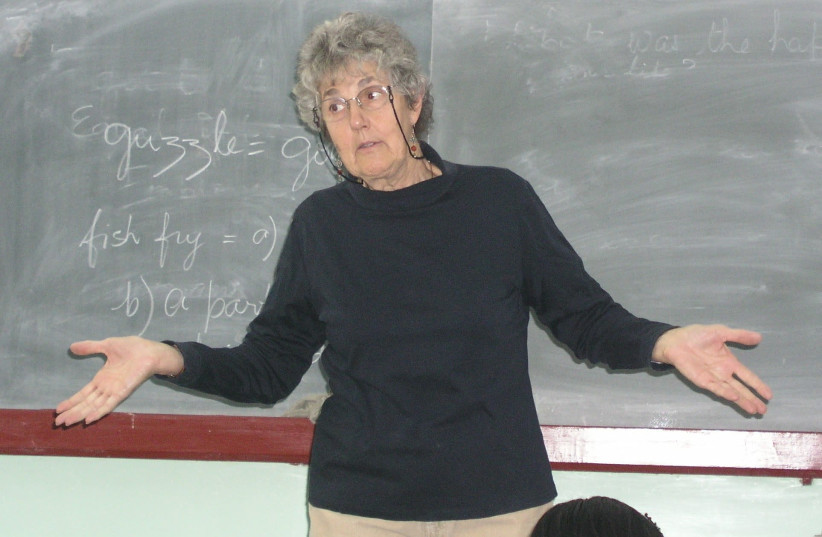
                               photo credit: Courtesy


If there was a single phrase to sum up Helen Kaye, the veteran arts and culture reporter whose byline in The Jerusalem Post publications first appeared in July 1987, it would be mistress of the metaphor.

Kaye had a unique gift for allegory. She also wrote succinctly, and invariably succeeded in packing a lot of information and drama into a small amount of text.

For instance, a theater review would include not only her impressions of the performance, but also the reactions of the audience, a brief history of the play, and the future plans of the theater group, the director, or the main actors.

Kaye, who died on Sunday [26 July 2020], after a short-lived battle with an aggressive form of lung cancer, would have turned 86 in early August [3 August].

She did not originally set out to be a theater critic when at age 18 she first made aliyah from her native London. All in all, she made aliyah three times: the first time from England, the second time from the United States and the third time from China.

When she first came in the early 1950s, her ambition was to be a nurse, and she trained under the late Dr. Chaim Sheba, the founder of the Sheba Medical Center in Tel Aviv.

She worked for several years in her profession until 1963 when her husband, Jacob Eleasari, decided to go to America to study filmmaking at UCLA, because at that time there was no film school in Israel.

There’s an old Hebrew saying that a change of location means a change of luck, but for Kaye, it meant a change in calling.

She enrolled at a theater course at the University of North Carolina at Charlotte, where she earned a bachelor’s degree in theater arts.

When she returned to Israel in 1983, she opted for yet another career – journalism, working initially as a freelancer.

When she began writing for The Jerusalem Post in July 1987, it was for the now-defunct Metro weekend supplement that was distributed throughout the Coastal Plain.

It did not take long for her to begin writing for the Arts and Entertainment section of the daily paper and to eventually become the editor of that section.

When Barry Davis, who is today the key writer for the Arts and Entertainment section, first encountered Kaye some 20 years ago, their work relationship did not exactly get off to a flying start.

Perhaps, because of her nursing background, she was a stickler for detail and accuracy.

“On more than one occasion I was subjected to a bit of a ticking off over some professional matter or other which, Helen felt, dipped below her requisite high standards of editorial and literary excellence,” recalls Davis. “Once – feeling miffed one time too many – I fired back that she was being dogmatic. She suggested that, in fact, I meant didactic and I replied that I meant what I said. She went very quiet for a while and I became aware that, behind the stern, professional and, seemingly, unforgiving exterior lay a sensitive and warm soul.

“Once Helen recovered her poise, our relationship changed – for the better. I learned to appreciate her attention to detail and, after reading some of her reviews of theatrical and dance performances, I realized she had earned the right to be critical of anything she considered not quite up to scratch.

“I also learned to appreciate her warmth and generosity, and it became clear to me, over the years, that she had taken her fair share of knocks in life and managed to stay true to her principles and to veer to the sunny side of the street. She will be missed, professionally and personally.”

Following her retirement, Kaye was far from ready to just sit and ruminate. Instead, with boldness and courage which were typical of her, she shot off to China to teach English, and stayed there for several years.

She thoroughly enjoyed the experience, and long before cars gave way to bicycles in the West, Kaye was traveling by bike wherever she had to go in China.

On her return to Israel, she once again began writing critiques of theater, ballet and opera performances, and of various special events connected with the performing arts. One of her last news items, written as recently as late April of this year, was about the Israel Festival, which she had long written about annually.

This time, her opening paragraphs were completely different to anything she had written in the past.

“No other event – not the 1967 Six Day War or the 1973 Yom Kippur War or the 1991 Gulf War – has in 59 years done what COVID-19 did this year: scupper the Israel Festival.

“Festival general manager Eyal Sher announced Sunday that due to the coronavirus pandemic, the 59th Israel Festival in Jerusalem, slated to take place from June 4-20, would be indefinitely postponed.”

Given the rapid deterioration of her health, it is doubtful that Kaye would have been able to attend the festival even if it had taken place as originally scheduled.

She is survived by her two daughters: Rava who lives in Israel and Eylat who lives in Los Angeles.

Despite travel restrictions, Eylat was miraculously able to catch a flight to Israel, undergo isolation, and still spend a few days with her mother during Kaye’s final days.

The family will hold a private funeral on Monday [27 July 2020].

[Helen was survived not only by her daughters, but also three grandchildren; Rava gave her two, a boy and a girl, and Eylat another granddaughter.  I only met Helen’s daughters once, when she was still living here in New York.  I did a small Thanksgiving dinner in my apartment one year and invited Helen; she brought her daughters, then both still little girls. 

[I said above that Helen came to New York City several times after she moved back to Israel.  One evening during one of those visits, I was home, but Helen was out seeing other friends when a phone call came.  Eylat, who was pregnant with her daughter—the reason for Helen’s visit to the States that time—and a complication had occurred. 

[This was years before cell phones were available, and I had no way to reach Helen.  I had to wait until she came back and after Helen called L.A. to find out what had happened, we spent the rest of the night getting her on a flight west, repacked, and to the airport. 

[Helen got to L.A. in time to see the crisis resolved and Eylat delivered the baby, not without difficulty and, I daresay, a lot of anxious prayer, and all ended well.]

*  *  *  *
MANIFESTO
by Helen Eleasari 

[Helen sent this to me on 17 March 2019.  She had submitted the manifesto—the word she used to characterize the piece, to Haaretz, an Israeli newspaper published in both Hebrew and English and known for its left-wing and liberal stances.  The paper, considered Israel’s newspaper of record, didn’t publish the manifesto, which didn’t surprise Helen.  She also posted it on her Facebook page (no longer on line). 

[I didn’t know what to do with Helen’s manifesto, with respect to Rick On Theater.  It seemed too tied to Israeli politics to be of general interest, and too personal to Helen to fit on a blog belonging to someone else (that is, me).  I never did figure it out, so it never appeared on the blog.  I felt now would be a good time to unveil it

[According to Wikipedia:

Early legislative elections were held in Israel on 9 April 2019 to elect the 120 members of the 21st Knesset. Elections had been due in November 2019, but were brought forward following a dispute between members of the current government over a bill on national service for the ultra-Orthodox population, as well as impending corruption charges against incumbent Prime Minister Benjamin Netanyahu.

Netanyahu's Likud [Israel’s principal rightist political party] tied with Blue and White alliance of Benny Gantz [a centrist and liberal political alliance], both winning 35 seats.  The balance of power was held by smaller parties, with a majority being right-wing and religious parties that had previously sat in coalition with Likud, which would have allowed Netanyahu to form the next government.

Due to continuation of the disagreements over the national service of the ultra-Orthodox, a snap election was called, and was held on 17 September 2019.  (April 2019 Israeli legislative election - Wikipedia)

[Then:

Snap legislative elections were held in Israel on 17 September 2019 to elect the 120 members of the 22nd Knesset.  Following the previous elections in April, incumbent Prime Minister Benjamin Netanyahu failed to form a governing coalition for a second consecutive time.  On 30 May, the Knesset voted to dissolve itself and trigger new elections, in order to prevent Blue and White party leader Benny Gantz from being appointed Prime Minister-designate.  This election marked the first time the Knesset voted to dissolve itself before a government had been formed.  (September 2019 Israeli legislative election - Wikipedia)

[And:

Legislative elections were held in Israel on 2 March 2020 to elect members of the twenty-third Knesset.

The election result showed a political stalemate, which was resolved when Likud and Blue & White reached a coalition agreement.  Under the terms of the agreement, the premiership would rotate between Benjamin Netanyahu and Benny Gantz, with Gantz given the new position of Alternate Prime Minister until November 2021.  These elections followed continued political deadlock after the April and September 2019 Knesset elections.  (2020 Israeli legislative election - Wikipedia)

[Finally:

Legislative elections were held in Israel on 23 March 2021 to elect the 120 members of the 24th Knesset.  It was the fourth election in two years.  Yair Lapid and Naftali Bennett announced they formed a rotation government on 2 June 2021, which was approved on 13 June 2021.  (2021 Israeli legislative election - Wikipedia)

[Since December 2016, Netanyahu, the prime minister to whom Helen refers below, had been under investigation for corruption by Israeli police and prosecutors.  On 21 November 2019, he was indicted on charges of breach of trust, bribery, and fraud.  Due to the indictment, Netanyahu was legally required to relinquish all of his ministry posts other than the prime minister position prior to his ouster.  Helen had died before the final resolution.]

Not since November 29, 1947 has there been so critical a date for the state of Israel. On that day the United Nations passed Resolution 181 that divided Mandatory Palestine into two states, one for the Arabs, one for the Jews. On April 9, 2019 we shall vote in a general election that will either confirm us as a democracy or denigrate us to the state of a third rate banana republic mired in the sludge of corruption and toxic nationalism that have here become the norm.

Politics are frequently murky, but over the last few years our politics and politicians have attained an unparalleled level of indecency. It began with the assassination on November 4, 1995 of Prime Minister Yitzhak Rabin, continued with the enactment of laws and statutes curtailing civil rights, such as the recently passed Nation State Law, interfering with due process, such as the law attempting to curtail the activities of the High Court of Justice, and most recently readmitting the outlawed Jewish supremacy party, hitherto Kach, now Otzma Yehudit (Jewish Power) to the electoral rolls.

Over the last decade our Prime Minister, in word and deed, has denigrated and insulted the Arab citizens of Israel. He and his government label as traitors any person or institution that dares to suggest that promoting discrimination, lawlessness and extremism is not the way to go. Israeli citizens have been detained at the border for presuming to question government policy, and the list goes on.

Many years ago, and however much it’s quoted, it’s still relevant, German pastor Martin Niemöller wrote his famous poem:

First they came for the communists, and I did not speak out—
Because I was not a communist.

Then they came for the trade unionists, and I did not speak out—
Because I was not a trade unionist.

Then they came for the Jews, and I did not speak out—
Because I was not a Jew.

Then they came for me—and there was no one left to speak for me.

Is that who we want to be?

[Kach was a radical Orthodox Jewish, ultranationalist political party in Israel, existing from 1971 to 1994.  The party was founded by Rabbi Meir Kahane (1932-90) based on his Orthodox Jewish-nationalist ideology (subsequently dubbed Kahanism).  

[Kach was barred, however, from participating in elections after 1988 under the revised Knesset Elections Law banning parties that incited racism, and banned outright in 1994. 

[Martin Niemöller (1892-1984) was a German theologian and Lutheran pastor.  He was a national conservative and initially a supporter of Adolf Hitler, but he became best known for his opposition to the Nazi regime during the late 1930s and for his widely quoted 1946 poem “First they came . . .,” the verse that Helen quotes above.

[Many variations and adaptations in the spirit of the original have been published in English.  The best-known versions of the poem in English are the edited versions in poetic form that began circulating by the 1950s.  The United States Holocaust Memorial Museum in Washington, D.C., quotes a version of the poem.]


02 August 2021

Travel Journal: Israel & Egypt, 1982 – Part 6


[As I observed at the end of Part 5 of “Travel Journal: Israel & Egypt, 1982” (23 July), this is the final installment of the Israeli portion of the account of my travels in Israel and Egypt.  It chronicles my last days in the country, including a visit to Bethlehem five days before Christmas, a day in the Negev Desert in the south of Israel, and then my departure from Jerusalem and arrival in Cairo, Egypt. 

[As I always do, I recommend going back to 11 July and reading Parts 1 through 5 of you haven’t been following along.  Explanations and comments on some of what will come up below are in the earlier parts of the post and what transpires below will make more sense if you’ve read that first.  (Parts 2, 3, and 4 were posted on 14. 17. and 20 July, respectively.)]

Jerusalem & Bethlehem – Monday, 20 December

Today we got a look around the Old City of Jerusalem.  Until 1967, of course, visitors to Israel wouldn’t have been permitted to enter the Old City because it was under Jordanian control, but that changed after the Six-Day War and Israeli occupation of East Jerusalem.

Israel has never formally annexed East Jerusalem, but in defiance of a United Nations resolution condemning the occupation, the Knesset passed the Jerusalem Law of 1980 which declared that a “complete and united” Jerusalem was “the capital of Israel.” 

Upon the occupation, Israel granted permanent residency to all East Jerusalem Arabs present there at the time.  Palestinian Jerusalemites were offered the opportunity to apply for Israeli citizenship, but most opted to remain permanent residents. 

East Jerusalem has been integrated into Jerusalem and the Arab population has become an integral part of the State of Israel.  Members of all religions in greater Jerusalem have access to their holy sites under Israeli administration; Muslims maintain control of the Temple Mount and other Islamic holy sites in the Old City.

The visit to the Old City included following the Via Dolorosa (Latin for ‘Sorrowful Way,’ often translated ‘Way of Suffering’), the traditional route Jesus is believed to have walked from the Antonia Fortress, the presumed site of Jesus’ trial for treason (there is archeological reason to believe that the trial occurred elsewhere, but this is the traditional site since the 18th century) to the Church of the Holy Sepulchre, believed to be the site of Jesus’ crucifixion and his empty tomb, possibly the two holiest sites in all Christendom.

The Church of the Holy Sepulchre was consecrated in 335 CE, which is when the church established that this was the place called Calvary or Golgotha where Jesus was crucified and then buried, and where his burial place was found open and empty by Paul the Apostle three days after Jesus’ death on the cross.  This miracle is the foundational event of Christianity.

The Via Dolorosa is marked by nine of the 14 Stations of the Cross; the remaining five stations are inside the Church of the Holy Sepulchre.  The route and the churches and chapels that commemorate the several New Testament events pertaining to Jesus’ life and ministry in Jerusalem are mostly in the Christian Quarter of the Old City.

The walled Old City, which was the whole of Jerusalem until as late as the 19th century—today’s neighborhoods and sections of the New City were separate towns and villages until absorbed into modern Jerusalem.  (The city walls date to the mid-16th century, built by the Ottomans.  The Ottoman Empire ruled Jerusalem from about 1516 to 1917.  After World War I [1914-18], the League of Nations awarded Great Britain a mandate to administer Palestine; the British Mandate was in force from 1923 until Israel declared independence in 1948.)

Simon took particular delight in taking us to certain of the wall’s entry gates—mostly because of their names.  One was the Golden Gate which, according to Jewish tradition, is the gate through which the Messiah will enter Jerusalem.  To prevent the Messiah's entry, the Arabs sealed the gate several centuries ago.

The other spot, a much older gate (whose actual location is still in debate) that’s mentioned in the Old Testament Book of Nehemiah (Chapter 8), is the Water Gate.  Remember, this was 1982, only 10 years after the Watergate Scandal (so called because it took place in the Watergate Complex near the Potomac River in Washington, D.C.) was revealed and eight years after Richard Nixon’s resignation in disgrace from the U.S. presidency because of his part in the skullduggery.

Jerusalem’s Water Gate is the place from which the priest Ezra (see also Part 5), who is celebrated for bringing the Torah back to Jerusalem after the Babylonian Exile, read the law to the Jerusalemites (from verse 3):

And he read therein before the broad place that was before the water gate from early morning until midday, in the presence of the men and the women, and of those who could understand; and the ears of all the people were attentive unto the book of the Law.

Jerusalem’s Water Gate was so named because, according to most theories, it was located near Jerusalem’s only source of fresh water. 

(Washington’s Watergate is also named because it’s near water—the Chesapeake & Ohio Canal, one of whose locks or “gates” is near the site of the complex and the “gate” that regulates the flow of water from the Potomac River into the Tidal Basin.  There was also the Water Gate Inn, a restaurant that operated on the site before the complex was built.)

The Old City is divided into four quarters: the Muslim Quarter, the Christian Quarter, the Armenian Quarter and the Jewish Quarter.  These are historical and traditional names and no longer have any relationship to the populations of the various sections of the city.

The Western Wall (so called because it’s the remains of the western segment of the retaining wall for the Temple Mount) or Wailing Wall is located in the Jewish Quarter.  (The Temple Mount is the site of the Dome of the Rock and al-Aqsa Mosque, important holy sites for Muslims.)

After walking through parts of the Old City, we ended up at the Western Wall, which has been designated a synagogue and commands extreme reverence from all visitors, Jew, Muslim, or Christian.  Yarmulkes (that’s a Yiddish word; the Hebrew, more common in Israel, is kippot [plural; singular is kippah]) are worn by Jewish men—there’s always a supply for non-observant Jews like me—or some respectful head-covering for non-Jewish men, and conversation is kept to a minimum and conducted in soft tones.

Historical lectures and tour-guide spiels are delivered back from the Wall itself in the plaza, which also serves as the spectator section for religious ceremonies conducted at the Wall.

Which brings us to the special event of the tour: the bar mitzvah of the young man—since the ritual marks his passage from childhood into adulthood—traveling with us.  These ceremonies are arranged by agencies around the world and there are bar mitzvot going on all the time at the Wall, several at once.  The ceremony is held right in front of the Wall along a narrow stretch of pavement that runs the length of the Wall fragment which serves as the bimah or “stage’ for the rabbi and other participants—in this case, of course, the bar mitzvah boy. 

Tables are set up along the path to serve as reading desks on which the Torah rests during the service.  (There are vaults at the left end of the path where the materials for the ceremonies are kept, including the Torah scrolls, since there aren’t arks on the Wall as there would be on the walls of a synagogue building.

Because the Western Wall is an Orthodox synagogue, bar mitzvot are only for young men.  Girls have their bat mitzvah ceremonies several yards away within sight of the Wall.  Our young man’s sister observed her coming-of-age that way here.

There are always scores of observers at these multiple ceremonies—some, of course, are relatives and friends of the celebrants, but others are just people who like to watch events at the Wall.  Some are visitors like us, and others are Jerusalemites who come out regularly.

On the day we gathered for our traveling companion’s event, there were large groups of Yemeni Jewish women—apparently not an uncommon presence—and they engaged in a customary celebration of the ceremony when it was over: they ululate, a kind of high-pitched vocal trilling resembling a wail, and then they throw pieces of hard candy toward the bimah.  The ululation is an expression, in this instance, of joy and the candy is a symbol of the wish for the boys to have sweet lives.

The ceremony, the only one if its kind I’ve ever witnessed, was touching and moving.  I’ve been to many bar mitzvot over the years, though they were all for boys I knew or to whom I was related.  (I’ve only been to a few bat mitzvot, and they were all for cousins.)  I got to know what to expect—except for this one.  Aside from taking place at the Western Wall, which would make it stand out in any case, it was an Orthodox service, which is less streamlined—and less English—than the Reformed tradition in which I grew up.

Oh, and our little gifts were appreciated—in case anyone was worried.  The children didn’t have mezuzot already (see also Part 3).

In the afternoon, we drove to Bethlehem, a West Bank city about six miles south of Jerusalem.  [Bethlehem’s population then was about 16,300; today it’s about 28,600.]  Until the Six-Day War, Bethlehem was under Jordanian control and inaccessible from Israel; now it’s administered by Israel like all the West Bank, so we were able to pay a visit to the traditional birthplace of Jesus.

But first, a little catch-up.  This was 20 December, five days before Christmas, and I’d brought along my holiday cards, all with greetings written and sealed in addressed envelopes so I could get them stamped and postmarked from Christmas Town—Bethlehem.  I was taking a chance that five days would be enough time for the cards to get to their destinations in the States and elsewhere around the world in good time (I still had a few correspondents in Europe back then).

I suppose it’s no shock that Christmas isn’t a big whoop in Israel—except, of course, in Christian areas and at Christian shrines (like, for instance, Bethlehem).  I needed a few additional cards after I got to Israel, and I was a little surprised to discover how few places in Jerusalem sell Christmas Cards.  Not only were there few stores with any cards at all, but no store that even sold cards had a very wide selection.

(It shouldn’t have been surprising that there also weren’t many Hanukkah cards for sale, either.  First, Hanukkah isn’t as big a holiday outside the U.S. as we make of it here.  It’s American Jewry’s way of competing with Christian Christmas, and it wasn’t really until after World War II and the dawning of the Baby Boom that Hanukkah took on that significance.

(Second, sending out greeting cards of any kind is more an American thing than it is a popular habit anywhere else.  When I lived in Germany, there were Christmas cards—fewer kinds than we have here, but Germans did send and receive them.  But no other holiday or observation was marked with greeting cards the way we use them.

(Oddly, when I got to Cairo, an almost entirely Muslim city, there was more acknowledgment of the Christian holiday than there was in Jerusalem or Tel Aviv.  When I was in Beijing on Christmas in 1980, I was really surprised to see holiday decorations in the capital of the officially atheist People’s Republic of China.  Of course, in both Egypt and China, it was for tourists.)

In any case, I had my cards all ready to go when we got to Bethlehem.  Simon not only promised to set aside time for the several of us who had this same errand to take care of it—I thought I was being clever, but it turns out that sending Christmas cards postmarked in Bethlehem is a big thing!—but he informed us that the Bethlehem post office has a special window dedicated to handling Christmas mail.  

Sure enough, that’s exactly what happened.  Furthermore, the Bethlehem post office is right on Manger Square, in the center of the town.  So, we Christmas-carders got on the line for the special window and before we knew it, we got our cards processed and we were back out on Manger Square, ready to join Simon and the rest of the group for our visit to the Church of the Nativity, probably the main attraction for visitors, especially Christian pilgrims, to Bethlehem.

The Church of the Nativity, which is shared among several Christian faiths, is built over the traditional site of Jesus’ birth.  Below the sanctuary is a grotto, a small cave that’s traditionally venerated as the birthplace of Jesus, known as the Grotto of the Manger or the Grotto of the Nativity. 

The church, built in the 330s CE, was dedicated in 339.  It’s the oldest major church in the Holy Land and the oldest place in Christendom used continuously as a place of worship.

The birthplace is situated beneath the church’s main altar, and when we went down to see it, I asked a member of our group to take a photo of me next to the grotto.  Unhappily, like the picture of me at Galilee, I no longer have this photo.  (I may not ever have had them; I don't remember getting them from the person who took them—I don't travel with a camera any longer—and we may never have exchanged addresses.)

Negev Desert – Tuesday, 21 December

The next day, we drove south from Jerusalem into the West Bank on our way to the Negev Desert.  Our itinerary said we were going to visit Hebron, a city (population [1982]: 50,000 [2016: 215,000]) 18 miles south of Jerusalem and west of the Dead Sea.  Simon said that Unitours decided to bypass the town because it had been restive lately and could present a danger to western tourists.

Hebron had become the center of the Kach movement, an extreme-right party founded by Rabbi Meir Kahane (1932-90) in 1971.  [The religious extremist who perpetrated the 1994 Cave of the Patriarchs massacre in Hebron was a member of Kach and the man who assassinated Prime Minister Yitzhak Rabin in 1995 was associated with Kach.] 

The main attraction which we missed in Hebron was the Cave of the Patriarchs or the Cave of Machpelah, said to be the burial place of Abraham and his wife, Sarah; Isaac and his wife, Rebecca; and Jacob and his first wife, Leah. 

These tombs make the cave the second holiest place in Judaism (after the Temple Mount) and one of the four most important sites in Islam.  As a result, Hebron has been a place of contention between Muslims and Jews for generations, predating the formation of Israel, not to mention the Six-Day War.

In the Negev, we stopped in Beersheva (also known as Beersheba and Be’er Sheva), a city of 110,000 in 1982 [210,000 in 2019] 74 miles southwest of Jerusalem.  Another biblical city—associated in the Old Testament with Abraham and Isaac—on this tour, Beersheva’s a little different from other Israeli cities we’ve seen.  Most have had largely Arab populations or Ashkenazi Jews, immigrants from Eastern or Central Europe. 

A large portion of Beersheva’s inhabitants, however, were  Sephardi Jews and Mizrahi Jews who immigrated from Arab countries after 1948.  Also among the arrivals were Jews from Ethiopia (Beta Israel) and India (Cochin Jews and Bene Israel).  [Later, immigrants from the Soviet Union and Eastern Bloc countries, Ashkenazi Jews, arrived as well (see Part 2).]

Thirty miles further south into the desert is Sde Boker, a tiny kibbutz that became the retirement home of the first Israeli prime minister, David Ben-Gurion.  A farming collective of fewer than 500 residents, Sde Boker was founded in 1952.  Ben-Gurion served from 1948 to 1954 and then from 1955 to 1963.  When he stepped down, he retired from public life and moved to Sde Boker; his modest house on the kibbutz is now a museum.  (Though he died in Jerusalem—at 73 of a cerebral hemorrhage—Ben-Gurion is buried near Sde Boker.)

A little over six miles further south is Avdat, the site of the ruins of an ancient city from the 3rd century BCE.  Built by the Nabateans, a nomadic Arab tribe of successful traders, Avdat was a camping ground for Nabataean caravans.  The former archeological site is now part of the Avdat National Park (not to be confused with the Ein Avdat National Park, a few miles north, which is mostly a nature preserve), established shortly after Sde Boker was founded in the early 1950s.

The Avdat ruins were the location for the filming of scenes in the 1973 movie adaptation of Jesus Christ Superstar. 

Traveling in Israel, you get used to seeing antiquities associated with Judaism, the Romans, Christianity (including the Crusades), and Islam.  The Nabateans were an odd-man-out, so to speak—although, of course, there were many ancient civilizations that came and went in the Near East.

This was my last day in Israel.  That evening, I packed for departure for the airport in the morning and my flight to Cairo.

Jerusalem – Wednesday, 22 December

Those of us continuing with Unitours on the Egypt leg of the trip left for Ben Gurion Airport, Israel’s main international gateway.  It’s sort of between Tel Aviv (15 miles northwest) and Jerusalem (33 miles southeast). 

It was built during the British Mandate in the town of Lydda, for which it was named.  In 1948, when the State of Israel was declared, the airport was taken over by the new nation and renamed Lod, the Hebrew name for the town.  It was renamed again in honor of David Ben-Gurion in 1973, the year he died.

We flew El Al, Israeli airlines, I think, and the flight was about an hour.  But here’s an oddity: since Jerusalem is an hour ahead of Cairo, we arrived at about the same time (Eastern European Time) that we left (Israel Standard Time)!

[It’s time to say farewell to the State of Israel and the Middle East.  In Part 7, to be published on 5 August, I’ll commence my recollections of my journey through Egypt, starting with Cairo, the capital.  I was in Israel for 12 days (departing on the 13th) and my sojourn in Egypt will last 11 days (with departure on the 12th).

[I hope you’ll all return for my stay in North Africa, including visits to the Great Pyramids, the Sphinx, many ancient temples, and a cruise down the Nile (“See the pyramids along the Nile . . . .”  Actually, the pyramids are about 10 miles west of the river!  —With apologies to Chilton Price, Pee Wee King, Redd Stewart, and, especially, Jo Stafford!)]


23 July 2021

Travel Journal: Israel & Egypt, 1982 – Part 5


[This is the penultimate installment of the Israeli portion of my account of my travels in Israel and Egypt.  It comprises a single day’s sightseeing and covers only modern-day Israeli sights in the Jerusalem vicinity. 

[A contrast with the Egyptian part of the trip, where the places we visited were all historical, either part of Egypt’s ancient times or the early Muslim and Ottoman eras, was that a good deal of what made visiting Israel interesting encompassed its 20th-century accomplishments.  Part 5 of “Travel Journal: Israel & Egypt, 1982” shows some of why this is so.

[Once again, I recommend that any reader who’s just joining this thread go back to Parts 1 through 4 (11, 14, 17, and 20 July, respectively) and catch up.  Things will make a lot more sense if you read what went before.]

Jerusalem – Sunday, 19 December

This morning, we got a better look around Jerusalem’s New City, the western part of the city.  As I said earlier, the modern city is as hyper-modern as was Tel Aviv, but the buildings seemed to have more character.  (I’m not sure if this was real or a projection of my imagination because we were in Jerusalem, the ancient capital of biblical Judea.  I think it was true, but I wouldn’t swear to it!)

Israel's government buildings are mostly located in Givat Ram, a neighborhood of Jerusalem built on one of the city’s highest elevations (givat is Hebrew for ‘hill’).  It’s home to many of Israel’s most important institutions, including several government buildings such as the Knesset, the Ministries of Finance and Interior, and the Prime Minister’s Office.  The Supreme Court is also situated here [though a new building was constructed in 1992, after I visited Jerusalem]. 

Also in this quarter is the Israel Museum, which includes the Shrine of the Book, which we visited on this outing, and a campus of Hebrew University, Israel’s second-oldest university (the Technion is older by six years; see Part 2) and its highest-ranked.

On 14 May 1948, David Ben-Gurion declared the State of Israel and became the new nation’s first prime minister.  A year-and-a-half later, 5 December 1949, he proclaimed Jerusalem as Israel’s “eternal” and “sacred” capital.

Though virtually no other nation recognized the status of Jerusalem at the time, establishing their embassies and missions in Tel Aviv (which had been Israel’s capital during the Arab-Israeli War [May 1948-March 1949]), the offices of all the branches of the Israeli government are here, except, as I reported earlier, the Ministry of Defense, which is headquartered in Tel Aviv, 42 miles west, an hour’s drive away.

At the time of Ben-Gurion’s declaration, Jerusalem was divided between Israel in the west and Jordan in the east, and thus the proclamation only applied to West Jerusalem.  The Palestinian National Authority claims East Jerusalem as the capital of the future state of Palestine.  In the meantime, its administrative headquarters is Ramallah in the central West Bank located six miles north of Jerusalem.

The Knesset building, which one architect-cum-tour guide dubbed “modest” and characterized as a “thoroughly modernistic building, an appropriate style to represent the rebirth of Israel,” was dedicated in 1966.  For the preceding 17 years, the Knesset (the name applies to both the legislature and its home) met in several alternate locations in Jerusalem and in Tel Aviv, including the Kessem Cinema (Tel Aviv; 1948-49). 

(As I noted earlier, knesset is Hebrew for ‘assembly.’  The name for the modern state’s legislature was chosen as a reference to the Great Assembly [Knesset Hagedolah] described in the Book of Nehemiah, chapters 8, 9, and 10, in which the priest Ezra speaks of such a gathering in the 5th century BCE.

(Together, Ezra [fl. 480-440 BCE] and Nehemiah [fl. mid-5th century BCE] returned the Torah to Jerusalem and rebuilt the city after the Babylonian Exile [597-539 BCE]; the men of the Great Assembly—the precise term isn’t used in the Bible—were 120 Jewish leaders who ruled Judea from the dedication of the Second Temple in 516 BCE to the invasion of Judea by the Greeks under Alexander the Great [356-323 BCE] in 332 BCE.

(There are 120 Members of Knesset, known as MK’s, in today’s parliament and the majority of Israel’s citizens are Jews who’ve “returned” from the worldwide diaspora that began after the destruction of the Second Temple and the collapse of the short-lived Jewish state with the Roman victory in the Jewish-Roman War of 66-73 CE.)

Plans for the legislature’s new home began in 1957 with a design competition.  The land is leased from the Greek Orthodox Patriarchate of Jerusalem, making Israel the only nation whose legislature sits on land its government doesn’t own.  The building was subsidized by a gift from Baron James de Rothschild (1878-1957).

The structure is basically a square (symbolizing that all “sides” are equal) made of concrete, steel, and glass—in keeping with my description of present-day Israeli architecture as hyper-modern.  Overall, the Knesset is replete with works of art—which is all also distinctly contemporary. 

I’ve already mentioned the Knesset Menorah (Part 3), designed by British sculptor Benno Elkan (1877-1960), a Jew born in Germany.  It was a gift from the British Parliament to the Knesset in 1956.  Originally installed at the temporary seat of the Knesset in Jerusalem, the sculpture was reinstalled in its current location, the small plaza across from the main entrance to the Knesset, in 1966.

Standing about 15 feet tall, the Knesset Menorah was modeled by the artist on the golden candelabrum that stood in the Second Temple—as depicted on the Arch of Titus outside the Colosseum in Rome, which shows the ruination of the Temple and the menorah and other Temple treasures being carried away by the Romans. 

(Titus, the son and second-in-command to Roman General-then-Emperor Vespasian, sacked Jerusalem and burned the Temple in 70 CE.  Titus himself became Emperor of Rome from his father’s death in 79 CE to his own in 81.  See Part 4.)

Scenes of some 30 important events, idioms, characters, and terms from Jewish history are shown in relief on each of the seven branches of the menorah.  It’s viewed as a “visual textbook” of Jewish history.

Nearby are the wrought-iron entrance gates with abstract depictions of the destruction of European Jewry in WWII (1966), created by Turkish-born Israeli sculptor David Palombo (1920-66). 

Within the building is a great deal more art, from the likes of Israeli multidisciplinary artist Eliezer Weishoff (b. 1938), Romanian-born Israeli painter Reuven Rubin (1893-1974), Irish-born Israeli sculptor Dan Ben-Shmuel (b. 1927), and Argentinean-born Israeli ceramicist Hava Kaufman (b. 1957), among many others.

The most memorable, at least for me, was the Reception Hall, known as the Chagall State Hall.  The hall is entirely adorned with art by the Russian-born Jewish artist, Marc Chagall (1887-1985), one of my all-time favorites. 

(Anyone who doesn’t know Chagall’s work will recognize it from the Chagall-inspired covers created by veteran American commercial artist Tom Morrow [1928-94] for the original cast album or the 1964 Playbill for the première Broadway production of Fiddler on the Roof.  Not only was the play’s title suggested by Chagall’s 1912 painting The Fiddler, but Boris Aronson [1898-1980], the show’s original set designer, wrote the book Marc Chagall in German in 1924.)

The French artist’s works in the hall, including three tapestries entitled The Vision of the Final Redemption, Exodus, and Return to Zion, designed to represent the story of the Jewish people with symbols ranging from biblical images to the Holocaust, as well as a wall mosaic and a dozen floor mosaics, were all his gifts.  The “cartoons” (full-scale painted models) for the three weavings were completed in the mid-1960s and the monumental (15¾' x 18' to 15¾' x 31⅕') tapestries were hung in 1969.

If, like me, you’re a devotee of modern art, especially the Impressionists and Post-Impressionists, and a fan of Chagall, the Reception Hall might well be the most memorable part of a visit to the Knesset.  If that had been all I saw, I would have been well satisfied!

One time when I was in Florence, Italy—I’d been there before so I didn’t need to see the city—I went to “watch” Michelangelo’s David.  That’s how I feel about that statue, because Michelangelo’s sculptures are alive—they move. 

I spent a couple of hours at the Accademia watching the most remarkable piece of carved marble ever created, and I could have sat in the Chagall Hall the same way and just absorbed those magnificent hangings and been blissfully happy.

As it was, though, I was part of a group and we had more places to go.  (I had made them all wait for me in Safed, if you recall, and I couldn’t do that again; see Part 2.)  So off we went, a half mile south in Givat Ram and a few minutes’ drive to the Israel Museum and the Shrine of the Book.

Constructed in 1965, the Shrine of the Book houses the Dead Sea Scrolls.  I guess it’s self-evident that “the book” in question is the Bible, principally the Old Testament—otherwise known as the Hebrew Bible.  But by extension, the Shrine celebrates all the scriptures of all the Abrahamic faiths, like the New Testament and the Koran, which were at least partially derived from—and whose existence was inspired by—the Torah, which, in turn, is descended from the writings in the Dead Sea Scrolls.

The scrolls, which, as I pointed out earlier (Part 4), were first discovered in 1946, date from as early as the 8th century BCE to as late as the 11th century CE (which is just about the time of the First Crusade, 1096-99).  Researchers have assembled a collection of 981 different manuscripts from 11 caves.  The texts are written on a variety of media, including parchment, papyrus, and even one on copper.

[The copper was alloyed with a small amount of tin, probably to give it increased malleability to create the metal sheets on which the scrolls were written.  The copper was hammered so thin that it could be rolled up but, due to corrosion from age and weather, it had to be specially handled to unroll it.  After being beaten into sheets, the text of the scroll was carved into the copper with an engraving tool. 

[Since ancient Judeans couldn’t make anything remotely approaching an endless sheet, small sheets were riveted together to create a long scroll.  The Copper Scroll of the Dead Sea collection is made of three sheets.

[The Copper Scroll, which consists of two rolls, was discovered in one of the Qumran caves in 1952 by an archaeologist on an expedition sponsored by the Jordan Department of Antiquities.  It’s believed to date from about 50-100 CE, among the latest of the Qumran finds.  In addition to its medium, the Copper Scroll bears a number of differences with the other parchment and papyrus scrolls. 

[The Copper Scroll isn’t on reposit at the Shrine of the Book.  Since 2013, the Copper Scroll has been on display at the Jordan Museum in Amman after being moved from the Jordan Archaeological Museum in Jordan’s capital.]

Because of their extreme age and the fragility of the materials from which the scrolls are made, it’s not safe to display all of them continuously.  So a system of rotation has been devised in which once a scroll has been exhibited for three to six months, it’s swapped out and placed in a special storeroom to "recover" from exposure to light, temperature changes, and other damaging conditions.

The shrine is built two-thirds below ground-level, covered by a white dome surrounded by a reflecting pool that vaguely resembles a landed flying saucer like the one depicted in the original 1951 version of The Day the Earth Stood Still.  It’s meant to evoke the lids of the jars in which the first scrolls were found.

Across from the white dome is a black basalt wall which brings to mind the monolith in 2001: A Space Odyssey (1968).  The contrast between the white dome and the black wall alongside it refers to the images in the Scroll of the War of the Sons of Light Against the Sons of Darkness of the spiritual struggle of the “Sons of Light” and the “Sons of Darkness.”

Because the shrine holds a collection of extremely ancient documents and those documents are among the oldest known texts of the monotheistic faiths followed by over half the world’s people, it felt a little ethereal—not like a museum but like a . . . well, shrine.  I’m not an especially religious person, however I felt I was in the presence not so much of divine objects, but something immensely venerable. 

From the Shrine of the Book and the Givat Ram neighborhood of central West Jerusalem, we drove further west to the big Holyland Hotel [no longer operating] to see the Holyland Model of Jerusalem.

Located on the grounds of the hotel in the Bayit Vagan neighborhood in southwest Jerusalem, the open-air model was built between 1962 and 1966 on a 1:50 scale.  (That’s roughly ¼ inch to the foot; a human figure would be about 1⅖ inches tall.)  [The model was moved to the Israel Museum in 2006.]  It’s probably the largest model in the world depicting Jerusalem in around 66 CE (the year the Jewish-Roman War started, before the holy city was sacked) and one of the most accurate reconstructions of the city at that time. 

The model, which covers an area of about 445 acres (that’s a little over 336 American football fields, representing 35 square miles in real life), was used as a surrogate means of study when Israelis had no access to the Old City of Jerusalem, which was controlled by Jordan until 1967.  The scale replica was designed based on the writings of Josephus as well as other historical sources. 

Under the supervision of Israeli archeologists, the model was built by craftsman.  They used the same materials for the miniatures as were used for the actual structures 1,900 years ago: Jerusalem stone and marble for the buildings, ceramic tile for the roofs, actual gold leaf for the ornamentation of the Temple and palaces. 

The aim of the builders and sponsors of the Holyland model is historical accuracy, so over the years, the miniature city has been modified, refined, and renewed as new archeological facts are uncovered.  [For example, the Hippodrome, built by Herod I, was found to have been located outside the city walls and was removed from the model when it was transferred to the Israel Museum.]  Some sites that are “traditional,” that is, not archeologically verified, are also indicated on the model, such as the hill west of the Temple which is identified as the site of Jesus’ crucifixion some three decades before the date of the model’s setting.

I must add that the Holyland Model of Jerusalem reminded me of nothing so much as the Panorama of the City of New York in the Queens Museum, a 9,335-square-foot, 1:1200-scale replica of my city built for the 1964 World’s Fair showing every building that existed then (it’s been updated periodically to keep it relatively current).  One big difference, of course (aside from the fact that New York City isn’t holy—except to those of us who live here): the panorama doesn’t require archeology to be accurate as the Holyland Model does.

Our last stop of the day was Yad Vashem, Israel’s official memorial to the victims of the Holocaust, located west of Jerusalem’s center on Mount Herzl, also known as the Mount of Remembrance.  It’s located near Israel’s national cemetery, also on Mount Herzl (named for Theodor Herzl [1860-1904], the founder of modern Zionism who was reburied here in 1949).

About 10 minutes from the center of Jerusalem, Yad Vashem was established in 1953.  The next year, the cornerstone for the Yad Vashem building, which was opened to the public in 1957, was laid.  [In 1993, plans were laid for a larger, more technologically advanced museum to replace the original building; the new museum opened in 2005.]

Yad Vashem was called a museum as well as a memorial site, but it wasn’t a true museum.  It contained almost no actual artifacts or documents, for instance.  It was a place of honor and remembrance.  The Hebrew name, Yad Vashem, means ‘a memorial and a name’ (or, as my mother’s 1917 translation of the Hebrew Bible has it: ‘a monument and a memorial’) and comes from the Book of Isaiah, chapter 56 (4):

Even unto them will I give in My house and within My walls a monument and a memorial (yad vashem) . . . that shall not be cut off.

In other words, it was meant to be a place where the deeds of those lost to the Holocaust will be memorialized and their names never forgotten.  And Yad Vashem makes a point of honoring Jews who fought the Nazis (Pillar of Heroism [1970]) and non-Jews who risked their lives to save threatened Jews (Avenue of the Righteous Among the Nations [dedicated, 1962]).

Now, Yad Vashem is a really big deal in Israel.  It’s either second or third on everybody’s list of places in the country to visit.  But I have a serious problem with Holocaust stories and memorials.  I can’t even look at a collection of Holocaust-related photographs without getting so angry that I come close to losing control.  

I don’t like feeling that way—it actually scares me—so I seldom watch those movies or TV shows anymore and I don’t go to those places.  [I’m a native Washingtonian and my parents still lived there until their deaths.  I visited them often—but I’ve still never been to the Holocaust Memorial Museum.]  I actually had to leave Yad Vashem because I was beginning to shake with anger.

[When I next pick up this chronicle, we’ll be visiting the West Bank and the Negev Desert.  That’ll be Part 6, now scheduled for 31 July, the last installment of the account before I travel on to Cairo, Egypt.  I hope readers will continue to join me in my recollections of this fascinating journey into worlds that date back to the earliest days of human history.

[ROTters should note, however, that I have decided to interrupt the publication of my Israel-Egypt chronicle to accommodate a topical post.  On Tuesday, 20 July, Actors’ Equity announced “Open Access,” a significant change in the union’ s membership requirements.  I'll be publishing a post on this announcement on the 28th and return to “Travel Journal: Israel & Egypt, 1982” on the 31st.  Be sure to come back for the rest of the current post.]


20 July 2021

Travel Journal: Israel & Egypt, 1982 – Part 4


[My visit to Israel was chock-a-block full of amazing sights and experiences, including natural phenomena, biblical sites and ancient history, and modern accomplishments.  This day, we caught a little of all of those—as you’ll read in Part 4 below.

[If you haven’t read Parts 1 through 3 of “Travel Journal: Israel & Egypt, 1982,” I strongly recommend going back to pick them up before getting into Part 4.  (The previous installments of the journal were posted on 11, 14, and 17 July.)]

Jericho, Dead Sea, & Masada – Friday, 17 December

The next day, we drove north and east to Jericho, a city in the West Bank that was occupied by Israel in the Six-Day War.  [The city gained limited self-rule under the Palestinian Authority in 1994.] 

Believed to be one of the oldest continuously inhabited cities in the world, Jericho has revealed settlements dating back to 9000 BCE.  Archaeologists have excavated more than 20 successive layers of civilization.  What’s believed to be the oldest protective wall in the world, made famous in the African-American spiritual that goes back to the early 19th century (not to mention the Old Testament story of its fall in Joshua 6:1-27), the city wall was built in approximately 8000 BCE.

Jericho was first excavated in 1868 and has been explored archeologically continuously ever since, each dig making significant discoveries.  An Italian-Palestinian expedition conducted a dig for over 20 years from 1997 to 2017. 

Archeologists from the 1950s on have put the battle of Jericho at around 1500 BCE, based on examination of a network of collapsed walls unearthed in the 1930s.  The biblical account, however, dates only from the 6th century BCE, with earlier versions composed between the 8th and 7th centuries BCE.

Jericho is the fifth site in Israel of archeological excavation I’ve mentioned.  Of course, there are many more—the whole country is an active, former, or prospective archeological site.  Jericho is arguably the granddaddy of them all in a sense.

There’s such a thing as the Jerusalem Syndrome.  It strikes visitors to the Holy Land who are overwhelmed by the religious significance of so much of the surroundings.  In its mildest form, the syndrome can cause ordinary people—usually those with strong religious backgrounds or beliefs—to hear the voices of angels or wander the Old City in robes fashioned from the bedsheets from their hotel rooms.

Well, I developed an even milder form of the phenomenon.  The trigger wasn’t the religiosity surrounding me or the echoes of the Bible—it was the ancientness of various sites.  I first experienced this shadow of the syndrome at Stonehenge in 1963, when I was 17.  Visitors were allowed to walk around and in the stone circle then and standing before those primeval megaliths, which were already ancient when the Romans were in Britain, suffused me with a sense of being in the presence of things immensely old.

[Stonehenge wasn’t only old.  It was also mysterious.  We know—or think we know—more about the ancient stone monument today than we did 58 years ago, but it’s still a powerful mystery after more than 5,000 years.]

Of course, you can’t move in Israel without coming into contact with something really old, so it was hard not to feel that sense of age and history over and over again.  I wasn’t tempted to wrap myself in a sheet, don sandals, and carry a staff—but standing before the wall of Jericho . . . well, it was Stonehenge times 10.  I just stood there in honest-to-God (not a bad description in this instance) awe for seconds without moving.  Though I hope not, my mouth might have been open as well.  In my mind, it was.

[I would feel this sensation again here in the U.S. when I visited New Mexico in 2002—specifically in Taos.  We went to the Taos Pueblo, and though the present-day structures are only a few years old because the adobe needs to be replaced periodically, the village as a whole has stood on the same spot since as early as the 14th century—700 years ago.  (See my two-part post “Taos & Taos Pueblo,” 24 and 27 May 2012.)]

After seeing the ruins of ancient Jericho—we didn’t spend any time in the modern town—we drove south to the Dead Sea.  The deepest salt lake in the world at 997 feet, its shores are also the lowest elevation on Earth of any place on land at 1,412 feet below sea level.  (By comparison, Death Valley, the point of lowest elevation in North America, is 282 feet below sea level.)  On a list of the saltiest bodies of water around the world, the Dead Sea is seventh—9½ times as salty as the ocean. 

The lake’s hypersalinity and its high mineral content make it impossible for any living creature to survive in its waters except for bacteria and a few other microscopic life forms.  That’s why it’s called the Dead Sea—nothing lives in it.  (If the salinity and mineral content are diluted, say after a particularly rainy period, some sea plants, principally algaes will grow for a time.)

The lake’s water is so dense that it’s virtually impossible to sink—but very easy to float.  Simon invited anyone in our group who wanted to to jump in and try to sink under the surface—but I don’t recall anyone taking him up on his challenge.  No one had brought a swim suit, of course, and going in dressed, even partially, would have meant spending the rest of the day in wet clothing.

Besides, anyone who did get wet from the Dead Sea’s water, with its salt and minerals, would have been pretty stinky for the rest of the day as well.  Mineral baths are not what you’d call fresh-smelling!

The Dead Sea, by the way, is a mineral spa.  In fact, it’s one of the world’s first health resorts (for Herod I and his court).  At least one nearby kibbutz was set up as a health spa for visitors to the Dead Sea (another example of a non-agricultural kibbutz).  It also marketed products made from the lake’s waters, salts, minerals, and mud sold to promote various health benefits.

(The Dead Sea and the other sights on this outing are all in the Judean Desert, which lies in Israel and the West Bank east of Jerusalem and south to the lake.  Later, we’d drive into the Negev, further south.  Israel, save for the coastlines of the Mediterranean and Galilean Seas, the Gulf of Eilat [Gulf of Aqaba] of the Red Sea, and the banks of the River Jordan, is largely a desert country—as is most of the region. 

(Unlike the Sahara—which I’d be seeing later when my trip moved west to Egypt—which is sand, the Israeli deserts are dirt and rocks, more like the U.S. deserts such as the Mojave in California and Nevada.  Simon liked to joke that in most countries, tourists and visitors are admonished not to take anything they didn’t buy away with them . . . but in Israel it was different.  If you see a rock you like, he’d plead, please—take it with you!

(Israel was still in the process of reclaiming desert land for agriculture and homesites.  It was almost an obsession with the first modern Zionists who came to Palestine in the late 19th century, and it had been a pursuit of the new State of Israel, to make the desert bloom. 

(It was one of the most astonishing phenomena of modern Israel to see how fields of growing vegetation have taken hold of what had been for centuries barren, brown, lifeless wasteland.  It’s truly a remarkable accomplishment—even as it’s precariously artificial in that it can all disappear in a flash if the man-made and man-assisted irrigation systems are removed—say, by war or sabotage, or natural disaster.)

It’s hard to talk about the Dead Sea and not at least mention the scrolls.  The famous Dead Sea Scrolls are ancient Jewish and Hebrew religious manuscripts that were found in the Qumran Caves near the northern end of the lake. 

The initial find was seven scrolls found in 1946 and ’47 by three Bedouin shepherds; many more were discovered in the years to come in other locations in the Judean Desert.  [The most recent discoveries were made in March 2021, but newly uncovered fragments have been found continuously since the first finds.]

I won’t say any more about the scrolls now because coming up shortly was our visit to the Shrine of the Book in Jerusalem (see Part 5), where some of the scrolls and fragments were on display.

From the Dead Sea, we drove further south along the western shore of the lake to the ruin of Masada, the site of perhaps the most famous Jewish revolt against the Roman occupiers of Judea.  According to Josephus (37-ca. 100 CE), the Roman-Jewish historian, the siege of Masada took place from late 73 to early 74 CE.  (The actual dates are debated among historians.)

Masada had taken on a mythic aura less because of history or archeology, but because of the television miniseries that had just aired on ABC in the United States in April 1981.  (Airing over four nights with stars like Peter O’Toole, Peter Strauss, Anthony Quayle, and David Warner, Masada attracted a lot of attention.  Furthermore, shortly before I left on this tour, I participated in a reading of a musical on Masada, Grains of Sand by Lois W. Gunsberg, William Garvin, and Donna G. Lerner.)

The miniseries had been filmed on location in Masada itself, which was another reason this visit was impressive to many of us American tourists.  As Jews, standing in the ruins of the ancient fortress atop a plateau [much like the mesas of the U.S. southwest that I saw in 2002] in the Judean Desert, my companions and I felt a frisson.  

For those who don’t already know this bit of history, I’ll summarize: The First Jewish-Roman War, a Jewish rebellion against Roman rule in Judea, was the result of a series of clashes in which small groups of Jews offered sporadic resistance to the Romans.  The Romans, in turn, responded with severe reprisals.  

In the fall of 66 CE, the Jewish insurrectionists expelled the Romans from Jerusalem.  King Herod Agrippa II (27/28-ca. 92 or 100 CE; reigned: 50-92/100 CE), who was pro-Roman, fled Jerusalem.

One rebel faction launched a surprise attack on the garrison at Masada and took the fortress.  A Roman force under a general from neighboring Syria marched on Jerusalem and retook the city, but foolishly withdrew and was ambushed and destroyed by the insurgents.

The Jews controlled the capital again and established a provisional government which extended its influence throughout the whole territory.

Emperor Nero (37-68 CE; reigned: 54-68 CE) dispatched Vespasian (9-79 CE) to crush the rebellion.  Under his command, the Roman legions entered Galilee, where Josephus (then a rebel leader known as Yosef ben Matityahu) commanded the Jewish forces.  Josephus’ army was confronted by Vespasian’s legions and fled and Josephus surrendered.

The Roman forces swept the country—but back in Rome, Nero committed suicide on 9 June 68.  In July 69, Vespasian was named emperor (reigned until 79) by his own legions and returned to Rome, leaving his son and second-in-command, Titus (39-81 CE), in Judea to finish the war.

Titus laid siege to fortified Jerusalem and on Tisha B’Av (literally, the ninth of the month of Av) in 70 CE (29 August), Jerusalem fell; the Temple, also fortified and one of the last bastions to fall, was burned. 

(Known as the saddest day of the Jewish year, Tisha B’Av, a fast day in the Jewish calendar, is observed as a day of mourning for the destruction of Solomon’s Temple and the Second Temple, as well as other disasters that have befallen the Jewish people throughout their history from the murders by the Romans of the Ten Martyrs [ten rabbis executed on the order of the Roman emperor in the period after the destruction of the Second Temple], massacres in several Jewish communities during the Crusades [1095-1291], and the European Holocaust during the 1940s.  Tisha B’Av is observed between mid-July and early August on the modern Western calendar.)

The Jewish state collapsed, although the fortress of Masada was not conquered by the Romans until April 73. 

The rebel faction that had taken the fortress at Masada in 66 had been joined by other rebels who’d been expelled from Jerusalem between 67 and 68 during the period of internecine struggles.  Later, after the destruction of the Temple in 70, more Jerusalem refugees and their families fled to Masada.

The insurgent faction that held Masada were radical and extremist in their drive to rid Judea of the Roman occupiers; they even saw other Jewish groups as enemies if they didn’t oppose the Roman rule vehemently enough.  Known as the Sicarii, a splinter group of the Zealots, these radicals used Masada as a base to raid and terrorize the surrounding countryside.

In 71 CE, the Roman governor of Judea laid siege to Masada with an estimated force of 8,000 to 9,000 fighting men.  (Josephus, the only historian to chronicle the Jewish revolt and the siege of Masada, recorded that the fortress held 960 people, though archeologists have found no evidence to support such a large figure.)

The Sicarii defenders had made some alterations to the original fortress, including cisterns for capturing rainwater carved into the rock on which Masada was built and a tunnel to the spring or well that provided water to the fortress.  The storehouses had been filled with food, much of it obtained in raids on the nearby towns and villages.

A long siege by the Romans was inadvisable as the Masada defenders could hold out for many months, if not years.  So the Romans built an earthen ramp, completed in the spring of 73 CE, to the fortress.  The Romans pushed a siege tower equipped with a ram up the ramp and battered a breach in the wall on 16 April 73. 

When they entered the fortress, however, the legionaries discovered its 960 inhabitants all dead.  Witnesses—Josephus claimed to have gotten an account of the siege from two survivors who hid inside a drain—claimed that, because suicide was against Jewish belief but preferring death at their own hands to slavery or execution, the Sicarii had drawn lots to kill each other, with the last man the only one to take his own life.

The siege of Masada has become controversial in modern times.  Some Jews regard Masada as a place of reverence, commemorating ancestors who fell fighting heroically against oppression.  Others, several of my traveling companions among them, see it as a paradigm of extremism and a refusal to compromise.

Masada was the last act of the Jewish war.  The Jews became scattered into areas around the Mediterranean with many thousands being sold into slavery.  Though a Jewish diaspora had existed for centuries as merchants and travelers moved around the known world and resettled beyond Palestine, the sack of Jerusalem and the destruction of the Second Temple was really the beginning of the dispersal of Jews around the globe, with no homeland of their own.

[Part 5 of “Travel Journal” will come out on 23 July.  I hope you’ll come back to Rick On Theater for glimpses of the Israeli Knesset (parliament), the Shrine of Book, Yad Vashem, and more. 

[That’ll be the next-to-last entry of the Israeli portion of my trip.  After Part 6, I move on the Egypt.]