Showing posts with label fog. Show all posts

27 October 2018

“Light The Lights: A Focus On Lighting Design,” Article 3


[The July/August 2018 issue of the Theatre Communications Group’s American Theatre (vol. 35, no. 6) contained three special articles spotlighting (if you will) lighting design in the theater.  On AT’s on-line site (https://www.americantheatre.org/category/special-section/light-the-lights-a-focus-on-lighting-design/), the forum was expanded to include five additional articles.  As part of my on-going interest in posting articles about theater professions and arts that many spectators (and even some pros) don’t know much about, I’ve collected the eight AT articles, covering diverse aspects of the art of lighting design, which I’ll post on Rick On Theater over the next few weeks.  The third article in the AT series, “Cutting Through The Haze: A Response To A Foggy Argument” by Cory Pattak, is a response to  William Youmans’s “A Hazy Shade of Theatre,” Article 1 of “Light the Lights,” posted on 24 October.]

Theatre is as much a visual as a verbal medium, and among the key perceptual guides not only to what we see but how we see it are theatrical lighting designers. Though it’s only been officially recognized as its own distinct profession since the 1940s, the manipulation of light and its properties has been an integral part of theatremaking since its beginning. This special issue looks at the latest developments in the craft and technology of illumination through the eyes of some of its leading practitioners.

CUTTING THROUGH THE HAZE: A RESPONSE TO A FOGGY ARGUMENT
by Cory Pattak

What was missing from a recent op-ed? A sense of how lighting designers actually work to tell visual stories and create stage space.

As a lighting designer who often uses haze (and sometimes doesn’t), I want to respond to Williams Youmans’s recent article (“A Hazy Shade of Theatre: The Case for Clearer Design’ [posted on ROT on 24 October]), which really paints lighting designers in an unfavorable light. (Bonus points for a pun?)

I realize it was meant partly as a humor piece, but while we can all stand to take ourselves less seriously, we take our work and our craft very seriously. I’ve enjoyed Bill’s stage work over the years, but this seems to me an odd topic for him to write an op-ed on. It would be a bit like me writing a piece suggesting performers use less vibrato or pick up their cues. I might have an opinion on these, sure, but it doesn’t really feel like my place to give notes on how other artists create their work.

But he did write it, and by no fault of his own, the timing is somewhat unfortunate. Designers all over the country are fighting for credit on multiple levels: on theatre websites, press releases, reviews, articles that feature photos of our work, even in this magazine. We are in a constant battle for respect and recognition and are always trying to better educate the public about what we do (help tell the story, convey emotion) and what we don’t (we are in fact, not the backstage crew). And let’s not forget those couple years the Tony Awards felt sound design wasn’t an art. So if my response seems a bit disproportionate, it’s only because it touched a nerve.

This article was bizarrely included in the latest issue of American Theatre, featuring articles on lighting design and the virtues of that particular design discipline. An accompanying piece this condescending toward that same industry only serves to discount the good reporting done in those pieces. To that end, I would like to address some of Youmans’s points:

1. “Stage ‘fog’ is generally of two kinds: Let’s call them ‘fog’ and ‘haze,’ respectively.” I’m not here to quibble over semantics, but since he brought it up, yes: Haze is the atmosphere that hangs in the air. Fog generally refers to low-lying fog that hugs the ground, and there is also smoke (think of the Wicked Witch melting). I only bring up the terms because later in the article he says that “stage fog has been essential in every production with the budget to afford it.” That is obviously not true. Perhaps he means haze in this case? I can’t remember low-lying fog in any of the recent productions of Who’s Afraid of Virginia Woolf?. If we’re going to define the terms, let’s use them correctly and be consistent so we’re all on the same page. I’m only discussing the use of haze in the following.
2. “I always thought light was supposed to illuminate the thing being lit, not draw attention to itself.” This is a bit of outdated thinking only held by those who still view design as a secondary art form. There are certainly shows where you shouldn’t notice the lighting. But the generalization that lighting should never really be noticed is archaic and narrow-minded. Great theatre artists understand that every design element—set, lighting, costumes, sound, projection—work in service to each other and the text to help tell a story. Sometimes that means the lighting should be purely utilitarian. Sometimes it means the lighting should be completely divorced from the action onstage. Sometimes it means the lighting and scenery function as characters in themselves. But the notion that each or any of these elements, no matter what the piece, should always perform a specific function isn’t just outdated thinking—it’s destructive to a collaborative process. Consider some of the recent Tony winners for lighting design: There was the beautifully understated The Band’s Visit (Tyler Micoleau), Indecent (Chris Akerlind), and Once (Natasha Katz), the technically jaw-dropping Harry Potter (Neil Austin), the lush and painterly South Pacific (Don Holder) and American in Paris (Natasha Katz), and yes, the high impact and flash of Great Comet (Bradley King) and Hedwig (Kevin Adams).
3. “But I have never met a director who wasn’t at least a bit enthralled by gorgeous gestures of light…” I would tend to agree. And let’s remember that aside from helping tell the story, the designer is there to help shape and realize the director’s vision. We often love large lighting gestures because directors love large lighting gestures, and we like making our directors happy and creating for them the show they see in their head. If they were concerned about lighting distracting from their play, I’m sure they would be the first to speak up.
4. “You can’t just have [haze] in one scene for which it might be appropriate—a rest stop outside a power plant on the New Jersey Turnpike, say—and then clear it in time for another scene where it might not be, like on a desert plateau in New Mexico.” This is an extremely literal way of thinking about haze, something we rarely do. Lighting designers (and by extension our lights) don’t just tell the audience, Where are we and is there a smoke stack nearby? We also help convey the feel, smell, taste, tone, and personality of any given scene. To me, a desert is dry, dusty, hot, and sandy. A sense of atmosphere helps convey all of that and transport the audience. Hot and relentless sun is assaulting. If you can practically feel (by seeing the atmosphere) the oppressive wash of light beating down on the characters, then we have helped tell the story.
Contrary to the impression Youmans gives, lots of shows don’t use haze at all. And lots of shows definitely shouldn’t have haze. And yes, there are undoubtedly high school productions of The Music Man that feel like the launch of Apollo 13. But haze, when appropriate, is a powerful tool that serves multiple functions. Light is inherently invisible. When a beam comes out of a fixture, you will only see that light when it A) hits an object like a person, scenery, or floor or B) you see it reflecting off of particles in the air. Many if not most shows often have limited resources. Not enough scenery, cast too small, small amount of lighting fixtures, etc. When you want to make a big impact with lighting if you have nothing to light, then the impact of the cue is minimal, especially for those audience members who can’t see the floor.

So designers often consider “air architecture.” It’s a way to create something out of nothing. Haze allows the lighting to make the stage feel fuller. It helps fill in the gaps made by small budgets. When a director says, “This cue needs to feel bigger,” they are talking about contrast, the difference between Point A and Point B. If you can see the beams move, or change color, or turn on, it’s a more dynamic action, thereby making the moment feel stronger. A lone performer on an empty stage with no haze feels very different than that same performer with a shaft of light backlighting them from the high corner of the back of the stage, barreling its way down to the back of their head. The decision to make that beam visible says something, makes you feel something different, and reconfigures the space in a completely different way. The geometry of the space is always something designers are considering.

Believe it or not, haze can actually assist the performers in garnering more applause. It’s like an alley-oop from a great point guard. Ask any lighting designer who’s been forced to sit through a show where the haze wasn’t working (as I did recently on an opening night at the Kennedy Center) and they will tell you it feels like half the energy has been sucked out of the room. Big musical theatre buttons, key changes, and builds are accented and punctuated by lighting (along with musical dynamics and orchestrations). If you see those visual accents at the same time you hear them, it’s that magical combo that makes the hairs stand up on the back of your neck.

Just think about the final image of “Defying Gravity,” Kenneth Posner’s hazy beams all ablaze, and then the intensity in which the blackout slams in on the musical cutoff, or the final moment of “The Room Where it Happens,” when Burr is left alone down center in a single white backlight, snapping even smaller with the gun click button (design by Howell Binkley). Those visible beams make big theatre moments feel even bigger and make an audience rise from their seats. We’re not showing our work to distract; we’re there to propel the performer to the ovation they surely deserve.

Directionality is one of the main properties of theatrical lighting, and we think a lot about where light comes from. Consider Hal Morey’s famous Grand Central Terminal photo, with the shafts of light streaming through the window. The only reason that photo has become so iconic is because of the strong (and visible) directionality of the light source. It elevates the photo to something ever greater. Of course, not every scene calls for “Game of Thrones”-style shafts of light. But having a sense of the source of the light often helps tell the story. Is it the sun, the moon, an offstage room, a lighthouse, a spaceship, a candle? When you can’t see where the light is coming from, we have less access to directionality as a tool in our arsenal.

Visible beams can also help draw the eye of the viewer. Film and TV have the camera lens to tell you where to look. In theatre, the audience can choose to look anywhere. Great care and attention by the director and the designers is placed on telling the audience where to look. Every good stage picture should tell you where the focal point is. The use of haze can act like a camera lens: panning, tilting, and zooming, leading the audience to focus on exactly what we want, and telling a clearer story.

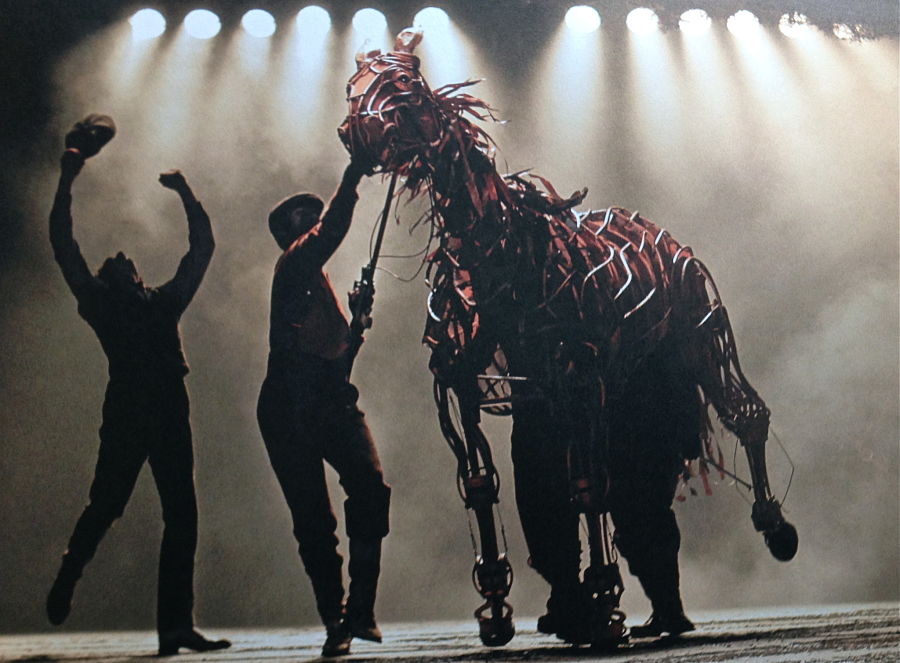
Sometimes haze is used to intentionally conceal stage business. Paule Constable’s use of haze in War Horse and Angels in America, or Neil Austin’s deft use of it Harry Potter, allows characters to slip in and out of the stage picture. The haze creates a “gauze,” as Youmans mentioned, allowing greater control of what the audience does and doesn’t see, thereby creating magic right before your eyes. If there is a more breathtaking moment onstage of seeing young Joey turn into an adult horse through a thin wall of atmosphere, I’ve yet to see it.

Haze can also be crucial in productions performed in a thrust space or in the round. As these shows often have little or no background, the “background” is sometimes just the audience on the other side. There is nothing worse than watching Desdemona pour her heart out while a guy on the other side of the theatre checks his text messages. The use of haze in these spaces creates a virtual backdrop. It puts a layer of light between the stage and the opposite audience and keeps your attention drawn to the stage. This can be seen in practice in the current production of Once on This Island (lit by Jules Fisher and Peggy Eisenhauer) or in the recent production of Fun Home (lit by Ben Stanton), both performed in the round at Circle in the Square.

As you can see, there are many uses for haze, and we spend tireless hours trying to dial in just the right amount. Keep in mind that this can be extremely difficult in theatres where the air temperature and current is impossible to replicate unless you have a full house of warm bodies. The use and amount of haze is thought out and considered. It may not seem that way from the other side of the footlights, but it’s a design tool to be wielded with great care, just like anything else.

An opinion piece about haze use peppered with some light humor and industry jokes would not normally merit a response of this length. But in the context of all the other ways our work is being marginalized, and all the ways we keep having to stand up for ourselves, it takes on greater significance when we are told how we are doing our jobs thoughtlessly. This article paints all lighting designers with a broad brush, making them seem lazy, ambivalent, and unoriginal in their use of haze, and even seems to suggest that we might be working against the performers and distracting from their work.

Lighting designers are by definition and practice collaborative artists. We cannot work on our own or in a vacuum; we are wholly dependent on bodies in a space before we can begin to work. We are there to assist and elevate the work onstage, and make sure the audience walks away with a night that will stay with them. In a time when the arts are being attacked by an administration that would rather see more troops than trumpets, we all need to stick together and lift each other up. I’m all for having a good laugh at the expense of podiatrists, professional curlers, or yacht owners, but the theatre community is a small and tight-knit group, and this article, however satirical its purpose, feels like it’s punching down on some of our own. Let’s save the criticism for the people and organizations interested in keeping us down and try to respect and support those in our own community a little more. If you want to create a better “atmosphere” onstage, that feels like a good place to start.

[Cory Pattak is a New York City-based lighting designer and host of the design-themed podcast “in 1.”

[The AT series on lighting and lighting design is just getting underway.  Please come back for the rest of the discussions, continuing on Tuesday, 30 October, with an examination of diversity in the field of lighting design.]

24 October 2018

“Light The Lights: A Focus On Lighting Design,” Articles 1 & 2


[The July/August 2018 issue of the Theatre Communications Group’s American Theatre (vol. 35, no. 6) contained three special articles spotlighting (if you will) lighting design in the theater.  On AT’s on-line site (https://www.americantheatre.org/category/special-section/light-the-lights-a-focus-on-lighting-design/), the forum was expanded to include five additional articles.  As part of my on-going interest in posting articles about theater professions and arts that many spectators (and even some pros) don’t know much about, I’ve collected the eight AT articles, covering diverse aspects of the art of lighting design, which I’ll post on Rick On Theater over the next few weeks.  First up are two pieces: one is a general introduction to the series and the second, a possibly unusual article for a discussion of lighting: “A Hazy Shade of Theatre: The Case for Clearer Design” by  William Youmans, a stage actor and singer, is about fog and haze on stage.]

Theatre is as much a visual as a verbal medium, and among the key perceptual guides not only to what we see but how we see it are theatrical lighting designers. Though it’s only been officially recognized as its own distinct profession since the 1940s, the manipulation of light and its properties has been an integral part of theatremaking since its beginning. This special issue looks at the latest developments in the craft and technology of illumination through the eyes of some of its leading practitioners.

WHAT SHINES THROUGH
by Rob Weinert-Kendt

To tell the story of theatrical lighting design, we need to get beyond adjectives and surfaces.

“Dusky.” “Stark.” “Versatile.”

These are some of the adjectives I’ve used most frequently to describe lighting design in my former (and still occasional) life as a theatre critic. Designers must know this drill all too well: Most stage reviews focus on the work of the playwright, with some reference to the lead performances and the work of the director, followed by a sprinkling of somewhat obligatory mentions of set, lighting, sound, and costumes. Typically the most these hard-working folks receive in a review, if they’re mentioned at all, is an adjective next to their name attempting to suggest the competence of their work (“deft,” “resourceful,” “fluid”) or to characterize its special qualities (“glaring,” “wintry,” “mottled,” “creepy,” “sepulchral”). In my partial defense, in my reviews I have very occasionally devoted whole sentences to the work of designers, and even used other parts of speech—verbs, nouns, adverbs—to capture what I think they’re doing. But I confess that I, like many of my critical colleagues, have mostly raided my thesaurus and imagination to come up with succinct one- or two-word summations of what I’ve seen. (Real talk: When it comes to lighting I apparently have food on the brain, as I’ve variously used such descriptors as “egg-dye,” “oven-baking,” “deliciously rich,” “marzipan,” and, getting right to the point, “edible.”)

Indeed, while lighting design is seen as so central to movies it’s called cinematography, the work of stage lighting designers may be the most imperceptible to the average theatregoer (and hence to professional theatregoers, a.k.a. critics). Sets and costumes are three-dimensional, often pictorial things, and sound design unmistakably greets our ears; even projection design, a cousin of sorts to lighting, is right there before our eyes. But lighting designers work on and over those palpable surfaces, directing our attention and framing how we see more than what we see. Their closest analogues in the film world, funnily enough, may be sound designers: You may not quite be able to point to their work—it seems like a simple sensory given, that there is light onstage and sound on film—but you’d certainly miss it if it were gone. Perhaps music is a better analogy: As the fin de siecle producer/playwright David Belasco, no slouch in the lighting department, once said, “Lights are to a drama what music is to the lyrics of a song…No other factor that enters into the production of a play is so effective in conveying its moods and feeling.”

Belasco’s heyday stretched from the 1880s through the 1920s, which means that he got in on the ground floor of a fundamental change in theatrical lighting: from gas to electric. The field now seems to be on the cusp of another huge transition, from incandescent to LED, as reporter Jerald Raymond Pierce details in a story in this issue. American Theatre doesn’t typically delve too deeply into stage tech, but for this issue on the theme of stage lighting, we found that to do the subject justice we had to go beyond talking about the art with such masters as Jules Fisher and Peggy Eisenhauer or such emerging talents as Know Theatre artistic director Andrew Hungerford. Like lighting designers, we felt the need to reckon with the how as much as the what, all the better to expand our vocabulary beyond mere adjectives. You might even say we’ve seen the light.

[Rob Weinert-Kendt is editor-in-chief of American Theatre.  He was the founding editor-in-chief of Back Stage West and writes about theater for the New York TimesTime Out New York, and the Los Angeles Times.  He studied film at USC and is a composer member of the BMI Lehman Engel Musical Theater Workshop.]

*  *  *  *
A HAZY SHADE OF THEATRE: THE CASE FOR CLEARER DESIGN
by William Youmans

Stage fog and haze are great tools for the right occasion. But must they be a default design element?

During a performance of Bright Star, the superb Broadway musical of two seasons past by Steve Martin and Edie Brickell, a cast member was momentarily engulfed by a cloud of fog. Stephen Bogardus, playing Daddy Cane, was “frog gigging” on the bank of a river in North Carolina, and all river banks are always completely covered in fog, as anyone who has ever been to one knows. It is a truth universally acknowledged that you cannot show a river in a play unless its banks are shrouded in fog; it just wouldn’t feel like a river. The fog gives the impression of dampness, a quality hard to convey on a dry stage—unless it’s covered with fog.

Bogardus completely disappeared for a few seconds, just like Isaac Hayes did on the Oscars that one time, earning him the nickname Isaac Haze. Eventually Stephen was able to dispel the fog with a few vigorous waves of his arms; we could see him again, and the play went on, after a few adroit improvised lines from Stephen’s voice within the cloud (“Who started the car?” and “Is the sausage burning?”).

Legends of stage fog vanishings are legion. One tale has it that after the fog cleared in Phantom of the Opera one night in the late 2000s, an actor completely disappeared, only to turn up the following week in a touring company of Jersey Boys. This is almost certainly exaggerated. (It didn’t add credibility to the tale that the allegedly apparating actor’s name was Rosco Fogg.)

Stephen Bogardus, at any rate, did not report any ill effects from his submersion. He was called on to roll over in the fog every night, breathing in quite a bit of the stuff, and so far has not reported any symptoms.

Stage “fog” is generally of two kinds: Let’s call them “fog” and “haze,” respectively. The fog that enswathed Stephen, and on which the cute angels can be seen sitting in in the current Broadway production of Carousel (sometimes it sits on them), is produced from a compound made by a German company called Look Solutions. It’s a mixture of water and triethylene glycol (a plasticizer used to make vinyl polymers, brake fluid, and air fresheners like Prestone; it’s also a disinfectant, a side benefit if an actor happens to have a sore throat). It may also contain propylene glycol, found in things like polystyrene, which is used to make styrofoam (and gives a nice kick to a mimosa). According to Wikipedia, the acute toxicity of these is very low, and large quantities must be ingested to cause “perceptible health damage in humans.” Imperceptible health damage is of course nothing that need concern us.

Haze, on the other hand, is made of “white mineral oil,” a highly refined petroleum-based substance. The haze which permeates every scene in Hamilton, and with it the entire Richard Rodgers Theatre, for example, was made by a Canadian firm, MDG Fog Company, “Generateurs de Brouillard,” according to Max Frankel, the show’s electrician. The spec sheets available on the company’s website, mdgfog.com, report that the Occupational Safety and Health Administration, (OSHA) does not consider the product hazardous (a “keep out of reach of children” triangle with a black exclamation point on the canister notwithstanding). No significant critical effects or hazards are known from inhalation, eye contact, skin contact, or ingestion, though I’m not sure I’d want this oil in my Dijon vinaigrette.

I’ve never met an actor who liked working in this gloomy pea soup; you don’t hear actors exclaiming, a la Robert Duvall in Apocalypse Now, “Ahh, I love the smell of theatrical haze in the morning!” It’s not pleasant, haze, though most of the time you don’t notice it. And since it appears not to be bad for you, no one complains. But bear in mind, “no known hazards” is not the same as “good for you.” You won’t see hospitals administering tanks of stage fog to the elderly.

I was a subject in a study of the effects of haze during the late 1990s, as a member of the cast of Titanic, the musical. The study examined our vocal cords before and after performances of that moderately hazy show, and several others, and found no signs of irritation worth mentioning.

So no, I will not be attacking the use of stage fog from the standpoint of health concerns in this piece. I, like the EPA under the current administration, wouldn’t have a leg to stand on. The fog of theatre is clearly not as deadly as the fog of war, although it might be used to depict it scenically.

Nor do audiences find fog hard to take, despite the occasional cough. When I was a stage manager for CSC Repertory’s 1974 production of Edward II, I forgot to turn off the smoke machine one matinee, and the audience and actors were forced to evacuate the theatre amid much coughing and gagging. But that was the old days, when powdered smoke was burned in a coiled ceramic heating device. This medieval procedure may have been effective for Edward, but whatever health risks were involved don’t apply to the modern methods.

No, as much as I dislike breathing the stuff, my objections here will not be medical, but aesthetic.

It has been quite a while now—maybe three decades?—that stage fog has been essential in every production with the budget to afford it. Lighting designers love it. It makes their beams of light cut lusciously through the atmosphere; it shows off their fancy vari-lites and computer controlled multiple beams, as they split, come together, and perform spectacular motions in the air. Dappled light from gobos shows up with great effect; candy-colored light beams can dance in the space above the stage, a dazzling display for the viewers.

So what’s the problem, if fog supposedly isn’t harmful, and it makes the stage pretty?  

Well, first of all, maybe it’s just because I’m an actor, but I always thought light was supposed to illuminate the thing being lit, not draw attention to itself. In a few productions I have found myself admiring the luminous beams, and missing for a few seconds something that was happening in the play. This is simply distraction, and as Shakespeare might say, it’s “villainous,” showing a “most pitiful ambition in the fool that uses it.” The designer is showing you their genius, but you are watching the air above the stage, not what is on the stage.

Distraction is one of the things directors have to worry about, and, to be honest, it is usually actors, myself not excepted, who perpetrate it. But I have never met a director who wasn’t at least a bit enthralled by gorgeous gestures of light, which are usually larger than any actor’s arms by several orders of magnitude.

Now, fog dissipates pretty rapidly. In Carousel’s wharf scene, the fog is so dense at the top that the scene might be mistaken for a musical of Backdraft, but it is mostly gone in time for Renée Fleming to sing her gorgeous rendition of “You’ll Never Walk Alone” without looking like she she just exhaled a drag of a Virginia Slim. But haze, which is used more often, is designed to hang around so that the lights will be equally dazzling in all the scenes. This is fine if your play has a single set. But since haze lingers longer, you can’t just have it in one scene for which it might be appropriate—a rest stop outside a power plant on the New Jersey Turnpike, say—and then clear it in time for another scene where it might not be, like on a desert plateau in New Mexico. No, with haze, every scene, regardless of location or atmosphere, is equally smoky.

And smoky is the right word. A glance at the beams shows the mineral oil, in haze form, swirling around in the light, like the smoke from Edward R. Murrow’s cigarette in Good Night, and Good Luck. A gesture within a gesture, you might say.

This in turn creates a gauze effect. At times a gauze drop is brought in downstage in a proscenium theatre, as something to project images or printed information onto. The action of the play is still visible behind the drop, but there is looking-through-a-veil effect, as if there were greater distance between the actors and the audience, like blurry memory scenes in movies. With theatrical haze, you get a kind of constant virtual gauze. And since the density increases with distance, the farther you sit from the stage, the more blurry everything becomes.

To be sure, this is sometimes desirable. But what if it’s not? What if you want to minimize, not increase the sense of distance from the action? You may have a fight with your lighting designer on your hands.

Finally, there’s just the truth that stage fog is already passé. It has been for decades. It’s just so…’80s. It’s so Les Miz. So Cats. Someday soon a lighting designer is going to light a show without using it at all, and it will be like a revelation. Critics will rave: “The crystalline clarity of the production is as refreshing as a dry martini.” “There was such definition in every moment!” Audiences will cheer: “I could see the actor’s faces, from the back row!”  “I didn’t cough once!”

Come on, lighting designers and directors. I dare you to break the mold. It’ll make your name. You can always go back to it, if you’re doing a play about the Battle of Gettysburg; you can smear cannon smoke all over the Winter Garden Theatre. But if you’re doing, oh, I don’t know, a revival of On A Clear Day You Can See Forever, maybe try showing an actual clear day? The actors will sing your praises, for what that’s worth.

Really, we will. If we wanted to work in smoke, we’d have joined Ladder Company 54, the Broadway district fire department. As it says on the engine, they’ve never missed a show.

*  *  *  *
Since it was posted, the preceding piece inspired a lot of feedback, to put it mildly, reported AT’s editors, not only in the comments section but on social media. They decided to publish a response, which you can read in the next post. Below are some of the comments submitted to the website:

KJ Hardy • 4 months ago
Next week William Youman[s] covers the controversial subject of Tap dancing, and why decibel levels from the shoe’s can be dangerous! What is the OSHA rating of a Kick, Ball, Change? "But bear in mind, “no known hazards of Charleston” is not the same as “good for you.

Kate McGee • 4 months ago
I think we all need to have a hater party every now and again (preferably at the bar :P). It's just like, dang bro, did you really need to write this in a major trade publication? Is the industry better because you used your considerable platform to air (ha!) a pet peeve?

Aaron Copp • 4 months ago
Haze is a tool of the theater, like any other. Done right, in the right place, it's awesome; done badly, it's egregious - like jazz hands, or vibrato. I think the author is engaging in a bit of hyperbole - in reality there are shows with and without it, and while it might be a default choice for a certain style of Broadway musical, it's not the default choice for most other shows. Having been at the table for plenty of these discussions, I can assure you that it's not something lighting designers do unilaterally or take lightly. It's a design choice that is made like any other stylistic choice - in collaboration with the team, for good reasons. Frankly, it's often directors who ask for it, and they're not wrong to do so. I just wish there could be a little less snark directed towards designers who are often being underpaid and under-recognized for their efforts, and who frequently are uncredited in press releases and reviews, including by this magazine.
Aaron Copp - Lighting Designer, NYC

mplsbrat • 4 months ago
This article is incredibly uninformed about the use of fog and haze, and insulting to the entire field of lighting design. It's not true that "every production with the budget to afford it" uses fog or haze. And to describe that "Lighting designers love it" is to accumulate them all into one homogeneous body. Which they are not.

The self aggrandizing tone of "In All My Years In The Theater..." is undercut by what is clearly a lack of actual knowledge. This article has a citation from Wikipedia, a crowd sourced and notoriously unreliable source of any information, let alone health information. Publishing this is article is absurd.

[William Youmans is best known for originating the roles of John Jacob Astor in Titanic: The Musical (1997-99), and Doctor Dillamond in Wicked (2003-present).

[There are six more articles in this series.  Please come back to ROT on Saturday, 27 October, for the next installment, a response to Youmans’s column.]