Showing posts with label vaudeville. Show all posts

29 December 2024

Go-Won-Go Mohawk (1859-1924), Part 3


GO-WON-GO MOHAWK: SUPPLEMENTAL BIOGRAPHY
(Continued) 

[This is the conclusion of my supplemental biography of Go-won-go Mohawk, the Native American actress and playwright.  Readers who haven’t read Part 2, posted on Rick On Theater on 26 December, should go back before reading Part 3 below, as this is a continuation of my biographical sketch of Mohawk and it will be hard to follow if you start in the middle.

[The supplemental bio follows on the New York Times‘ obituary, part of the paper’s “Overlooked” series.  It’s posted as Part 1 of this series on 23 December.  Parts 2 and 3 are my attempt to fill in the missing details of the Times’ belated obit.

[Part 3 covers the later period of Mohawk’s life, including her most important performances: Wep-ton-no-mah: The Indian Mail Carrier, which she wrote for herself, and The Flaming Arrow, which playwright Lincoln J. Carter wrote for her.]

Go-won-go Mohawk wrote her first play, with contributions from her husband and manager, Charles W. Charles, soon after arriving in New York City in 1888.  This was Wep-ton-no-mah: The Indian Mail Carrier, Mohawk’s best-known work.  The Native American actress—and now dramatist—kept the play on stages around the world from 1889 to about 1910 playing the title role until she was over 50—3,000 times by her own count.

The play begins on the ranch of Colonel Stockton (played by Charles), with a gathering of his servants; his young daughter, Nellie; his cowardly, gambling-debt-ridden nephew, Captain Franklin; and Franklin’s Mexican partner-in-crime, Spanish Joe, who, along with cowboys and Indians, come to round up Stockton’s cattle.  

The cattle begin to stampede and a young Indian man, Wep-ton-no-mah (Mohawk), gallops onto the stage on horseback and rescues Nellie.  The colonel rewards him with the position of Pony Express mail carrier to the fort.  In the West, both in reality and in fictional portrayal, the Pony Express rider was a figure of stature among the settlers on the vast spaces of the frontier who relied on him for personal and commercial communication and news.  Wep-ton-no-mah would receive substantial income unavailable to other indigenous people in the 19th century.

Next, Wep-ton-no-mah prevents Spanish Joe, who’s obsessed with Nellie, from kidnapping her—a scheme tied to Franklin’s forgery to cover his gambling losses—by beating him in a fistfight.  In revenge, Spanish Joe shoots at a figure he mistakes for Wep-ton-no-mah, but who turns out to be the young Indian’s father, Chief Ga-ne-gua (frequently played by an actual Seneca chief; this character was given the Native name of Mohawk’s father [see Parts 1 and 2]).

The rest of the plot is essentially a revenge narrative, as Wep-ton-no-mah, while heroically saving the mail from attack, tracks down Spanish Joe, ultimately defeating him in what the press called “a dreadfully realistic knife fight” (“Empire Theatre,” Pittsburgh Dispatch 25 January 1910).  Along the way, stock melodrama elements—disguise, ethnic (often racist) humor, visual spectacle (including thunder, lightning, and the special “red fire” effect typical of 19th-century frontier melodrama)—are staged.

(“Red fire” refers to a pyrotechnic stage effect that creates a striking red flame, often used to simulate fire on stage in scenes with highly dramatic elements.  It’s essentially a colored flame produced by a specific chemical mixture that burns with a red glow.  Using red fire on stage, however, even if it's meant to appear as a visual effect, is considered a fire hazard.)

Although Charles is acknowledged as a co-author of The Indian Mail Carrier, the U.S. copyrights are solely in Mohawk’s name.  This was highly unusual for a woman at that time, and even more so for an indigenous woman. 

Publicity for the show also stressed that Mohawk had written the play on her own.  Charles was largely credited with the comedy in the play, which, by all accounts, was the period standard of racial (and racist) caricatures and language and slapstick gags and pratfalls.

In addition to being the playwright and lead actor in the play, Mohawk was also the costume and scenic designer—some of whose creations were quite elaborate.  Furthermore, she had a large degree of creative and managerial control over the production, another unusual achievement for an indigenous artist of that time.

Mohawk and Charles quickly started assembling a theatrical troupe under her name.  The first production of The Indian Mail Carrier was on 4-9 February 1889 at H. R. Jacob’s Lyceum Theatre in Brooklyn (according to Odell’s Annals of the New York Stage, vol. 14: 195).

As much as the summary of The Indian Mail Carrier sounds like standard late-19th-century American melodrama, there are significant differences.  First, during the round-up in the first scene, Indians are shown working alongside white cowboys. The publicity asserts that the indigenous cowhands are “played by genuine Indians”; in The Buffalo [New York] Enquirer of 18 January 1898, the producer pledges that “Miss Go-Won-Go-Mohawk claims to be the only Indian actress on the stage,” but who really knows. 

It is accepted, though, that Mohawk employed members of her immediate family and some performers from the Cattaraugus Reservation in her entertainment troupes.  The actor who played Ga-ne-gua, for instance, Wep-ton-no-mah’s father, was often identified as an Onondaga Indian (a people whose historical homeland is in and around present-day Onondaga County, New York; pronounced on-un-DAH-guh).

Of course, the main difference of The Indian Mail Carrier with the standard 19th-century melodramatic fare on American stages is Go-won-go Mohawk herself, playing the male lead.  In “From Wigwam to Stage,” Alice W. Eyre (see Part 2) described her:

Physically, Miss Mohawk is well-nigh perfect inasmuch as she meets . . . all the requirements of the high standard of physical excellence demanded by art.  She’s very tall, her carriage is graceful, and added to this is a quiet dignity of manner.

In her dissertation, Michelle S. A. McGeough pointed out some of the principal differences between Mohawk’s The Indian Mail Carrier, and the contemporaneous border plays of white dramatists. 

The five-act play is a musical drama of deception, murder, and greed of epic proportions.  In all instances, Go-won-go’s narrative offers the audience a very different view of Indigenous people in comparison to that of her contemporary playwrights.  Go-won-go revealed her motivation for writing the plot of Wep-ton-no-mah in an interview where she said that her work was the desire, “above all things to prove the native Indian is capable of the highest civilization” ([Roger A.] Hall[, Performing the American Frontier, 1870-1906 (Cambridge UP, 2001),] 159).  Although Go-won-go’s desire to use the theater to prove that the Native American was capable of the highest civilization, that same desire did not extend to other minorities.  Her depictions of Mexicans and Afro-Americans in the characters of Spanish Joe and Sam, the help, rely heavily on racialized stereotypes.  Spanish Joe is seen as the villain in both his greed and the licentious pursuit of the virginal Nellie, and he pays for his miscreant behavior with this life.  Franklin, the Colonel’s nephew, on the other hand, whose money troubles lead him to enter a criminal partnership with the villain, is forgiven for his errant ways by the end of the play (“The Indigenous Sovereign Body: Gender, Sexuality and Performance,” Ph.D dissertation, University of New Mexico, 2017, pp. 91-92; Hall is a professor of theater at James Madison University in Harrisonburg, Virginia).

The play toured the United States and Canada, and between 1892 and 1897, Mohawk toured the United Kingdom and Europe with her company, performing The Indian Mail Carrier to large and enthusiastic audiences engrossed by the myth of the American “wild west.”  She was so popular in Britain that in 1903, she returned for another tour there that stretched into 1908.

When Mohawk returned to the U.S., she continued to tour and performed to full houses all across the country.  The Baltimore Sun reported on 3 December 1889, for instance, that the show “attracted large audiences yesterday and . . . promises to fill the house all the week.”  “‘The Indian Mail Carrier’ . . .,” recounted the 13 January 1891 Philadelphia Inquirer, “opened before large audiences, who thoroughly enjoyed the excellent acting done by the star and her carefully selected company.”

Between her two tours of Great Britain and Europe, Mohawk took on her second-best-known play, The Flaming Arrow.  On 24 April 1900, the Detroit Free Press announced:

Lincoln J. Carter has signed to write a play for Go-Won-Go-Mohawk [sic].  It will be a new Indian play, which he will bring out next season with an Indian band and a herd of bronchos [sic] to give it local color (“The Stage: Hit or Miss,” p. 4).

Mohawk played the lead role in Flaming Arrow, an Indian man named White Eagle.  The play premièred in Chicago at the Criterion Theatre on 26 August 1900; it moved to New York City for an opening on 17 December 1900 at the Star Theatre, on Broadway at East 13th Street, south of Union Square, which was the city’s theater district at the time.  Mohawk toured the show around the country for three years.

The play was frequently labeled “the stirring drama of western life” and one account went on that it

relates the love of [Mary,] a daughter of a colonel [Colonel Fremont—played by Mohawk’s husband, Charlie Charles] of the United States Army, commanding a western post [Fort Reno, Oklahoma, an actual cavalry post until 1908] for a young Indian, “White Eagle” [the role played through about 1903 by Mohawk], and the machinations of two villains [a “treacherous” former army officer who’s a deserter in league with a Mexican] which furnish the motives of the action.  The villain inflames several braves to make war on the decimated forces at the fort and in the attending excitement abduct the commander’s daughter.  The daughter, after a series of hair-raising adventures, is rescued by her Indian lover and justice is dealt out to the villains in true western style.  The cast is a large one and contains the names of many prominent people.  A tribe of full-blooded Indians are also carried.  The scenery is said to be especially elaborate, many of the scenes being taken from real life (“A Story of an Army Romance: The ‘Flaming Arrow’ is an Interesting Drama,” Decatur Daily Democrat [Decatur, Indiana], 29 October 1907: 1).

In another comparison with the prevailing content and presentation of border melodramas in this era in the United States, a Norfolk, Virginia, reviewer of The Flaming Arrow asserted:

A decided novelty in the way of melodrama will be the offering of the Academy tomorrow night, when Lincoln J. Carter will present “The Flaming Arrow.”  The name of the play is significant of blood and thunder in a superlative degree, and the fact that it is produced by a company composed largely of real live Indians naturally strengthens the impression.  But by the time the curtain descends on the last act the audience begins to realize that there isn’t much in a name after all, and that Indians under certain circumstances can present another phase of character other than that usually depicted in a dime novel.  The show is clean and wholesome, well staged and has some of the best scenic effects Mr. Carter has as yet turned out (“About Plays and Players: ‘Flaming Arrow’ Tomorrow,” Norfolk Dispatch [Norfolk, Virginia] 28 December 1904: 3).

(Readers will note that this notice was of a later performance of the play, after Mohawk was no longer leading the cast.  I contend, nevertheless, that as Flaming Arrow was composed for and at the behest of the Native American actress, and the reviewer’s remarks are about the script and not the performances, it’s still a valid comment on Mohawk’s intentions for the play’s content.)

The Flaming Arrow toured widely (with and without Mohawk) for 11 seasons from the fall of 1900 to the fall of 1911.  The play should not be confused with the 1913 film of the same title (but with a significantly different plot), also written and directed by Carter (1865-1926), a director, designer, writer, and lyricist, who, during the late 19th and early 20th centuries, authored scores of popular melodramas.  A master of the genre, Carter used many novel visual effects to add realism to the situations in his plays.  His realistic staging of such dramatic events as train- and shipwrecks were only surpassed by the advent of motion pictures.

But Mohawk’s time with melodrama was coming to an end.  She took The Indian Mail Carrier to Britain again in 1903 and when she returned to the U.S. in 1908, she was almost 50, a little old to be playing the young hero.  Furthermore, the growing popularity of movies in the middle of the decade was beginning to outdraw stage melodrama, which couldn’t compete with its technological thrills and magical film spectacle.

It was also easier to perform in a movie than to put up with the hard life of a stage actor, especially at the lower end of the accommodation and workspace—not to mention the often two-a-day performances and the traveling from small town to far-flung city every few days for months at a time and even years.  And that’s not even considering the remuneration for a movie versus a play.

It was also less likely for a movie cast and crew to be stranded in some remote place after the production company goes broke or sneaks out of town in the dead of night, a circumstance, as we saw the Michael Strogoff company suffer in 1889 (see Part 2), and which happened not infrequently.  (It was one of the principal motivations for the formation of Actors’ Equity Association in 1913; see “Actors’ Equity at 100: Part One,” 19 June 2013.)

So, Mohawk shifted to vaudeville and then film, although vaudeville was on a downward track as well.  Movies were taking a bite out of variety, too, as many of the stars shifted over to film: Charlie Chaplin, Buster Keaton, Al Jolson, Fanny Brice, W. C. Fields, The Marx Brothers, Mae West. 

(When talkies came along in 1926, that really sounded vaudeville’s death knell (pun semi-intended).  Ironically in a way, television sort of resuscitated it with the advent of the sitcom and, most of all, the variety show.  Many of the big stars of TV shows in the early days of the 1950s and ’60s—George Burns and Gracie Allen, Jack Benny, Sid Caesar, Kate Smith, Milton Berle, Rose Marie, The Three Stooges—were all alumni of vaudeville.)

Little is known of the film version of Wep-Ton-No-Mah, the Indian Mail Carrier except that it was released in 1909 by the Carson Film Company as a silent, black-and-white one-reeler.  (That would only have been about 15 minutes of film.  I don’t even know if a print of it is still extant.  Apparently, what is known comes from contemporary cinema magazines such as Moving Picture World, and theatrical trade newspapers like the New York Dramatic Mirror.) 

I mentioned above in passing that The Flaming Arrow was also produced as a two-reel movie (around 24 minutes long at most) in 1913, and Go-won-go Mohawk was featured.

Mohawk went on writing plays after returning from England.  In 1909, she copyrighted An Indian Romance: A Forest Tragedy, a one-act drama.  There’s no evidence that it was ever staged, but Christine Bold posits, “By length, economy of setting, compression of plot, deployment of conventional tropes, and stagecraft (working the curtain to allow another act to set up in the space behind) it clearly is a vaudeville playlet or afterpiece” (Christine Bold, Vaudeville Indians” on Global Circuits, 1880s-1930s [Yale University Press, 2022], 103).  She describes the play:

An Indian Romance is a fascinating work that converts the concentrated tempo of vaudeville specialties, in which Mohawk was already adept, into narrative form.  Mohawk compacts spectacular action and formulaic plotlines familiar from dime novels, including the ones in which her namesake featured, into one “thickly wooded lot” between a wigwam, a hut, and a tree stump.  Trick riding (one rider on two horses and two riders on one horse), two murders, and a climactic knife fight punctuate the strands of English aristocratic romance, Prussian-sounding skullduggery, and revelation and restitution of the Englishman’s inheritance by letter.  Like the script of Wep-Ton-No-Mah, this playlet interweaves comic blackface dialogue and stage Injun speech, again moving in and out of both in ways that remind the reader that these are prerequisite conventions of the period.  Among the sensations, caricatures, and sentimentality, the playlet makes two statements that would be far from conventional on the vaudeville stage—especially from the pen, mouth, and bodily presence of an Indigenous actor.   One concerned the perceived value of an Indigenous woman’s life, the other enacted a direct riposte to the dime-novel industry’s appropriation and containment of Go-won-go.

At the center of An Indian Romance are two love stories that double the sentimentality and cross Indigenous-settler lines in two directions.  The romance concerns a white brother and sister, Anthony and Lena, unjustly exiled from their English home, and an Indigenous brother and sister native to these woods—the two pairs constituting two heterosexual, cross-race couples.  For the Indigenous brother and sister, Mohawk reprised her role as Wep-ton-no-mah, for whom she created a female twin, Mi-ra-no-mah, and played both parts herself.  Never seen on stage at the same time, the twins ride on and off on Mohawk’s trained ponies, demonstrating equestrian skills while advancing the plot.  Mi-ra-no-mah ends up carrying the letters that prove her English lover’s innocence and restore his inheritance; when she refuses to surrender them to the villainous Karl Kovoloff, who initiated and stands to profit from the lie, he kills her off stage.  At that point, Wep-ton-no-mah gallops on stage in a panic, searching for Mi-ra-no-mah, and confronts Anthony, her white lover, about his missing sister . . . .

The play ends with Mi-ra-no-mah’s coffin centered on the stage, the white heroine reaching out her arms to her Indian lover.  As with the ending of Wep-Ton-No-Mah and The Flaming Arrow, the Indian hero leaves that romance unresolved—indeed, almost beside the point.  Wep-ton-no-mah leads his horse off into the sunset, the male character and his creator reunited bodily, the Indian princess deployed by the dime novel to straighten out Go-won-go killed off.  The centuries-old trope of the sacrificial Indian maiden, when read within Go-won-go Mohawk’s performance history, is here used against itself, Mohawk once more clearing and riding into vaudeville space as her own kind of Indian (103-05).

Not much is recorded of Go-won-go Mohawk’s last years.  Performance reports peter out around 1910 or so, soon after she returned to the U.S. from England in 1908; she’s reported to have become retired by 1917 (“Indian Chief Makes Patriotic Address,” Evening Record and Bergen County Herald [Hackensack, NJ] 6 June 1917: 1).  Seven years later, we know her health had deteriorated, but whether that had started as early as the second decade of the 20th century is uncertain.

Other reports indicate that Go-Won-Go continued to tour and perform until her health failed in 1924.  She owned a large home in the Borough of Edgewater, New Jersey, at the foot of the Palisades in Bergen County, across the Hudson River 14 miles north of New York City.  She kept her two white stallions at the Mohawk Wigwam, as Mohawk and Charles had named their house.  They had lived there for over 27 years when she died in her home, following a series of “strokes of apoplexy,” on 7 February 1924 at the age of 64. 

Mohawk was laid to rest on 10 February in “a solemn and beautiful” ceremony, described by Wilhelm Benignus in the Altoona [Pennsylvania] Tribune of 20 March 1924 (“‘Go-Won-Go Mohawk,’ American-Indian Princess,” pp. 6, 11), at Edgewater Cemetery, where the remains of heroes from the Revolutionary War (1775-83) through the Spanish-American War (1898) from the local area are also buried.

Fifteen years later, Mohawk, “the last Indian in Edgewater,” was remembered as

a familiar sight along River Road where she was wont to ride a strapping gracefully proportioned white horse.  She is often recalled by old residents of the Borough who relate that she was a woman of striking personality and philanthropic character (“Water Supply Paces County Growth: Our River Front Grew As Indians Boosted Trade,” Bergen Evening Record [Hackensack, NJ] 29 Sept. 1939: 33).

Go-won-go Mohawk was one of the first Indian actresses on Broadway—possibly the first—though not in one of her own plays.  It wouldn’t be until 2023 that the first woman Native writer would have a play on Broadway: Larissa FastHorse (Sicangu Lakota Nation) with The Thanksgiving Play.  It's mentioned in “‘Superheroes on Native Land,' Part I,” 21 January 2024.

*  *  *  *
One further comment—of an entirely personal and irrelevant nature: In his opening remarks to a post concerning his family history, my friend Kirk Woodward wrote:

It’s hard for us . . . to realize how recently life in the United States was vastly more primitive and basic. . . .  Two generations between ourselves and the War Between the States – and one more long lifetime would reach all the way back to the Revolutionary War!  And both those events seem buried in the mists of history (“A Lawyer and a Life,” 11 November 2010).

I thought about that statement when I noticed the relation of Go-won-go Mohawk’s death to the birth dates of my parents.  When she died on 7 February 1924, my mother was 10 months old already and Dad was 5-years-and-3-months old.  Not old enough to have seen her on stage, but still, in their lifetimes.  We’re not talking about my grandparents or great-grandparents—this is just one generation back from me.  It doesn’t mean a thing, really, but it astounded me when I noticed that Mohawk lived into the lifetimes of both my parents.

[This project kept expanding because, as I read more about Mohawk, especially about her work, I came upon elements that aren’t well known today, or, in some cases, not known at all—especially outside the theater world.  The piece became partly a disquisition on the theater of the late 19th century (melodrama, vaudeville) and, even more so, on the Native American adaptation of American performance tropes (“vaudeville Indians,” Indian bands).

[Another aspect of the post that took extra time was the details of Mohawk’s non-theater life.  The salient aspects of her life—marriages, homes, schooling—were covered at least as to the bare facts, but other specifics were either unrecorded—but I still searched until I was sure the record didn’t exist—or were buried in sites/articles/reports that weren't readily accessible.

[All this was further complicated by the fact, as I mention in the post, that Mohawk's native first name is written several different ways, which significantly affects computer searches, especially in newspaper databases.  

[Even after posting, I continued to do some searching for missing or "fudged" information along the way.  Mostly life dates (i.e., James Rider, Mohawk’s first husband; Lydia Hale Mohawk Killey, Mohawk’s mother) and other bio bits from that period, which are hard or impossible to find or confirm.

[Among the details I still haven’t located are two plays in which Mohawk appeared that I couldn't identify fully.  One is Michael Strogoff; the other’s called The Outcast.  It starred Louise Pomeroy, Mohawk’s sister-in-law, and was Mohawk’s first theater job.  It was based on a French novel by Edmond About, and I even found some newspaper announcements and reviews that confirmed the title and a New York theater where it played.  But I have not found the novel from which it was adapted.

[Nowhere is the French title of The Outcast noted, either as the play or a translation of the novel.  Oddly, About wrote a novel called L'Infâme, which means 'the infamous [one],' a likely title to be translated as The Outcast—except that the synopsis of the novel's plot is not the same as the plot of the play!  The characters’ names are also completely different, too.  (The novel is translated, but uses the French title for the English version.  Go know!)

[One of the “fudged” details has to do with East Lynne, a popular melodrama to which Mohawk refers in a quotation (see Part 2).  The actress used the play as an example, and I searched to see if there’s any record of her having done that show.  There wasn’t, so I surmised that she’d simply seen it, because it was such a popular property.

[I subsequently found that East Lynne was frequently playing at a theater in the same town where Mohawk was doing either The Indian Mail Carrier or The Flaming Arrow, and at the same time.  I decided that may be why she used it as a talking point: not only had she probably seen it, but it seemed often to be on stage somewhere near her.

[But then, when I was using a search of Pomeroy to see if I could find more details about The Outcast—Part 2 was already posted—I came upon two seemingly irrelevant pieces of information about Pomeroy’s career.  Until, that is, I considered them from a different perspective.

[First, Pomeroy did East Lynne, probably more than once.  I don't know when—whether it was while Mohawk was associated with her, for instance—or in what part.  (She was usually a lead actress, so she probably played Isabel Vane.)  So, it's possible that Mohawk not only saw East Lynne, but saw it with her sister-in-law in the production, giving her an even stronger reason to cite it as an example.

[I also found that Pomeroy was well known for having (creditably) played Hamlet, one of few women to have done so.  (Sarah Bernhardt [1844-1923] was famously among them, in 1899.)  I wondered if that could have given Mohawk the idea to play men's parts in her own plays, or convinced her that it was a viable idea?  She just took it to another level than Pomeroy. 

[I decided to insert those two little factoids, and my speculations, into Part 2, even though it’s already published.]


26 December 2024

Go-Won-Go Mohawk (1859-1924), Part 2


[Go-won-go Mohawk’s life and career were so interesting that I couldn’t even sketch them in in a single post.  I’ve therefore split my attempt to fill in some of the gaps in the New York Times obituary that constitutes Part 1 of this short series (posted on 23 December) into two installments.

[“Go-Won-Go Mohawk (1859-1924), Part 2” takes readers up to the composition of her first play, Wep-ton-no-mah: The Indian Mail Carrier.  Part 3 picks up at that point and brings ROTters to Mohawk’s retirement and death.  As Michelle S. A. McGeough, professor of art history, observes, after Mohawk’s death, she “faded from the public’s memory and consequently very little has been written about her”—until quite recently.  (McGeough’s dissertation was submitted in 2017 and Christine Bold’s “Vaudeville Indians” was issued in 2022.)]

GO-WON-GO MOHAWK: SUPPLEMENTAL BIOGRAPHY

The New York Times and I have already explained (see Part 1) that Go-won-go Mohawk went by different names at different times and under different circumstances, depending as well on the publication in which her name appeared.  The Times explained about the three variations of her English name: Carolina, Carrie, and Carolina (or Caroline) A.  I added that along with Go-won-go, her native name was often also written as Go-Won-Go and Gowongo.  I have also found documents in which the name was spelled Go-wan-go (with an a in the middle). 

It’s not even certain under which name Mohawk was born—though most accounts say that she didn’t use her indigenous name, which she said means “I fear no one” in the Seneca language, until later in her life when she began writing and performing her own plays in the 1880s.  Several sources indicate that Mohawk was called Carolina while she lived in Greene, New York (1860/61-1870/71).

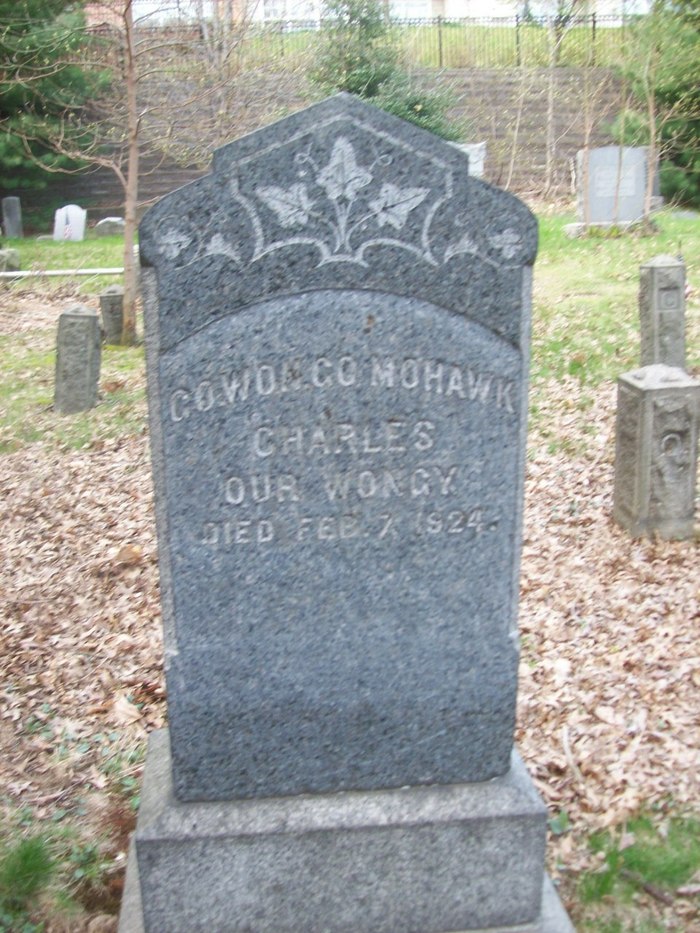
The obituary in Part 1 gives the date of Mohawk’s birth as 11 August 1859, but numerous other sources, including the Library of Congress, give the year as 1860.  (Oddly, her gravestone is inscribed with the date of her death, but not her date of birth.)  The problem with this, aside from merely the accuracy of her date of birth and her age at the time of any given event, is that all dating information that follows from that is ambiguous. 

One case in point relates to the historical marker that designates the house in Greene, New York, as a former residence of the Mohawk family.  I found two sources that recorded that the Mohawk family moved there when Go-won-go was one year old.  It goes on to say that she left with her mother after her father’s sudden death at 46 in 1869, adding that Go-won-go Mohawk lived in Greene for eight years.

But that would only be so if she was born in 1860 and had moved to Greene in 1861.  If she was born in 1859 and moved in 1860, she’d have lived in Greene for nine years.  (The date of Allen Mohawk’s death is not in dispute.  Furthermore, almost all sources say that Lydia Mohawk left Greene with Go-won-go a year after her husband died, making it 1870, 10 or 11 years after the family moved to Greene.)

(I’ll be going by the date the Times uses; another source I found that uses 1859 as her birth year is Wikipedia—but that’s hardly conclusive since it gives the Times obit as the source of this datum.  Wikipedia does note that “Records vary on exact birthdate.”)

The place of birth for Mohawk is also unclear, but the consequences are much less pervasive.  As the obituary makes clear, some sources say she was born in the small town of Gowanda, New York, while others say she was born on the Cattaraugus Reservation. 

This is only a small issue, depending on how much store one puts on whether Mohawk was born in an American town or in an indigenous community within the Seneca Nation.  The fact is that the reservation is mostly rural and Gowanda is a town practically on its southeastern border. 

In any case, as I’ve noted, the Mohawks moved to Greene, 330 miles east of Gowanda, by the time Go-won-go was one year old.  Go-won-go Mohawk’s father, Allen (or Alan) Mohawk—also known as Ga-ne-gua (“Brave Man” in Seneca)—was an herb doctor and a well-regarded member of the community. 

(The marker in front of the Mohawks’ South Chenango Street house refers to Go-won-go as an “Indian princess,” an appellation she often used in publicity for her performances and appearances.  It was common at the time to use the title “princess” for female Indian performers, although Native Americans had no such concept.  Presumably, this comes from her father’s status as a chief of the Seneca Nation.)

A year after Allen Mohawk died, Lydia Hale Mohawk moved with her 11-year-old daughter to Painesville, Ohio, where she was from, and where she had family.  She married widowed blacksmith Robert Killey (1826-90), a non-Indian, in 1873, and gave birth to a son, William (“Will”) Henry Killey, the next year.  Sadly, Go-won-go’s mother, too, died in 1875, when Mohawk was about 15.

At her mother’s death, Mohawk was named the sole heir of Lydia Killey’s estate; her mother left nothing to Will or her husband.  The inheritance may have allowed Mohawk to enroll in Lake Erie Female Seminary in Painesville (which became Lake Erie College in 1908), a religious boarding school which she didn’t like.

In Greene, Mohawk had felt like an outsider at her school, presumably a regular public school where she was likely the only Indian student.  She dressed Indian style, she said, wearing moccasins and clad in a blanket.  At recess, she recounted, she stood alone while the other children played.  They sometimes asked her about her Indian life—based on the stories and myths about indigenous Americans told in newspapers and dime novels, and displayed in the popular wild west shows.

“When I think of those American children, the English ideas of Indians don’t seem so funny after all,” she said bitterly.  When she got to Paineville, she rejected institutional discipline and resisted enforced assimilation, wore her hair over her eyes, and eschewed hats.  The interviewer who elicited these recollections remarked that “she must have been anything but an elegant member of a young ladies’ seminary” (Christine Bold, “Vaudeville Indians” on Global Circuits, 1880s-1930s [Yale University Press, 2022], 80).

(According to Wikipedia, citing two 19th-century newspaper articles, Mohawk later attended university.  That’s the only source I saw that stated she went to “the University of Ohio,” but no such school exists, and I couldn’t find any reference to a school in the 19th century that used that name. 

(There’s no telling how far off the references are, but there are only two similarly named universities in Ohio: Ohio State University, founded in 1870 in Columbus, the state capital, and Ohio University, chartered in 1787 in Athens.  I couldn’t establish any connection between Mohawk and either school.  Miami University in Oxford, Ohio, the other large state school in Ohio, while it opened in 1824, was closed between 1873 and 1885, covering the period when Go-won-go Mohawk would most likely have been a college student.

(I can only surmise, but it’s possible that the reference to Mohawk’s having gone to college might be a reference to Lake Erie Seminary, which “offered an advanced curriculum that was more extensive than high school,” according to Michelle S.A. McGeough.  Her 2017 University of New Mexico PhD dissertation, “The Indigenous Sovereign Body: Gender, Sexuality and Performance” quotes a description of the seminary’s curriculum [p. 80] and describes other aspects of the school’s program.)

In 1879, when she was 19, Mohawk married Civil War Veteran James E. Rider (or Ryder) who was in his early 30’s.  She married under the name of Carrie A. Mohawk.  The marriage didn’t last long as her husband was abusive and Mohawk left him.  Rider, however, was the brother of well-known actress Louise Pomeroy (née Ryder; c. 1853-93).

Mohawk began her acting career in 1883, when her sister-in-law was the first person to cast her in a small role in a play.  (The play was reported as The Outcast, an adaptation from a French novel by Edmond About [1825-85].  It played at New York’s Fourteenth Street Theatre—on West 14th Street, west of 6th Avenue—in December 1884, but I wasn’t able to identify it any further since neither the novel nor the stage adaptation seems to be listed anywhere.)  Mohawk also worked at the Windsor Theatre at 43 Bowery in New York on the Lower East Side of Manhattan, but I couldn’t discover what play(s) she did there, or when.

Over the next six years, Mohawk played various female roles in many European and American melodramas and comedies in cities such as New York and Philadelphia.  She was displeased with the parts in which she was cast, observing dismissively, “Indian parts?  No, indeed: roles of great ladies and suffering heroines, such as Isabel in ‘East Lynne’ and adventuresses in melodrama—adventuresses must be dark, you know” (Bold, p. 81).

(Melodrama is a form of drama that emphasizes emotion and heightens plot or action, stressing romantic sentiment and agonizing situations at the expense of characterization.  Its plots don’t follow the principle of cause and effect.  The characters are flat archetypes, usually of exaggerated disposition: evil villain, innocent victim, stalwart hero/savior; there are no such figures as antiheroes or conflicted bad guys.  Suggestive musical accompaniment often underscores scenes which are especially thrilling or pathetic.  It was arguably the most popular type of play in the Victorian era.)

(East Lynne, in Mohawk’s reference, is one of the many—at least nine—stage adaptations of the 1861 “sensation” novel by Ellen Wood [English; 1814-87], under the pen name Mrs. Henry Wood.  “Isabel” is the central character of the story, Isabel Vane, who’s beleaguered by many misfortunes and tragedies. 

(Considered the archetype of the Victorian melodrama, the most successful version was Clifton W. Tayleur’s [American actor and dramatist; 1831-91] adaptation of 1862; another popular version was the 1866 dramatization of John Oxenford [English; 1812-77].

(It was a much-disparaged—for its elaborate and implausible plot—but immensely popular melodrama of which one theater manager who produced it many times quipped: “No other play in its time has ever been more maligned, more burlesqued, more ridiculed, or consistently made more money” [Denis Meikle, Mr Murder: The Life and Times of Tod Slaughter (Hemlock Books, 2019)].  

(I found no information that Mohawk ever played in East Lynne, but it was often playing at another theater in towns where she was performing The Indian Mail Carrier or The Flaming Arrow.  Furthermore, I did find that Louise Pomeroy, who’d cast Mohawk in her first stage role around 1884, played Lady Isabel Vane/Madame Vine many times from 1879 on all around the U.S., including New York City, as well as abroad in Australia, New Zealand, and India.

(Pomeroy gave several performances of compilations of scenes from her many productions.  They always included Lady Isabel/Mme. Vine.  I posit that Mohawk might well have seen Pomeroy in that role, leading her to cite East Lynne as an example of the kind of characters leading actresses were asked to play on Victorian stages.)

During a production of Michael Strogoff, another adaptation from a novel, this one by Jules Verne (French; 1828-1925), in Philadelphia, she met her second husband, Charles W. Charles (1834-1926), who was also in the play.  (Charles was, like Rider, a former army officer.  He was a captain who had served with General George Armstrong Custer [1839-76].)  

The company presenting the production in which Mohawk and Charles performed—as “Sangarra, a gipsy [sic] woman,” and “Landlord of the Post Relay,” respectively (Daily Mail [Toronto, Ontario, Canada] 23 August 1887, as cited in McGeough, p. 82)—was Charles L. Andrews’s Minuet Carnival Company.

(Michael Strogoff is a stage adaptation of an 1876 novel, Michael Strogoff: The Courier of the Czar [French: Michel Strogoff, initially entitled Le Courrier du Tsar].  I couldn’t definitively identify the version used in the 1889 Philadelphia production referenced above, but Verne staged his own adaptation, entitled in English Michael Strogoff: A Play in Five Acts and Sixteen Scenes, with playwright and novelist Adolphe d’Ennery [1811-99] in 1880.)

The Minuet Carnival Company went broke in Rochester, New York, as reported in the Rochester Democrat and Chronicle of 24 February 1889, leaving the company members without jobs or funds (“Stranded Actors: The Michael Strogoff Company Disbanded with the Salaries not Paid,” p. 6). 

Mohawk and Charles were married in May of 1889—and this time, Mohawk signed the documents as Go-won-go Mohawk, proclaiming her indigenous status and her Seneca heritage.  (Despite her own accounts, the actress was often erroneously identified in the press as a member of the Mohawk people because of her name.)

According to several reports, when Mohawk and Charles married, neither of them was divorced from previous spouses. This caused a stir in 1892, as reported in the Paterson [New Jersey]  Evening News of 25 January, when Mohawk’s first husband, James Rider, confronted the couple in Newark, New Jersey, where they were scheduled to perform at the Grand Opera House.  Mohawk was arrested but discharged.

(Some biographical sketches of Mohawk state that she had been married to an “Indian-fighter.”  I haven’t been able to determine to whom that refers.  Brigadier and major general were brevet, or temporary, ranks Custer held only during the war [March 1865-July 1866].  As commander of the 7th Cavalry Regiment in the West [July 1866-June 1876], during the post-Civil War Indian Wars, he was a lieutenant colonel.)

Back in Greene when she was growing up, Mohawk kept close ties with the Seneca community until she was 10, when her father, who had grown up on the reservation, died.  Then her mother, who was only part Indian, moved away, 140 miles southwest of the Cattaraugus Reservation.  Her new stepfather wasn’t an Indian, and the girls’ seminary was an alienating environment for Mohawk.

Her father, an excellent rider himself, taught Mohawk to ride and fish.  She had enjoyed riding horses, running, hunting, fishing, and rowing, none of which were really the activities cultivated by genteel young Victorian ladies.  In an 1898 issue of Metropolitan Magazine, a monthly periodical published in New York City, Alice W. Eyre further described Mohawk as: “a clever shot, an able fencer, an excellent archer, and very skilful [sic] with the lariat” (“From Wigwam to Stage,” Metropolitan Magazine 7.1 [January 1898], 101-2).

Now fully adopting Go-won-go as her identity on and off stage, Mohawk was also obscuring her gender identity.  Her native name was gender-inclusive—perhaps in today’s terms, non-binary is more accurate—and at least one source notes that Mohawk shifted pronouns in her copyright documents (Bold, p. 300 [notes to pages 79-82]: note 17).  At the time of her marriage, as she took the name by which she’d be known for the rest of her life, she declared to the 31 March 1910 Des Moines Register and Leader (Bold, p. 300 [notes to pages 79-82]: note 15):

I grew tired of being cast in uncongenial roles.  I said to myself that I must have something free and wild that would fit with my own nature.  I wanted to ride and wrestle, and I thought, “Well, I can’t do that as a woman, I must act a man, or better, a boy.

(I can’t prove it, but I wonder if Mohawk’s notion of playing a male character in order to portray strong and heroic Native Americans on American stages might have come in part from seeing her initial mentor, Louise Pomeroy, play Hamlet with some success in the 1880s.  Mohawk’s sister-in-law performed the play several times, but her “doleful Dane” was also always part of her compilation presentations of scenes from her various productions.)

Once Mohawk was in charge of her own stage career—husband Charles W. Charles was her manager—she was frequently billed in programs, posters, newspaper display ads, and announcements of coming attractions as “The Only Indian Actress” or “The First Indian Actress,” though modern-day authorities assert that this was more marketing hype than historical accuracy.

In her PhD dissertation, Michelle S. A. McGeough, assistant professor of art history at Concordia University (Montreal, Quebec, Canada), wrote that “Go-won-go, by all accounts, had a larger than life persona(s) that seemed to defy labels of any kind” (“The Indigenous Sovereign Body: Gender, Sexuality and Performance,” Ph.D dissertation, University of New Mexico, 2017, p. 68).

I find it noteworthy that Mohawk so stalwartly fought against the racial and ethnic stereotyping with which she’d been burdened in her nascent stage career—not to mention her daily life—but she apparently bought into, however begrudgingly, the gender typecasting to the extent that she had to cross-dress to accomplish a degree of self-determination—to play a strong and heroic character.  Perhaps she saw that fighting that stereotyping was just a losing battle, and she took the one victory she saw she could win.

Nonetheless, Mohawk’s construction of Native Americans, particularly Native American men, contradicted the common stereotypes.  In that Metropolitan Magazine of 1898 I quoted earlier, author Eyre reported that Mohawk’s “acting [of male characters] is so realistic that it is often hard to believe that she is a woman.”

Eyre, however, also declared: “She has overcome the thousand-and-one barriers which strew the pathways of any woman who starts out to fight her own battles . . . .”  The writer added, “Miss Mohawk is not lacking in purely feminine accomplishments.”

As I noted within the Times obituary, most of the plays in which Go-won-go Mohawk acted in her later career were border or frontier dramas.  (Frontier plays that featured horses, as did Mohawk’s—she was an accomplished horsewoman and trick rider—were called “equestrian dramas.”)  The genre of the frontier drama was the precursor of western movies—which were sometimes referred to as “horse operas.”)

The portrait of the frontier of these plays, as in other forms of literature, was not necessarily accurate or even realistic, despite being promoted as “based on real events.”  Not only was the setting a mythical place and time, but it was a vehicle for making socio-political statements.  The opposition of savagery and civilization, for example, functioned significantly as a way of distinguishing characters and motivating the plot in border plays.

Another norm was a hardworking, rough-hewn hero paired with a morally upright, and educated heroine.  The homespun hero (that would have been Mohawk’s part) was romantically linked to the refined heroine, and together they were pitted against morally bankrupt villains, who endangered the girl but were thwarted by the hero (who sometimes died in the effort).

While as a genre, border plays may be set anywhere where there was once a frontier, usually in Mohawk’s day, the plays were set in the West and almost always featured Native Americans.  In Mohawk’s scripts, however, Indians were portrayed in contradiction to their usual depiction.  

The violence and savagery in Mohawk’s plays, in contrast to, say, Buffalo Bill’s Wild West extravaganzas—contrary to the popular misconception, the word ‘Show’ was not a part of the title—wasn’t always the province of the Indians; often the savages were white men. 

“Did your father ever kill any one [sic]?” Mohawk’s schoolmates back in Greene had asked her, prompted by the images of Indian life in the stories and sensationalist wild west pageants.  “Well, did your mother ever kill any one?”  She answered no, but they’d just move away (Bold, p, 80).

Mohawk arrived in New York City in 1888, where she appeared on the vaudeville stages.  From the early 1880s until the early 1930s, vaudeville was the most popular theatrical form in the United States.  A form of variety entertainment, close kin to music hall in Victorian Britain and variété on the Continent, a typical vaudeville show was a series of unrelated comic, musical, and acrobatic “turns” or “numbers” selected to appeal to a mass audience of mostly middle- and working-class people.

Almost immediately, indigenous performers—or faux-indigenous poseurs—became a staple of vaudeville.  Almost all were used to reflect the stereotypes of popular lore and, like other ethnic groups or communities (blacks, Jews, immigrants, country folk), made figures of fun and ridicule.  A few were presented to perform acts considered Indian expertise, such as throwing tomahawks or knives, ritual dancing, trick horseback riding (Mohawk’s forte), rope tricks (the specialty of Will Rogers—of Cherokee descent; 1879-1935), drumming, juggling, and so on.

The Native American performers were dubbed “Vaudeville Indians,” and Christine Bold, a research fellow at the School of English and Theatre Studies at the University of Guelph in Ontario, Canada, has published “Vaudeville Indians” to cover this phenomenon.  The book has a chapter on Go-won-go Mohawk and there’s an online version interested readers may access.

Indeed, Bold states in her introduction of Mohawk in her book: “Go-won-go Mohawk (1859-1924) can equally be celebrated as, in several senses, the mother of all vaudeville Indians” (p. 78).

Specialty acts, as the vaudeville turns were called in drama circles, that could be easily dropped into any plot drove play production.  In fact, as Bold reports:

“It was standard for stage melodrama to intersperse ‘specialty acts’ into its plotline. . . .  Precisely because the vaudeville acts changed, the script does not specify them, but it is clear from reviews that Mohawk did horse-riding tricks, whip routines, and fancy lariat work years before Will Rogers won fame doing the same; she also sang.  Her turns came among established vaudeville specialties: sand-dancing and minstrelsy by blackface Sam, sentimental singing by Nellie, piping and comic jigs by the Irishman, and “a roaring burlesque of the familiar serio-comic young woman of the vaudevilles” included (p. 88).

The humor of the vaudeville comic turns was low, based on racial and ethnic stereotypes that would be anathema today.  Though Mohawk turned the Indian characterizations on their heads, using the format of the vaudeville comedy to contradict its habitual message, she played into the portrayals of other ethnic Americans. 

Here’s a bit of a review of a 1902 performance of The Flaming Arrow, Mohawk’s later play (1900), written for her by Lincoln J. Carter (1865-1926), at the Camden Theater in Camden, New Jersey.  Note that the “specialties” to which the anonymous reviewer refers are the variety or vaudeville numbers commonly inserted into melodramas:

The specialties introduced in the third act were good and dovetailed naturally with the thread of the plot.  The Indian band won applause as did also Snow Ball’s coon song and dance, Jerry’s cornet solo and Sergeant True’s really clever work on the bugle (Camden Daily Courier, 4 March 1902: 8).

In case readers haven’t twigged to it, Snow Ball is an African American character, labeled earlier in the review as “a colored gent,” and Jerry is “one of the fighting Irish.”  They were stock farcical characters in the melodrama, along with several others—including Native American characters in the hands of white dramatists writing frontier melodramas. 

Sergeant True, who was in charge of the Indian band, was listed as being played by W. H. Killey, noted in one announcement of the play as “the world’s champion bugler” (“Two Big Productions,” Camden Daily Courier 26 November 1900: 8).  In case readers don’t recognize the initials, that’s William Henry Killey, Mohawk’s half-brother, her mother’s son born in the year before her death in 1875.  After his father’s death in 1890, Mohawk took him in as part of her household and company; he made bugling his specialty and appeared in both The Indian Mail Carrier and The Flaming Arrow.

A “coon song” was a type of musical number, adopted from minstrelsy, that made racist fun of a black character.  Snow Ball and characters like him were usually played by white actors in blackface.  (Indian characters in other frontier plays would be played by actors in red-face makeup.  There were professional non-indigenous performers who regularly performed as Indians on American popular stages; in a review of “Vaudeville Indians,” Benjamin R. Kracht dubbed them “‘pretendians’ and red-face poseurs” [American Indian Culture and Research Journal 47.2 (2024): 177; https://escholarship.org/content/qt2rk0k2kf/qt2rk0k2kf.pdf?t=shl6wv].  In Mohawk’s productions, Indian characters were ostensibly all played by indigenous actors.)

The mention of the “Indian band” in the Daily Courrier review needs a little explanation as well.  In the 19th and 20th centuries, there were scores of Indian bands in the U.S.  A band composed of and led by Native American musicians, sometimes playing music that incorporates elements of their traditional tribal sounds, stories, and instruments, they were a byproduct of the Indian boarding schools of the era, though many tribes organized marching bands that toured both at home and abroad. 

Though the bands were meant as a way to support assimilation of the Indians into mainstream American culture (“Kill the Indian, Save the Man”), the Indians were able subtly to subvert this plan under the radar of the dominant society.  Indians succeeded in nativizing and Indianizing the bands so that they became part of their indigenous culture.

The music Indian bands played was mostly American and European, though occasional indigenous music and even pieces by Indian composers, was included in the program.  I have no evidence for this supposition, but I posit that Mohawk’s performances were accompanied by bands playing more Indian music than was standard in the 1890s and 1900s—because that would match her intentions for the plays in the first place.

In addition, most Indian bands wore uniforms that were modeled on American military garb, but some wore native clothing.  Given Mohawk’s intentions for the theater she produced—remembering the level of control she maintained—I suspect, though again, I can’t prove it, that the bands she had for support in her productions wore Indian dress.

[This is a good place to break my report of the life and work on Go-won-go Mohawk, Native American actor and playwright.  I will post Part 3, which starts with Mohawk’s creation of her first original play, on Sunday, 29 December.  I hope readers will come back to Rick On Theater then to read the conclusion of this series.]


23 December 2024

Go-Won-Go Mohawk (1859-1924), Part 1


[When I read the long-delayed obituary of Go-won-go Mohawk in the New York Times last month, I was immediately interested.  I thought I’d never heard of her, an indigenous actress who became a sensation on America’s stages at the turn of the 20th century, and I wanted to know more.  

[(As it turned out, I had run across the name Go-won-go Mohawk.  She got a passing mention in “Superheroes on Native Land: Supplement – History of Native American Theater,” posted on Rick On Theater on 2 February 2024.  “Superheroes on Native Land” is a series of five posts on Native American theater, published between 21 January and 2 February 2024.)

[I also wondered if there’s enough of her story on record to make a post for Rick On Theater, since a Native American actress from the end of the 19th century and the beginning of the 20th would be a perfect subject for my theater blog.  So, I did a quick survey of the Internet to see what’s online—and I was happy to see that there are dozens of sites with at least a bit of information.

[I even did a quick scan of one of the newspaper databases on the New York Public Library site to see what old newspapers might yield, and I was delighted to find a number of reviews of some of Mohawk’s performances.  (As students of the history of theater in the United States will know, plays toured all over the country in those years, so even small-town papers as well as regional dailies covered the shows that were the popular entertainment in the decades before movies and television—even if a popular figure like Go-won-go Mohawk weren’t a draw.)

[So, I set out to see what I could learn about this phenomenon.  I’m going to start out with a repost of the Times piece, and then expand on that with what I’ve uncovered in my own research.  I found the story of Go-won-go Mohawk fascinating.  I’m sure you will, too.]

OVERLOOKED NO MORE: GO-WON-GO MOHAWK,
TRAILBLAZING INDIGENOUS ACTRESS
by Elyssa Goodman

[Elyssa Goodman’s belated obituary of Native American actress Go-Won-Go Mohawk ran in the New York Times of 12 November 2024 in section B (“Business”/”Sports”); updated online, 13 November 2024.  It’s part of “Overlooked,” a series of obituaries about remarkable people whose deaths, beginning in 1851, went unreported in the Times.

 [Readers should note that Mohawk’s first name is spelled in English at least three different ways in various publications.  The New York Times obituary below (and other Times articles) used “Go-won-go,” capitalizing only the first letter.  Other publications use “Go-Won-Go” or, as in Wikipedia, “Gowongo” (without hyphens). 

[There doesn’t seem to be any rationale for the variations, so I will select one arbitrarily.  Except in quotations from published material, within which I must conform to the original usage, I will use “Go-won-go.”]

In the 1880s, the only roles for Indigenous performers were laden with negative stereotypes. So Mohawk decided to write her own narratives.

For a long time, theatrical roles for Indigenous characters were laden with stereotypes: the savage, the tragic martyr, the helpless drunk. And it was rare in stories of any kind, on the page or on the stage, for an Indigenous character to have a starring role.

By the late 1880s, the actress Go-won-go Mohawk had had enough. “I grew tired of being cast in uncongenial roles,” like meek princesses or submissive women who were restrained in corsets, she told The Des Moines Register and Leader in 1910. So she decided to write her own roles, ultimately carving out a groundbreaking career in which she told stories onstage about Indigenous people as the heroes of their own lives. And she did it while performing as a man.

Mohawk’s primary work was “Wep-ton-no-mah, the Indian Mail Carrier” (1892), which follows the title character, a young Indigenous man, as he saves a young white woman from a stampede, winning her heart and earning the respect of her family.

The woman’s father, a colonel, offers Wep-ton-no-mah a position as a mail carrier, which he initially turns down. “I could not start being under the control of anyone but the great Manitou,” Wep-ton-no-mah says, referring to the spiritual power of the Algonquians. “I want to be free–free–free like the birds, the eagles and deers — owning no master but one.”

Another man, Spanish Joe, plots to kidnap the woman, but when Wep-ton-no-mah thwarts his plan, Joe vows to kill him. Joe, however, accidentally kills Wep-ton-no-mah’s father, Ga-ne-gua, instead. Wep-ton-no-mah then takes the mail carrier position and later kills Spanish Joe in a knife fight.

The play presented themes of interracial coupling and Indigenous power and autonomy that were rare at the time.

[The five-act play, Wep-ton-no-mah: The Indian Mail Carrier, was first performed in Liverpool, England, in April 1893, and became incredibly popular.  An 1892 copy of the script is held by the Library of Congress and has been digitized.

[All the later plays of Mohawk (after she started creating her own male characters), including those she didn’t herself write (see The Flaming Arrow, below), were labeled “border dramas.” These were plays focused exclusively on the performance and commercialization of an image of the “frontier”—wherever that was located at the time each play was set. Indeed, “border play” and “frontier play” were terms commonly used synonymously.]

Mohawk herself played Wep-ton-no-mah, riding horses, fighting and performing stage combat with knives. She was the powerful Indigenous woman in the role of the powerful man, the hero and not the villain or the victim.

“I said to myself that I must have something free and wild that would fit with my own nature,” she said in 1910. “I wanted to ride and wrestle, and I thought, ‘Well, I can’t do that as a woman, I must act a man, or better, a boy.’” 

Mohawk started touring the show in 1889, in vaudeville shows across the United States and Canada and in England. The accolades rolled in. “She acts with intelligence and has the repose of an expert,” The Brooklyn Daily Eagle wrote that year of her performance, although the reviewer found the play ordinary and questioned whether she was actually Indigenous.

“Miss Mohawk is a clever actress,” The New Haven Morning Journal and Courier in Connecticut wrote a few weeks later. “She came entirely unheralded, and has already proven that she possesses unusual dramatic talent.”

Records vary, but Mohawk is believed to have been born on Aug. 11, 1859. She was known by the English names Carolina, Carrie and Carolina [or Caroline] A. at various times in her youth; she later permanently adopted her Indigenous name, Go-won-go, to remain connected to her heritage.

She was born in upstate New York, either in the village of Gowanda or on the Cattaraugus Reservation of the Seneca Nation, according to the scholar Christine Bold’s 2022 book, “‘Vaudeville Indians’ on Global Circuits, 1880s-1930s” [Yale University Press, 2022]. There is also a historical marker on a former residence of hers in Greene, N.Y., that was placed in 1935.

[Gowanda (guh-WAN-duh) is a village in western New York. It lies partly in Erie County and partly in Cattaraugus (cat-uh-RAWG-us) County. Its population in 1870, the earliest figure I could find, was 994. (By my approximation, there could have been as few as 728 people in Gowanda in 1860, the year after Mohawk was born.)

[The Cattaraugus Reservation is in the same area of New York State, covering today about 34.4 square miles in parts of Erie, Chautauqua (cha-TAW-kwa), and Cattaraugus Counties. Gowanda lies just south of the reservation's southeast corner. As of 1850, Cattaraugus Reservation had a population of 871; I estimate that its population might have been about 997 in 1860.

[At the age of one, Mohawk moved with her family to Greene, New York, a town of 3,809 in 1860, in Chenango County in the south-central section of the state, part of the Southern Tier region, just above the border with Pennsylvania. Her father, Dr. Allen (or Alan) Mohawk, a chief and medicine man of the Seneca Nation, set up practice and she lived there for about nine years until the death of her father.  The historical marker is alongside the road in front of the house on South Chenango Street where Mohawk lived in Greene.]

Carolina’s father, Allen Mohawk (b. 1823), who was known as Ga-ne-gua, practiced herbal medicine. He died in 1869. (The character in “The Indian Mail Carrier” was named after him.) Her mother, Lydia Hale Mohawk, remarried, and Carolina entered a religious boarding school.

Her mother died when she was about 15, and a few years later she married James Rider [1846-?], a Civil War veteran 13 years her senior. Marrying a white man enabled her to change her status in the eyes of the law from a ward of the state into someone who would be able to navigate the complex American political landscape more independently, said Christiana Molldrem Harkulich, a professor of theater, film and gender studies at Eastern Illinois University. Mohawk began looking into a career in acting. (Her husband was abusive, and she soon left him.)

The roles available to Indigenous people were limited, and the few that were available often depicted them in a negative light. Buffalo Bill’s Wild West traveling shows [1883-1913; William Frederick Cody (1846-1917)], for instance, showed Indigenous people attacking white settlers and exoticized their culture for entertainment purposes.

Mohawk wrote “Indian Mail Carrier” with her second husband, Charles W. Charles [1948?-1926], a former Army captain turned actor, whom she married in 1888. The play’s copyright belongs entirely to her, which was exceedingly unusual for a woman at the time, let alone an Indigenous woman (her husband’s contributions were relatively minimal).

“It is natural for me to write,” she told The Liverpool Weekly Courier in 1893 while on tour in England, “and besides that, I never had a part in a play which seemed suitable to me, and therefore I made one for myself.”

Mohawk was often billed as the “only living Indian actress,” or the first. But that was most likely a marketing tactic, said Bethany Hughes, of Oklahoma’s Choctaw Nation, an assistant professor of Native American studies at the University of Michigan.

Still, Mohawk was probably one of the first. “There’s going to be very few self-identified Native female actresses or actors in the time period that are understood as legitimate theatrical performers,” Hughes said in an interview.

Mohawk made her Broadway debut in 1900 as the lead in “The Flaming Arrow,” a five-act melodrama written by Lincoln J. Carter [1865-1926], playing a male Indigenous character named White Eagle who falls in love with a white woman.

[The Flaming Arrow opened at the Star Theatre on 17 December 1900. The closing date is unknown but the next show booked at the theater opened on 14 January 1901. (Short runs were the norm at the time and all the shows at the Star with both opening and closing dates recorded ran for five or six days, so Flaming Arrow probably closed on 22 or 23 December.) The Star, which was demolished in 1901, was at 844 Broadway at East 13th Street, south of Union Square.]

Mohawk copyrighted another work, a melodrama chronicling the push and pull of Indigenous heroism and interracial love called “An Indian Romance: A Forest Tragedy.” But it was never published, and there is no record of it ever having gone into production.

Mohawk became so popular in England that she toured the country for almost a decade, first from 1893 to 1897 and then from 1903 to 1908. On returning to the U.S., she and her husband settled in Edgewater, N.J.

By then, audiences had become fascinated with the degree of fame she had achieved. She had previously been serialized as a character in [Beadle & Adams] dime novels; the character was reinvigorated, and a song, “Go-Wan-Go Mohawk: Intermezzo in Two-Step,” was released as sheet music by Dewitt Bell of the Bell Music Company in 1910.

[Erastus Beadle (1821-94) started his pulp fiction publishing company with his brothers in 1850. In 1856, Robert Adams (1837-67) and his brothers joined the Beadle brothers’ company. Beadle & Adams became the foremost publisher—and pretty much the inventor—of the dime novel.]

She died of a stroke at her home on Feb. 7, 1924. She [was] around 64.

[Elyssa Goodman is a New York-based writer and photographer specializing in nonfiction writing and documentary photography about arts and culture.  Her work has appeared in the New York Times, VICE, Billboard, Vogue, Vanity Fair, T: The New York Times Style Magazine, ELLE, and the online LGBTQ magazine them, among others.  Her first book, Glitter and Concrete: A Cultural History of Drag in New York City, was published in 2023 by Hanover Square Press and named a 2024 Stonewall Honor Book.]

*  *  *  *

[Now, I’m going to try to expand on Goodman’s obituary profile of Go-won-go Mohawk.  The details of Mohawk’s life and career are not well documented, considering both the era in which she lived and, on top of that, the fact that she was a Native American woman.  I probably can’t clear up any conflicts or gaps in the record, but I can point them out.

[In addition, the New York Times focused mostly on Mohawk’s theatrical career to the detriment of other details, and I can try to fill that in a bit.  Finally, there’s the fact that she went by four names, three English first names and an Indigenous name that was spelled at least four ways that I found, so there are information sources under most of them.

[I’ll be posting Parts 2 and 3 on Thursday and Monday, 26 and 29 December.  Please come back and see what I found out about Go-won-go Mohawk, the Native American actress and playwright of the turn of the last century.]


25 December 2013

'The Last Two People On Earth'


In a crowded month of theater for me, as well as a somewhat varied one (one straight play—plus another one at the end of November—one monodrama, one dance-theater piece), comes now a self-described “apocalyptic vaudeville” presented by the Classic Stage Company (in association with Except For This LLC, executive producer Staci Levine; and the American Repertory Theater in Cambridge, Massachusetts).  Aside from the theater’s own promotional blurb (“It’s the end of the world as we know it.  A flood of biblical proportions leaves us with only two people on Earth, who discover their common language is song and dance”), I had no idea what to expect when Diana, who shares the CSC subscription, and I went down to the Lower East Side to the Abrons Arts Center, the performing and visual arts facility of the renowned Henry Street Settlement, on a snowy, blustery, and cold Saturday, 14 December, for the evening performance of The Last Two People On Earth: An Apocalyptic Vaudeville co-conceived and performed by Mandy Patinkin and Taylor Mac singing a mix of music by Gilbert and Sullivan, Rodgers and Hammerstein, Sondheim, R.E.M., The Pogues, Paul Simon, Randy Newman, and others.  (The two remaining co-conceivers are Susan Stroman, who choreographed and directed, and Paul Ford, the show’s musical director.)  It was the opening night of 18 performances which are scheduled to end on 31 December. 

 
The Classic Stage Company was founded by Christopher Martin at Rutgers Presbyterian Church on West 73rd Street in 1967 and has made its home on East 13th Street in the East Village since 1985.  (Martin, who focused the theater’s repertory on European classics, was forced out in 1985 when the company’s board insisted that the theater shift direction to more popular American fare.)  CSC still maintains a commitment to “re-imagining the classical repertory for contemporary audiences.”  Over the years, I’ve seen quite a few productions there, including a fascinating two-part revival of Henrik Ibsen’s Peer Gynt in November 1981 (and a less fascinating original play by David Ives—better known now for Venus in Fur, 2010, also at CSC—about Baruch Spinoza, the 17th-century Jewish philosopher, entitled New Jerusalem, 2008).  (I have a report on a Washington, D.C., revival of Ives’s Venus in Fur on ROT; see 11 July 2011.)

The Abrons Center, at 466 Grand Street between Pitt and Willet Streets, was originally built as the Neighborhood Playhouse in 1915.  (The Henry Street Settlement, a not-for-profit social service agency, was founded in 1893.)  The Abrons has been a performance venue continuously, but under various names, starting with the Neighborhood Playhouse: Henry Street Playhouse (1927), Harry De Jur Playhouse (1967); from 1970, Woodie King, Jr.’s New Federal Theatre occupied the De Jur.  (NFT has moved its administrative offices, but it still produces at the Abrons, among other venues.)  The current building, incorporating the 1915 theater, opened in 1975 and was landmarked in 1989; a complete renovation occurred in the 1990s.  The facility houses the 350-seat Playhouse (the original Neighborhood Playhouse), the 75-seat black-box Experimental Theater, and the Underground Theater which accommodates 99 patrons.  Over the decades, some illustrious performers have appeared at the Abrons, from contemporary figures like the late Lou Reed, Philip Glass, and Rufus Wainwright, to artists out of performance history like Martha Graham, Doris Humphrey, Aaron Copeland, Eartha Kitt, Orson Welles, and Agnes de Mille.

The 65-minute “workshop presentation” of Last Two People is “fully staged” by Stroman (Crazy for You, Tony – choreography, 1992; Show Boat, Tony – choreography, 1995; Contact, Tony – choreography, 2000; The Producers, Tony – choreography and directing, 2001) with live music performed by a trio led by Ford (Mandy Patinkin in Concert: "Dress Casual" – musical director, 1989; Mandy Patinkin in Concert: "Mamaloshen" – musical arranger, 1998; Celebrating Sondheim – musical director, 2002; An Evening with Patti LuPone and Mandy Patinkin – conceiver and musical director, 2011).  Stroman was also the director and choreographer of the short-lived Broadway movical Big Fish which opened in October and will close this month and she will do the same services for the upcoming Bullets Over Broadway, another movical, scheduled to open next April.  Diana believes the producers are thinking Broadway ultimately, which may be so, but my guess is Last Two People is headed first for ART, the co-producer.  (When Diana called to find out where the Abrons is and how long the show runs, the CSC announcement said it’s 100 minutes, considerably longer than it actually is.  I suggest that, as a workshop—a program note even warns that the songs may change without notice—this incarnation of The Last Two People On Earth is still being tweaked and developed and may end up longer than the version Diana and I saw, which is probably wise if a Broadway or commercial Off-Broadway run is under consideration.  I guess we’ll find out.)

The New York Times theater writer Charles Isherwood called the pairing of Patinkin and Mac a “startling matchup” because “they come from radically different worlds.”  Patinkin is, of course, a Tony-winning Broadway actor and singer whose credits include Evita (1979 – Tony, 1980), Sunday in the Park With George (1984), The Secret Garden (1991), and The Wild Party (2000), as well as several concerts on Broadway (produced by Except For This and Staci Levine).  He famously starred on TV in Chicago Hope (1994-2000) and Criminal Minds (2005-2007), both of which shows he left precipitously; Patinkin currently appears in the Showtime series Homeland (2011-present).  Mac is a playwright, actor, singer-songwriter (one of his songs, “Fear [Itself],” is in the show), cabaret performer, performance artist, director, and producer who often appears in drag.  His past projects include Good Person of Szechwan at the Public (2013); A Midsummer Night’s Dream at CSC (2012); and The Lily’s Revenge (book, lyrics, and concept by Mac based on Noh plays) at HERE Arts Center, New York (2009); The Magic Theater, San Francisco (2011); Southern Rep, New Orleans (2012); and ART (2012).  The Village Voice crowned Mac the “Best Theater Actor” in New York for 2013.

Patinkin and Mac (the “characters” don’t have names—which works out fine since there’s no dialogue anyway) are survivors of a global flood that has wiped out everyone on earth except the two of them.  They find that their only common language is song and dance.  Sort of like Gogo and Didi of Waiting for Godot (coincidentally on stage uptown starring another intriguing pairing of performers), Patinkin and Mac keep each other company, entertaining one another by recounting the history of humankind to “chronicle the rise and fall and hopeful rise again of humankind, through music.“  (Ironically, the CSC illustration for the show depicts Patinkin and Mac in bowler hats, making them look like some portrayals of Estragon and Vladimir in Godot, including the current Broadway version.  The illustration also brings to mind René Magritte’s surrealistic paintings The Son of Man and Man in the Bowler Hat.)

As for the performance itself—well, who’da thought Mandy Patinkin, whom Jesse Green calls a “shvitzy warbler” in New York magazine, could be a clown?  Okay, he’s not Bill Irwin or David Shiner, but he does mime and sight gags in baggy pants—his are “dad” jeans, but what the hey!—and a bowler hat and carries—wields is perhaps a better word—a cane!  Who knew?  I don’t know Mac’s work at all except by rep, but I gather this is right in his wheelhouse.  Hell, from the evidence of this brief encounter, I’d guess not much isn’t in Mac’s wheelhouse!  If I had to characterize this pairing, I’d say, in a very loose sense, that Mac (an “adorable genderkind”) is a postmodern Stan Laurel (he even vaguely resembles Laurel) and Patinkin is a sort of grumpy, stern Oliver Hardy.  (Well, they are in a fine mess, though Mac didn’t get them into it.)  I still don’t think clowning comes naturally to Patinkin—this is a character he’s playing, and it’s still a little studied and controlled—but Mac is a natural buffoon.  Neither his body nor his face are as rubbery as either Irwin’s or Shiner’s, possibly the best clown-mimes working this side of the Atlantic today (I saw them in Old Hats last spring and reported on the performance on ROT on 22 March), but he’s immensely flexible nonetheless, and apparently endlessly inventive and imaginative.  The program doesn’t say who came up with the idea for Last Two People, but I suspect that Mac contributed most of the gags that punctuate the narrative the songs and dances lay out.  (My guess: Patinkin and Ford, who’ve collaborated a number of times, together came up with the song selections.) 

The teaming of Patinkin and Mac, of which New York’s Jesse Green says “an unlikelier duo” is “hard to imagine,” is not only surprising, it’s not a natural fit, either.  Mac’s organically goofy and silly—his face is changeable depending on things like where he’s facing and what he’s wearing on his head.  Patinkin’s a classically-trained actor-singer (he went to Juilliard), not an improvisational performer (from what I can tell), and being loose and unfettered doesn’t seem to come instinctively to him.  While Mac is comfortable in his role in Last Two People, enticing Patinkin to stay when he threatens to leave after a disagreement or devising ways to feed themselves or pass the time, Patinkin is more studied, rehearsed, and planned out.  This was the opening performance—there were no scheduled previews—so I presume Patinkin will loosen up some as the work progresses before an audience, but Mac’s already there.  It’s a small distinction, perhaps, but it makes the match-up uneven in some performative aspects and unbalances the production, as if the two singers were in different shows with the same script.  Again, this may be the consequence of the first night plus two actors with different kinds of backgrounds and it will even out subsequently.  (Then again, maybe it won’t, either.)

The physical production holds some little pleasures and even a couple of surprises.  William Ivey Long’s costumes, since there’s only one for each performer, are the easiest to handle.  Mac is dressed as a traditional vaudeville clown: baggy pants, threadbare cut-away, bowler—all in black.  He also carries a cane and has various props (including a full dinner setting plus three apples) stashed in his pants or in his coat pockets.  He also wears a vest, but it’s not a once-elegant black one, it’s an olive-drab, canvas commando’s vest.  (He is a survivor, after all, of a global flood and washed up on the stage—we never learn where the two are: it’s up to our imaginations—in an orange inflatable boat, like some kind of clown-universe SEAL.)  Patinkin, beardless here in contrast with the hirsute Saul Berenson on Homeland, wears work clothes: the baggy jeans I mentioned, flannel shirt, kerchief  (or bandage) tied around his forehead.  Mac provides the bowler and cane from the rubber boat (which somehow also holds a host of other useful items like two bentwood chairs and an inflatable, life-sized naked female doll).  Like Didi and Gogo, they are Nobodies and Everymen at the same time. 

Beowulf Boritt’s scenery is also simple but highly effective.  It’s been a long time since I saw a show with a front drape, but upon entering the Abrons auditorium, a traditional proscenium house of the early 20th century, we’re confronted with a curtain, painted to depict an apparently endless, dark blue body of water with what looks an immense, gray cliff beyond.  Two empty, round spotlights are side by side rising from the stage level in the center.  When the main drape rises, the stage set is revealed: a decaying, free-standing proscenium arch (the theater’s actual stage doesn’t have an arch), circa 1910-ish, blue with gold maple leaves or medallions; there’s a huge steamer trunk up center left.  The lighting by Ken Billington and sound design by Daniel J. Gerhard, which included piping the live music by Ford on piano, Tony Geralis on keyboard, and Paul Pizzuti on drums into the house from behind the scenery, helped establish the apocalyptically vaudevillian atmosphere physicalized by Boritt’s set.  There were also some wonderfully low-tech special effects, which I presume were developed by technical supervisor Aurora Productions.  After Mac flings the inflatable lady off stage lest Patinkin see it, it comes sailing back during a windstorm a few minutes later, flying across the stage above everyone’s head on an obvious harness and pulley like a tiny zip line!  (Eat your heart out, Spider-Man!)

The show starts with the sound effects of a great storm.  I don’t know how someone would interpret this without having read the promos for the performance; maybe it’s obvious to the uninitiated, but it seems ambiguous to me.  (Unlike some vaudeville-inspired shows, like the Irwin-Shiner Old Hats I mentioned, Last Two People doesn’t use title cards or captions for the scenes.)  Though I had expected two people to emerge through the curtain to stand in the light spots, that doesn’t happen and when the curtain rises, Mac is revealed arduously pulling his rubber boat on stage from the right wing.  Singing an English translation of “The Song of the Volga Boatmen” (“Yo heave ho!  Yo heave ho!”), he’s pulling from a seated position with his back to us, scooting a few feet to the center of the stage after each successful tug until he manages to get the boat on to the platform.  Then he unloads the accouterments for a picnic, taking the dinnerware out of his pants and setting them all carefully on a table cloth he’s spread out next to the large trunk.  When he pulls an apple out of his pocket, shines it up, and places it next to him, right by the trunk, a hand snakes out surreptitiously and snatches the fruit.  Finding it mysteriously missing, Mac takes out a second apple and repeats is action, only to lose it again the same way.  The third time Mac repeats this business, he watches the apple and grabs the hand and Patinkin emerges from the trunk, to the great shock of Mac that there’s another survivor of the flood. 

We know from publicity that the two don’t understand each other (though there’s no dialogue, so we have to take on faith that this is so), until one of them starts to sing and the other picks up the song and they realize that this is how they can communicate.  This leads to a rendition of Thomas Haynes Bayly’s 1833 composition “Long Long Ago,” a song about love.  The rest of the story unfolds through song and some dance and pantomime, as the two last people on Earth go through friendship, conflict, near breakup, and reconciliation. 

The score covers songs from the 19th to the 21st century, from traditional tunes to show music to pop and rock numbers, including comic pieces and serious and even melancholy ones, but the styles are all mixed and no thought seems to have been given to matching or blending them.  That’s not actually a fault, but I did wish that so many of the songs weren’t so familiar, especially the show tunes.  Songs that well known, at least for me, arrive pre-stocked with a lot of context and Patinkin and Mac don’t necessarily intend for that meaning to carry over into Last Two People.  Rogers and Hammerstein’s “You’ve Got to Be Carefully Taught” (South Pacific, 1949), for instance, is given an ironic and mocking rendition which fights with the straightforward, sincere plea against bigotry that I know from the musical.  Sometimes, of course, the familiarity helps in this new setting, as with the closing number, the children’s camp round “Row, Row, Row Your Boat.”  In the end, though, this is a small quibble.

Now, right at the outset, the narrative of Last Two People gets a little sticky if you don’t take it on a metaphorical level.  The premise of the vaudeville is that the arc of Patinkin and Mac’s developing relationship relates the story of humanity and, potentially, its revival.  The songs are often about love and one early number is E. Y. Harburg and Burton Lane’s “The Begat” (from 1947’s Finian’s Rainbow), which is about . . . well, procreation (“Sometimes a bachelor, he begat”).  Ummm, how does that happen with two guys?  (Parthenogenesis, anyone?)  Before I got to the show, I wondered if Mac would be doing one of his drag roles (as he did in the Public’s Good Person, in which he played Shen Tei, the title character—as well as her male alter ego, Shui Ta, roles usually played by a woman), but he doesn’t.  (I recently saw an e-card with the text, “I'm not saying you’re not my type, I'm just saying if you and I were the last two people on Earth the human race would die out,” but that doesn’t seem to be what’s going on here.)  The characters Mac and Patinkin are playing don’t seem androgynous or genderless, and maybe I’m being too literal once again—but when they sing about love and, let’s face it, sex—a late song is “Real Live Girl” by Cy Coleman and Carolyn Leigh from Little Me in 1962—well . . .”I’m so confyoooosed!” as Vinnie Barbarino used to say. 

All told, for 65 minutes, even on a miserable evening on the New York streets, The Last Two People On Earth is an entertaining, intriguing, and provocative piece of theater.  The theme is a little daunting if taken seriously, but the form is unusual and engaging and seeing Mandy Patinkin in an uncharacteristic role and getting the chance to see Taylor Mac for the first time was more than worth the price of the ticket.  There’s some opinion, it seems, that Last Two People has intentions of being more than an off-beat cabaret comprising a peculiarly eclectic selection of songs accompanied by rudimentary vaudeville dances like the cakewalk.  There may be plans for a more performance-art style presentation with more physical acting, something more postmodern, which could account for the missing 35 minutes.  I have no idea if this is correct, or where it comes from (I saw it in cyberspace, and we know how accurate that is), and I can’t evaluate what isn’t there, of course.  But it’s thought-provoking.  It’ll be interesting to see what happens next with Last Two People and how it ends up when the team’s finished workshopping it and they decide it’s ready for prime time.  I’ve only seen one report about that future and that only said that Mac and Patinkin plan to tour the show to theaters around the U.S. before returning to New York for an Off-Broadway run in 2014.  My guess about an ART visit is just that: a guess, so we’ll just have to wait and see.

[At the time I composed this report, no reviews of The Last Two People On Earth had appeared, either in print or on line, and that may be because the performance is billed as a workshop, so there won’t be any coverage.  That makes it difficult to do my customary survey of published notices, so readers of ROT will just have to go with my assessment and see what else they can find on their own.]