17 November 2020

James Shapiro’s Shakespeare

by Kirk Woodward

[Kirk’s an insatiable reader even in ordinary times, but the enforced leisure (if that’s even the right term) of the pandemic shut-down has given him time and the inclination to do more reading.  And thank goodness for that lagniappe.  The Max Beerbohm article he contributed to Rick On Theater on 2 November was the consequence of his having just read a book (or several, I’m not sure) on the man. 

[Now comes another guest-post Kirk drew from his reading.  He just finished four books by Shakespeare scholar James Shapiro and he’s composed a sort of book review of three Shakespeare volumes and one on the Passion Play of Oberammergau.  As you’ll see, Shapiro takes uncommon approaches to his Shakespeare studies; combined with Kirk’s own habitually unexpected perspective, “James Shapiro’s Shakespeare” will be a most interesting read, whether you’re a Bardolater or not.] 

Books of James Shapiro Discussed Below:
Oberammergau. Vintage Books, 2000.
A Year in the Life of William Shakespeare. HarperCollins, 2005.
Contested Will. Simon & Schuster Paperbacks, 2010.
The Year of Lear. Simon & Schuster Paperbacks, 2015.

 *  *  *  *

The plays and life of William Shakespeare (1565-1616) are inexhaustible subjects, his plays because they are so numerous and so rich, his life because so little is known about it. One person who has done a great deal to close the gap between the two is the writer James Shapiro (b. 1955), who is Professor of English and Comparative Literature at Columbia University.

I first became aware of Shapiro’s books inadvertently. Killing time while someone was completing house repairs, I glanced at a library shelf and saw a book called Oberammergau, aptly described as “The troubling story of the world’s most famous passion play.” I had no idea I owned this book and no idea where it came from.

Its subject is the famous play based on the New Testament’s gospel accounts which has been performed in the small town of Oberammergau, in Bavaria, Germany, roughly every decade for the last four centuries or so. Half the town’s citizens perform in the play, which was supposedly first created as a response to the plague, and by all accounts it can be quite stirring.

It has also been, throughout its history, horribly anti-Semitic, and the struggle to eliminate or at least mitigate those elements in the play is the subject of Shapiro’s book. He does a fine job of reporting, and he puts his finger on what seems to me to be the center of the problem it discusses:

For all the ecumenical attention to a shared spiritual heritage, the play forces Jews and Christians to face the painful fact that they read differently, and that a single version of the founding story of Christianity cannot be comfortably shared.

However true this may or may not be, and whether or not it is the last word on the subject, I was impressed by Shapiro’s thoughtfulness and his ability to put himself in many other people’s shoes. So I was delighted to have read the book.

Then, to my further surprise, I found another book by Shapiro on my shelves that I did not remember reading, much less owning, although since there is a bit of underlining in it I may have. That book is A Year in the Life of William Shakespeare. Shapiro begins by making it clear that “we don’t know very much about what kind of friend or lover or person Shakespeare was.”

I can’t report what Shakespeare ate or drank or how he dressed, but I can establish some of the things he did this year [1599] that were crucial to his career, what he read and wrote, which actors and playwrights he worked with, and what was going on around him that fueled his imagination. . . . I hope to capture some of the unpredictable and contingent nature of daily life too often flattened out in historical and biographical works of greater sweep. . . . I end up focusing more on things that can be dated, such as political and literary events, rather than on more gradual and less perceptible historical shifts – though because Shakespeare’s plays are remarkably alert to many of these, I do my best to attend to them as well.

And he sensibly proposes to avoid “awkwardly littering the pages that follow with one hedge after another – ‘perhaps,’ ‘maybe,’ ‘it’s most likely,’ ‘probably,’ or the most desperate of them all, ‘surely . . . .’

And then we’re off, on the most interesting and exciting presentation of Shakespeare’s life that I’ve read, matched only in my reading by his follow-up book The Year of Lear: Shakespeare in 1606.

The choices of 1599 and 1606 are not arbitrary. Although scholars differ on estimated dates for Shakespeare’s plays, Shapiro follows substantial scholarly opinion that 1599 saw the writing and/or first performances of Henry the Fifth, Julius Caesar, As You Like It, and Hamlet.

1606, in its turn, saw the advents of King Lear, Macbeth, and Antony and Cleopatra. It makes sense, as Shapiro tells the story, that these seven masterpieces arise in a period of notable, important, and often deeply upsetting events in the history of England and its neighbors Ireland, Scotland, and Wales. It was certainly a dramatic time.

1599 was the year in which Queen Elizabeth (1533-1603; reigned 1558-1603) tried to crush a ferocious rebellion in Ireland by sending there a reluctant Duke of Essex and an equally reluctant ad hoc army, with appalling results. Although Shapiro does not make this comparison, the Irish situation was basically England’s Vietnam War of its time.

The health of the Queen, nearing the exhausted end of her reign amid suspense about who would succeed her, was also on everyone’s mind. And nobles and citizens alike thought it likely that Spain would try to invade the country again (everyone thought they knew exactly when), as it had tried to do in the famous Great Armada of 1588.

1606 was even grimmer, introduced as it was by aftershocks from the Gunpowder Plot to blow up the King, Parliament, and most of the rest of the government, a scheme uncovered in late 1605. Although the plot did not succeed, the resulting panicked activity brings to mind an equivalent mood in the United States following the destruction of the World Trade Center.

Partly as a result of the Gunpowder Plot, Elizabeth’s successor, James I (1566-1625; reigned in England, 1603-25), found himself trying to balance political and religious disputes. And in the second half of the year, the situation was complicated by a serious outbreak of the plague.

Shapiro effectively draws us into these stories with detailed and vivid descriptions of events, so it’s hard not to feel we’re learning what it must have been like to be there. I have seen comments on these two books complaining that Shapiro spends too much time describing events like the Gunpowder Plot, as though his only intention were to give an historical narrative. I find these complaints off the mark for two reasons.

In the first place, Shapiro handles beautifully the historian’s dilemma – to concentrate on the great sweep of history, or on the experiences of the “common people” of the time. Shapiro gives us in detail both the objective side of events and the way they may have looked “at ground level,” at the level they would have manifested themselves to obscure but real people who were affected by them.

In the second place, the fact is that in both these years we don’t know much about Shakespeare except that he was writing and at least to some extent acting. Shapiro makes it clear that he doesn’t want to try to describe “what Shakespeare might have been thinking,” and he usually avoids it.

However, he can and does describe where Shakespeare would likely have been at the time of those events, and the results are revelatory.

To give one example, people sometimes wonder where Shakespeare got the impressions of court life that are so convincingly embodied in his plays. Shapiro provides multiple answers. He demonstrates that London was essentially a fairly small place, with a population of around 200,000. Shakespeare would have known members of the nobility.

And Shapiro makes it clear that as a member of the Chamberlain’s Men, and later of the King’s Men, Shakespeare would have been inside the royal palaces many times, often in close proximity to the sovereign.

Shakespeare saw plenty of court life at first hand. He would have known other notables of the time as well – for example, he and his family were uncomfortably close to the social circles of the Gunpowder plotters, a dangerous relationship at a fraught time.

Shapiro is not a breezy writer, but I found both these books engrossing, and I will certainly reread them. Meanwhile, I have not yet mentioned an even more important aspect of his approach: the light that it throws on Shakespeare’s plays themselves.

Shapiro does not claim that Shakespeare wrote any of the plays under discussion as a direct response to historical events. Playwrights who did, like Ben Jonson (1572-1637), whose satirical play Eastward Ho (1605) was considered by the government too satirical, found themselves in jail. Elizabethan England was not a permissive state, and neither was Jacobean England.

However, Shapiro does demonstrate that Shakespeare was attuned to the social and political events and currents of his time, and that he let them flow through his plays, not explicitly taking sides, but letting immediate circumstances influence his work.

I will sketch a few of his insights. Shapiro writes of Henry the Fifth that

Conquest, national identity, and mixed origins – the obsessive concerns of Elizabethan Irish policy – run deep through Henry the Fifth and sharply distinguish it from previous English accounts of Henry’s reign.  . . . Battlefield deaths have not gentled the condition of the [non-noble] anonymous soldiers who fought alongside Henry. . . . In the end this fraternal goodwill doesn’t cut across social lines.

Shapiro sees within Julius Caesar an ongoing discussion of censorship, an issue continually faced by playwrights of his time. “No play by Shakespeare explores censorship and silencing so deeply . . .” as terrifyingly illustrated by the death of Cinna the poet, and by the executions ordered after Caesar’s death.

The trends affecting As You Like It, as Shapiro presents them, have to do with increasing sophistication in the demands on playwrights by the times and the audiences. “Flat” characters like those of The Comedy of Errors (1592-1593?), and routine romances, would no longer do. In As You Like It, Shakespeare parodies, mimics, and overturns stereotypes of romantic love and conventional comedy, even (in the person of Rosalind) calling the idea of love itself into question.

Of Hamlet Shapiro writes

What the Chamberlain’s men did to the wooden frame of The Theatre [they tore it down and moved it], Shakespeare did to the old play of Hamlet [a version now lost, apparently written around 1587]: he tore it from its familiar moorings, salvaged its structure, and reassembled something new. By wrenching this increasingly outdated revenge play into the present Shakespeare forced his contemporaries to experience what he felt and what his play registers so profoundly: the world had changed. Old certainties were gone, even if new ones had not yet taken hold . . . Hamlet [is] a play poised midway between a religious past and a secular future.

In King Lear Shapiro sees those two same elements in conflict, and also identifies resonances with the impact of the Gunpowder Plot, the succession to the royal throne, King James’ desire to make England, Ireland, and Scotland into one nation (“Britain”—of which Wales was already part), the plague, and heated attitudes toward witchcraft, including the King’s own opinions.

Macbeth continues those themes. In it Shakespeare carefully walks a thin line of discussion about Scottish kings (James I, of course, was a Scot like Macbeth), their weaknesses, and their murders – a very sensitive topic. And, finally,

Any play about Antony and Cleopatra would have been seen as a reflection on the past regime as well as on the present one; it would also measure how much had altered in the political landscape during those seven years.

To this brief survey of the seven plays discussed in Shapiro’s two books can be added numerous examples of Shakespeare’s involvement with his own theater company, the Chamberlain’s (and later King’s) Men, and their theater, the Globe. These details help Shapiro answer an often-heard question: did William Shakespeare from Stratford actually write the plays attributed to him?

Shapiro approaches this question, in his book Contested Will, from an interesting angle. Although he discusses the authorship question, and to my mind settles it as well as it can be settled with the available evidence, his primary focus in the book is on why the question of authorship came up in the first place.

Shakespeare had been dead for about 200 years before the discussion began in earnest, and Shapiro asks what changed during that time. What made it a subject that people began to have opinions on? Shapiro provides fascinating answers. For example, how many of these assumptions do you share?

  • Shakespeare is virtually a divinity in the world of art. He is in a world by himself. No one and nothing comes close.
  • Shakespeare from Stratford was too involved in the world of commerce and business to have been the great artist that we see in the plays.
  • The plays show a refinement and an awareness of exalted social circles, professional specialties, and foreign countries that an ordinary citizen from Stratford could never have had.
  • Aristocrats, on the other hand, are refined and aware people (particularly the candidate for authorship that an individual has in mind).
  • If Shakespeare were well known at the time, his life should have been better documented.
  • The world Shakespeare lived in was essentially the same as ours in the way people lived.
  • Writers always reveal themselves in their writing. All writing is essentially autobiographical.
  • Personal events (for example, his father’s and son’s deaths) must have affected him in the way we assume they did.
  • Shakespeare’s plays show him to be a champion of social justice/rebellion/the common people/the nobles/Protestants/Catholics/whatever else is important to the biographer.
  • Shakespeare was basically a person a great deal like me (whoever the “I” is that is speaking).

Shapiro demonstrates that none of these assumptions would have applied, or had a factual basis, in Elizabethan and Jacobean times, and that it is a mistake to assume that people in Shakespeare’s time lived under the same circumstances that we do. Yet all these assumptions are crucial to the authorship debate. Start to question them, and the debate loses its punch.

For me the clincher to the authorship issue is, as Shapiro expresses it:

Whoever wrote these plays had an intimate, firsthand knowledge of everyone in the [acting] company, and must have been a shrewd judge of each actor’s talents. . . . It’s impossible to picture any . . . aristocrats or courtiers working as more or less equals with a string of lowly playwrights, especially with [George] Wilkins, who kept an inn and may have run a brothel.

Whoever wrote Shakespeare’s plays knew a lot of things, but he had inside knowledge of his own theater. The same conclusion, incidentally, is also inevitable after reading On Producing Shakespeare by Ronald Watkins (The Citadel Press, 1965).

Ultimately, it seems to me, the authorship controversy is really just a game, one that anyone can join, which is the source of the fun – but that’s all.

I called this article “James Shapiro’s Shakespeare” because the temptation for each of us, and for the many, many people who have written biographies of Shakespeare, is to see him as a person very much like ourselves - whoever we are.

Shapiro does not do this. He tells us that there are only so many known facts about Shakespeare, and that we have no idea if the plays and sonnets reflect states of his mind and experience (nor do they in the works of many other artists of his time and of ours).

Nevertheless Shapiro has gone remarkably far into the world Shakespeare lived in, dealing with what we can know, and he strikes me as a reliable and valuable guide.

[I have a personal take on the "who really wrote Shakespeare’s plays" debate.  It’s irrelevant to Shapiro’s book Contested Will (I kinda like that title) or Kirk’s précis of Shapiro’s discussion.  In fact, not only do I recognize that Shapiro’s not entering into the debate about who wrote the plays, but I think, from what I glean, I agree with his notions of why the debate exists.

[I also see that, as Kirk pointed out when I expressed the thought that follows, the debate “matters” because Shapiro’s response “extends not just to the Shakespeare authorship controversy, but to conspiracy theories like the Kennedy assassination, and from there on to Trump’s ‘fake news,’ etc.”

[Such as it is, however, the authorship question is a matter of interest only to litterateurs.  We theater people look on the whole issue as both silly and meaningless.  We don’t care.  (Okay, yes—I’m generalizing.) 

[The only thing about the plays that’s important to theater folk is that they exist.  Whoever wrote them, they’re wonderful and we’re blessed just to have them to act in, watch, and read.  Period.  End of argument.  Nothing else matters and is all just masturbatory.  IMHO, naturally—but I think you’ll find that most actors, directors, and others in the business of show will agree.]


12 November 2020

Some Off-Broadway Plays from the Archive


FAR AND WIDE
by Arthur Schnitzler
adapted by Jonathan Bank
Mint Theater Company
13 February 2003 

I saw an adaptation of Das Weite Land, a 1911 play by Austrian dramatist Arthur Schnitzler (1862-1931), Tuesday night, 11 February [2003].  The Mint Theater calls this version Far and Wide, but in 1979, British playwright Tom Stoppard (b. 1937) did a version he called Undiscovered Country.  I never saw the Stoppard (it was done at Hartford Stage, but was never staged in New York City), but I have to believe it was at least more amusing in its use of language than Jonathan Banks’s rendition. 

The Mint’s adaptation, which cuts the play from four hours (it was recently performed in its original version in Salzburg, Austria) to 2½ and from 29+ characters to 11, is talky and entirely undramatic.  (I have some real problems with the set and costume designs—they make no sense in any context I can figure out—but these are inconsequential considering the problems with the text.) 

Even with the missing 18+ characters, there are several that serve no dramatic purpose, and barely a plot function.  Two, in fact—left over from the one scene in which most of the extra characters appear—have no purpose at all.  (They’re clearly meant to be comic, and may have been part of the “local color” of the scene, a sort Grand Hotel setting, but they’re not funny here and add nothing useful to the play.) 

Other extraneous characters are required for the plot—though they’re not important—and mostly clutter the production.  I had trouble keeping some of them straight—there are lots of domestic relationships in this play: spouses, ex-spouses, children, lovers, ex-lovers, friends, and so on. 

Worst of all, the play’s point—or the point director/adapter Bank thinks it makes—is entirely obscure to me.  Hell, the dramatic focus doesn’t even show up until the end of the fourth act, and then takes place off stage in the fifth.  (Yes, that’s right: it’s a five-act play.)

Bank includes a note in the program about his “adaptation” and at the end, he says he hopes that his shortening and trimming of the play will cause other theaters to be interested in producing it.  I can’t see any reason for this hope.  [Indeed, after 17 years, no one in New York’s picked it up.]  Short or long, Far and Wide’s an enervating experience and I can’t imagine any other director wanting to stage the play. 

(Actually, I had a thought Diana, my usual theater partner, thought might work: turn the play into a PBS-type TV miniseries.  It’s a five-act play—the first “part,” three of the acts, is 90 minutes!—and if you “open” it up and put in all the atmosphere of 1911 Vienna—two of the characters, for instance, are military officers; I can just picture the uniforms!—and add some kind of climax for each act, it could make a five-part series, each act being a one-hour segment. 

(The third act—the Grand Hotel scene—takes place at a mountain hotel in the Tyrol where the guests go cliff-climbing up a mountain where a friend of the main character had fallen to his death some years earlier; the last act centers on a duel in which the main character fatally shoots a young officer who had been his wife’s lover.  Both these incidents take place off stage in the play, but on TV, I can see them played out, cutting back to the people waiting for the outcome.) 

By the way, that young officer is designated an ensign in the marines.  (The other was a lieutenant of some kind, probably in the army—so two different pre-WWI, that is, elaborate and colorful, uniforms.)  Now, both Austria and Hungary are land-locked countries; they have no coast, and, as far as I know, never had a navy.  (Although, one ruler of post-WWI Hungary was an Admiral Horty!  My dad always thought that was silly—what was he an admiral of?)  I’m sure Schnitzler wasn’t in error over this detail, but it’s curious: What service was he in?  Where did they sail?

(Irrelevant side note: In the musical The Sound of Music—and in the real-life story on which its based—the paterfamilias of the singing von Trapp family is a retired Austrian naval captain.  Now, Austria does have part of Lake Constance—the Bodensee in German—but I don’t think there are any naval installations on its shores.  Where did he serve?)

I’ve never seen a Mint Theatre show before, but I’ve seen its name around and I believe it has a good reputation  I’m not sure it’s entirely deserved, and I’ve always had the impression that it’s a kind of vanity operation.  [I’ve gone on to see several more productions at the Mint, and I came to the opinion that I wasn’t going to be a fan.  Diana is, to a degree—she likes old-fashioned plays, the Mint’s stock-in-trade—so I’ve accompanied her a few more times in recent seasons.  I have not changed my opinion.]

The Mint’s been around since around ’92, apparently—I’ve seen reviews and I’m on the mailing list somehow so I get their flyers.  Bank took over in ’94, and like I said, it seems to be his operation now.  He not only adapted this script (he’s done that before, too) and directed the production, but he’s also the artistic director of the company. 

The list of past productions is dominated by those he has directed himself (though there are occasionally other directors), and since there’s no literary manager mentioned in the program’s staff list, I assume he selects the plays Mint produces on his own.  I have no proof of this; it’s just a feeling I’ve had with the reports of this company’s work.  (The company’s turf is revivals of old plays they feel have been neglected or forgotten.  The company recently published a book of some of the plays it staged in recent years.  Bank is the book’s editor.)

Diana and I chose to go to a preview because we were just curious about this unfamiliar old play but didn’t want to pay full fare.  The production opens on 17 February and I’m curious to see what the reviews will be—if it gets reviewed.  (Mint does get reviews, but if it’s a non-commercial production, papers don’t always publish if they don’t think a show’s worth writing up.  I can certainly conceive of the Times, say, deciding this isn’t worth covering; I don’t know about other papers.)

_____

Addenda (written after the report above): There wasn’t a review in the Times on Tuesday, 18 February, but that doesn’t surprise me.  As a matter of fact, I’m surprised that the New York Post covered it.  The two tabs don’t usually devote as much space to theater as the Times (which really only started making a point of covering Off-Broadway and Off-Off-Broadway ten years ago or so) and I wouldn’t have thought they’d have bothered. 

As for the Post’s take on Far and Wide on Tuesday, reviewer Donald Lyons must have seen a different production.  Maybe the Mint did some heavy fixing in the time since I saw the preview—though I can’t guess what they could have done.

“Imagine Chekhov as an Austrian,” suggests Lyons.  “Such is the work of Arthur Schnitzler . . . .”  All I can tell you is that that this doesn’t line up with what I saw.  The Mint’s Far and Wide sure didn’t seem Chekhovian to me—and I just saw a Chekhov (Uncle Vanya from London’s Donmar Warehouse at BAM in January).

The Daily News’s review (say that five times fast—sounds like a Danny Kaye routine!) on 19 February is a little closer to my version of the truth—though Robert Dominguez seems kinder to the play than I would have been.  “Soap opera” is a milder put-down than I think the script deserves.  He also captures Hans Tester’s performance as the husband, but gives him an out at the end.  The man never stopped waving his arms about.  (Maybe he was sending semaphore and that’s what the New York Post critic got that I didn’t see.)

I’m just surprised that both tabs have covered this show within days of its snowy opening night, and the Times hasn’t said a word.  Today’s Times even has one of its occasional omnibus theater review columns.  I wonder if Newsday is reviewing it, too.  In any case, they all seem to be being very kind to Schnitzler and the Mint, though I can’t see why. 

Clive Barnes used to be queer for anything British—he still might be, for all I know—but I don’t know why any critic would have a special bias for either Schnitzler or the Mint Theater, if that’s what’s going on here.  (Neither review really said very much about either the play or the performance; they were both very general and unspecific—and short.)

By the way, the headline for the News review—”Round & ‘Ronde’ They Go”—is awful!  (It’s a punny ref to Schnitzler’s best-known play, La Ronde.)  The paper ought to fire that headline writer.  Yeccch.

Looks like I guessed wrong about the Times’ reviewing Far and Wide.  I thought they’d let so much time go by because they weren’t going to bother running a review, but they had a small one by Wilborn Hampton in today’s paper (4 March).  It was cool, but not entirely negative.  It was actually somewhat complimentary about the play itself.  Odd that three dailies seemed to see so much more value in that script than I can.  (Not one reviewer mentioned how long the damn thing was for so little reward.  I think that’s material.)

*  *  *  *

TRYING
by Joanna McClelland Glass
Victory Gardens Theater (Chicago)
Promenade Theatre (New York)
1 November 2004
 

On 29 October [2004], I saw the Off-Broadway production of Trying by Joanna McClelland Glass (b. 1936) with Fritz Weaver [1926-2016] at the Promenade Theatre on the Upper West Side.  It got a very cool review in the Times on 14 October—the writer (Charles Isherwood) praised Weaver’s performance but didn’t think much of the play or the actress opposite Weaver, Kati Brazda.  (It’s a two-character play.)  The review was exactly right, in my opinion. 

Dubbing Trying “a slight and sentimental new play . . . that is given a measure of ballast by Fritz Weaver’s gracious, subtly turned performance,” Isherwood characterized it as “both touching and comic.”  Weaver “gives a wonderfully conscientious performance,” affirmed the reviewer.  Brazda, he lamented, “recites her lines with admirable articulation but brings little emotional depth or variety to her portrayal.”

Except for the Times review, there doesn’t seem to have been much press on the play in New York.  It’s an autobiographical melodrama about the author’s stint as the secretary to Francis Biddle (1886-1968), a retired judge (the Nuremberg tribunal) and Attorney General (under Franklin Roosevelt) just before his death at 82 in 1968. 

It’s sort of Magnificent Yankee-lite—Biddle’s a stuck-in-his-ways curmudgeon, the secretary is a plucky, determined Canadian mid-westerner.  Except that he dies in the end (actually between the last two scenes), nothing happens.  It’s about the least dramatic play I’ve seen in many years.  

I have always insisted that I want theater to do more than just tell a story and this doesn’t come near making the cut.  Weaver’s performance is good, even excellent—he’s almost 79 (next January—I just looked it up); the character’s about to be 82, as he often reminds us—but he has nothing to play off of: the secretary (Brazda) is nothing more than a cue-provider.  (At one point, she brings in a Dictaphone.  It provides as much for Weaver to play against as the living actress did.) 

I don’t think this is entirely Brazda’s fault—the part isn’t written with anything to give—but she was hardly a stage presence at all.  Since we pretty much know Biddle’s going to die—he even tells us several times that that’s what he’s waiting for, just in case we don’t see it coming—the ending isn’t even remotely dramatic.  (That’s beside the fact that he dies off stage between scenes.  The final scene is the definition of anti-climax.) 

The script’s nothing more than a compilation of scenes of nostalgic reminiscence—like looking through old snapshots of someone else’s youth.  For 2½ hours, by the way.

The play was originally produced by Victory Gardens Theatre in Chicago, and Glass, who’s apparently also Canadian-born (she became a U.S. citizen in 1962)—she didn’t change that factoid for the play—has had a few other plays produced, though none whose title I recognized from anywhere.  (Brazda also has some credits, but again, I didn’t recognize any of them.  She apparently originated the role in Chicago, as did Weaver)  

For my money, there doesn’t seem to have been any reason to write this play or, then, to have produced it—much less to have moved it to New York City.  [Trying ran 11 weeks in New York, plus 2 weeks of previews.] 

One odd note: for a very small play—two actors; one set; no special effects, live music, elaborate costumes or props; and so on—the roster of producers is immense.  Then there are a half dozen listed “associate producers”—whatever they are. 

All those people piled onto this mediocre effort, but August Wilson was having trouble keeping his investors for Gem of the Ocean, the ninth in his decology of plays about the black experience in 20th-century America—and he may be our preeminent living playwright for serious drama.  Somethin’ ain’t right here.

There was one interesting thing at the performance.  As you might guess from the fact that Biddle was a Roosevelt Attorney General, he was a Democrat.  But, true to his patrician family roots (the Biddles are an old, old Pennsylvania family who in colonial days owned large chunks of what is now New Jersey), he had been a Republican until the coal miners’ strike of the 1930’s.

Every time Weaver’s Biddle said something about the switch and the reasons for it, most of the audience applauded uproariously.  It happened two or three times in the middle of the play.  The only plausible reason for this response that I could see, given that the play itself isn’t all that inspiring, was the current George W. Bush-John Kerry presidential campaign. 

New York City is a Democratic town—and the Upper West Side (where the Promenade Theatre is) is a liberal stronghold within a blue city.  [The day after I wrote this report, 75% of us in the city voted for Kerry; slightly fewer in the state.]

*  *  *  * 

LANDSCAPE OF THE BODY
by John Guare
Signature Theatre Company (New York City)
Peter Norton Space
9 May 2006 

I saw the revival of John Guare’s 1977 Landscape of the Body at the Signature Theatre Company here back last month, and I never got around to writing up my response.  Landscape  was, to put it simplistically, a disappointment.  Ben Brantley gave it a rave (a “terrific revival . . . directed with equal measures of sensationalism and sensitivity”) in the Times a day before I saw it on 18 April [2006], especially singling out the two female leads. 

I went into the show expecting to like it, even wanting to, if you know what I mean.  I’ve had serious problems with Brantley’s criticism since he became the Times’ main theater reviewer, and I have mostly come to discount his judgment and just read him for description and whatever objective information he provides.  [Brantley, who retired from the Times’ theater desk in October 2020, started reviewing for the Gray Lady in 1993.]

We’ve differed so often, in both directions, that I’ve concluded he and I don’t see the same shows.  (I may have once explained that I think Brantley, who doesn’t associate with anyone in the New York theater scene, experiences things, including plays, in his own imagination, not in the same reality in which the rest of us experience things.  [See “The Art of Writing Reviews by Kirk Woodward,” Part 2, posted on Rick On Theater on 8 November 2009.]

Nevertheless, because Landscape isn’t a new play but a “known quantity,” if you will, and because I generally like Guare, I was prepared to like the play despite the dichotomy of my responses with Brantley’s.  Even a stopped clock, as a friend used to like to say, is right twice a day.  I shoulda gone with my instincts.

I wanted to like Landscape so much, it took several scenes before I realized that it’s a confused, and possibly self-indulgent, mess.  I tried at first to see if the production was to blame, but it wasn’t.  Brantley had praised the stagework heavily, comparing it favorably to the previous Signature show, the wonderful revival of Horton Foote’s Trip to Bountiful [see my report on ROT on 25 May 2013]

He asserted that that was the definitive revival of the Foote play—an opinion I actually won’t argue with (except to caution that “definitive” in live theater is a dubious claim, no matter how good something is)—and that this staging of Landscape will do for Guare’s 1977 play what the earlier one did for Foote’s 1957 masterpiece.  Uh-uh—no way. 

It’s not that the acting or directing is lacking, but that the play just isn’t for Guare what Bountiful is for Foote [1916-2009].  The Foote’s a wonderful evocation of a world which the playwright created and populated, then revisited—with us along for the rides—on many subsequent occasions.  His characters are lovingly created human beings with personalities, foibles, quirks, failings, and strengths.  They ebb and flow, just like those in real people (except to more dramatic consequence, of course). 

The plays seem slight—because the slice of the Foote world he lets us see each time is small, but not inconsequential—but they’re not.  None of this is in evidence in Landscape. 

Allowing that Guare doesn’t deal in the realities that Foote does, it’s not entirely fair to compare the two in all aspects, but when Guare goes off into his Dadaistic world, like in House of Blue Leaves or the one-act Day for Surprises, you go along with him, accepting the absurdities and non sequiturs as parts of that world. 

Landscape is just incredible—in the sense of ‘not credible.’  The coincidences are too silly to be world-shaking, the characters are all too eccentric to be anything but that—eccentric (as opposed to somehow following the dictates of a parallel reality).  There are too many of them thrown into the situation, as if Guare had all these queer folk left over from past scripts and decided to use them all up in one fell swoop. 

And too many of the main quirks assigned to each character seemed irrelevant, as if they were just selected to make us ask, ‘What’s going on here?’ but without ever answering the question.  The (male) travel agent boss, Raulito (Bernard White), wears a gold lamé evening gown . . . because when he was growing up in Cuba, he thought that’s how all rich Americans dressed (ooookaaaay).  But what’s the dramatic point of that?  So he can get shot in an apparent bank robbery wearing the dress?  Why

The nutsy southern (and why does he have to be southern—because they’re all nutsy somehow?) suitor, Durwood Peach (Jonathan Fried), is allowed to leave the protection of his clinic and grand estate back home to come up to woo Betty, with the blessing of both his mother and . . . his wife.  Why?  Because the only way to get Betty out of his system is to let him make the trip—alone, with thousands of bucks in cash. 

And of course, Betty (Lili Taylor) goes back south with him.  Why?  Just so she can leave her 14-year-old son, Bert (Stephen Scott Scarpulla—and what’s with all these three-part names nowadays, anyway?), home alone so the plot can happen the way Guare wants it to. 

That’s basically all it amounts to—a way to get the plot on track.  All the craziness of the suitor doesn’t accomplish much else, except provide some hoops for the actor to jump through (rather well, I must say, in this case).

The big theatrical coup of Landscape is that the characters sing.  It’s not a musical in the conventional sense, but the main characters all come down front several times and sing.  Rosalie (Sherie Rene Scott), the dead sister (yeah, that’s right) was a nightclub chanteuse wannabe, so she hovers around in a white satin gown, à la Marilyn Monroe in Gentlemen Prefer Blonds, and sings her torch songs; Betty contributes several ballads; and Bert does a big rock number that Brantley thought was the bomb.  (Poor Scarpulla, his raspy voice, obviously still in the throes of the change, was almost too painful to listen to.  I wanted to reach for a cough drop just out of sympathy.) 

Guare wrote the lyrics and music, and I guess that’s an accomplishment in itself, but I never felt the singing really did anything for the play either theatrically or dramatically.  It was a gimmick, as far as I was concerned.  (Everybody’s gotta have one, you know.)  Reminded me of the bit about the dog who reads the newspaper: It’s not a matter of how well he does it, but the fact that he does it at all.  So, it didn’t matter how effective the songs are, but that Guare wrote them and inserted them into his play.  Harrumph!

I never really figured out what Guare was on about in Landscape.  I was a little embarrassed when a small group of spectators seated next to my friend Diana and me—Diana having gone off to the convenience—turned to me after discussing their confusion among themselves and asked what I thought the play was about.  I couldn’t answer. 

(I actually thought briefly of lying and making up an answer.  I’d been a grad student in theater, for Pete’s sake—I could certainly come up with some bullshit or other.  I decided on a sheepish grimace of shared confusion and left it at that.  Brave soul that I am.) 

Brantley says things like “‘Landscape’ identifies the human condition as an almost unbearable wistfulness,” that it “locat[es] the loneliness in the celebrity-besotted American culture of the late 20th century” and “identifies the unbearable wistfulness of being.”  What does any of that MEAN? 

As directed by Michael Greif, according to Brantley, Guare is illustrating the “obsession with fabulous fame and conspicuous wealth, qualities perceived as infinitely desirable and equally unobtainable” in America, “a lyrical and sordid world where tabloid prurience has become a religion.” 

Okay, maybe he is—but that seems a slight and well-worn point that can’t really bear up under the weight of so much contrivance, I don’t think.  I didn’t see the play in ’77, but I remember when it played at the Joseph Papp Public Theater and I remember feeling that it wasn’t anything I wanted to see.  I probably should have remembered that feeling.


07 November 2020

Background Actors


[Background actors, often known popularly (but not professionally) as “extras,” are essential in creating the tone, mood, and atmosphere of feature films and television scenes.  There are background actors in all performance media, including stage plays (though that’s rare and expensive), and they have different names in some other performance forms (such as “supernumeraries” in opera). 

[The most common performing arts where background actors are found are television and film.  Movies, especially war films and historical epics, can employ hundreds of background actors.  Most actors start out in movies with background appearances.  It’s not unheard-of for a background actor to get bumped up to a “silent bit” or even a “day player,” with a contractual increase in pay.

[(Those last two film terms mean pretty much what the names imply.  A silent bit [part] is a role that stands out from the crowd, or background, because the actor has to do something significant to the scene’s plot but has no lines.  A day player is an actor contracted for one day’s shooting, or part thereof, to perform a role that never appears as a significant character in the movie.  The job may be one or more scenes, but they are all shot in one day.)

[In most cases in the United States, background work, like all film performances, is regulated and overseen by SAG-AFTRA, the union that represents screen actors in all media.  (There used to be a union called the Screen Extras Guild, which had a limited geographical jurisdiction.  SEG’s members were ultimately absorbed into the Screen Actors Guild, and SAG then merged with the American Federation of Television and Radio Artists to become SAG-AFTRA.) 

[Background actors are defined as performers who appear in non-speaking or non-singing roles, usually in the background of scenes—for example, in an audience or busy street scene.  (Crowd scenes aren’t the only places background actors may appear in films and TV shows; they might be seen at a nearby café table, tending bar behind the featured actors, or walking a dog on a suburban street.  I was once a counterman at a deli (an episode of Nurse) and a cop who arrested Woody Allen (Stardust Memories, 1980); that latter gig got upgraded to a silent bit. 

[Related to the background performer is the stand-in.  In film and television, this is an actor who substitutes for a featured performer before filming, for technical purposes such as lighting and camera setups.  (The featured actor is usually in make-up or wardrobe, taking a break, or rehearsing an upcoming scene during these times.) 

[A stand-in may also work as a background actor when not occupied with his or her stand-in duties; sometimes the stand-in has a small role in the film or TV show.  (In the original Perry Mason television series [1957-66], Raymond Burr’s stand-in for all nine years was Lee Miller.  Miller also played the recurring role of police Sgt. Brice.)

[I know of people who made extra pocket money—retirees, office workers, and even teachers—by doing background work in movies and TV shows even though they weren’t pursuing careers in acting.  One acquaintance, Jack Beers, whose wife, Bertha, was a friend of my mother’s, became famous in his own right when a film of his life (Holes in My Shoes) was aired on PBS in 2009, shortly after his death at 99.]

BACKGROUND ACTORS IN THE SPOTLIGHT

[The following article was published in SAG-AFTRA, the magazine of the union for screen actors in film, TV, and video (vol. 8, iss. 3 [Fall 2019]); it’s also accessible on the union’s website, https://www.sagaftra.org/background-actors-spotlight, posted on 5 November 2019.] 

With the explosion of new production on a variety of platforms, background actors are in demand, and earnings are up.

But, increasingly, some members are concerned about the competition for the number of spots allocated for union background in SAG-AFTRA contracts as well as the lack of contract coverage in emerging production areas such as New Mexico, Louisiana and Georgia.

Recently, they have been on the receiving end of an outpouring of support from high-profile members, including Jeff Bridges, Amy Adams, Mandy Moore, Mark Duplass and Rachel Brosnahan. But many of these performers have only spoken out after witnessing or experiencing firsthand some of the poor treatment their colleagues who work background have received on set. For instance, Adams recalled how she was mistaken for her stand-in while shooting HBO’s Sharp Objects.

“I’ve never experienced this before but, because we looked so much alike, at one point somebody grabbed me really hard and pulled me,” she recently told THR [The Hollywood Reporter]. “I went, ‘What’s going on?’ And they’re like, ‘(Gasp) You’re not Reb!’ I went into producer [mode] and I was like, ‘You will not handle her like that.’”

In April, the multihyphenate Duplass tweeted about how appalled he was to see background performers treated badly. “If you see this happening, please gently bring it to the attention of the offender(s) and ask them to reconsider their approach. It’s an odd blind spot in our industry,” he wrote.

New York Local Board member and Background Advisory Committee Chair Avis Boone agrees.

“In New York, while shooting exterior scenes in January in out-of-season wardrobe without proper breaks and a place to keep warm between shots, sometimes background actors will ask for hand warmers and be told that they only have enough for the crew or the talent [industry jargon for featured performers]. Even though background actors are a key ingredient to make a scene look real, they are often an afterthought when it comes to the things like being given proper breaks, water and safety rides,” she said.

Some performers, including Bridges, Moore and Brosnahan, used their time onstage during the last awards season to single out their stand-ins and background colleagues. While accepting the SAG Award for Outstanding Performance by a Female Actor in a Comedy Series [The Marvelous Mrs. Maisel, 2019], Brosnahan saluted “Our too-often unsung background actors who worked the same hours as us and share the same union as us. I couldn’t be luckier to be a part of this amazing group of artists.” Moore made a similar shout-out during the 25th annual SAG Awards in January [2019], telling This Is Us background performers: “Our show wouldn’t be what it is without you.”

Bridges, too, has talked about how his longtime stand-in, Loyd Catlett, has been essential to his work, acknowledging their 50-year collaboration during his Oscars acceptance speech in 2010 and while receiving the Cecil B. DeMille Award [an honorary award for “outstanding contributions to the world of entertainment”] at the 2019 Golden Globes in January.

SAG-AFTRA leaders have also made the working conditions of background performers a priority. Last spring, President Gabrielle Carteris made a point of visiting Central Casting, the industry’s largest employment facilitator of background performers, to hear directly from members about their on-set experiences.

“Background performers are our fellow actors, our fellow members and so critical to all of our shared success,” she said after the visit. “We perform together and we fight for our protections and fair wages together — as one union.”

Ron Ostrow, chair of the National and Los Angeles Background Actors committees, said the recent attention has been a morale booster. Still, he encouraged other high-profile members to speak up, not just in public forums, but in the moment if they see something happening on set.

“Background actors want it known that they look at this like a profession. This is not something that they just go and hang out and do. They know their obligations. They know how to make a scene look good,” he said.

Ostrow noted that while some of the 56,000 members who do background work each year do so to supplement their careers, others have dedicated themselves to the craft. “There are people who are doing this full time who are raising their families and making their benefits,” he said. “They know how to bring their game to this — not just their wardrobe, props and cars.”

*  *  *  *

5 WAYS TO GET THE MOST OUT OF WORKING BACKGROUND

[The information below was published alongside the article above in the same issue of SAG-AFTRA magazine; it, too, was posted on 5 December 2019 at https://www.sagaftra.org/5-ways-get-most-out-working-background.]

Get a copy of SAG-AFTRA's Background Actors Contracts Digest

Richard Markman, an alternate on the Background Actors Committee, said that he will often pass out copies to new members so they can understand the protections of each contract — and understand any adjustments that they could be due during a production. When he sees new members dog-earing the booklet, he feels a sense of pride. “That to me is such a victory: I have done my job,” he said. “They want to know what their rights are and what they’re entitled to.” Find the Background Actors Contracts Digest and a downloadable PDF at sagaftra.org/background-actors-digest.

Don’t address adjustments with production staff.

Samantha Hartson, a member of the National and Los Angeles Background Actors committees, advised background performers to note any adjustments that they didn’t receive and file with SAG-AFTRA after their work has been completed. “Don’t make a production of it on set. File a claim with the union,” she said.

Treat background work like a job.

“It doesn’t matter how little the job is or how big the job is; it doesn’t matter if you’re just a cross, take pride in it,” said Hartson. [A cross is the movement of a background actor who passes through the view of the camera.] “Don’t be looking to sit down as soon as you can. People are always watching you.” She also advised members not to carry their phones on set and stay close during breaks in shooting. “You never know when they’re going to need you,” she said.

Keep your headshots up to date and target your submissions.

Photos that don’t match your current look will annoy casting directors. Hartson and Markman both stressed that members should keep their photos current with Central Casting and L.A. Casting. “Submit for who and what you are. Be honest about your age range. If you’re 60 years old, don’t submit for 40 unless you actually look that age,” said Markman.

Bring the proper wardrobe.

If you’re required to bring wardrobe, bring wardrobe. Markman suggested going a step further and having multiple looks for the character available, in case the casting director doesn’t like the initial selection. “The production absolutely loves that,” he said. “Personally, I bring wardrobe for whatever my role may be. If you’re cast as a lawyer, don’t bring a pair of shorts.”

*  *  *  *
WORKING BACKGROUND
by Katie Doyle, CSA 

[Katie Doyle is a Hawaii casting director;  her article below was posted on the SAG-AFTRA website on 1 April 2016 at https://www.sagaftra.org/working-background.  The Casting Society of America (CSA) is a professional society of about 700 casting directors for film, television, and theater in Australia, Canada, India, France, Germany, Ireland, Spain, Italy, the United Kingdom, and the United States.  The society is not to be confused with an industry union.]

When prepping for principal or background actor casting, we look for folks who have an understanding of the basic technical components of a television or film set, and who can follow production rules and instruction. Of course, everyone needs that first opportunity, and working as a background actor is a good way to get familiar with what actually goes on in the world of film production. 

The technological advances in our industry have impacted every aspect of film/television-making. The pace is faster and the stakes are higher than ever before, which translates into multitudes of schedule changes that affect everyone, including the background actors. This can be very frustrating — especially since the casting department is often the last to receive the information.

It used to be the exception to the rule when large-scale schedule/shooting changes occurred. Now, changes are the accepted norm. The casting department relies on advanced technology and good old-fashioned telephone-calling to keep up with the daily/hourly changes given to us by production. But, if you want to work in this industry and stay sane, it’s best to be adaptable. If you don’t want to do background work, say so. 

If you want to work, here is a quick reminder to use these very basic tools: 

VOICEMAIL: Make sure your voicemail is set up and able to take messages. So many times we get a recording that says, “This user’s voicemail is not set up.” We can’t hire you if we can’t reach you. Please check your voicemail regularly — especially if we are in production. (See above regarding "changes.") 

EMAIL: Have a simple email address that you use for business and check it regularly. You need to check your trash, junk mail/spam folders to see if our correspondence has been sent there — especially in the beginning of a project if your system doesn’t recognize a new email address.

EMAIL REPLY: Reply to emails that require replies with the proper information in the subject line so your email won’t get lost.

READ the email we send and print out your maps and wardrobe instructions so you have them handy — we give background actors a lot of information. It’s frustrating when you call with questions about something that has been clearly explained in the email. 

HOTLINES: Numbers and procedures vary from production to production — as a general rule, it’s good to check in the evening after posting time and then once more in the morning before you leave the house. Most often, these are not set up to receive messages, so please follow the instructions given to you at the time of booking.   

And that’s a wrap.

[There are other jobs in movies and TV that are similar to background acting.  (Make no mistake, by the way, that it is acting.  I once was part of a street crowd for a scene set in the dead of winter in 1981’s Rich and Famous.  The problem was that not only was the scene shot in summer on location in midtown Manhattan, but it was during one of the heat waves we used to have here once or twice a summer when the temps reached three digits.  There we were, wearing winter coats, hats, gloves, and mufflers—I even had on a Russian ushanka (fur hat with ear flaps)—while swallowing salt pills and wearing nearly nothing beneath the heavy coats.  Between shots, we sat on air-conditioned buses, then hopped out to do another take, pretending we were shivering in sub-freezing weather.)

[One similar film gig to background work is “looping,” or dubbing dialogue or other verbal expressions in post-production.  Like some background jobs, actors can be selected for special skills or talents or possession of special clothing or equipment.  (This information is listed on the actor’s qualifications at the union—the actors are admonished to update this list frequently.)  I was called once because I owned a complete army uniform (kept from my service which had ended only a few years earlier) and another time because I had a dog.  (I was a guy walking his dog in Greenwich Village in 1980’s Willie & Phil, written and directed by Paul Mazursky.)

[I got one gig because my résumé indicated that I spoke some Russian; the job was for Real Men, a 1987 Cold War spy comedy starring Jim Belushi and John Ritter.  The producers wanted to dub in some off-screen Russian phrases in the background during chases and fights.  When the small group of actors met at the sound studio, we were also asked to do some Russian-accented English as well.  In the end, we also did some ordinary English background dialogue, mostly in a scene in a crowded bar and one at an L.A. farmer’s market, and we “sweetened” a couple of fight scenes by dubbing some grunts and groans to enhance the slug-fests.]


02 November 2020

Max Beerbohm’s Theater Reviews

by Kirk Woodward 

[I should no longer need to explain why I post articles by my friend Kirk Woodward on Rick On Theater.  First, I’ve known him for over 55 years; second, starting ROT in 2009 was largely Kirk’s idea.  Most important, though, and really all the rationale that’s necessary, is that Kirk’s thoughts on a variety of topics and ideas are invariably and reliably interesting and informative.  

[He knows as much about theater as I do, if not more—and he’s practiced more of the theater arts than I could ever even attempt: acting, directing, teaching, playwriting, lyric-writing, composing, reviewing and criticism, and some I probably haven’t mentioned (but should).  He’s also a musician himself, principally a keyboardist, and plays in a band and has played for both musical theater rehearsals and performances.

[Perhaps most significantly as far as ROT is concerned, Kirk writes excellently—and especially articulately—about all his fields of interest.  He also writes quickly and concisely, much to my envy.

[I’ve never done a count of Kirk’s contributions to this blog.  The topics he’s covered would make a long list as well.  He always seems to land on a surprising and provocative perspective for his articles.  That’s what he’s done again here: his choice of subject is Max Beerbohm, called by the old-fashioned term “a man of letters,” a phrase that suggests a literary jack of many trades.  It’s both a perfect description of Beerbohm—and monumentally inadequate. 

[As you’ll read, George Bernard Shaw dubbed him simply “the incomparable Max”; the label stuck.  Kirk hints at what made Beerbohm such a figure, but focuses on only one aspect of his long life and career—his theater reviewing.  He succeeded Shaw at London’s Saturday Review (1898-1910), but you’ll see that he had his own inimitable view of “the fabulous invalid.”

[So read, learn . . . and, above all, enjoy.  ~Rick]

Max Beerbohm (1872-1956) was a notable figure in a London, England, full of notable figures. He met the flamboyant Oscar Wilde (1854-1900) at Oxford; his half-brother, Herbert Beerbohm Tree (1852-1917), was a celebrated actor; and he married a respected actress, Florence Kahn (1878-1951).

In person he was small, quiet, and ironic. (“I was a modest, good-natured boy,” he said; “it was Oxford that has made me insufferable.”) But he forged a path for himself in numerous areas, among them as a caricaturist, as a parodist, and as a drama reviewer.

He also wrote a novel, Zuleika Dobson, or, An Oxford Love Story, published in 1911, which is still respected, and beginning in 1935 he also made a series of popular radio broadcasts. In each of those three areas, he was remarkable. The novelist Virginia Woolf (1882-1941) considered him the first important essayist in decades.

The reader who hasn’t seen Beerbohm’s caricatures must take my word for their quality and appeal. I recommend finding a collection of them at once. Waste no time. (The collection I own is Max Beerbohm Caricatures by N. John Hall, Yale University Press, 1997.)  

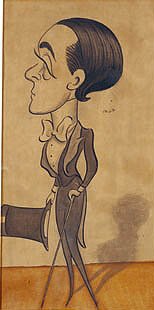
[You can also catch glimpses of many of them online. (Image at right is an 1897 self-caricature by Beerbohm.)  ~Rick]

The American writer Edmund Wilson (1895-1972) defined a caricaturist as a “portrayer of personalities,” and that’s exactly Beerbohm’s greatness – once you’ve seen his sketch of George Bernard Shaw (1956-1950) dancing the Highland Fling, or the reviewer William Archer (1856-1924) kissing the toe of the shoe of playwright Henrik Ibsen (1828-1906), or G. K. Chesterton (1874-1936) as an enormous balloon at the dinner table, you know exactly what they were like, and what Beerbohm thought they were like.

One can’t draw a good caricature (his are much better than “good”) without a deep understanding of its subject matter, and the same is true for the writer of parodies, so it’s perhaps not too surprising that Beerbohm excelled in both. Dwight MacDonald (1906-1982), who compiled the splendid volume Parodies: An Anthology from Chaucer to Beerbohm – and After (1960), calls Beerbohm’s A Christmas Garland (1912)

a set of variations on a theme which I am not alone in thinking the best single book of parodies in our language. The chief drawback to it . . . is that about half the eighteen parodees are no longer of interest. And yet even so one gets such a vivid impression of the literary personalities . . . that one is able to reconstruct these extinct forms of life from the single parodic bone thrown to one, and perhaps to enjoy them even more than their contemporaries did.

I would love to quote endlessly from Beerbohm’s parodies, but I will only cite as an example his “P.C., X, 36,” a parody of Rudyard Kipling (1865-1936) that incorporates Kipling’s often-so-masculine tone, his fascination with men in uniform, and his ear for dialects, in a story about a London cop on Christmas Eve who arrests Santa Claus:       

The captive sniveled something about peace on earth, good will toward men.

“Yuss,” said Judlip. “That’s in the Noo Testament, ain’t it? The Noo Testament contains some uncommon nice readin’ for old gents an’ young ladies. But it ain’t included in the librery o’ the Force. We confine ourselves to the Old Testament – O.T., ’ot. An’ ’ot you’ll get it. Hup with that sack, an’ quick march!

Would a gift for caricature and a mastery of parody be useful to a theater reviewer? As it turns out, if the reviewer is Beerbohm, the answer is yes. He became the “critic” for the influential weekly London paper The Saturday Review in 1898, succeeding the brilliant George Bernard Shaw (1856-1950), who was moving on from reviewing to greater things, and who in his last column gave Beerbohm a soubriquet that would stick:

Still, the gaiety of nations must not be eclipsed. The long string of beautiful ladies who are at present in the square without, awaiting, under the supervision of two gallant policemen, their turn at my bedside [he was ill], must be reassured when they protest, as they will, that the light of their life will go out if my dramatic articles cease. To each of them I will present the flower left by her predecessor, and assure her that there are as good fish in the sea as ever came out of it. The younger generation is knocking at the door; and as I open it there steps spritely in the incomparable Max.

For the rest, let Max speak for himself. I am off duty for ever, and am going to sleep.

“The incomparable Max” Beerbohm was then twenty-six years old.

He stayed at The Saturday Review twelve years – four times as long as Shaw. He wrote over five hundred reviews, selected the best of them for a book called Around Theatres in 1930, and a smaller selection of those was published by Simon & Schuster as A Selection from Around Theatres in 1960.

He begins, on May 28, 1898, with a bang, in an essay called “Why I Ought Not To Have Become A Dramatic Critic.”

Frankly, I have none of that instinctive love for the theatre which is the first step towards good criticism of drama. I am not fond of the theatre . . . in drama I take, unfortunately, neither emotional nor intellectual pleasure. I am innocent of any theories on the subject. I shall have to vamp up my first principles as I go along, and they will probably be all wrong and all dull. . . . My self-respect and my ignorance of bygone formulae of drama will prevent me from the otherwise easy task of being an academic critic. . . . In a word, I don’t quite know what to do with the torch that G. B. S. has handed to me.

Immediately one wonders, is this true? He is clearly lowering expectations, but for what reason – out of serious awareness of his own limitations? As part of a game played with the reader? Both? Or can he simply not avoid writing droll and humorous essays – caricaturing, perhaps, himself?

Whatever the answer, he has neatly differentiated himself from his predecessor, Shaw, who had definite and well worked-out opinions about everything:

I have not that well-considered attitude towards life which gave a kind of unity to G.B. S.’s worst inconsistencies about art. In a word, I don’t quite know what to do with the torch that G. B. S. has handed me.

One sees, slyly inserted into that sentence, a very definite attitude toward Shaw. Beerbohm is certainly not as ingenuous as he presents himself. What’s more, in an oblique fashion he establishes his right to craft his reviews in the way he wants, not according to someone else’s pattern. In any case:

I daresay that there are many callings more uncomfortable and dispiriting than that of dramatic critic. To be a porter on the Underground Railway must, I have often thought, be very terrible. Whenever I feel myself sinking under the stress of my labours, I shall say to myself, “I am not a porter on the Underground Railway.”

As I read Beerbohm’s reviews, the first thing I think of, unlikely as it seems, is a passage from the mystery novel The Case of the Amorous Aunt by Erle Stanley Gardner (1889-1970) in which the lawyer Perry Mason tells a junior attorney:

Take him on, Duncan. There’s not very much you can do with him. Don’t generalize. Pounce on the one point that you can emphasize and then let him go.

The last sentence in that quotation summarizes the approach Beerbohm generally takes in writing his reviews: he pounces on one point to emphasize, and the discussion of that one point takes up most of the review. To put it another way, the underlying genre of Beerbohm’s reviews is the essay.

Quite likely this approach would not have worked for him if he were a reviewer on a daily newspaper; the pressure to get an immediate response into print would have made it difficult for him, or anyone, to write a meditative piece, and it is also likely that an ordinary editor might have instructed the reviewer to stick more to the play, and less to his ideas about drama.

Beerbohm’s editor, however, was anything but ordinary. He was Frank Harris (1855-1931), a bull in the china shop of journalism with a shrewd eye for talent. Harris had spotted Shaw and been richly rewarded. To choose Beerbohm as Shaw’s successor had to be more than good luck. Beerbohm’s unusual approach and style made him a “main attraction” well able to follow Shaw.

There are aspects of Beerbohm’s reviews that may strike the reader as irritating. He takes all the time he wants to make his points. Someone looking for “a quick quote” might have to read a long time to find one.

He also has an irritating habit of referring to actors as “mimes” and to characters in plays as “puppets.” As far as I can determine, silence was thoroughly associated with mimes by the time Beerbohm wrote, and actors in plays typically are not silent. Furthermore, the dramatist whose characters come across to the audience as “puppets” is probably not a very good dramatist, “wooden” being another word for such characters.

On the other hand, it is a pleasure to read the work of someone who writes superlatively well – and for a weekly magazine at that! – and although his first column gives the impression that he has no opinions worth writing about, that is actually not the case. Reviewing a play by the novelist Joseph Conrad (1857-1924) he writes that

What I want from art is some kind of emotion. It matters not at all to me whether the emotion be in itself one of pleasure or one of pain. In whatever way I be quickened, I am grateful. I pity the critics who can find no aesthetic pleasure in “One Day More.” They ought to give up criticism.

Further in the same review he writes:

And that, I insist, is the keenest, truest kind of aesthetic emotion to which we can attain – simply to be “bowled over.”

Throughout his twelve years of reviewing, despite his claims to be bewildered by the theater, he expresses numerous definite opinions, although he is not beyond changing them. For example, he finds it almost impossible for a dramatist to put on stage a convincing portrayal of a writer:

The playwrights seem to be almost as hazy as actors in their notion of what literary men are like. I search my memory in vain for one passable presentment of a literary man in modern drama.

(He had not seen the Tony Award winning performance of Christian Borle (b. 1973) as the manically insecure rock star playwright William Shakespeare in the musical Something Rotten! (2015), but that exception, I would say, proves the rule.)

[There are two reports on Something Rotten! on Rick On Theater—one by me, posted on 14 May 2016 and one by Kirk himself, on 11 May 2016.  Both posts have similar praise of Borle as The Bard.  ~Rick]

On principle he is not excited about the 1908 equivalent of what came to be called “kitchen sink” or determinedly realistic drama:

The relation of a playwright to his audience is the same as the relation of any one to the friend whom he button-holes, to tell him something, in a room. The playwright wants to interest his audience, just as I want to interest my friend. The more abnormal the matter of the communication, the likelier is interest to be aroused.

While Shaw and his fellow reviewer William Archer (1852-1924) championed and promoted Ibsen’s plays, Beerbohm, a member of the next generation, is considerably more objective about them:

[Ibsen’s] was a strange mind, this mind into which I have been peering. Posterity, too, I think, will always, from time to time, peer into it, with something of my own awe. Even when time shall have robbed the plays of the sharp savour that for us they have, Ibsen himself will be as dominant a figure as he is for us. Against his lack of love may be set the fact that he loved not even himself… Perhaps it is but another instance of Ibsen’s egoism that he reserved his most vicious kick [in When We Dead Awaken] for himself.

He is extremely skeptical of plays written by actors such as William Gillette (1853-1937), because those plays tend, in the words of Shaw (who agreed with him), to be “a tissue of effects:”

I must find such solace as I can in my prevision of the time when Mr. Gillette will have ceased to write anything but stage directions.

He argues, logically if futilely, for the use of the soliloquy in modern drama:

Though in real life we do not talk to ourselves, we do think to ourselves, and many of these thoughts we could not or would not divulge to any other creature, however dear a friend he might be. Perhaps these incommunicable thoughts are the most important we ever have – the thoughts which, if they were divulged, would best elucidate our characters and our actions.

He scoffs, or claims to scoff, at the label of the “hard-working” actor:

To walk and talk for half an hour in the course of the evening makes no great strain on your physique, even though you have to walk gracefully and to talk in a loud tone. Moreover, the amount of brain-power you require for “studying” the average creation of the average dramatist is – well, not above the average.

He suggests that mornings are the best hours for watching serious drama:

The morning always has been recognized as the time when the functions of the brain and the heart are best performed. In the morning all our faculties are agog. We are fresh from sleep. . . . And just as our emotions are in proper trim, so are our brains. We celebrate clearly, cleanly, assimilating facts, detecting fallacies, at a glance. We are as receptive as tiny children, yet, unlike them, able to reason from our learning. Like the shining day itself, we are young.

Nor is Beerbohm incapable of changing his mind. He jousts with Shaw throughout his twelve years of reviewing, at first speaking of Shaw as a sort of pamphleteer who uses actors. Many have expressed this opinion about Shaw’s plays. It is certainly inaccurate or at least incomplete, as I have tried to describe elsewhere in this blog [see Kirk’s “Bernard Shaw, Pop Culture Critic,” posted on ROT on 5 September 2012; “Eric Bentley on Bernard Shaw,” 3 December 2015; and the 5-part “Re-Reading Shaw,” 3 & 18 July, 8 & 23  August, and 2 September 2016]. Beerbohm at first agrees with the criticism but eventually comes to the understanding that

[the reviewers] still maintain that Mr. Shaw is not a playwright. That theory might have held water in the days before Mr. Shaw’s plays were acted. Indeed, I was in the habit of propounding it myself. . . . I wrote here a special article in which I pointed out that the plays, delightful to the reader, would be quite impossible on the stage. This simply proved that I had not enough theatrical imagination to see the possibilities of a play through reading it in print. . . . To deny that [Shaw] is a dramatist merely because he chooses, for the most part, to get drama out of contrasted types of character and thought, without action, and without appeal to the emotions, seems to me both unjust and absurd. His technique is peculiar because his purpose is peculiar. But it is not the less technique.

Like Shaw he thinks continually, if sometimes fancifully, about the role of the reviewer:

No critic is able to criticize a play rightly after seeing it but once. If he write for a daily paper he has to exhaust himself with the effort to remember every turn of the plot, in order that he may write a clear precis. If he write for a weekly paper, he has to be on the alert for something which will make the basis for a theory – some salient feature on which he can fasten an idea.  . . . Will the critics, I wonder, be swayed by this counsel of perfection? Not I, for one. Few plays deserve to be seen at all; on the other hand, I grow more and more fond of first nights.

It seems to me that the word “incomparable” fits Beerbohm well. Who can we compare him to? In an era when reviews seem, as a matter of style, to be much the same, Beerbohm shows that a great deal more is possible. Of course it helps to be Max Beerbohm.

In 1939 he became Sir Max. I cannot think of any other drama reviewers who have been knighted. That surely must indicate something. 

[Kirk notes that Beerbohm, who was knighted in 1939, was apparently the only theater reviewer to receive that honor from the British Crown.  It’s interesting to note, however, that Beerbohm’s predecessor on the drama desk of the Saturday Review, George Bernard Shaw,  was offered a knighthood  in 1925, but he declined the honor. 


[The year of the offer is somewhat in doubt, apparently, as other sources put it sometime “during the 1930s and 1940s.”  Furthermore, some references say the offer was never formally made, “but that he was sounded out.”  (It almost certainly would have been for his playwriting more than his drama criticism.)  I couldn’t pin this down, but it’s more certain that an offer of an Order of Merit award was considered in 1946, but Shaw let it be known that he wouldn’t accept the honor so it was never officially offered.


[Shaw refused most other honors and awards as well; he basically disparaged such recognition, feeling that it should be left to posterity.  Nonetheless, he’s one of only two people ever awarded both a Nobel Prize and an Academy Award (the other double-winner was Bob Dylan).  Shaw won his Nobel for Literature in 1925 and the Oscar in 1938 for the screenplay adaptation of Pygmalion.  (Dylan's academy award was in 2001 for his song "Things Have Changed" from Wonder Boys; he won the Nobel Prize for Literature, recognizing the poetry of his song lyrics, in 2016.)


[Reportedly, Shaw wanted to refuse his Nobel Prize, too, but his wife urged him to accept it as an honor for Ireland; however, he refused the concomitant monetary award (usually around $1 million or €850,000), requesting that it be used for the English translation of Swedish books.]