Showing posts with label Anne Azzi Davenport. Show all posts

27 May 2026

'Seagull: True Story'


[Readers of Rick On Theater, even those who aren’t theater folk, probably know that Anton Chekhov, the renowned turn-of-the-20th-century Russian dramatist, is a beloved figure in the Western theater world.  Actors and directors, especially, love to do his plays.  He has a prominent place in nearly every repertory theater’s repertoire. 

[Chekhov’s plays are translated into almost every known language.  They’re also adapted and modernized almost as often as William Shakespeare’s are.  Below is the story, told via an interview with the play’s 34-year-old director, of one of those adaptations.  

[The play, The Seagull, which is about theater and theater people—two actresses and a playwright, has become a vehicle for the director, an exile from Chekhov’s own country, who conceived the adaptation, to tell his own story, 118 years after the playwright’s death.]

RUSSIANS WHO FLED AFTER UKRAINE INVASION
STAGE FRESH TAKE ON CLASSIC PLAY IN U.S.
by Jeffrey Brown, Zeba Warsi, and Anne Azzi Davenport

[This segment on PBS News Hour on Tuesday, 19 May 2026, caught my attention for two reasons.  One, it was an interesting theater story: a young, émigré Russian stage director of some accomplishment who fled Putin’s autocratic regime under duress, made a play based on a Chekhov classic that told his own story, got it produced at New York City’s esteemed Public Theater to considerable acclaim.

[And two, I hadn’t heard about it—or him—though he’d been here, working, since 2022 and his play has been staged a few times since early 2025!  So, maybe others missed the memo, too.]

Two Russians who left their country after the invasion of Ukraine and are now rebuilding their lives and careers in the U.S. Senior Arts Correspondent Jeffrey Brown reports on a recent production in New York for our Art in Action series, exploring how art and democracy shape one another, as part of our CANVAS coverage.

Geoff Bennett [Co-anchor of “PBS News Hour”]: Now a different kind of migration story, one involving theater and two Russians who left their country after the invasion of Ukraine and are now rebuilding their lives and careers in the U.S.

Senior arts correspondent Jeffrey Brown reports on a recent production in New York for our Art in Action series exploring how art and democracy shape one another as part of our Canvas coverage.

Jeffrey Brown: [On screen: a performance; singing in Russian.] It’s a play within a play, with cabaret humor, even slapstick, alongside the drama of loss of friends, family and country.

Alexander Molochnikov: [Giving a curtain speech.] And I’m very thankful to all of you for allowing me to tell the personal, sometimes even dramatic story in a playful way.

Jeffrey Brown: For Alexander Molochnikov [Александр Молочников; often romanized as Aleksandr Molochnikov; b. 1992], the creator and director of “Seagull: True Story” [written by Eli Rarey (b 1977), with music by Fedor Zhuravlev (b. 1995)] this is personal. It’s based on his own story.

[Molochnikov is a writer, filmmaker, and internationally acclaimed theater director. He worked for over 10 years in Moscow where he directed five major productions in drama, a ballet, an opera, two feature films, and a TV show.

[Molochnikov has created and directed over 10 shows and films in Moscow including the most-viewed six-episode TV series, The Monastery (МонастырьMonastyr), in 2022. His production of the operas The Telephone and The Medium by Gian Carlo Menotti (1911-2007) premiered at the Bolshoi Theatre, along with his ballet, The Seagull: Interrupted Flight, which was honored with the Golden Mask (Золотая маскаZolotaya maska; the Russian equivalent of the Tony Awards) for best ballet of the year.

[Since 2014, his first play, 19.14, an antiwar cabaret play about World War I, had been running in repertoire for over 11 years at the Moscow Art Theater of Chekov. However, the theater has removed his name from all materials. The billing now says “Directed by Director” because the names of directors who supported Ukraine in 2022 no longer appear in print.

[In 2022, he spoke out against the Russian military invasion of Ukraine and then in August, he moved to New York. Molochnikov is now unable to return to Russia. He became a U.S. citizen in early 2026, roughly four years after fleeing Russia.

[His feature film, Tell Her (Скажи ейskazhi yey), about moving to the U.S. as a child, premiered in 2020 at the 47th Seattle International Film Festival. He premiered a cabaret-style stage adaptation of Fyodor Dostoevsky’s classic novel, Crime and Punishment (1866), at the Tel Aviv Gesher Theatre in December 2024. He is working now on a feature film related to the novel.

[His short film Extremist (ЭкстремисткаEkstremistka) premiered at the 2025 Telluride (Colorado) Film Festival and won the 2025 BAFTA (British Academy of Film and Television Arts) Student Award for Live Action (as well as the Special Jury Prize); he is now turning it into a feature.]

What did you most want to bring out in this play?

Alexander Molochnikov: I think the value of art, the value of art as air and water for some people, and not only for people who make it, but sometimes for people who watch it. With choosing between food and art, anybody would choose food if we are dying of hunger.

But, for me, I literally realized through this experience how, without doing theater, I start kind of dying inside.

Jeffrey Brown: [On screen: scenes from the play.] “Seagull: True Story,” recently at New York’s Public Theater [26 March-3 May 2026], plays off Anton Chekhov’s classic “The Seagull” and tells of a young Russian theater director named Kon, Molochnikov’s alter ego, about to achieve his dream of directing a play at the world-renowned Moscow Art Theater, when a very different kind of drama intervenes, Russia’s invasion of Ukraine in February 2022.

[The Seagull by Anton Chekhov (1860-1904), Russian playwright and short story writer, premièred in 1896 in Saint Petersburg, Russia. (Its title is sometimes rendered in English as The Sea Gull, A Seagull, or A Sea Gull. The Russian title, Chaika [Чайка], has no article (because there are no articles in the Russian language), so it can also be translated as simply Seagull.)

[The character in the original version who becomes Kon, the avatar of Molochnikov in the adaptation, is a symbolist playwright named Konstantin Treplev. (Prior to its Public Theater run, the play was presented Off-Off-Broadway at La MaMa Experimental Theatre Club from 16 May to 1 June 2025. From 17 to 19 January 2025, a workshop version of the play was staged under the “working title” Seagull Fucker at La MaMa as part of the Under the Radar Festival.)  

[The first production of Seagull in Saint Petersburg was famously a failure. Not only the play, but Chekhov’s reputation as a dramatist was all but written off.  Then, in 1898, the famous director Konstantin Stanislavsky (1863-1938), cofounder of the Moscow Art Theater, directed it for his troupe, and the production was a success.

[The playwright’s career was saved and The Seagull has since generally been considered the first of Chekhov’s four major plays and one of the masterpieces of modern Western theater.

[The famous Moscow Art Theater opened in 1898, after Stanislavsky, a talented, forward-looking amateur actor and director from a wealthy family, and the successful professional, establishment playwright, critic, and drama teacher Vladimir Nemirovich-Danchenko (1858-1943), met at Nemirovich-Danchenko’s invitation for an 18-hour discussion in 1897. Both men, who knew only each other’s reputations, wanted to reform the clichéd, melodramatic mainstream Russian theater.

[To develop and teach his acting “system,” which eventually changed the acting style and actor-training practices of almost all Western theater (and formed the basis of the Method), Stanislavsky began opening MAT studios for training actors in 1912, and MAT eventually opened the MAT School in 1943. 

[The theater, which went through a series of name-changes—it didn’t actually become the Moscow Art Theater until 1901—split into two theaters in 1987: the Gorky Moscow Art Theater, the descendant of the original theater, and the Chekhov Moscow Art Theater, the house in which the young Molochnikov worked.]

Alexander Molochnikov: In the beginning, you don’t think it’s forever. Or maybe some people understood. I didn’t.

Jeffrey Brown: Four years later, Molochnikov, who in his 20s had already directed productions at leading Moscow theaters, including the Bolshoi . . .

Man [actor in cast rehearsing on stage]: Happy birthday!

Jeffrey Brown: . . . celebrated his 34th birthday with the cast of “Seagull” in New York, where he now lives and works.

Alexander Molochnikov: Oh, wow.

Woman: Make a wish.

Sofia Kapkov, Producer: I had a team of 40 people who was working for me. I signed all documents and I left.

Jeffrey Brown: Also a new New Yorker, the producer of “Seagull: True Story,” 47-year-old Sofia Kapkov [b. 1978].

Sofia Kapkov: I came here without any plan, so I stayed with my friend. I told him I’m going to be there for a week. I ended up for a month. And then after a month, I realized that’s it. That life is gone.

Jeffrey Brown: That former life included heading her own production company that put on prominent contemporary theater and dance performances in Russia and abroad, not overtly political art, but she says a form of activism nonetheless.

Sofia Kapkov: I wanted to open this window to the freedom to show them, OK, another world exists. There is different type of art, for example, or different forms of art. And in a way, this is my type of activism to show something that is relevant, that it’s timely.

Jeffrey Brown: Russia’s invasion of Ukraine ended that. She left within days, taking her two younger children, joining an older daughter who was studying at NYU.

Sofia Kapkov: I had a nice life back then. I had a comfortable life. I had home, friends, projects, successful business.

But I had my doubts in my country. I woke up in the reality that we are killing our neighbors. For me, it was obvious I need to live for the sake of my kids. I don’t want them to get used to the idea that war is normal. And it’s a very hard decision, because you’re not just changing your life from one comfortable life to less comfortable.

You’re changing the destiny of your kids. It’s a very big responsibility.

Jeffrey Brown: Huge changes, big struggles documented in a memoir titled “Arts Hustler: A Story of Resilience” [MART Foundation, 2025], along with some advantages, including having international experience and contacts.

And within two years, she had co-produced “Our Class,” a play [by Tadeusz Słobodzianek (Polish; b. 1955)] set in Poland during World War II about neighbors turning on neighbors. It had successful runs in New York [Classic Stage Company, 12 September-3 November 2024], Boston [Calderwood Pavilion at the Boston Center for the Arts, 13-22 June 2025], and most recently San Francisco [Z Space’s Steindler Stage, 27 March-5 April 2026]. 

In prewar Moscow, Alexander Molochnikov had demonstrated in support of prominent Russian dissident and opposition leader Alexei Navalny [1976-2024]. And after the invasion of Ukraine, he registered his protest with a series of anti-war posts on social media and danced to Ukrainian music in the Russian version of “Dancing With the Stars” [video clip of Molochnikov dancing]. 

His name was taken off production credits and he says he received death threats. In August 2022, he left Russia, enrolling in a graduate film course at Columbia University.

[Immediately after he publicly criticized Russia’s invasion of Ukraine, Molochnikov says, he received threats against his safety from the state-funded Wagner Group, the private military company controlled at that time by Yevgeny Prigozhin (1961-2023), a former close ally Vladimir Putin (b. 1952; President of Russia: 2000-08 and 2012-present). The young theater artist reports that mercenaries from the Wagner Group sent him photographs of his parents’ houses in Moscow and Saint Petersburg with such text warnings as “Be careful walking there, you might slip and fall into a pond.”]

From that came a short film titled “Extremist” based on the true story of a young Russian woman whose public protest of the Ukraine war, putting anti-war and anti-Putin messages on grocery items, led to her imprisonment. [Scenes from the film are shown, with balalaika music (“Kalinka,” Russian folk-style song written in 1860 by Ivan Larionov [1830-89]) from the soundtrack.] The film would win various international awards and was also short-listed for an Academy Award for best live-action short.

Today, Molochnikov can see the positive impact of the upheaval he went through.

Alexander Molochnikov: Because collapse motivates you to rebuild and really develop as a person. I didn’t really want it to happen again. We just, like, built something here. I would love a few more years to build more.

But the feeling of apocalypse – and, of course, I want to say that, like, this my little art apocalypse is nothing compared to what people lost in Ukraine. But, still, you lose your career that you’ve been building for 10 years. It’s healthy sometimes to lose it.

Jeffrey Brown: The second half of “Seagull: True Story” is partly based on Molochnikov’s experience after coming to the U.S., including the overt commercialism of the theater world here and what he says were different kinds of restrictions on language and expression he encountered.

[Since we don't have official censorship in the United States, as Molochnikov had experienced in Russia under Putin, when he speaks of “restrictions on language and expression,” he’s talking about “political correctness,” “cancel culture,” ideological conformity, and similar socio-political pressures.

[In 2025, in Cultured, a print and digital magazine about contemporary art, architecture, design, fashion, film, and music, the émigré director asserts, “There are so many things everyone is afraid to talk about [in the U.S.] because we’re afraid society will turn against you. We’re afraid of a witch hunt. We’re afraid to say something that would offend someone when you didn’t mean to offend them.”

[Last April, Molochnikov told the Columbia Daily Spectator, the student newspaper of Columbia University, that many Americans don’t seem to “know how to be free in their society, because of the control over what you can say, words you can use, things that are possible to talk about, and impossible to talk about.”]

And the play includes a moment amid the crackdown in Russia in which one character asked the American audience:

Actor [scene from the play]: And something like this could never happen in America, right?

Actor: Right?

Alexander Molochnikov: Right?

And there’s always – it’s interesting. It’s not a laugh. it’s not a clap. Everyone’s like, oh.

Sofia Kapkov: It just is a concern.

Alexander Molochnikov: I hope that that this play, maybe not in everyone, but in somebody, it would leave some thought or some concern about what’s going on in U.S. today, and I hear it a lot. And many people who saw it a year ago, now they’re like, wow, this is about Iran now.

Jeffrey Brown: Molochnikov and Kapkov say New York is their home now. Both have become U.S. citizens and aim to further build lives here with their artistic work leading the way.

Sofia Kapkov: Theater is very similar to democracy. It should be a free space. There people are allowed to ask any questions. I believe in democracy, and I love this country, and I have hope for America. I’m American now, right?

I don’t have any hope for Russia, unfortunately. And what Putin did, he destroyed life of many generations. I don’t like a lot of stuff that’s going on here in America, but America is even younger than the Bolshoi Theatre in Moscow.

Jeffrey Brown: America, the country.

Sofia Kapkov: America, the country, United States.

[Though the famous theater, opera, and ballet company didn’t acquire the name Bolshoi Theater until 1825, the linear ancestor of the company, which actually had no formal designation, was founded on 28 March 1776 (by license from Empress Catherine II [1729-96; Empress of Russia: 1762-96; commonly known as Catherine the Great]). That’s exactly 98 days (or 14 weeks) before Independence Day, when the U.S. was officially born.

[The name (in Russian: Большо́й Теа́тр) means “Big Theater” or “Grand Theater” to distinguish it from the Maly Theater (Малый Театр), which means “Little Theater” or “Small Theater.” Many cities, such as Saint Petersburg/Leningrad and Moscow, had both, among the many entertainment venues.

[In 18th- and 19th-century Imperial Russia, the designations signified an official categorization of a theater's artistic discipline and its rank within the Imperial Theaters system. The Bolshoi Theaters were designated for grand-scale productions like opera and ballet, which require larger auditoriums to accommodate orchestras, large choruses, and elaborate sets. The Maly Theaters were authorized for dramatic plays, comedies, and spoken theater which are better served in intimate settings constructed so that the performances are closer to the audience.]

Jeffrey Brown: [Over a scene with singing and music.] Good perspective from the theater world to today’s political realities.

For the “PBS News Hour,” I’m Jeffrey Brown in New York.

[I observed in my introduction to this post that the plays of Anton Chekhov are popular with theater people: repertory theaters like to produce them, actors like to act in them, and directors like to direct them.  I also noted that Seagull held a special place among Chekhov’s works because it’s about theater and theater artists.

[One example of the phenomenon is experimental theater director Leonardo Shapiro (1946-97), about whom I’ve blogged many times on ROT.  He acknowledged that Seagull was deeply meaningful to him since he saw a school production of it as a prep school student.  Seagull stayed with Shapiro for the rest of his life.

[Before he’d ever staged a production of Seagull, Shapiro confessed to me, he’d long wanted to direct “an all-star, multi-racial” production of the play in Central Park for Joseph Papp (1921-91).  It was a recurring dream—which never came true.  The play had “always been mixed up in my mind with the love of literature and with idealism,” he explained, but he also admitted that he’d always wanted to direct The Seagull because of the “schmaltz” as well as the “lyricism.” 

[The play had long been a symbol for Shapiro, figuring prominently on a list of influences and inspirations he once wrote out for me.  He even invoked it in a 1965 playlet from his early college days.  When an old New York cabbie morphs into Joe Cino (1931-67), the seminal Off-Off-Broadway café-owner and impresario, the young passenger, a stand-in for Shapiro, asks, “Who are you?” and the cabbie replies, “I am a seagull.  No, that’s not it.”  These are the same words Nina says to Konstantin in Act IV of the play.  Apparently, 19-year-old Shapiro had already cast himself in that role.

[The play “speaks to artists about creativity,” said Shapiro, “and getting caught up in the ‘theater world.’”  He explained that the “basic values” of The Seagull are “love and art,” and that the “theme” was “showing the audience the need for art” in society. 

[(Note that Mokochnikov says above that the message he sees in Seagull is “the value of art, the value of art as air and water for some people, and not only for people who make it, but sometimes for people who watch it.”  The Russian’s statement is, I daresay, the same sentiment as Shapiro expressed.) 

[In the fall of 1992, Shapiro directed Karen Malpede’s Blue Heaven, which was Shapiro’s last New York production and centers loosely on a film production of The Seagull involving several of Blue Heaven’s characters.  For the promotional postcard for Blue Heaven, Shapiro posed the cast and crew in a restaging of a photograph of Konstantin Stanislavsky’s first rehearsal of Seagull in 1898, with Malpede sitting in Chekhov’s place and Shapiro in Stanislavsky’s.

[Ironically, Shapiro eventually directed a production of The Seagull, with the Riverside Repertory Theatre Company of Albuquerque, New Mexico, in 1996.  It was his last work.  

[In the final year of his life, Shapiro approached Riverside and told the company, “I’m about to die, I want my final show to be The Seagull, and I want you all to be in it.”  Over a five-month period, the company “camped out” three or four days a week near Shapiro’s mountain cabin, spending days on the small, white backyard stage that Shapiro had built against the mountain background—reminiscent of the one for Konstantin’s play.

[Shapiro had initially resisted chemotherapy, but when he started working with Riverside, several company members reported, he began undergoing the treatment.  They figured it was a way to prolong his life in order to finish the play.  Seagull, one cast member felt, helped him decide to take the chemotherapy “so that we wouldn’t have to finish the play without him.” 

[The Riverside Seagull played in Albuquerque from 5 to 14 September 1996 and then in Baltimore, Maryland, from 6 to 17 November.  Shapiro hadn’t been able to travel with his cast, but he lived to see their success in the town—and at the theater—where, 23 years earlier his Shaliko Company débuted.  Leo Shapiro died of cancer on 22 January 1997, 15 days after his 51st birthday (and 18 months after he was diagnosed and given 6 months to live).

[It’s perhaps an interesting sidelight to Shapiro’s special feeling for The Seagull that he had such a proprietary attitude toward the play that he apparently resented when even another artist whom he admired appropriated it.  Tennessee Williams (1911-83), an inspiration and model for Shapiro, wrote his own adaptation of Chekhov’s play, The Notebook of Trigorin, in 1981. 

[Shapiro was aware of Williams’s adaptation, and on 14 December 1992, shortly after the downtown opening of the Shaliko production of Blue Heaven with The Seagull at its center, a staged reading of Williams’s play was performed uptown at Lincoln Center.  Shapiro refused to go despite his special interest in the writer and the source. 

[In his more than 30-year career with the News Hour, Jeffrey BrownJeffrey Brown has served as co-anchor, studio moderator, and field reporter on a wide range of national and international issues, with work taking him around the country and to many parts of the globe.  As arts correspondent he has profiled many of the world’s leading writers, musicians, actors, and other artists.  

[Among his signature works at the News Hour: a multi-year series, “Culture at Risk,” about threatened cultural heritage in the United States and abroad; the creation of the News Hour’s online “Art Beat”; and hosting the monthly book club, “Now Read This,” a collaboration with the New York Times.

[Zeba Warsi is a foreign affairs producer, based in Washington DC.  She’s a Columbia Journalism School graduate with an M.A. in Political journalism.  She was one of the leading members of the News Hour team that won the 2024 Peabody award for News for our coverage of the war in Gaza and Israel.

[Anne Azzi Davenport is the Senior Producer of CANVAS at PBS News Hour.]


18 October 2025

'Waiting For Godot' on Broadway, 2025 (I)


[A new production of Samuel Beckett’s (1906-89) Absurdist masterpiece, Waiting for Godot (1953), opened on Broadway on 28 September, after starting previews at the Hudson Theatre on 13 September.  Its limited run, directed by Jamie Lloyd, is scheduled to end on 4 January 2026. 

[The production stars Keanu Reeves as Estragon in his Broadway début, and Alex Winter as Vladimir.  The rest of the cast is made up of Brandon J. Dirden as Pozzo and Michael Patrick Thornton as Lucky, with Zaynn Arora (also making his Broadway début) and Eric Williams alternating as the Boy.

[The scenic and costume design are by Soutra Gilmour, the lighting design is by Jon Clark, and the sound design is by Ben and Max Ringham.]  

KEANU REEVES AND ALEX WINTER REUNITE ON STAGE
IN BROADWAY’S ‘WAITING FOR GODOT’
by Jeffrey Brown and Anne Azzi Davenport

[Below is the transcript of the PBS News Hour segment of 10 October 2025 in which Jeffrey Brown, the program’s arts correspondent, discusses the new production of Godot with its stars.]

It’s a classic of theater that continues to be taken on by top actors and still resonates with audiences. “Waiting for Godot” mixes despair and comedy to raise questions about the meaning of life. Now, Keanu Reeves and Alex Winter, two actors who are great friends, are doing their waiting on Broadway. Senior arts correspondent Jeffrey Brown has the story for our arts and culture series, CANVAS.

Geoff Bennett: It’s a theater classic that continues to be taken on by top actors and resonates with audiences.

“Waiting for Godot” — yes, that’s how it’s pronounced [GOD-oh] — mixes high despair and low comedy to raise big questions about, well, the meaning of life. And now two actors, great friends themselves, are doing their waiting on Broadway.

[GOD-oh is the standard pronunciation in Ireland and the United Kingdom.  In North America, it’s commonly pronounced go-DOH.]

Senior arts correspondent Jeffrey Brown gets a look for our arts and culture series, Canvas.

Keanu Reeves, Actor [in a scene from Godot]: Who am I to tell my private nightmares to if I can’t tell them to you?

Alex Winter, Actor: Let them remain private. You know I can’t bear that.

Keanu Reeves: There are times when I wonder if it wouldn’t be better for us to part.

Alex Winter: You wouldn’t go far.

Jeffrey Brown: Two men, Estragon, called Gogo, and Vladimir, or Didi, fearing, laughing, talking, waiting for someone they don’t know.

The two men playing them, Keanu Reeves and Alex Winter. And why are they here?

Keanu Reeves: Yes, but what did I know? I just had the — I just answered the universe and said you should do “Waiting for Godot” with Alex. And I was like, you’re right. OK, I will ask him.

(Laughter)

Jeffrey Brown: And he said?

Alex Winter: Absolutely. Yes, but it’s a mountain. Let’s go climb the mountain.

Jeffrey Brown: That mountain, “Waiting for Godot,” or Godot [GOD-oh], as they have chosen to pronounce it in this production, by Nobel Prize-winning Irish playwright Samuel Beckett.

Written and first performed in the 1950s, it’s still raising deep issues of human existence through a mix of pain and suffering along with broad comedy.

Actor [Brandon J. Dirden as Pozzo; in a scene from Godot]: Which of you smells so bad?

Keanu Reeves: He has stinking breath and I have stinking feet.

Actor: I must go.

Jeffrey Brown: Keanu Reeves, of course, is a mega-movie star, best known for his roles in “The Matrix” and “John Wick” series. This is his Broadway debut.

Alex Winter, a Broadway and film veteran, is best known in recent years as a director of documentaries, including one on rock star Frank Zappa.

Alex Winter AND Keanu Reeves: Excellent!

Jeffrey Brown: The two are forever linked through their roles starting in their 20s in the “Bill and Ted” sci-fi comedy films that began in 1989 about two rather clueless dudes who get their history lessons through time travel.

They have been close friends ever since, the kind who often finish each other’s sentences on and off stage. And when we met recently at Broadway’s famed Sardi’s Restaurant, Reeves, now 61, and Winter, 60, said taking on “Waiting for Godot” together was a must.

Is that because it made it more fun or because it got you past the fear of doing it or . . .

Keanu Reeves: For me, it just started with the fun.

(Laughter)

Keanu Reeves: This seems like a really good idea. Yes.

Alex Winter: Yes, and also that they’re — it is a play about two old friends who are interested in interrogating the questions of life, which is very much the two of us. So . . .

Jeffrey Brown: It is?

Alex Winter: Oh, yes.

Jeffrey Brown: You mean off stage.

Alex Winter: Oh, yes. Yes, yes, yes, like going back to — look, we’re goofballs and lead normal lives as well, but, like, I remember certain nights even on “Bill and Ted” one, it would be like 2:00 in the morning. We’d be sitting on the hood of my car in like in a strip mall in Phoenix, like, debating existence.

Keanu Reeves: Yes.

(Laughter)

Alex Winter: You know? So, like, in some ways, nothing has changed.

[In a scene from Godot] Look at me. Will you look at me?

Keanu Reeves: What a day.

Alex Winter: Who beat you? Tell me.

Keanu Reeves: Another day done with.

Alex Winter: Not yet.

Keanu Reeves: For me, it’s over and done with no matter what happens.

Jeffrey Brown: Are Gogo and Didi refugees from war or some environmental catastrophe, figures from outside of time? And who is this Godot?

Alex Winter: Beckett was cheeky, but he — I think he liked the fact that people debated these things. I think he was cheeky. He would say, oh, it’s not God necessarily, but maybe it is. You know what I mean? Like, I mean, come on.

(Laughter)

Alex Winter: Come on.

Keanu Reeves: Like, come on. If Samuel was here . . .

Alex Winter: Yes.

Keanu Reeves: I mean, come on.

Alex Winter: Yes.

Jeffrey Brown: You would say, come on, God — it is God.

Alex Winter: Of course God is in Godot, of course, of course, of course.

Steve Martin, Actor [in the 1988 Off-Broadway production at Lincoln Center]: Moron.

Robin Williams, Actor: Vermin.

Steve Martin: Abortion.

(Crosstalk)

Steve Martin: Sewer-rat. Curate. Cretin.

Robin Williams: Critic!

(Laughter)

Jeffrey Brown: The play has been done by certified funnymen such as Steve Martin and Robin Williams and amid boarded-up flooded homes [artist Paul Chan, Creative Time, and the Classical Theatre of Harlem staged a production in New Orleans in the flooded, hurricane-damaged Lower Ninth Ward and Gentilly neighborhoods, November 2007] in the wake of Hurricane Katrina [2005].

This production led by acclaimed British director Jamie Lloyd takes a stripped-down story and strips it further to a bare large tunnel, or cone, with no props at all. That, says Reeves, forced him to think and act in a new way.

Keanu Reeves: It’s even like the way I talked about the play early days, we can have mud, and why don’t we have water, and how about if we do this, and I will come out through the stage.

(Laughter)

Keanu Reeves: And then Jamie Lloyd and Soutra Gilmour, the production designer, went, here’s the set, and all of those ideas like a — like a mandala, just was like — that’s — get over that.

Jeffrey Brown: Yes. Did you find that freeing, though, too to not have the props?

Keanu Reeves: Oh, it’s freeing, but also illuminating. I think that our production is actually illuminating the themes of the play and what it’s asking and talking about. To have a literal tree that doesn’t look like a tree, you’re doing the same thing. You’re asking the audience to pretend that it’s got lots of leaves, and it’s like the spring.

Or then there’s a literal tree, and then I’m saying I see nothing. So they almost become more alive.

[Beckett’s original set instructions were: “A country road. A tree.”]

Alex Winter: Yes.

Keanu Reeves: And to the conceit, it’s more accurate.

Alex Winter: It is, yes. Every night, you find something else. We will come off stage even between act one and act two, and he will say or I will say, that — like, oh, wow, right, that.

Jeffrey Brown: But it’s still — you’re doing that between acts?

Alex Winter: Every night. Every night. Every night, there’s something. It’s just a play of limitless ideas and depth and possibility.

Keanu Reeves [in a scene from Godot]: Do you see anything coming?

Alex Winter: What?

Keanu Reeves: Do you see anything coming?

Alex Winter: No.

Keanu Reeves: Nor I.

Jeffrey Brown: Does it feel that way on stage too, where you’re saying, oh, I’m with Alex?

Keanu Reeves: Oh, yes. I get — I mean, so much of the night or the day of the performance, I’m just literally like looking at you . . .

(Laughter)


Alex Winter: Yes, we do a fair amount of that.


Keanu Reeves: . . . go through your contortions.

(Laughter)

Keanu Reeves: Poor Vladimir.

Alex Winter: Poor Vladimir.

Keanu Reeves: Trying to figure it out.

Alex Winter: I know, and failing miserably.

Jeffrey Brown: And how does the play land today, in a time of deep cultural and political divisions? Alex Winter had thought much about that, while Keanu Reeves offered lines from the play.

Alex Winter: And we’re certainly driving into it with the way we’re doing, is about looking past those divisions to this sort of human condition as a uniform issue that everyone faces, and this idea that we are all in this struggle together.

Keanu Reeves: And all mankind is us.

Alex Winter: Yes, for this moment of time.

Keanu Reeves: For this moment of time.

Alex Winter: Whether we like it or not. So let’s do something.

Keanu Reeves: Do something. Let us . . .

Alex Winter: I mean, that’s a pretty great thing to say right now.

Keanu Reeves: To help someone.

Alex Winter [lines from Godot]: Yes. Yes.

Keanu Reeves: We help him. We help him.

Alex Winter: Yes. Yes.

Keanu Reeves: Let us help him. We help him.

Alex Winter: Yes.

Keanu Reeves: Yes. Let’s go.

Alex Winter: Yes.

Jeffrey Brown: Is it ultimately a hopeless or hopeful play?

Keanu Reeves: Hopeful.

Alex Winter: Yes.

Jeffrey Brown: You’re going with hopeful?

Keanu Reeves: Yes.

Jeffrey Brown: Yes?

Keanu Reeves: I mean, they say, let’s go. Well, shall we go? Yes, let’s go.

Jeffrey Brown: But then they don’t move.

Alex Winter: But they’re together.

Keanu Reeves: But they still said, let’s go.

Alex Winter: Yes.

Keanu Reeves: They’re still doing it.

Alex Winter: Yes, they’re together. I think that — I think it lands. . .

Keanu Reeves: I will fight another day.

Alex Winter: Yes, they — it lands on this idea that it — that all we may have is each other, but that is enough to continue on. But everything else is up for grabs.

(Laughter)

Jeffrey Brown: Keanu Reeves and Alex Winter, Gogo and Didi, are waiting for Godot into early January.

Alex Winter: Finish a phrase, I tell you.

Keanu Reeves: Finish your own.

Alex Winter: Moron.

Keanu Reeves: That’s the idea. Let’s abuse each other.

Jeffrey Brown: For the “PBS News Hour,” I’m Jeffrey Brown on Broadway.

Alex Winter: Moron!

Keanu Reeves: Vermin!

Alex Winter: Abortion!

Bennett: Online, you can see more from Keanu Reeves and Alex Winter, including their mutual love of Dr. Seuss and their favorite plays. That’s on our YouTube page.

[A word or two about Godot and God: Many people in the English-speaking world feel that Godot is Beckett’s stand-in for God and that the name is meant to invoke that belief.  However, Becket refused to say so, though he hinted that he might have had that in his mind.  However, it should be remembered that he originally wrote the play in French (it had its world première in Paris in 1953), and in French, the word for God is ‘Dieu,’ which has no resemblance to the English word ‘God.’

[In his more than 30-year career with the PBS News Hour, Jeffrey Brown has served as co-anchor, studio moderator, and field reporter on a wide range of national and international issues, with work taking him around the country and to many parts of the globe.  As arts correspondent he has profiled many of the world’s leading writers, musicians, actors and other artists.  Among his signature works at the News Hour: a multi-year series, “Culture at Risk,” about threatened cultural heritage in the United States and abroad; the creation of the News Hour’s online “Art Beat”; and hosting the monthly book club, “Now Read This,” a collaboration with the New York Times.

[Anne Azzi Davenport is the Senior Producer of CANVAS at PBS News Hour.]


07 October 2022

Little Amal and 'The Walk'


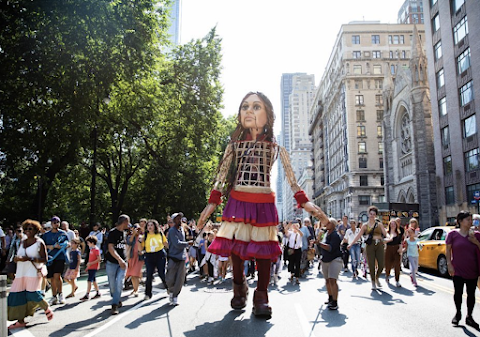
[I’m a regular watcher of the PBS NewsHour and on a Tuesday evening last month, the program ran a segment on a 12-foot-tall puppet named Little Amal who was walking the streets of New York City to attract attention to the plight of international refugees, especially children.

[The puppet and the project fascinated me.  Amal and her handlers had just come off a journey across Europe, following a route taken by hundreds of thousands of refugees from war and violence for decades now, a gigantic performance art event called The Walk.  Now they were in New York on an analogous quest to one of the cities of the world that’s been a mecca for refugees, migrants, and asylum-seekers worldwide. 

[After all, we have that other giant figure right out in our harbor, the one with the torch held high and the words of Emma Lazarus (1849-87) carved into its pedestal: “Give me your tired, your poor, / Your huddled masses yearning to breathe free, / The wretched refuse of your teeming shore. / Send these, the homeless, tempest-tost to me, / I lift my lamp beside the golden door!”

[One of these is Amal, a 10-year-old girl from Aleppo, Syria, torn apart by an 11-year-long (and still going) civil war, who was searching for her mother in Europe and now her uncle here in New York City.

[I’m going to post the transcript of that NewsHour report by Jeffrey Brown, but before I do that, I’m posting a report of my own, compiled from various sources on the background, history, and mission of The Walk, and the construction of Amal, the giant puppet.]

On 18 July 2021, a 9-year-old refugee girl from Aleppo, Syria, crossed the Syrian-Turkish border, her first steps along a 5,000-mile path followed by many refugees before and since.  The girl, whose name is Amal, which means ‘hope’ in Arabic, is all alone and looking for her mother, who set out in search of food and never returned.

Little Amal, as she’s known, is a 12-foot-tall puppet who’s the only figure in a performance piece called The Walk, which traveled from the border between Syria and Turkey across Europe, stopping along the way in 85 cities, towns, and villages in Turkey, Greece, Italy, France, Switzerland, Germany, and Belgium, ending in the United Kingdom (where she arrived on 19 October 2021 and stayed through 3 November). 

COVID caused a four-month postponement of the start of The Walk, and Little Amal and her entourage of 25 had to handle many other glitches and snags as they trekked over land and sea by boat, truck, and foot.  (Amal doesn’t actually hike the whole 5,000-mile route.)

Amal has made several additional trips since her trek across Europe.  For instance, in May 2022, she made a special visit to Ukraine and Poland, which are experiencing their own refugee crisis just now.  Then from 14 September to 2 October, Little Amal walked through the five boroughs of New York City. 

The New York walk coincided with the meeting of the United Nations General Assembly here (13-27 September), certainly a planned overlap, but also came at a time when the governor of Texas has been transshipping Latin American migrants—more than 2,200 to date, many who are refugees and asylum-seekers processed by USCIS (U.S. Citizenship and Immigration Services) and awaiting adjudication of their cases—by bus to New York City since April 2022.

On 9 November 2021, Little Amal took to the stage at the U.N. climate summit (COP26) in Glasgow, Scotland, to raise awareness on gender equality regarding the impact of climate change.  From 15 to 21 November 2021, Amal attended the Open Festival, a festival of music, dance, and other cultural and educational events, in The Hague, Netherlands.  While in New York, she appeared at the Global Citizen Festival in Central Park on 24 September 2022.

As of the conclusion of her New York visit, Amal had traveled 6,000 miles and called at over a dozen countries.  Her producers estimate that she’s been seen in person by more than a million people and millions more online.

At each stop, Little Amal is celebrated at special events—190 in western Europe alone in venues ranging from opera houses to cathedrals, mosques, bridges, thermal pools, and even a cemetery; there were 55 events in New York City—to draw attention to the plight of refugees, especially children.  (Fifty percent of worldwide refugees, or about 13½ million, are children.)  

In London on 24 October 2021, she marked her 10th birthday (Amal will turn 11 about 2½ weeks after this post is published).  Her message is “Don’t forget about us.”

Wherever she goes, in spite of her gargantuan stature, children flock to her.  She’s not, however, always so popular with adults.  In Greece (9 August-5 September 2021), Amal was actually pelted with eggs, fruit, and even stones in Larissa (31 August). 

She was scheduled to have a picnic with local children in Meteora, Greece, a UNESCO World Heritage site known for its assemblage of Orthodox monasteries.  On 23 August. the local council prohibited the event because they decided that a “Muslim doll from Syria” appearing at a site of significance to Orthodox Christians was inappropriate. 

Amal has an established age, birthday, and birthplace, but her faith isn’t specified.  Religious differences weren’t the only cause for Greek resistance to Amal’s visit, though.  Politicians protested the attention to Little Amal because they believe that more refugees will follow her.

The U.K., once a place of refuge for the politically persecuted, has lately been less welcoming of migrants.  Brits have also long had a broad streak of xenophobia in their national character, and not everyone greeted Amal with hugs and kisses. 

One British politician, herself of Ugandan-Indian extraction, who’d been Home Secretary (whose portfolio includes national security, policing, and immigration policy) under Prime Minister Boris Johnson (P.M.: 2019-22), called Channel-crossers “illegal migrants who just want to stay in hotels.”  Actor Mark Rylance (first artistic director of Shakespeare’s Globe, among other credits) was heckled when he serenaded Little Amal in Trafalgar Square on her birthday.

A columnist for a London tabloid wrote after seeing one of Amal’s appearances, “Syrian refugees are not little girls but strapping young men.  I wonder how a huge puppet of such a person would be greeted.”

The puppet of Little Amal was created by Handspring Puppet Company, world-renowned puppet-makers in Cape Town, South Africa, who created the puppets for the international hit play War Horse (London’s Royal National Theatre of Great Britain, 2007-09; Lincoln Center’s Vivian Beaumont Theatre in New York City, 2011-13).

Little Amal was designed to traverse great distances and many divergent terrains.  To build a puppet capable of such physical challenges, Handspring carefully crafted Little Amal from durable but lightweight materials such as cane, carbon fiber, and other light-but-strong materials so that she can be operated for extended periods under varying conditions.

Amal’s carbon fiber head is realistic in a puppet sort of way; maybe anthropomorphic is a better label.  Her eyes, probably her most prominent feature, are large and expressive.  Her hair is brown and long—to the middle of her back.  (I don’t know what the hair is made of; it looks like ribbons of leather, but I’m sure it’s not because that wouldn’t be very weather-resistant, among other detractions.)  It’s flexible and shifts freely as Amal moves her head.

The puppet’s cane body is a latticework of molded bamboo shoots.  The lower part of her body, below her waist, is clothed—a floor-length “peasant” skirt—but her torso is unclothed (save for a collar and cuffs at her wrists) and the cane latticework is exposed.  The purpose of this may be to show spectators how Amal works—the interior puppeteers are also visible through the canework—or, more likely, I’d guess, it provides the puppeteers a view of the landscape before them like the windshield of a car or plane and allows them to breathe open air while they’re inside the puppet.

(Curiously, this anti-realistic appearance doesn’t seem to make Little Amal any the less a magnet for displays of affection.  By the way, do you notice that I keep calling the puppet “she”?  It’s hard not to think of her as a person, as if an actress were giving a live performance.  And I’m not alone: in all the reports and descriptions I’ve read, including in the Gray Lady, the New York Times, the journalists all do the same thing.  The theater reviewer of the venerable New Yorker reported that “we all kept calling her by name, utterly caught up in her personhood, identifying by proxy with those she is meant to symbolize.”)

The crew at Handspring that built Amal was made up of dozens of craftspeople, each with various specialties.  It took approximately five months to design and make Amal.  (A video by Handspring about the creation of Little Amal called “Creating Little Amal” is posted on YouTube at https://www.youtube.com/watch?v=dwoy0ve3b1g&list=PLPHTkaNpl_ycOmzg2jr1dj0WI5VDfOAaM&index=5.)

A month into the work, Basil Jones and Adrian Kohler, co-founders of Handspring, sent a test model to London and followed to conduct a two-week workshop.  Eleven puppeteers had to learn to walk with stilts on a variety of terrains.

Three to four puppeteers are required to bring Little Amal to life: one on each arm, one supporting her back, and one inside walking on stilts.  The inside puppeteer also controls “the harp,” a complex assembly of cables that animate Little Amal’s face, head, and eyes. 

(The puppet’s eyes are controlled by a small computer, thus she’s partly animatronic.  The puppeteer who controls Amal’s back is optional so that the puppet can be worked with only three puppeteers.)

The puppeteers manipulating the arms do so with long poles, like a giant rod puppet.  The stilts used by the interior puppeteer are made in 10 different lengths so that they’ll fit 10 different puppeteers.  (There is currently an international team of nine men and women who rotate as puppeteers for Little Amal, some of whom were themselves refugees.)

There are actually three identical puppets so Amal can make simultaneous appearances in different locations (and in case something happens to one of them).  A puppet sometimes needs to be taken out of service for maintenance or repair.

Amal’s very mobile, especially her face: she can express shock, shyness, curiosity, and many other emotions by casting her eyes down and gracefully raising and lowering her arms.  Puppetry director Enrico Dau Yang Wey remarked that she’ll “often adopt different personalities depending on who is with her.” 

But she’s mute—she doesn't speak—so there’s no dialogue in The Walk.  I figured that’s so there are no language barriers as she crosses borders.  Jones, however, had another rationale: “The fact that she says nothing means that she can’t be misconstrued; your interpretation of who she is has to be yours.”

She also has a sense of humor.

On an episode of ABC-TV’s The View on Wednesday, 28 September, when Little Amal made her live studio world début, moderator Whoopi Goldberg told her that she hadn’t brought Amal a cookie, something the little girl apparently especially likes, because she couldn’t get it in her car.  Amal lowered her head as if in a pout and turned to leave the studio.  Goldberg pleaded with her to come back, and Amal hesitated a moment, turned around, and returned, extending her giant hand to Goldberg.

Little Amal, incidentally, is so huge, explains award-winning Palestinian theater director and playwright Amir Nizar Zuabi, artistic director of The Walk, “because we want the world to grow big enough to greet her.  We want her to inspire us to think big and to act bigger.”  Zuabi also says that the purpose of The Walk is to highlight the refugees’ promise, not just their predicament.

Zuabi sees The Walk, organized by the Good Chance Theatre, as a theatrical event: “Knowing the problem of refugees is an ongoing problem in the world caused by climate change, wars, conflict,” the artistic director told the hosts and audience of The View, “and we wanted to create a project [that] honors them, but is also theater.”

Yasmin Alibhai-Brown of the British newspaper i described the spectacle as “visually stunning, insistent and brazenly political.”  Alex Marshall, a European culture reporter; Carlotta Gall, the Istanbul bureau chief; and Elisabetta Povoledo, who writes about Italy, of the New York Times dubbed The Walk “one of the year’s most ambitious pieces of theater.”

In the Guardian of London, Susannah Clapp, the theater reviewer for London’s Observer, asserted that Amal “makes the hearts of those around her beat faster.  She is a tremendous example of how a feeling of reality and truth does not depend on naturalism.”

Vinson Cunningham, the New Yorker’s theater reviewer since 2019, characterized Amal as “a tender, instantly moving figure.”  Furthermore, he described The Walk as “a long-running work of theatre, and also a brilliant, mobile extension of the idea of statuary public art.” 

The day after Little Amal arrived in New York City, she made an appearance at the main public library branch on 5th Avenue (15 September).  Laura Collins-Hughes, a freelance journalist who writes about theater for the New York Times, was there and found that “she left me cold when I first went to scope her out.”  However, on the way to Lincoln Center to greet new friends . . .

Then, last weekend [Saturday, 17 September], my heart abruptly cracked wide open.  On that tree-lined stretch of West 63rd Street, the brass band accompanying Amal broke into a festive rendition of “When the Saints Go Marching In,” and she began to dance as she walked along.  It was a gentle, reveling bounce, and it made her utterly enchanting.

Little Amal and The Walk were spun off from a play called The Jungle by Joe Robertson and Joe Murphy, founders of the Good Chance Theatre, co-organizer (with The Walk Productions) of The Walk.  (The Jungle premièred at the Young Vic in London in December 2017-January 2018.  It transferred to the Playhouse Theatre in the West End from June-November 2018.  It subsequently played at St. Ann’s Warehouse in Brooklyn, New York, December 2018-January 2019, and the Curran Theatre in San Francisco, March-May 2019.  It received several award nominations in both London and New York City.)

The idea of the play was born in the summer of 2015 when “The Two Joes,” as they’re known, were volunteering at the Calais Jungle, the unofficial refugee camp that grew up near the French terminus of the Chunnel between January 2015 and October 2016.  Robertson and Murphy decided to create a Theatre of Hope at the camp; it became the foundation of Good Chance.

The Joes conceived of the Theatre of Hope as a welcoming place where refugees could come together to participate in workshops, perform for each other, or watch visiting artists.  In addition to the tents and shanties in which the migrants lived, a whole community had arisen in the Jungle, with shops, restaurants and bars, hairdressers and barber shops, schools, and places of worship.  

After the camp was razed in October 2016, the Joes returned to the U.K. and began working on a project based on what they’d experienced and seen in Calais.  When their play débuted in the West End, Susannah Clapp wrote in the Observer that The Jungle was “one of the most vital productions of the year.”

The production was directed by Stephen Daldry, who would become one of the producers of The Walk.  Another Walk producer was David Lan, who was artistic director of the Young Vic at the time of The Jungle’s première.

Among the characters in the cast was a 9-year-old Syrian refugee named Amal.  In her Guardian review, Lyn Gardner describes Amal as a “small, silent girl [who] haunts the action, as if representing all the lost children who never made it even to Calais, all the futures denied and dreams crushed.”  Lan felt, New Lines Magazine reports, that the girl “had a strong presence even if she didn’t speak much.”

In ruminating about their next project over lunch during the run of The Jungle, Daldry, Robertson, and Murphy decided on a walk as an apt reflection of the refugee experience.  They also realized that they wanted to make Little Amal the emotional center of the piece.

They were equally certain, though, that they couldn’t cast a real girl, as Little Amal was in The Jungle.  They began thinking about puppetry, in particular the puppet work in the National Theatre’s War Horse and another performance with great puppetry, a French outdoor spectacle called The Sultan’s Elephant they’d seen on the streets of London in May 2006.  That brought the team directly to Handspring and voilà!—a half a year later, they were en route.

On her original trek across Europe, Amal met Pope Francis in Rome, posed before the Eifel Tower in Paris, and visited CERN, the European nuclear research institute, in Geneva.  In Çeşme, Turkey, the little girl walked along a trail of shoes to the Aegean Sea, where many refugees perished.  When she arrived in Folkestone, England, actor Jude Law greeted Little Amal and held her hand.

In Ukraine, she embraced the blue-and-yellow national flag. In Lviv, in western Ukraine, she met children and their families who fled their homes because of the Russian invasion.  Then she traveled to Lublin and Kraków, Poland, to meet other Ukrainian refugee children and families.

When she came to New York City, Little Amal visited all five of the city’s boroughs.  Among other places, she stopped at Saint Patrick’s Cathedral in Manhattan, where she met with migrants and refugees who’d only recently arrived in the city.  She also walked through Grand Central Station, crossed the Brooklyn Bridge, and met with world leaders at the United Nations.

Amal’s arrival in New York, in search of her uncle Samir, was through JFK Airport, which is in Jamaica, Queens.  After she landed and was greeted at the airport with an excerpt from Philip Glass’s opera Satyagraha, played by the Metropolitan Opera Orchestra and sung by 23 members of its children’s chorus, she visited Jamaica and the Jamaica Center for Arts and Learning, then moved on to Astoria (14 September 2022).  She went back to Queens later in her New York City “walk,” to the neighborhoods of Corona and Jackson Heights (21 September).

After Manhattan (15 September-1 October), Amal visited Brooklyn (19 September-2 October), making several appearances at St. Ann’s Warehouse in the DUMBO (for Down Under the Manhattan Bridge Overpass) section, the theater that had produced the U.S. début of The Jungle and served as one of the organizers of the New York walk.  She also made stops at the Brooklyn Children’s Museum, Brooklyn Bridge Park, and Green-Wood Cemetery.

In the Bronx (25 and 26 September), Amal visited the Mott Haven waterfront and crossed the High Bridge, the oldest bridge in New York City, opened in 1848 and reopened in 2015 as a pedestrian walkway.  She then took the ferry to Staten Island (30 September) and stopped at Sailors’ Snug Harbor, a collection of architecturally significant 19th-century buildings originally founded as a retirement home for sailors and now functioning as a cultural center, where she was welcomed by a parade.

The Walk’s producers haven’t revealed where Amal will visit after New York, but the Big Apple won’t be her last stop.  She has invitations from countries all around the globe, including other parts of the U.S. 

[There is an official companion book to Little Amal’s walk available: The Long Walk with Little Amal by Good Chance Theatre Company and Handspring Puppet Company (Mountain Leopard Press, 2022).]


 *  *  *  *
12-FOOT PUPPET WALKS STREETS OF NEW YORK
TO RAISE AWARENESS OF GLOBAL REFUGEE CRISIS
by Jeffrey Brown, Alison Thoet, Anne Azzi Davenport 

[This is the transcript of the PBS NewsHour report of 20 September 2022 on Little Amal’s visit to New York City.  The reporter is Jeffrey Brown, the program’s principal arts correspondent.  A video of the NewsHour segment is at Giant puppet in NYC raises awareness of refugee crisis | PBS NewsHour | ALL ARTS or 12-foot puppet walks streets of New York to raise awareness of global refugee crisis | PBS NewsHour.]

JUDY WOODRUFF: To bring awareness to the global migrant crisis, a theater project is using a different kind of stage and a puppet of a young Syrian girl to stand in for millions of refugees. Now she has come to the U.S. amid an annual gathering of the world’s leaders at the United Nations General Assembly.

Jeffrey Brown has the story for our arts and culture series, Canvas.

JEFFREY BROWN: A 10-year-old girl alone in the world arrives in a new country.

She falters, unsure where to turn.

She’s called Little Amal, though, at 12 feet tall, she is hardly small in stature.

And at JFK Airport in New York last week, she was greeted by the musicians and Children’s Chorus of The Metropolitan Opera. Now again she has her own role to play, walking through a city, attracting attention, stopping to greet other children, as a symbol of the world’s refugee crisis.

Amir Nizar Zuabi is artistic director of The Walk Productions.

AMIR NIZAR ZUABI, Artistic Director, The Walk Productions: I can tell you that, on a personal level, the first time I walked with her down a street, I felt something very deep.

JEFFREY BROWN: Which was what?

AMIR NIZAR ZUABI: Which was, hope is not a cliche. And empathy, albeit not such a fashionable word, is very important in today’s world.

JEFFREY BROWN: Hello, Amal. Is she shy?

CRAIG LEO, Senior Puppeteer, The Walk Productions: She can be when she meets someone for the first time.

JEFFREY BROWN: Well, welcome to New York.

We got a behind-the-scenes look at Amal and the international team working with her at St. Ann’s Warehouse, a performing arts institution in Brooklyn. New York is just the latest stop of an astounding journey, an artistic idea that grew out of the real-life experiences of migrants from the Middle East and Africa living in a camp in Calais, France, with an uncertain future.

It turned into a theater project called The Jungle and finally the character of Little Amal, a Syrian girl who fled her war-torn home and made a 5,000-mile journey from the Syrian-Turkish border, through Europe, to Britain, in search of her mother. She was usually greeted warmly, including by the pope.

But, as in real life, she was at times caught up in the anti-immigrant politics of our era.

For Zuabi, a veteran Palestinian theater director, Amal is also an embodiment of the power of art.

AMIR NIZAR ZUABI: For me, this is the act of theater, the first ingredient in it is, you need to have something important to say, or else why should I come and spend an hour of my life?

I think she has something important to say. She doesn’t say it in words. But maybe that’s the idea, that she doesn’t need to speak, because we can listen to somebody who isn’t speaking as well, and then our words matter.

JEFFREY BROWN: Amal is the creation of Handspring Puppet Company, a South African performance and design group. Craig Leo, senior puppeteer for the project, explained the mechanics, a three-person team that operates Amal’s movements.

CRAIG LEO: The puppeteers are visible, so they are part of the expression.

JEFFREY BROWN: Including one puppeteer inside on stilts, controlling her breathing and facial expressions, a shy smile, even eye-rolling.

CRAIG LEO: We spend a lot of time trying to access those emotional states and find out what we need to do to get that to read to an audience.

JEFFREY BROWN: Leo and many other members of the team have been with Amal the entire journey, now in New York.

CRAIG LEO: New York is an insane city for a little 9-year-old.

JEFFREY BROWN: Yes. How much does she know about New York?

CRAIG LEO: Not very much.

JEFFREY BROWN: Right.

CRAIG LEO: Yes? She’s going to find out.

JEFFREY BROWN: She'll have a busy 17-day schedule, more than 50 events in diverse neighborhoods of every borough, including Jamaica, Queens; Coney Island; Times Square, often coordinated with local community groups.

YAZMANY ARBOLEDA, Civic Engagement Commission: And when I think about my own story of growing up in Colombia and being displaced by violence, it’s an incredibly personal story for me.

JEFFREY BROWN: You connected right away.

YAZMANY ARBOLEDA: That’s right.

JEFFREY BROWN: Colombian-born Yazmany Arboleda, who serves as the first people’s artist of New York City’s Civic Engagement Commission, helped coordinate Amal’s schedule and imagine her potential impact.

YAZMANY ARBOLEDA: Immediately, when they asked the question, what would a little Syrian girl do when she comes to New York, I immediately thought, gosh, I know that most people who I know aren’t coming from Syria, but they’re coming from Columbia, Venezuela, Mexico, Honduras.

So it was really important to make the bridge into migration and immigrants in general, right, like all of the different things that displace us as humans in the world.

JEFFREY BROWN: Of course, just as with her earlier walk in Europe, Little Amal steps into an extremely contentious issue here. Even as she arrived in New York, news stories showed busloads of migrants from the Mexican border also arriving, sent north by Texas and Arizona officials, part of our own divided politics.

For artistic director Amir Nizar Zuabi, this again is what makes the project so powerful.

AMIR NIZAR ZUABI: And I said it from the beginning. They said, do you think it will change anything? I don’t know. If it changes two people across 8,000 kilometers, it’s worth doing, it’s worth walking. I hope, I think, I know we affected more than two people.

But you know what? One of the most beautiful sayings in the old Bible is – this is in Hebrew -- if you save one soul, you have saved the world entire. And I don’t think we’re saving anyone, but we are opening eyes and we’re tugging the strings of the heart for people.

JEFFREY BROWN: Little Amal will be in New York through October 2, and her creators hope to return to other parts of the country next year.

For the “PBS NewsHour,” I’m Jeffrey Brown in Brooklyn.

JUDY WOODRUFF: And what a beautiful story.

[In his more than 30-year career with the NewsHour, Jeffrey Brown has served as co-anchor, studio moderator, and field reporter on a wide range of national and international issues, with work taking him around the country and to many parts of the globe.  As arts correspondent he has profiled many of the world’s leading writers, musicians, actors and other artists.

[Among Brown’s signature works at the NewsHour: a multi-year series, “Culture at Risk,” about threatened cultural heritage in the United States and abroad; the creation of the NewsHour’s online “Art Beat”; and hosting the monthly book club, “Now Read This,” a collaboration with the New York Times. 

[Anne Azzi Davenport is the Senior Coordinating Producer of “Canvas” at PBS NewsHour.  Alison Thoet is an Associate Producer at NewsHour for “Canvas.”]