Showing posts with label American Federation of Musicians. Show all posts

29 August 2023

A Titanic Mystery (And Its Solution)


HONORS TITANIC BANDSMEN

[It all started 111 years ago . . . .  The RMS (for Royal Mail Ship) Titanic sank on its maiden voyage from Southampton. England, to New York City on 15 April 1912.  Between 1,490 and 1,635 people died in the disaster, among them the eight members of the two orchestras on board.  They are reported to have continued to play as the ship foundered, keeping the sprits of the passengers up and preventing a panic at the end.

[The bravery of the musicians is recorded in the many newspaper accounts of the tragedy, attested to by survivors who told their stories to journalists.  Among the reports from across the country and around the world were “Nearer, My God, To Thee,” Sun [Baltimore, MD] 19 Apr. 1912: 12; “Musicians Heroes Of Titanic Wreck,” San Francisco Chronicle 19 Apr. 1912: 7; “Spur Of Iceberg Rips Open Bottom Of The Titanic,” Chicago Daily Tribune 19 Apr. 1912: 3; “Band Music Heard After Steamer Sank,” Austin [TX] Statesman 20 Apr. 1912: 1; and “The Orchestra Which Played ‘Nearer My God To Thee,’” Irish Times [Dublin, Ireland] 20 Apr. 1912: 8.

[Seven months after the great ship sank, the musicians’ union, the forerunner of the American Federation of Musicians, mounted a plaque commemorating their eight brothers from across the Atlantic who stalwartly sacrificed their lives to offer a measure of comfort to the doomed passengers.  Below is one report of that event, the start of a local mystery which wasn’t solved until a decade ago, 101 years after the musicians of the Titanic lost their lives.  It was published in the New-York Tribune on 4 November 1912.]

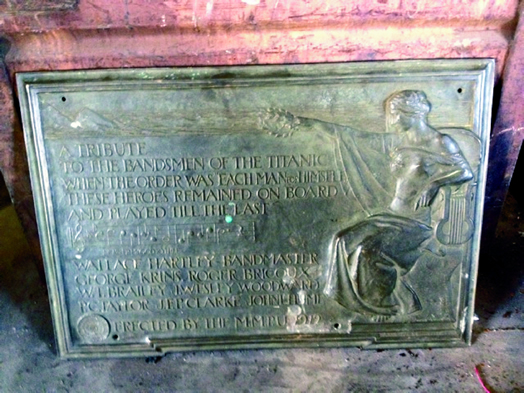
A bronze tablet in memory of the seven ship’s musicians who died when the Titanic sank was unveiled yesterday morning by members of the Musical Mutual Protective Union at their clubhouse, the Yorkville Casino.

The tablet is the work of Albert Weinert. It is 30 by 24 inches, and has a feminine figure, symbolic of music, placing a wreath of oak leaves on an expanse of placid water, broken by an iceberg. Beneath is the inscription:

A tribute to the bandsmen of the Titanic. When the order was “Each man for himself,” these heroes remained on board and played until the last.

Then follow the first two bars of the music of “Nearer, My God, to Thee,” and the names, Wallace Hartley, bandmaster; George Krins, Roger Bricoux, W. T. Brailey, J. Wesley Woodward, P. C. Taylor, J. F. P. Clarke, John L. Hume.

[As readers can see from the list of names, there were eight men.  Why the New-York Tribune report reads only seven, I don’t know—unless for some reason the reporter didn’t count bandleader Hartley as a musician.

[The hymn “Nearer, My God, to Thee” was chosen on the spot as the last tune the band played.  The Baltimore Sun article referenced above reported that Edward Wheelton, the chief steward of the liner, recounted:

The ship’s band played as the boats were being lowered.  These musicians were the real heroes.  They played selections from the operas and the latest popular melodies of Europe and America.  Only before the final plunge did they change the character of the program.  Then they played “Nearer, My God, to Thee.”

[Albert Weinert (1863-1947) was a German-born American sculptor.  Yorkville is a Manhattan neighborhood bounded on the south by East 79th Street, on the north by East 96th Street, on the west by Third Avenue, and on the east by the East River.  At the time of this history, it had largely German inhabitants.

[The Yorkville Casino at 210 East 86th Street was erected by the Musician’s Mutual Protective Union (the forerunner of Local 802 of the AFM) as a social center for meetings, dances, and such for the area’s growing population.]
                

 *  *  *  *
THE MYSTERY OF THE TITANIC MUSICIANS’ PLAQUE
by Tino Gagliardi

[The three following articles are all from the magazine of the American Federation of Musicians Local 802, Allegro 113.9 (October, 2013).  Local 802 is the branch of AFM that represents the pit musicians for Broadway and Off-Broadway musicals.  (There are some supplementary articles at the end of this post, from an earlier issue.)  They all have something to do with the same remarkable, and historic, tale which unfolded in the pages of Allegro in 2010 and 2013.

[I’m republishing them on Rick On Theater because, first, they are part of New York City’s arts history, which is an element of my mission for ROT, and, second . . . well, it’s a fascinating story.] 

President's Report

This month, we’re pleased to present in Allegro a story that’s stranger than fiction. It’s the story of a bronze plaque that Local 802 commissioned over 100 years ago from a well-known artist. The plaque was created to honor the heroism of the musicians of the Titanic, who literally went down with the ship. For years, we owned and proudly displayed this plaque as well as a similar plaque honoring our members who lost their lives in World War II. These plaques were hung in our old location – Roseland Ballroom – on West 52nd Street. When we left Roseland in 1982, the plaques stayed behind by mistake. In fact, they were there as recently as last year. Then, when Roseland started doing some renovations, they got rid of the plaques. (Why we weren’t contacted at that time is a mystery.) The next thing we know, the plaques are in Orlando at a Titanic exhibition! The complete story of these plaques’ journey will boggle your mind.

[Tino Gagliardi is President of Local 802.] 

*  *  *  *
TITANIC MYSTERY
by Charles A. Haas 

Musicians & Heroes

If you were performing on an ocean liner and suddenly the ship hit an iceberg and began to sink, would you keep playing? As many know, that’s the story of what the musicians on the Titanic did just over 101 years ago, on April 15, 1912.

The eight musicians, led by bandmaster and violinist Wallace Hartley, died playing their instruments, according to Titanic survivors who heard ragtime and other upbeat music being played until nearly the end.

A little over a year after the Titanic sank, members of the original New York City musicians’ local performed a benefit concert for the families of the musicians. The union also commissioned a bronze tablet to commemorate them.

The tablet was unveiled at a ceremony where eight union musicians played, using the same instrumentation as the Titanic band. The concert closed with the hymn Nearer, My God, to Thee, which some believe to be the last piece that the Titanic musicians played before the ship went down.

But where did the Titanic musicians’ memorial plaque end up? Three years ago, Allegro received an inquiry from the Titanic International Society asking about the whereabouts of the plaque.

It was the first we’d ever heard of it. But we had it all along. introduction by Mikael Elsila

This is the story of a bronze plaque that was twice rescued from the scrapyard. It has to do first and foremost with the Titanic and its brave musicians. But it also reminds us of the very origins of Local 802. There’s lots of luck here, too. It begins with the tragic events of April 15, 1912 . . .

When news came that the Titanic had foundered in the North Atlantic with the loss of more than 1,500, it was probably inevitable that the heroic deaths of Titanic bandmaster Wallace Hartley and his seven colleagues would touch the hearts of their musical brethren in New York. By Saturday, April 27, 1912 – a mere 12 days after the Titanic met its demise – the Musical Mutual Protective Union (MMPU), Local 310, then the New York City affiliate of the American Federation of Musicians, had appointed a committee chaired by its president, William J. Kerngood, to organize a concert to aid the bandsmen’s families. Victor Herbert and John Phillip Sousa were among the committee’s members. Additionally, the union apparently asked its 5,000 members to contribute what they could to the cause.

The concert, featuring the talents of more than 500 musicians, duly took place on Sunday, June 2, 1912 at New York’s Moulin Rouge Theatre (later renamed the New York Theatre), donated for that purpose by its owner, theater impresario Florenz Ziegfeld. As they entered their box seats, the captain and some of crew of the Carpathia – the ship that rescued the Titanic’s survivors – received prolonged applause, while about 100 additional Carpathia crew members took their seats below. Seven New York City-based bands played selections ranging from the grand march from Aida to the Leonore Overture and the Intermezzo from Cavalleria Rusticana. The evening, which raised $1,500, concluded with a poignant rendering of “Nearer, My God, to Thee,” the hymn famously played by the Titanic musicians as they went down with the ship.

On May 19, 1912, the musicians’ union offered a Sunday evening concert for members at their New York headquarters – the Yorkville Casino – to further aid the bandsmen’s next of kin, raising another $1,800. Meanwhile, the MMPU had begun to plan a more permanent remembrance of the heroism of Titanic’s orchestra in the form of a bronze tablet. The chosen design was that of German-born Albert Weinert, a 49-year-old sculptor at the zenith of his career. Among his earlier commissions had been the William McKinley Memorial in Toledo, Ohio, the Haymarket Martyrs’ Memorial in Chicago, and, at Washington, D.C.’s Library of Congress, the Court of Neptune Fountain and extensive Reading Room interior decorations.

Likely during the summer of 1912, the union’s board of directors authorized production of the bronze plaque by the Jno. Williams Foundry of West 27th Street in Manhattan. The highly regarded Williams firm had cast works by Daniel Chester French and Augustus Saint-Gaudens, among other notable American sculptors. Foundry workers carefully etched and sculpted the mold (possibly under Weinert’s direct supervision). Several test castings in a base metal may have been made before production of the final plaque began. Amid hellish heat inside the foundry building, workers began melting copper and tin, then mixed them to form bronze, and carefully poured the molten metal into the mold. On the plaque’s reverse side, mounting posts were imbedded or attached at each corner while the plaque’s metal was still liquid. The assemblage was allowed to cool and solidify. Then Williams’ skilled bronze smiths separated the plaque from its mold and carefully polished and perfected the tablet’s bas-relief front surface.

The completed plaque measured two feet tall by three feet wide by about a quarter-inch thick and weighed nearly 70 pounds. The first view of the finished product was a stand-alone photograph in the October 1912 issue of the Quarterly Bulletin of the American Institute of Architects, which credited the sculptor and foundry, but offered no further information.

While the bustle of America’s largest city paused on a Sunday, November 3, 1912, the musicians’ union officers, board of trustees, the Titanic Musicians Memorial committee and union members gathered at 11 a.m. at 210 East 86th Street in Manhattan, the MMPU’s Yorkville Casino headquarters. Associated Press reporters were invited to attend, and stories recording the plaque’s dedication soon appeared in newspapers throughout the United States.

In a simple ceremony in the building’s lobby, the tablet was formally dedicated. Draped in American and British flags, it was unveiled by union president William Kerngood, who said, “Language fails in attempting a tribute to the conduct of these heroes, just as it failed in the tumult and the panic when they died. The call of the Lord was as sudden for them as for the others, but they found a selection appropriate to that supreme moment and did their duty as they saw it. May we and all musicians prove as worthy of Music as they did, and may these men rest in peace.” Under union member Nic Briglio’s direction, an eight-member orchestra with instruments identical to those on board the Titanic played “Nearer, My God to Thee,” which was followed by a solitary trumpeter playing “Taps.”

Those present then pressed forward to view sculptor Albert Weinert’s artistry. His design featured a female figure representing music, casting a laurel wreath upon the ocean, its placid surface interrupted by an iceberg. Below were the words, “A Tribute to the Bandsmen of the Titanic. When the Order was ‘Each Man for Himself,’ These Heroes Remained on Board and Played Till the Last.” The words were followed by an image of the two opening bars of “Nearer, My God, to Thee,” (the “Bethany” or “American” version), followed by the eight musicians’ names: “Wallace Hartley, Bandmaster; George Krins, Roger Bricoux, W. T. Brailey, J. Wesley Woodward, P. C. Taylor, J. F. P. Clarke, John L Hume.” To the right of the union’s raised seal, the text concluded, “Erected by the M.M.P.U. 1912″; the sculptor’s name “A. Weinert” modestly appeared in the plaque’s outer framing.

The dedication ceremony concluded, the crowd quietly dispersed.

The plaque remained in its place of prominence even as a sizable addition to the building was constructed from 1916 to 1919 on adjacent East 85th Street in Manhattan. The Musical Mutual Protective Union’s Local 310 lost its charter in 1921 after a dispute with the parent union and soon was dissolved, to be replaced by Local 802.

Over the next 54 years, thousands of visitors – union members and those attending functions booked at the hall – passed by this enduring tribute to Titanic’s gallant musicians. No photographs of the plaque in situ are presently known to exist.

By 1966, the Upper East Side of Manhattan was undergoing a building boom, and the East 86th Street portion of the building, now owned by the Ornstein family of real estate developers, was demolished and replaced by a high-rise, multipurpose building; the East 85th Street addition remained, its engraved “Musical Mutual Protective Union” fascia still present in 2013. It is now a movie theater. It is not known who rescued the tablet when its longtime home was torn down, but it found its way to the Roseland Ballroom at 229 West 52nd Street, then Local 802’s headquarters. The building’s then-owner Louis Brecker said, “Cheek-to-cheek dancing, that’s what this place is all about,” but according to Wikipedia, “Brecker sold the building in 1981. Under new owners the Roseland began regularly scheduled ‘disco nights,’ which gave rise to a period when it was considered a dangerous venue and neighborhood menace,” with several murders taking place there. And apparently it was here, for more than 35 years, that the Titanic musicians’ plaque remained. Local 802 left Roseland for its new quarters in 1982, apparently leaving the plaque behind.

Titanic International Society’s historian John P. Eaton, a lifelong music aficionado, has maintained a long-term respect for and interest in Titanic’s musicians. His capacious files included a rather blurry photocopied image of the plaque he’d found years ago in a musicians’ journal at the New York Public Library; the image found its way into the first (1986) edition of the book he co-authored with Charles Haas, Titanic: Triumph and Tragedy, with a caption noting the plaque’s “current whereabouts are not known,” a notation sadly repeated in the second (1994) edition. In 2010, as work on the third edition of this book began, Haas suggested that Eaton contact Local 802 to inquire whether the union knew the plaque’s location. Eaton received a response from Mikael Elsila, the editor of the union’s magazine Allegro, who interviewed Eaton by telephone about the missing memorial. In April 2010, Allegro ran a story that said, in part, “The search is on for a missing plaque that commemorates the musicians. It’s just possible that an Allegro reader has some clues of where it might be,” and it urged union members to get in touch with Elsila if they “had ever heard of this tablet or even seen it.” And there, response to Jack’s inquiry ended, without success. Until now.

Upon graduation from high school in central Pennsylvania, Douglas Turner served in the 101st Airborne Division of the United States Army. He relocated to Naples, Florida in 1989, and now, at age 45, is a sergeant in the Collier County (Florida) Sheriff’s Department, a 23-year veteran specializing in criminal investigations. It’s a tough job with long hours and high stress. In his off-duty hours, Doug and his wife enjoy visiting local antique dealers and scrap yards, looking for unusual items.

On Friday, Jan. 25, 2013, Turner visited one of their favorite local scrap yards, meandering through a veritable jumble of discarded items awaiting resale or disposal. On the floor, leaning against a basket filled with insulated wire about to be melted down, was a flat metallic object covered with dust, grease, some corrosion and verdigris. Turner thought the item “kind of peculiar.” After going home and giving the matter some thought, its reference to Titanic intriguing him, he returned on Wednesday, Jan. 30, and inquired of the yard’s owner about its origins and the asking price. The owner, a friend of Turner’s, said someone had brought it in with another plaque, a Local 802 war memorial. The scrap yard owner was asking “a ridiculous price” for the pair, according to Turner, just $2 per pound, the going price for bronze, mentioning he had purchased it from someone from New York for $1.61 a pound. Turner happily paid the asking price for both the Titanic and war memorial plaques, totaling, with sales tax, just over $300, which certainly did not reflect any historical value. When he pointed out one plaque’s Titanic reference, the yard’s owner remarked, “I knew I should have thrown it into the basket to melt it down!” and said that within days, that would have been the fate of the plaque and the wire in the basket. During its five-day presence at the scrapyard, hundreds of people had passed it by without giving the historic piece much notice.

As a law enforcement officer, Turner realized he had a special obligation to check further into the plaques’ origins. He found no reports that either had been stolen. Eventually, he learned how they had made their 1,100-mile journey to Florida.

Under new ownership, the Roseland Ballroom underwent renovations in 2012. Early in that year, a Roseland employee told “Percy,” a construction worker in his early 40s, that the two plaques should be removed from the premises, and, so far as she was concerned, he could “take ’em and sell ’em for scrap.” Percy took the tablets and kept them at his home for nearly a year.

A Peruvian by birth and a U.S. resident for more than 20 years, Percy’s English was imperfect, perhaps explaining why several New York City antique dealers, when contacted, offered him as little as $10 for both plaques. It would have been easy for Percy to have ridded himself of them for such a pittance, but he did not do so.

Percy and his wife moved to Florida in early January 2013, bringing the plaques with them. The trip to the Sunshine State having left them nearly penniless, he sold the plaques to the scrap yard for $100.

After making his purchase, Doug Turner wanted to know more, and online had found the Allegro article in which Jack Eaton had inquired about the Titanic musicians’ plaque’s whereabouts. Turner contacted the musicians’ union in New York City and was given historian Eaton’s contact information.

On Jan. 31, 2013, Titanic International Society’s president Charles Haas spoke by telephone with Doug Turner at his Florida home. He mentioned that at some time in the past, likely when the plaques were removed from the MMPU’s Yorkville Casino, the mounting studs on the Titanic plaque’s reverse side had been broken off, and someone had drilled holes in each corner to permit its remounting, but otherwise it was in good condition.

Within minutes, Haas knew the plaque was in very good hands. Turner had gently wiped the plaque’s surfaces with a damp cloth to remove dirt and grime, and was seeking our advice about valuation, insurance, conservation and ongoing care. Haas offered several suggestions, then put Turner in touch with Andrew Aldridge of Henry Aldridge & Son Auctions in the UK, a respected firm specializing in Titanic items. Upon receiving details and photos of the plaque, Aldridge provided a valuation that permitted Turner to obtain insurance coverage and advised conservation (rather than restoration), explaining that the plaque’s present imperfections are part-and-parcel of the piece’s history. Despite its considerable value and its uniqueness, Turner does not wish to sell this historic piece. Instead, he wants very much to exhibit it publicly. Titanic International Society has assisted Turner in finding suitable venues for its public display.

On Aug. 15, 2013, in a ceremony recalling the original dedication in 1912, Turner and Haas unveiled the plaque at “Titanic: The Experience,” Premier Exhibitions, Inc.’s Titanic artifact exhibition in Orlando, Florida, where it will remain on display for at least six months. The plaque is the highlight of an exhibition room detailing the human cost of Titanic’s loss.

More than a century ago, the heroism of Titanic’s bandsmen prompted their musical colleagues ashore to create a lasting tribute to those men and their final moments. History saw fit to abbreviate the plaque’s role in reminding us of their deeds. But now, with its providential, last-minute reprieves from the smelter and its re-emergence in the hands of a history-conscious sheriff’s officer, it can resume its rightful place as one of America’s most significant Titanic memorials.

[Charles Haas is president of the Titanic International Society. Mikael Elsila is Communications Director at Local 802; he studied French horn, piano, improvisation and ethnomusicology. Additional information about Titanic International Society may be obtained from the Society’s Web site, www.TitanicInternationalSociety.org, or by sending a stamped, self-addressed envelope to Titanic International Society, Inc., Post Office Box 416, Midland Park, NJ 07432-0416.]

*  *  *  *
LOST AND FOUND
by Harvey S. Mars, Esq. 

Legal Corner

I recently had the unique experience of attending the unveiling of the recently discovered 101-year-old plaque commemorating the musicians who lost their lives on the Titanic. The ceremony took place at “Titanic: the Experience,” an exhibition in Orlando.

In April 2010, Allegro published an article regarding this plaque after we were contacted by John P. Eaton, historian of the Titanic International Society. Mr. Eaton was interested in learning the whereabouts of the plaque. The article beseeched anyone knowing of the whereabouts of the plaque to contact Allegro’s editor, Mikael Elsila.

Well, the plague was found, partially as a result of our article.

Florida resident Douglas Turner, a law enforcement officer who enjoys visiting scrap yards looking for items of value, found and purchased the Titanic plaque as well as another plaque commissioned by Local 802 memorializing musicians who had lost their lives in World War II.

Upon reading the Allegro article, Mr. Turner contacted the Titanic society and inquired as to where the plaque could be publicly shown. Ultimately, a six-month license was awarded to “Titanic: the Experience,” where the beautiful plaque currently hangs. Pictures truly do not do it justice.

During the unveiling ceremony, local musicians played “Nearer, My God to Three,” the same composition that many believe the musicians on the Titanic played while the ship was sinking.

As I listened, I wondered what the musicians were thinking and feeling while the ship was sinking. Were they absorbed by the music and solely focused on it? Did they play to soothe themselves knowing of their impending doom? Did they realize that they were heroes, who – through the calming strains of their music – saved many lives and helped keep order while the life-boats were boarded? It was hard for me not to get choked up.

How did the plaque wind up in the scrap yard? Charles Haas, president of the Titanic International Society, tells this amazing tale in this issue.

Two additional points are worth mentioning. First, the plaques were Local 802’s property for many decades. They last hung on the wall at the Roseland Ballroom, which was formerly the union’s headquarters. However, when Local 802 left Roseland in 1982, both the Titanic plaque and the World War II memorial plaque were inadvertently left behind.

Having been abandoned for more than 25 years, the plaques became the legal property of Mr. Turner when he purchased them in Florida. Under common law rules, the individual who purchases or takes possession of abandoned property becomes its rightful owner. (Hence, the partially true maxim: “possession is nine-tenths of the law.”)

However, we are very fortunate that Mr. Turner salvaged these plaques, since it is clear that they would have been destroyed. The hand of fate definitely played a role in this incident.

The other point is one I learned directly from Mr. Haas after the ceremony. The Titanic’s musicians were not employees of the White Star Line (Titanic’s owner), which had recently begun contracting musicians via an outside agency. Thus, these musicians were independent contractors who had been supplied by a third party. Because of this, they were listed as second-class passengers, and not crew. This meant that they were free to evacuate the ship with the passengers. They chose not to, and remained on board. They met their death doing what they loved to do: performing music for others.

We hope that at the end of the six- month lease, Local 802 can enter into an arrangement with Mr. Turner so that we can return both plaques to where they were meant to be: at Local 802.

[Harvey Mars is counsel to Local 802.]

*  *  *  *
LOCAL 802 HAS TITANIC HISTORY

[The two articles below, from Allegro 110.4 (April 2010), were the notices that started the saga of relocating and restoring the AFM plaques commemorating the sinking of the RMS Titanic.]

If you were performing on an ocean liner and suddenly the ship hit an iceberg and began to sink, would you keep playing? As many know, that’s the story of what the musicians on the Titanic did 98 years ago this month, on April 15, 1912.

The eight musicians, led by violinist Wallace Hartley, died playing their instruments, according to Titanic survivors who heard ragtime and other upbeat music being played up until nearly the end.

Now the search is on for a missing plaque that commemorates the musicians.

It’s just possible that an Allegro reader has some clues of where it might be.

Here’s the story.

A little over a year after the Titanic sank, members of the original New York City musicians’ local – originally called the Musicians Mutual Protective Union and later AFM Local 310 – performed a benefit concert for the families of the deceased Titanic musicians, raising $1,800.

The union was then located at the Yorkville Casino at 210 East 86th Street.

Later that fall, the union commissioned a bronze tablet to commemorate the Titanic musicians.

The tablet was unveiled at a ceremony where eight union musicians – utilizing the same instrumentation as the Titanic band – performed a tribute concert.

The concert closed with the hymn “Nearer, My God, to Thee,” which some believe to be the last piece that the Titanic musicians played before they went down.

Both the International Musician and the New York Times covered the event.

But where is the Titanic musicians’ memorial plaque now? Local 310 ceased to exist in the 1920’s after a feud with the nascent Local 802.

And the assets of Local 310 may have been absorbed by the AFM.

Recently, Allegro received an inquiry from the Titanic International Society asking about the whereabouts of the plaque.

It was the first we’d ever heard of it.

If any member has heard of this tablet or even seen it, please contact Allegro editor Mikael Elsila at Allegro@Local802afm.org.

Otherwise, the spirit of the Titanic musicians must live on in memory.

*  *  *  *
UNLIKELY HEROES:
REMEMBERING THE BANDSMEN ON THE TITANIC - 98 YEARS LATER
by John P. Eaton
 

Heroism in music takes many forms. The political heroism of a Sibelius or a Toscanini. Marian Anderson’s heroism of the spirit. The heroism of innovation: Bach, Richard Wagner, Charles Ives, Stravinsky. The quiet heroism of vocal coaches, chorus members and grade school music teachers: nameless people, but people without whose contributions to music’s fabric there would ultimately be no giants, no legendary stars.

The quietest, least known are often the most heroic.

Many years ago, when I was first encountering details of the liner Titanic and her tragic loss, I was introduced to a veritable pantheon of nameless heroes: men and women among the passengers who unselfishly gave up their lifeboat seats to others; stokers and engineers who kept the doomed vessel’s lights burning until almost the last moment; all those who died that others might live.

Among the many acts of heroism performed on the North Atlantic that cold night so many Aprils ago, none to me surpasses the contribution of Titanic’s bandsmen: Brailey, Bricoux, Clarke, Hume, Krins, Taylor, Woodward, and their leader, Wallace Hartley.

Titanic struck the berg which doomed her at 11:40 p.m. on April 14, 1912.

Shortly after midnight, the musicians assembled in the forward first-class entrance, where passengers began gathering before going to the lifeboats.

The band’s music established a quick, bright tempo that kept the passengers’ feet moving to its beat.

Suspicion and even panic was averted by the musicians’ presence.

(“Why, if they’re playing here, things can’t be that bad.”) Later, when most passengers were on the promenade and boat decks, the band reassembled outside the gymnasium near the first class entrance’s starboard side.

Around 12:45 a.m., as the first lifeboat was being lowered, they began playing a brave counterpoint to the sound of shuffling feet and the increasing murmur of confused passengers.

Their music helped to bring order to the proceedings.

Their repertoire of marches, quicksteps and occasional waltz tunes were performed with coldstiffened fingers through the next hour and 20 minutes.

The last lifeboat was lowered at 2:05 a.m. But a few brief moments remained.

High on the boat deck, Titanic’s bandsmen paused in their music making. The deck beneath them began a slow, almost imperceptible slant forward.

Cold hands gripped instruments tightly, chilled fingers groped for taut strings. Bandmaster Hartley tapped his bow and spoke a title.

The strains of the well-loved “Londonderry Air” (“Danny Boy” to many) drifted across the calm waters now dotted with drifting lifeboats.

The slanting deck grew steeper, more slippery. Footing became more difficult.

The music ceased, then began again, thinly, as Hartley, perhaps in reverie, pulled his bow across the strings for a final time.

He was joined as, one by one, the other players picked up the familiar tune – the hymn played at the gravesides of fellow musicians departed, and Hartley’s own favorite, “Nearer My God, to Thee.”

At this point, it became impossible to stand without falling. The music’s sounds were lost in an increasingly thunderous roar.

Titanic’s stern rose high out of the water.

Lights that had stayed lit for so long – at the price of many lives – flickered, turned red as current fails, then went out forever.

Dark, now, against the starlit sky, Titanic rose almost upright, paused, then began a slow, inevitable slide . . .

Today, Titanic rests in decaying grandeur at the bottom of the North Atlantic, a memorial to all who lost their lives, a remembrance of humanity’s folly and our disregard of nature’s supremacy.

Titanic is cold and dark and silent now.

But above the agony of her loss and the grief for her dead soar the unselfish, heroic harmonies of her bandsmen – steadfast to the end, sharing their lives, their gift of music, so that others might die with dignity; sharing their deaths with Titanic’s dead so that all are surely inscribed in the Book of Life as heroes.

[John P. Eaton (1926-2021) was the Society’s historian is an authority on the Titanic: he is the co-author of five full-length books and many articles about the Titanic and has even dived on the wreck site.  Eaton was the historian of the Titanic International Society until his death.]


05 July 2023

"Who Wrote Bach's Music?"

by Professor Martin Jarvis 

[uncovering a mystery: Why do the six suites for unaccompanied cello, historically attributed to Johann Sebastian Bach (1685-1750), sound so different from the sonatas and partitas for solo violin also linked to the German composer?  New evidence shows that Bach’s second wife, Anna Magdalena Bach (née Wilcke, 1701-60; m. 1721), may have composed the cello suites.  The score of the Cello Suite No. 1 from the historical edition is in Anna Magdalena’s own handwriting.

[Martin Jarvis’s “Who Wrote Bach’s Music?” first appeared in the March 2013 issue (113.3) of Allegro, the magazine of the New York City musicians’ union (AFM Local 802).  ALERT: Readers should be aware that since this article’s appearance, several musicologists, musicians, and Bach scholars have disputed Jarvis’s findings.  I’ve appended sections from two Wikipedia pages below which address this controversy.]

Were some of J. S. Bach’s compositions actually composed by his wife, Anna Magdalena? In this exclusive story for Allegro, Professor Martin Jarvis [b. 1951], from Charles Darwin University in Australia, shares with us the intriguing results of his research, just in time for Women’s History Month (and also Bach’s 328th birthday!)

Johann Sebastian Bach is often referred to as the father of Western music. And as a composer, Bach looms large in the minds of just about every musician I have ever met. Therefore, any suggestion that things might not actually be the way we have come to understand them is not likely to be greeted with great enthusiasm!

But it may be time for a serious upheaval in our understanding of who composed Bach’s works. In my book “Written by Mrs. Bach,” (HarperCollins/ABC Books, [2011;] see www.bit.ly/BachBook), I describe my attempt to uncover the origins of the six cello suites and other works long attributed to Bach.

My search for the truth has taken me on a great and rewarding adventure, including a deep foray into a field of scientific investigation called forensic document examination, which is the study of documents and handwriting for the purpose of demonstrating authenticity. The results are astonishing.

Because space is limited, what I have written here is merely a summary of the journey from my early suspicions that all was not right, to how I reached my conclusions.

My first experience of playing the music of Johann Sebastian Bach was when I began studying Bach’s A-minor violin concerto in my early teens. Later, I won a scholarship to study at the Welsh College of Music in Cardiff with Garfield Phillips, the concertmaster of the BBC Welsh Orchestra. I still remember my lessons with Professor Phillips, where we worked on Bach’s unaccompanied violin sonatas and partitas [a term Bach used as a label for collections of musical pieces, a synonym for suite]. He marked up my music with a green ink fountain pen – a very unusual habit!

In 1971, I won a place at the Royal Academy of Music, where I studied violin with the highly respected violinist and teacher Clarence Myerscough. At the same time I also studied viola with Winifred Copperwheat. Professor Copperwheat was only four feet ten inches tall, and I am six feet one inch tall, so I literally towered over this wonderfully insightful and very great musician.

Immediately after I began my studies with Professor Copperwheat, she instructed me to obtain a copy of the six cello suites of Bach, arranged for viola. She was very specific about the edition I was to purchase; she wanted me to get the Lifschey edition, not the Svenky.

What I was not aware of at the time was that in the case of the cello suites, there was a very significant reason for Winifred’s insistence. I was to learn soon that there was no manuscript of the cello suites in Bach’s own hand, and so every editor of the suites (whether for viola or cello) has made decisions about the bowings, and indeed even some of the notes to be played.

These changes were necessary, Winifred informed me, because the only complete manuscript of the suites was in the hand of Bach’s second wife, Anna Magdalena, and it was, according to tradition, full of inaccuracies and all but illegible.

It is important to know that the matter of the differing editions is very significant indeed. Cellist Dimitry Markevitch, editor of a 1964 edition of the suites and discoverer of the so-called Westphal manuscripts, claimed that he had 61 editions of the six cello suites in his library and stated that there have appeared, since the first printed edition, some 93 editions or versions of the suites.

It must be stressed that these different editions vary substantially one from another. The cellist Uzi Wiesel says that this caused a veritable mishmash of stylistic interpretations when he attended a series of performances in Paris in the 1990s. Further, Wiesel was most critical of those who played the suites using only Anna Magdalena’s manuscript as the source.

This begs a very interesting question: why does Anna Magdalena’s manuscript, as Wiesel says in his review, sound “strange to my ears”?

It is worth pointing out that the chamber music of Bach was not published during his lifetime, and it has been said that it was composed for domestic consumption or performance. So the cello suites are most likely to have been written for someone within the household, rather than an outsider – which is the traditional view, of course.

As well as the undated Anna Magdalena version, there are two anonymous handwritten copies of the suites from the later 18th century, plus a version written out by Johann Peter Kellner [1705-72], one of Bach’s most important copyists, with a suggested date of 1726.

Let’s return to my early lessons at the Royal Academy of Music in London. The following week, I duly turned up to my viola class with the Lifschey edition. As soon as I began to play the prelude, I was struck by the vast differences between the two sets of music I was studying: the unaccompanied violin sonatas and partitas on the one hand, and the cello suites on the other.

Visually, the violin works appear complex and intellectually very challenging. By comparison, the prelude of the first suite appears to be rather simple, at least on the surface.

I immediately became certain that I what I was playing was not written by the same person. However, I tried very hard to believe that J. S. Bach was, in fact, the composer. As I practiced the suite, I diligently applied all my knowledge and prior experience of Bach as I worked away at the music. But try as I might I could not feel at ease.

Despite the fact that over the ensuing four years I studied all the movements of some of the cello suites and some movements from others, the thought would not go away. There was something wrong with the sound and the structure of the music, but I couldn’t put my finger on it.

When I raised my concerns about the suites with Professor Copperwheat, she told me the story of Pablo Casals’ experience with the cello suites and his long journey to first performing them. The suites were, apparently, “rediscovered” by Casals in 1890 when he was around 14 years old. He and his father, it is said, came across a copy in a music shop. Later, according to a biography by Robert Baldock, “…Casals discovered that, if they were played at all, the Bach suites had been used as academic, technical exercises… For the next twelve years he worked on them in seclusion…at the beginning of his career he began to introduce them into his recital programmes…he performed them on many hundreds of occasions, he never approached them without reverence, humility – and even fear.”

I took heart from that story. Winifred also explained to me that the suites were not performed much, if at all, in concert during the 19th century. As I found out much later, this may be because when they were first published in Paris in 1824, they went under the title “Six Sonates ou Etudes Pour Le Violoncelle Solo” – technical studies for cello! The idea that they were etudes would undoubtedly have led to the perception that they were lesser music.

Even the great 19th-century composer Robert Schumann [1810-56] considered them to be musically incomplete, so he added a piano accompaniment!

Finally, Philipp Spitta [1841-94], the most significant 19th-century biographer of Bach, acknowledged the very different character and proportions of the cello suites, but attributed the difference to what he considered the cello’s limited expressive quality.

All of these reasons may have contributed to the fact that cellists apparently abandoned the suites at that time and why they were not considered an important part of the cellists’ repertoire.

After leaving the Academy in 1975, I first worked as a freelance player with the London Mozart Players and other London-based orchestras before taking up a position with the Halle Orchestra in Manchester. This group was very busy performing all over the world, so there was plenty of time to talk with colleagues about many musical issues, including the cello suites.

The cellists I spoke with had various opinions on the subject. Some believed that the suites were difficult to interpret because there had not been a continuous history of performance, unlike the violin sonatas and partitas. Others believed it was because the suites were not composed by a cellist. Some thought that they were written much earlier than the violin works by a very young J. S. Bach, and this was why they are musically simpler.

But no one could really say conclusively what it was about the cello suites that makes them, as the great Yo-Yo Ma [b. 1955] put it “…considered by many to be the most challenging of the solo repertoire.”

A powerful question kept rattling around in my brain. Was it possible that the cello suites were not actually composed by J. S. Bach?

In 2000, Bärenreiter published a new edition of the suites as part the commemoration of the 250th anniversary of Bach’s death. The edition included a facsimile of the Anna Magdalena manuscript of the suites. I was quite stunned by what I saw. The music calligraphy was very beautiful, precise and elegant, and not at all hard to read.

I immediately became convinced as I looked at Anna Magdalena Bach’s supposed “copy” of the cello suites that this was not a copy of someone else’s music – but her own. This was mainly because the music calligraphy appeared to flow easily and to be very self-assured, which is consistent with someone writing out material with which they are very familiar. At the same time it lacked any sense of the slowness of execution that would be consistent with someone working to accurately copy from another source, especially if they are trying to mimic the music calligraphy of the original.

I began the slow process of comparing the cello suites with the violin sonatas and partitas. This involved painstakingly deconstructing both sets of music by analyzing the harmonies used.

I examined the movement structures of the suites and aligned them with the movement structures of the violin partitas. The first thing that stood out to me was the apparent symmetry of the suites, when compared to the very non-symmetrical partitas. Was this just a coincidence, or an exception – or was this something important? I needed to find out.

By the end of 2002 my structural and musical analysis of the cello suites had revealed 17 reasons why they did not musically match any other work of J. S. Bach’s in the same genre. But it was the use of the science of forensic document examination that eventually enabled me to identify Anna Magdalena’s own handwriting and music calligraphy in manuscripts dating back to 1713 – seven years prior to the usually accepted date when Anna Magdalena and J. S. Bach first met. I realized finally that Anna Magdalena’s involvement was much deeper than usually believed.

Finally, if we look at one of the earliest copies of the cello suites from 1727 or 1728, we see the words of the chamber musician Georg Heinrich Ludwig Schwanenberger [1696-1774] on the title page. It says, in French, (“ecrite par Madame Bachen Son Epouse”), “Written by Mrs Bach His Wife.” That convinced me that Anna Magdalena was probably the composer.

So who exactly was Anna Magdalena Bach? The evidence strongly suggests that she was a composition student of J. S. Bach. It is known that she was a trained musician, and that when she was employed at the Cöthen Court at the age of 20 she was the second most highly paid musician. [Anhalt-Köthen was a principality of the Holy Roman Empire; Köthen is now the capital of the eastern German state of Saxony-Anhalt.] Only Bach was paid more. This begs a number of questions, including why was she paid so highly and why has she not been recognized as a composer before?

I hope I’ve left you with a tantalizing first course. Readers who wish to know more about Anna Magdalena will find answers to these and many more questions in my book.

One postscript. When the early findings of my research were first published in the very early 2000s I had no support from any of my colleagues, except the principal cellist of the Darwin Symphony Orchestra, Rebecca Harris. But over the ensuing years many cellists and other musicians have contacted me to welcome my findings. For example, one cellist wrote to me, “I have become convinced, at least on an emotional level, that the [cello] suites are indeed not by the same composer [as the violin sonatas and partitas] … I do feel somewhat heretical and have not said much of my thoughts on this subject except to my wife!”

[Professor Martin W. B. Jarvis is professor of music and head of the School of Creative Arts and Humanities at Charles Darwin University in Darwin, Northern Territory, Australia. There he teaches viola, violin and conducting. Professor Jarvis also served as artistic director of the Darwin Symphony Orchestra for 20 years.]

*  *  *  *

[When I first read Martin Jarvis’s “Who Wrote Bach’s Music” in Allegro seven years ago, I found it interesting in the same way that reading the arguments theater and literary scholars use to support claims that William Shakespeare didn’t write his plays and advocating for other claimants to The Bard’s achievement. 

[I know far less about music, let alone Bach, than I do about theater and Shakespeare, but I felt that Jarvis’s “evidence,” as he lays it out in the brief article (I haven’t read Written By Mrs Bach) was largely his impressions and feelings, not to mention his musical intuition.  Since I don’t know Jarvis, even by reputation, I don’t have any idea how much I can rely on that—it’s entirely subjective.

[Since the publication of both Jarvis’s book and the Allegro article, there have been a number of critical responses to his contention that Anna Magdalena Bach was the composer of the cello suites traditionally attributed to Johann Sebastian.  Below, I’m appending two excerpts from the Wikipedia entries on, first, Jarvis, himself (Martin Jarvis (conductor) - Wikipedia), and, second, Anna Magdalena Bach (Anna Magdalena Bach - Wikipedia).] 

From: “Martin Jarvis (conductor)
Wikipedia 

Research into Anna Magdalena Bach

During his studies at the Royal Academy of Music, his viola teacher Winifred Copperwheat [1905-76] made him aware of problems with the published editions of the six suites for unaccompanied cello commonly attributed to Johann Sebastian Bach. After research of his own, Jarvis has controversially postulated, using handwriting analysis heuristics, that the suites were composed by Bach’s wife Anna Magdalena [Lindy Kerin, “Bach’s wife believed to have penned cello works,” The Australian [Surry Hills, Australia] 28 Apr. 2006; Barbie Dutter and Roya Nikkha, “Bach works were written by his second wife, claims academic,” Daily Telegraph [London] 23 Apr. 2006]. Other academics such as Stephen Rose have responded that, while Anna Magdalena may have contributed to the labours on his manuscripts, “there is not enough evidence to show that she single-handedly composed the Cello Suites” [Dutter and Nikkha].

Jarvis was awarded a PhD from Charles Darwin University based on his research [“Wife behind Bach’s cello suites,” The Australian 31 October 2007], and presented his findings at an October 2008 meeting of the International Symposium on the Forensic Sciences in Melbourne [Anna Salleh, “Bach’s wife ‘may have been composer,’” ABC [Australian Broadcasting Corporation] News 4 Oct. 2008; Liz Porter, “The missus was the maestro,” Sydney [Australia] Morning Herald 5 Oct. 2008]. Regarding the generally-accepted portrayal of Anna Magdalena Bach’s role in music history and his own differing views, Jarvis himself has acknowledged, “My conclusions may not be wholly accurate, but the way in which tradition has put Anna Magdalena into this pathetic role [as merely the copyist] ... is rubbish” [Salleh]. Jarvis published the book Written by Mrs Bach in 2011; it was made into a documentary film in 2014 [LOOKSfilm, Written by Mrs Bach, wr. Robert Beedham, Martin Jarvis, and Pamela Kaufman; dir. Alex McCall and Irini Vachlioti; prod. Robert Beedham, Ramona Bergmann, et al.].

----------
From: “Anna Magdalena Bach
Wikipedia 

Dismissed claim of composership

Recently, it has been suggested that Anna Magdalena Bach composed several musical pieces bearing her husband’s name: Professor Martin Jarvis of the School of Music at Charles Darwin University in Darwin, Australia, claims that she composed the famed six cello suites (BWV 1007-1012) and was involved with the composition of the aria from the Goldberg Variations (BWV 988) [1741] and the opening prelude of The Well-Tempered Clavier [1722, 1742]. These ideas were also made into a TV documentary Written by Mrs Bach (BBC, 2018).

These claims have been virtually unanimously dismissed by Bach scholars and performers. Christoph Wolff [b. 1940] said:

When I served as director of the Leipzig Bach Archive from 2001 to 2013, I and my colleagues there extensively refuted the basic premises of the thesis, on grounds of documents, manuscript sources, and musical grounds. There is not a shred of evidence, but Jarvis doesn’t give up despite the fact that several years ago, at a Bach conference in Oxford, a room full of serious Bach scholars gave him an embarrassing showdown [Tim Cavanaugh, “Bogus Bach Theory Gets Media Singing,” National Review [New York] 29 Oct. 2014].

Writing in The Guardian, cellist Steven Isserlis [b. 1958] said, “I’m afraid that his theory is pure rubbish,” and continued, “How can anybody take this shoddy material seriously” [Steven Isserlis, “Suite scandal: why Bach’s wife cannot take credit for his cello masterwork,” Guardian [London] 29 Oct. 2014]?

Bach scholar Ruth Tatlow [b. 1956] has written a refutation at length, centred on the TV documentary, in the journal Understanding Bach, where she calls Jarvis’s claims “flawed and untenable” [Ruth Tatlow, “A Missed Opportunity: Reflections on Written by Mrs Bach,” Understanding Bach [Bach Network; Oxford, UK] 10 (2015); www.bachnetwork.co.uk/understanding-bach].


23 October 2019

"Winning On Stage: The secret weapon for winning auditions: 'Periodization'"

by Dr. Don Greene

[On 6 May, I republished an article from  Allegro, the member’s magazine of Local 802 of the American Federation of Musicians, called “Eight Strategies for Breaking Out of a Performance Slump” by Dr. Noa Kageyama, a sports psychologist and musician.  As the title states, it lays out some strategies for musicians to break out of a streak of poor performances.  Reading the article, I realized that Dr. Kageyama’s advice is valid for all performers, including actors.  So I posted her advice with inserted commentary concerning my own experience as an actor or stories I heard from colleagues in the biz.

[In the October 2019 issue of Allegro (vol. 19, no. 9), Dr. Don Greene, sports psychologist and stress coach, published an article with tips on succeeding at auditions.  Once again, the author is writing for and about musicians—Allegro is a musicians’ magazine, after all—but I can see that it’s applicable to actors, dancers, and singers.  (Dr. Greene’s bio indicates that he’s worked with Olympic athletes as well as musicians.)  So I’m posting “The Secret Weapon for Winning Auditions” on Rick On Theater for actors (and other performers) to consider.  We can all use help getting through auditions and, as Dr. Greene puts it, “winning” them.]


Do you ever find yourself peaking for your audition too early or too late? Do you feel yourself drained of energy before you even get to the audition? Or are you feeling so mentally and physically fatigued that you aren’t even motivated to prepare?

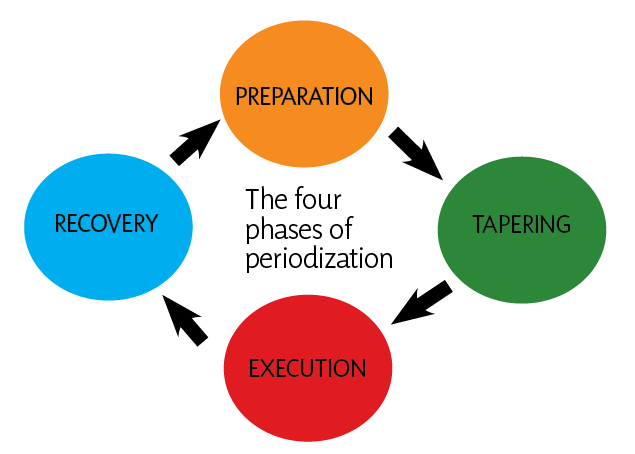
If so, you are reading the right article! There is a secret weapon that I teach called periodization, and it has been a game changer for all of my audition-winning clients. This periodization process involves training cycles with four distinct phases: preparation, tapering, execution and recovery. Periodization is designed to peak the performer’s energy at just the right time (like during the finals) in order to win.

Preparation phase

There is a lot of great information on the internet about various approaches to winning auditions. Most of the websites and blogs are by musicians who have won orchestral auditions themselves. These authors are emphasizing the physical, technical, organizational, and musical aspects of the audition preparation and actual audition performance. They usually address only the first phase of the periodization process: preparation.

Preparation involves both physical and mental work. The physical includes the organization of practice, technical work, listening, score study, mock-auditions, etc. The mental preparation includes centering practice, mental rehearsal or visualization, and concentration exercises. Long before their auditions, I have my clients complete a thorough assessment of their mental performance skills. We measure their abilities in five main areas: performance energy, confidence, courage, focus and resilience. After determining their individual mental strengths and weaknesses they can begin working specifically in the area(s) where they will make the most improvement in the least amount of time.

The mental training, which can replace some of the physical practice time, involves the centering process and positive affirmations. Centering helps control and channel performance energy before and during the audition process. The affirmations help to build self-confidence. Concentration exercises help musicians to focus past distractions and quiet the mind. They also learn how to become mentally tough and to recover quickly from inevitable mistakes. I don’t believe in perfectionism, especially at auditions. The idea is to continually strive for excellence which means doing your best under any circumstance.

Tapering phase

A few days prior to an audition, it is time to begin the second phase of the training cycle, which is the all-important tapering process. At this point you need to spend less time physically practicing as you increase your mental training even more, and begin to get more sleep and rest. In the last week before the audition it’s too late to cram (although many musicians do). If you don’t have all the excerpts or technical skills down by now you’re probably not going to master them in the next few days. If you try to do so, it will be counter-productive.

Instead of fretting over musical things or playing through the excerpt list one more time, there are better things to do. Believe it or not, I often recommend sleeping in, taking short power naps (20 minutes), watching comedy, doing a mental rehearsal session, or having lunch with a good friend (either a non-musician or a friend who promises there will be no audition talk!). In the last few days, the idea is to stay positive and mellow as you bide your time wisely and build up your energy. This is not easy for most musicians who are used to years of constant physical practice. Although you cannot win in the days leading up to an audition, you can lose!

In addition to maintaining the right mindset and conserving energy, it’s important that you carefully manage your heightened emotions in the final days before the audition. Due to the extra stress, many performers’ nerves get raw and they become testy or prickly, especially – and unfortunately – with those closest to them. For many musicians, the looming audition can feel as important as a matter of life or death. Keeping perspective and a sense of humor can be an immense help. Remember that your audition performance is too important to take too seriously.

The most important night of sleep is two nights before the audition. In terms of energy, there’s a one-day delay with the effects of sleep. So if the audition is on Saturday, you want to get a great night’s sleep on Thursday. Try your best to go to bed early, or sleep in, or both. If you feel very tired Friday afternoon, take a very short nap (10 to 15 minutes). After waking up I recommend that you get up, move around and get some fresh air.

The night before the audition, try to schedule dinner in the late afternoon or early evening. It’s wise to eat something that’s easy to digest, without a lot of spices. Wind down before going to bed (no exciting action movies, musical events or recordings). Turn off all musical thoughts in your head and get to bed at a reasonable time. Darken the room, lower the temperature, get into bed and find a comfortable position. If sleep doesn’t arrive within a few minutes, don’t worry. Just lie there and relax. Simply lying still provides 70 percent of the rest benefit of sleeping. Hopefully you will have been getting extra rest, naps, and had a good night’s sleep the previous night. That’s the energy you’ll be using tomorrow at the audition.

Execution phase

The third phase in the cycle is the execution phase. The first thing to do is to get up with plenty of time to get ready to do your best. I recommend arriving at the audition site early, keeping your mind on the process of what you need to do to execute a peak performance. Avoid thinking about all the possible outcomes. When they come up, just imagine your audition going well. Before walking in, summon up your courage, stay in the moment, and focus only on the task at hand. Follow your performance routine. (I have watched many clients throw their performance routine out the window the day of the audition.) Trust the process and all of your hard work, talent and training. Then go for it with everything you have!

Although many musicians try in vain to relax at auditions, I train my clients to channel that extra energy to blow away their competitors as well as the audition panel. In this process, they use a variety of peak performance skills like centering and mental rehearsal techniques. These help them do better in auditions because of the extra pressure and energy, not in spite of it. While most of their fellow musicians are trying to calm down I want my clients to get their energy up. My training teaches them how to control, channel, and peak that powerful performance energy when it really counts.

Recovery phase

After the audition, the final phase is recovery. Take some much-needed physical and mental rest away from the instrument and repertoire before you begin preparing for the next big performance or audition. Make sure that you feel fresh, rested and recovered before starting your next training cycle. Regardless of the final outcome, you need to reward yourself for the efforts you put in and the improvements that have resulted from those efforts. I suggest something tangible and permanent as a symbolic reminder of your progress.

After you recover and want to get ready for an even better performance, make good use of this four-phase cycle again. These four phases are indeed the secret weapon that I call periodization. Begin the cycle again with all the physical and mental work that needs to be done to prepare for the audition or concert. This is followed by tapering in the last days before the important event. Back off from the high level of training in order to build your energy so that you reach a peak in the execution phase at the audition or concert. Once again, you’ll deserve a few days off so you can recover – as well as another reward.

Remember to ask yourself this question: which phase of periodization do you struggle with the most when you’re getting ready for an audition or important concert? Be honest. Remember, all of the four phases affect each other and the final result. Tapering and recovery are just as important as preparation and execution!

For your next training cycle before a big performance, plan out your calendar, so you can schedule the four periodization phases.

Repeat the four phases until you begin to feel like each cycle of the periodization process has improved, as well as the results. Go for it!

[Dr. Don Greene, a peak performance psychologist, has taught his comprehensive approach to peak performance mastery at New York City’s Juilliard School; Colburn School in Los Angeles; New World Symphony in Miami Beach; Los Angeles Opera Young Artists Program; Vail Ski School; Perlman Music Program in Shelter Island; New York; and the U.S. Olympic Training Center in Colorado Springs, Colorado, and Lake Placid, New York.  During his 32-year career, he has coached more than 1,000 performers to win professional auditions and has guided countless solo performers to successful careers.  

[Some of the performing artists with whom Dr. Greene has worked have won jobs with the Metropolitan Opera Orchestra, Concertgebouw Orchestra in Amsterdam, New York Philharmonic, Chicago Symphony, San Francisco Opera, Montreal Symphony, Pittsburgh Symphony, National Symphony, Cincinnati Symphony, Pacific Northwest Ballet in Seattle, and the Dance Theatre of Harlem, to name just a few.  

[Of the Olympic track and field athletes he worked with up until and through the 2016 games in Rio, 14 won medals, including five gold.  Dr. Greene has authored 10 books including Audition Success, Fight Your Fear & Win, Performance Success, and most recently College Prep for Musicians.  In 2017, Dr. Greene was named a TED Educator and collaborated with musician Dr. Annie Bosler to produce the TED-Ed talk “How to practice effectively . . . for just about anything.”  The video went viral and received over 25 million views across Facebook and YouTube.  For more information, visit winningonstage.com, winninginsports.com, and collegeprepformusicians.com.]

06 May 2019

"Eight Strategies for Breaking Out of a Performance Slump"

by Noa Kageyama, Ph.D

[Last month, Allegro, the member magazine of Local 802 of the American Federation of Musicians (vol. 119, no. 4 [April 2019], https://www.local802afm.org/allegro/articles/eight-strategies-for-breaking-out-of-a-performance-slump/), republished an article by a musician- psychologist, Dr. Noa Kageyama, who applies sports psychology to the work of musicians.  Here, he’s providing guidance for defeating the debilitating sense of being in a performance slump.

[Dr. Kageyama uses the strategies described by cricketers—you can think baseball for this article; it fits well enough!—as a model for ways musicians can overcome the same problems.  I maintain that the strategies he passes on here are just as applicable to actors going through the same feelings—not moving up in the auditioning process—and, I daresay, probably dancers as well.  I’ll insert comments within Dr. Kageyama’s article below to draw analogies between his advice to musicians and equivalent situations auditioning actors may face.

[Truth be told, I’ve experienced the doubts and questions myself in my brief attempt to become a working actor, and I can tell you that it’s a discouraging experience.  The thoughts and fears Dr. Kageyama and the athletes he quotes describe also occurred to me after a spate of unsuccessful auditions.  So I’m passing along Dr. Kageyama’s advice to readers of Rick On Theater in the hope some of you will find the thoughts useful.]

Whether you’re watching basketball, baseball, or, say, cricket, broadcasters will often say that an underperforming athlete is in a “slump.”

I don’t know that I’ve ever thought of this phenomenon in a musical context, so my ears perked up a bit when I recently heard a few musicians use this term. Not like, “Oh, I’ve had a few subpar studio classes in a row; I think I’m in a slump.” But more in the context of orchestral auditions, where you might go through a few consecutive auditions where things don’t click, and you don’t advance.

Slumps can be really discouraging. They can make you start questioning your ability. And worry that perhaps you’ve hit your ceiling. Or lead you to start “pressing” and trying too hard. None of which is especially productive, and often just makes the slump last even longer.

[rick: I don’t recall hearing any actor friends using the word ‘slump’ and I’m not aware of ever having thought it myself, but I can attest, both from my own experience in auditions and from anecdotes by my friends and colleagues in the business, that most of us have had the experience of attending audition after audition and not getting called back.  Even harder on the delicate psyche of the actor, tyro or vet, is going to interviews and not even being asked to show our stuff.  A string of these experiences can be very debilitating.]

So how do elite athletes get out of slumps? Are there any specific techniques or strategies they rely on to stay in a good headspace and bounce back to their normal level of performance?

Cricket!

In a recent British study, 10 professional cricket players were interviewed to learn more about their experience of slumps, and what strategies or techniques athletes at this level might use to manage these dips in performance (Brown, Butt, & Sarkar, 2019 – see reference at this end of this article).

Different athletes emphasized different things, but there were a few key themes that emerged. And all in all, there were eight specific slump-busting strategies that seemed pretty relevant to performance slumps in the music world too.

THEME #1: HOW TO INTERPRET THE SLUMP

The first set of strategies relates to how you interpret the slump. Which I know sounds pretty abstract, but staying in a productive headspace is an important part of maintaining the motivation to work your way through a slump.

1) Explanatory style

Let’s say you advanced in your first few auditions while you were in school, but after graduation, experience a string of auditions where you don’t advance out of prelims. Your inner critic might try to explain this by telling you that you must have just been lucky before. And that you don’t have what it takes to do any betters.

[When I was working on my MFA in acting, my graduate acting classmates and I got cast in every show for which we chose to audition.  (I even had a special advantage: I was nearly 30—I did a stint in the army before grad school—so I was in demand as the “old man” any time one was needed in the cast.  Directors often asked me to read for their productions!)  

[After my first year in the program, I began to wonder if I could get cast by directors who didn’t know me.  So that summer, I started making the rounds in New York City and was cast in a (non-singing) role in a little Off-Off-Broadway musical.  

[I returned to school for the second year of the MFA program and after graduating and participating in a semi-pro summer rep the university produced, mixing grad students and Equity pros, I went out into the world of New York theater with confidence.  I soon faced the disheartening awakening Dr. Kageyama describes above.]

This is called a pessimistic “explanatory style.” And it’s the kind of story that could prolong the slump, because it provides an internal and stable (i.e. fixed and unchanging) explanation for why you’re not advancing. Because if failing to advance is a talent issue (internal), and talent can’t be changed (stable), how motivated will you be to work harder or try new things?

Conversely, an optimistic explanatory style is where you might say to yourself that performance is cyclical. That there are natural ups and downs from one audition or performance to the next (unstable), and that slumps will happen through no fault of your own (external). External and unstable explanations like this are less discouraging, and can help you stay confident and motivated in the face of disappointing results.

Of course, the danger here is that if you take this too far, you could find yourself making excuses and explaining away everything instead of taking ownership of the adjustments you could make to your preparation.

Which is where the growth mindset kicks in.

2) Growth mindset

Some of the athletes noted that slumps represent an opportunity to grow, learn, and become an even better player. Or at least, get better at handling inevitable future slumps. As one athlete noted:

“Rough patches are just as good as your better patches in a way, because it’s teaching you the game . . . because you’re not thinking about your game when you’re doing well.”

I love that last sentence. Indeed, when things are going well, we’re less inclined to pick apart our weaknesses and work as diligently at getting better. But the feedback we get when we run into problems can be invaluable, and make it much easier to pinpoint those sneaky hidden things that we most need to work on. 

[One of my acting teachers admonished us that we learn more from our failures than we do from our successes.  As Dr. Kageyama observes of musicians, actors seldom examine what we did when a performance goes well.  Sometimes we’re just satisfied with the positive outcome (and, when it comes, the reception) and don’t think about it further.  Other times, we don’t want to mess with the magic by analyzing it to look at how the parts worked.  When a scene, a gesture, or a line doesn’t work—then we pull apart the performance to try to see why.

[In a late rehearsal for a Revolutionary War play—one of the final dress run-throughs at which there was an invited audience—I nailed a moment when my character is mortally wounded in a battle scene.  It’s virtually a death scene—except that the character comes back briefly as a dying captive—and he’s shot, his sword drawn and raised in the air, in the midst of rallying his soldiers. 

[I was high above the audience on a bridge spanning the auditorium and the spectators burst into thunderous applause at the moment I fell to my knees, my sword falling from my hand.  It was a heady experience and everyone, including the other member of the large cast, was astonished.  ‘I got this scene.’ I assured myself.  ‘I killed it!’  Opening night—nothing.  ‘What  did I do wrong?’ I wondered, crestfallen.  I tried and tried to figure out what I did at that rehearsal that I failed to do later: timing, line reading, gesture, substitution, endowment, inner object, or some other overlooked technique?  I kept trying, analyzing—but I never got back that moment.]

THEME #2: MAINTAINING A POSITIVE MENTAL STATE DURING COMPETITION

Looking at our slumps in the larger context of lifelong growth and development can help us maintain the motivation we need to keep putting in the work.

But a slump can affect our experience during performances as well. Because sometimes a string of subpar performances can lead to more doubts and negative internal chatter when we’re on stage. Or, we might feel additional pressure to prove ourselves, and end up trying too hard to avoid mistakes, which paradoxically, can lead to more mistakes.

So how did these athletes stay in a good headspace during their slumps?

3) “Best performance” imagery

Under pressure, our thoughts can easily veer towards memories of times when we cracked a note, or when our bow shook in a quiet exposed passage. Or, we might start worrying about having a memory slip, as we sit and stew backstage.

To combat this, some of the athletes engaged in “best performance” imagery. Meaning, they made an effort to visualize times in the past when they were playing at their best. Which sounds straightforward enough, but here’s a quick test – how many specific auditions or performances can you think of, right now, off the top of your head, when you were having one of those awesome days where everything works?

Maybe 1? 2? Perhaps none? It often takes a couple minutes (if not much longer!) to recall performances like this from your past. But if you can’t see them vividly in your head now, imagine how much tougher it’ll be under pressure!

Not to worry though, because if you practice remembering these moments and visualizing them a tiny bit every day, these will be much more “top of mind” when you need something to shield you from those little doubts and fears that start creeping in on audition day.

[The parallels with an actor’s situation are obvious here.  Every actor has “gone up” on a line, missed an entrance cue, or reached for a prop that wasn’t there.  Those are the pitfalls of live performance as all performing artists know.  I’m sure it’s the same for dancers and musicians, but actors know they are the ones out there under a spotlight and when they screw up, it’s in front of God and everybody.  The psychological repercussions are huge, and hard to shake—especially when that particular moment comes around again. 

[Dr. Kageyama’s probably right, though I’ve never tried it: flash on one of the good moments you’ve had.  One of my best came in a scene-study class.  I’d been working for a while but decided I needed to go back to class (for reasons I’ll mention later).  This was an audition class, practice for cold readings.  I was assigned a scene from Tennessee Williams’s The Rose Tattoo, a scene between a young man and a young girl whom he loves with a very protective mother. 

[In the reading, I instinctively reached to caress the actress’s arm—but I stopped short and pulled back, afraid to be too forward.  The class actually gasped.  I don’t even remember what the teacher said to me in his critique—I was still lost in that moment that seemed so perfectly right.  I don’t think I could ever have created that moment if I’d planned it, and I doubt I could have repeated it if I did that scene again.  But at that reading, in that moment, I got it.  And obviously, I haven’t forgotten it even after . . . well, a lot of years.  I still take pleasure in reliving that brief moment in class; it can make up for a lot of mistakes.]

4) Attention control

Another strategy the athletes relied on was attention control. And the ability to focus only on what was in front of them in the moment. As one athlete said:

“You break it down to each ball, and each ball you say I’m going to deliver my skills here, just concentrate on every ball and just compete, just compete and think what does this team need right now, that’s the most important thing.”

For a musician, this might involve focusing on maintaining an internal pulse, shaping each phrase, or hearing the sound you want in your head as you play, instead of looking ahead, critiquing what just happened, or worrying about what people will think.

[Actors often refer to this as ‘being in the moment.’  It means believing in the circumstances of the scene you’re in and accepting it all as real and not concerning yourself with what happened during the performance of the  previous scenes or worrying about what’s coming up.  It also means playing your role and responding to the other actors on stage with you and not thinking about how your costume or hair looks or that guy in the second row having a coughing jag.

[I once thought I was fully engaged in a scene, sitting at a small table down front with a young woman, when I was pulled out because I heard snoring.  I thought an audience member in the front row had fallen asleep and was sawing away at a log!  I was actually at the point of saying something when I realized just in time that it was my scene partner, whose character had dozed off.  Never mind that she’d never done that before (that I’d noticed), but I was obviously not really in the scene or I’d have seen my “lady friend” nod off.]

5) Regulating arousal

Most of the athletes also noted the importance of learning how to stay calm and slow things down, instead of getting overexcited and magnifying the importance of every play.

This is easier said than done, but learning how to regulate your physical state is a skill that we can get better at with practice. How? Well, techniques like diaphragmatic breathing can give us more control over the physical part of our stress response (even though yes, telling people to breathe when they’re stressed is a total cliche).

The only problem, of course, is that this is a skill, and requires practice, just like anything else (you can learn more about how this kind of breathing affects us, and how do it correctly at bulletproofmusician.com.)

THEME #3: PROTECTIVE FACTORS

Lastly, the researchers described several “protective factors” that seemed to help athletes deal with the stress of poor performances and bounce back more effectively.

6) Enjoyment

Remembering that they enjoyed playing cricket, despite it also being their livelihood, was one protective factor.

“I just enjoy playing cricket, it’s something I’ve been brought up on and it’s something I would like to be involved in for as long as possible. If that means dragging myself down the nets or improving my fitness to get me through a bad run, then so be it.”

When was the last time you took a piece out of your music drawer, just to play through for fun? I’m not sure why that seems like such an unusual thing to do, but sometimes putting your audition repertoire aside for a moment, and taking a few minutes to play something you enjoy (a.k.a. “deliberate play”), might be an absolutely worthwhile use of your time. Especially if it helps you reconnect to the reason why you’re practicing and working so hard in the first place.

[This is one of the instances in Dr. Kageyama’s thesis that is different for musicians and actors.  A musician can pull out her instrument and a sheet of music and play for her own pleasure.  An actor can’t really just do a little acting in his living room.  (It’s one reason many actors keep taking classes all through their careers, even after they’ve become established—so they can keep their acting muscles limber between shows and movies and work on material they don’t get to do otherwise.)  

[But some actors do put together or join play-reading groups so they can get together with other actors and read scripts they love, especially plays or parts they don’t get to do in their professional lives.  It’s recreational and voluntary, not something that they have to do to make a living or advance their careers.  It’s not as easy for an actor to do this as it is for a musician, but the benefit is the same: you’re doing what makes you love your profession.]

7) Linking confidence to effort, not performance

One of the more intriguing observations was how many of the athletes deliberately worked to separate confidence from performance.

“I try to link my confidence to my effort, not my performance. So I’m doing everything I can to give myself the best chance of performing, and effort being the measure of your confidence level would give you more stability, because with the best will in the world, if you just base your confidence on your performance, it’s just the nature of the game, you could be in the best “nick” [form] of your life and still get nought if you get a good ball.”

Indeed, you can play a great audition and get cut. Conversely, you can play a mediocre round and still advance. Getting too caught up in results can therefore not only be pretty confusing, but is a rather unstable way to build confidence.

Meanwhile, the one thing you do have complete control over is your preparation. And so if you feel really good about the quality of your daily practice, and know you’ve thoughtfully incorporated run-throughs, recordings, and mocks into your process, etc., etc., it’s easier to trust and take confidence from the work you’ve put in, and stay in a good headspace on audition day. 

[This is another reason actors continue to take classes or work with a coach.  We don’t do “daily practice” like musicians and dancers.  (Although Uta Hagen did invent her “Object Exercises” for this purpose.)  It’s also a way to keep abreast of your technique, which, if taken for granted, can evaporate just when you need it in a performance or an audition. 

[The ultimate result of practicing an acting technique, whosever system you follow, is that it becomes an autonomic response to an acting situation, no longer a conscious effort that an actor has to contemplate separate from her or his inspiration.  But every now and then, it needs to be exercised willfully just to remind you that it’s there, waiting to be used.  Once you learn to trust it, have confidence in it, however, it becomes part of you, part of your art.

[But Dr. Kageyama is right as far as actors are concerned as well when he advises the they use all the available resources to backstop their prep for a performance or an audition.  One of my acting teachers recommended, among other, more obvious materials, plays of the era in which the one you’re preparing is set and portraits—yes, in art museums—of people from the period, locale, and class from which your character comes.  He also suggested songs and dances of the period as useful clues.]

[Editorial note: I wasn’t sure what “mocks” means in Dr. Kageyama’s use here, and trying to look it up led nowhere.  The closest I came on my own was “mockery,” meaning a parody of a piece of music, but when I turned to my friend  Kirk Woodward, who’s my go-to guy for most things musical, he suggested that Kageyama means “mock-up,” which he defines as “a preliminary recording, not for release but kind of a ‘proof of concept’—kind of like a ‘demo tape’ or ‘demo recording,’ but for internal use, so they can listen to it and figure out what the real recording will need.” 

[Kirk added that “if I’m correct, the article is saying that one way you’d prepare for a musical audition or a musical job interview is to do a recording more or less the way you’d do it for real, but not worrying about production quality, etc.—just on getting the basics down, so you have confidence in what you’ll be doing later for real.  (If anyone has a different idea what “mocks” means in this context, please let me know.  ~Rick)]

8) Support

Nearly all of the athletes also noted the importance of having a supportive, trusting relationship in their lives, that helped them maintain perspective during the difficult times. Sometimes it was a coach or more experienced teammate, but often, it was someone outside of cricket, who helped to remind them that they weren’t just a cricket player, but a son, a friend, and a human being with value and worth regardless of what happened in their last match.

“If I’m not performing well, then I speak to my father, family time. It doesn’t have to be cricket related . . . I will just go and speak to my dad just about life or other things…It’s important to have someone you can go to when you are going through bad form, whether that’s a family member, a friend, someone that you are very close to that you trust . . . My dad will just talk to me and give me a lot of confidence . . . he just says to me you know “keep going,” “you’re good enough,” . . . it gives me that inner confidence because he knows me, he’s known me all my life.”

[There came a time, after I’d been chasing the rainbow’s end for several years, when I was so discouraged that I was ready to quit.  My parents had been very supportive from the moment I started down the road in pursuit of a life in the theater.  (They came up to New York from Washington, D.C., to see everything I did, including plays I directed with middle-schoolers in Brooklyn and high-schoolers in New Jersey!)  

[When I told my folks what I was contemplating—I had gotten my MFA in acting and by this time had joined Actors’ Equity, SAG, and AFTRA, the principal actors’ unions—my dad said something that I will never forget: “Don’t quit.  You’re too good.  Give it more time.”  It was what I needed someone to say to me at that time.]

Takeaways

Every slump is probably a little different, of course. And sometimes one strategy might be more relevant and useful than another.

But many of these strategies and mindset tweaks sound like pretty healthy habits to adopt anyway, whether you’re experiencing a slump or not. And I’d like to think that in the same way that eating your veggies, sleeping well, and washing your hands after you’ve been in the subway can help protect you from the flu, maybe cultivating these habits could help you become more slump-resistant too!

Reference

Christopher J. Brown, Joanne Butt, and Mustafa Sarkar, “Overcoming Performance Slumps: Psychological Resilience in Expert Cricket Batsmen,” Journal of Applied Sport Psychology 2019, 1-20.

[Performance psychologist Dr. Noa Kageyama serves on the faculty of the Juilliard School and the New World Symphony, where he specializes in teaching performing artists how to utilize sport psychology principles to perform up to their abilities under pressure. Also a conservatory-trained violinist with degrees from Juilliard and Oberlin College, Dr. Kageyama’s understanding of performance pressure and excellence come from his own experiences on the concert stage from the age of two.

[Through 23 years of training, complete with television and radio appearances, solo performances with orchestra, and international competitions, he experienced first-hand the discipline, hard work, and perseverance it takes to reach an expert level of performance—as well as the frustration of performing poorly at the worst possible moments. Dr. Kageyama’s writing has been featured in media outlets ranging from the Wall Street Journal to Lifehacker, and he has provided seminars for institutions and organizations such as the New England Conservatory of Music, U.S. Armed Forces School of Music, Perlman Music Program, Starling-Delay Symposium, Music Teachers’ National Association, and the National Association for Teachers of Singing.

[Send feedback to Dr. Kageyama at bulletproofmusician.com, where this piece originated. Reprinted in Allegro with permission from the author.]