Showing posts with label auditioning. Show all posts

23 October 2019

"Winning On Stage: The secret weapon for winning auditions: 'Periodization'"

by Dr. Don Greene

[On 6 May, I republished an article from  Allegro, the member’s magazine of Local 802 of the American Federation of Musicians, called “Eight Strategies for Breaking Out of a Performance Slump” by Dr. Noa Kageyama, a sports psychologist and musician.  As the title states, it lays out some strategies for musicians to break out of a streak of poor performances.  Reading the article, I realized that Dr. Kageyama’s advice is valid for all performers, including actors.  So I posted her advice with inserted commentary concerning my own experience as an actor or stories I heard from colleagues in the biz.

[In the October 2019 issue of Allegro (vol. 19, no. 9), Dr. Don Greene, sports psychologist and stress coach, published an article with tips on succeeding at auditions.  Once again, the author is writing for and about musicians—Allegro is a musicians’ magazine, after all—but I can see that it’s applicable to actors, dancers, and singers.  (Dr. Greene’s bio indicates that he’s worked with Olympic athletes as well as musicians.)  So I’m posting “The Secret Weapon for Winning Auditions” on Rick On Theater for actors (and other performers) to consider.  We can all use help getting through auditions and, as Dr. Greene puts it, “winning” them.]


Do you ever find yourself peaking for your audition too early or too late? Do you feel yourself drained of energy before you even get to the audition? Or are you feeling so mentally and physically fatigued that you aren’t even motivated to prepare?

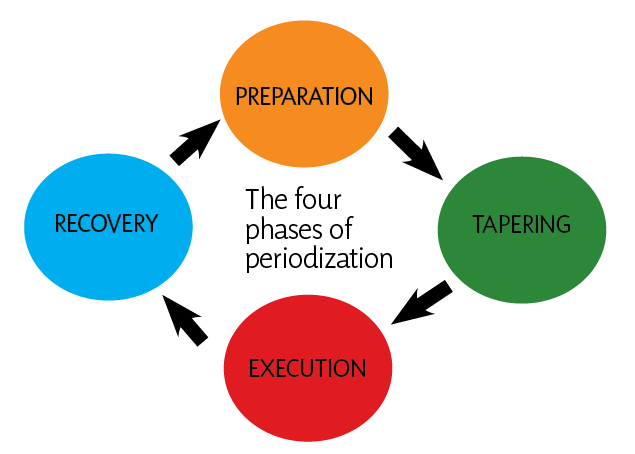
If so, you are reading the right article! There is a secret weapon that I teach called periodization, and it has been a game changer for all of my audition-winning clients. This periodization process involves training cycles with four distinct phases: preparation, tapering, execution and recovery. Periodization is designed to peak the performer’s energy at just the right time (like during the finals) in order to win.

Preparation phase

There is a lot of great information on the internet about various approaches to winning auditions. Most of the websites and blogs are by musicians who have won orchestral auditions themselves. These authors are emphasizing the physical, technical, organizational, and musical aspects of the audition preparation and actual audition performance. They usually address only the first phase of the periodization process: preparation.

Preparation involves both physical and mental work. The physical includes the organization of practice, technical work, listening, score study, mock-auditions, etc. The mental preparation includes centering practice, mental rehearsal or visualization, and concentration exercises. Long before their auditions, I have my clients complete a thorough assessment of their mental performance skills. We measure their abilities in five main areas: performance energy, confidence, courage, focus and resilience. After determining their individual mental strengths and weaknesses they can begin working specifically in the area(s) where they will make the most improvement in the least amount of time.

The mental training, which can replace some of the physical practice time, involves the centering process and positive affirmations. Centering helps control and channel performance energy before and during the audition process. The affirmations help to build self-confidence. Concentration exercises help musicians to focus past distractions and quiet the mind. They also learn how to become mentally tough and to recover quickly from inevitable mistakes. I don’t believe in perfectionism, especially at auditions. The idea is to continually strive for excellence which means doing your best under any circumstance.

Tapering phase

A few days prior to an audition, it is time to begin the second phase of the training cycle, which is the all-important tapering process. At this point you need to spend less time physically practicing as you increase your mental training even more, and begin to get more sleep and rest. In the last week before the audition it’s too late to cram (although many musicians do). If you don’t have all the excerpts or technical skills down by now you’re probably not going to master them in the next few days. If you try to do so, it will be counter-productive.

Instead of fretting over musical things or playing through the excerpt list one more time, there are better things to do. Believe it or not, I often recommend sleeping in, taking short power naps (20 minutes), watching comedy, doing a mental rehearsal session, or having lunch with a good friend (either a non-musician or a friend who promises there will be no audition talk!). In the last few days, the idea is to stay positive and mellow as you bide your time wisely and build up your energy. This is not easy for most musicians who are used to years of constant physical practice. Although you cannot win in the days leading up to an audition, you can lose!

In addition to maintaining the right mindset and conserving energy, it’s important that you carefully manage your heightened emotions in the final days before the audition. Due to the extra stress, many performers’ nerves get raw and they become testy or prickly, especially – and unfortunately – with those closest to them. For many musicians, the looming audition can feel as important as a matter of life or death. Keeping perspective and a sense of humor can be an immense help. Remember that your audition performance is too important to take too seriously.

The most important night of sleep is two nights before the audition. In terms of energy, there’s a one-day delay with the effects of sleep. So if the audition is on Saturday, you want to get a great night’s sleep on Thursday. Try your best to go to bed early, or sleep in, or both. If you feel very tired Friday afternoon, take a very short nap (10 to 15 minutes). After waking up I recommend that you get up, move around and get some fresh air.

The night before the audition, try to schedule dinner in the late afternoon or early evening. It’s wise to eat something that’s easy to digest, without a lot of spices. Wind down before going to bed (no exciting action movies, musical events or recordings). Turn off all musical thoughts in your head and get to bed at a reasonable time. Darken the room, lower the temperature, get into bed and find a comfortable position. If sleep doesn’t arrive within a few minutes, don’t worry. Just lie there and relax. Simply lying still provides 70 percent of the rest benefit of sleeping. Hopefully you will have been getting extra rest, naps, and had a good night’s sleep the previous night. That’s the energy you’ll be using tomorrow at the audition.

Execution phase

The third phase in the cycle is the execution phase. The first thing to do is to get up with plenty of time to get ready to do your best. I recommend arriving at the audition site early, keeping your mind on the process of what you need to do to execute a peak performance. Avoid thinking about all the possible outcomes. When they come up, just imagine your audition going well. Before walking in, summon up your courage, stay in the moment, and focus only on the task at hand. Follow your performance routine. (I have watched many clients throw their performance routine out the window the day of the audition.) Trust the process and all of your hard work, talent and training. Then go for it with everything you have!

Although many musicians try in vain to relax at auditions, I train my clients to channel that extra energy to blow away their competitors as well as the audition panel. In this process, they use a variety of peak performance skills like centering and mental rehearsal techniques. These help them do better in auditions because of the extra pressure and energy, not in spite of it. While most of their fellow musicians are trying to calm down I want my clients to get their energy up. My training teaches them how to control, channel, and peak that powerful performance energy when it really counts.

Recovery phase

After the audition, the final phase is recovery. Take some much-needed physical and mental rest away from the instrument and repertoire before you begin preparing for the next big performance or audition. Make sure that you feel fresh, rested and recovered before starting your next training cycle. Regardless of the final outcome, you need to reward yourself for the efforts you put in and the improvements that have resulted from those efforts. I suggest something tangible and permanent as a symbolic reminder of your progress.

After you recover and want to get ready for an even better performance, make good use of this four-phase cycle again. These four phases are indeed the secret weapon that I call periodization. Begin the cycle again with all the physical and mental work that needs to be done to prepare for the audition or concert. This is followed by tapering in the last days before the important event. Back off from the high level of training in order to build your energy so that you reach a peak in the execution phase at the audition or concert. Once again, you’ll deserve a few days off so you can recover – as well as another reward.

Remember to ask yourself this question: which phase of periodization do you struggle with the most when you’re getting ready for an audition or important concert? Be honest. Remember, all of the four phases affect each other and the final result. Tapering and recovery are just as important as preparation and execution!

For your next training cycle before a big performance, plan out your calendar, so you can schedule the four periodization phases.

Repeat the four phases until you begin to feel like each cycle of the periodization process has improved, as well as the results. Go for it!

[Dr. Don Greene, a peak performance psychologist, has taught his comprehensive approach to peak performance mastery at New York City’s Juilliard School; Colburn School in Los Angeles; New World Symphony in Miami Beach; Los Angeles Opera Young Artists Program; Vail Ski School; Perlman Music Program in Shelter Island; New York; and the U.S. Olympic Training Center in Colorado Springs, Colorado, and Lake Placid, New York.  During his 32-year career, he has coached more than 1,000 performers to win professional auditions and has guided countless solo performers to successful careers.  

[Some of the performing artists with whom Dr. Greene has worked have won jobs with the Metropolitan Opera Orchestra, Concertgebouw Orchestra in Amsterdam, New York Philharmonic, Chicago Symphony, San Francisco Opera, Montreal Symphony, Pittsburgh Symphony, National Symphony, Cincinnati Symphony, Pacific Northwest Ballet in Seattle, and the Dance Theatre of Harlem, to name just a few.  

[Of the Olympic track and field athletes he worked with up until and through the 2016 games in Rio, 14 won medals, including five gold.  Dr. Greene has authored 10 books including Audition Success, Fight Your Fear & Win, Performance Success, and most recently College Prep for Musicians.  In 2017, Dr. Greene was named a TED Educator and collaborated with musician Dr. Annie Bosler to produce the TED-Ed talk “How to practice effectively . . . for just about anything.”  The video went viral and received over 25 million views across Facebook and YouTube.  For more information, visit winningonstage.com, winninginsports.com, and collegeprepformusicians.com.]

06 May 2019

"Eight Strategies for Breaking Out of a Performance Slump"

by Noa Kageyama, Ph.D

[Last month, Allegro, the member magazine of Local 802 of the American Federation of Musicians (vol. 119, no. 4 [April 2019], https://www.local802afm.org/allegro/articles/eight-strategies-for-breaking-out-of-a-performance-slump/), republished an article by a musician- psychologist, Dr. Noa Kageyama, who applies sports psychology to the work of musicians.  Here, he’s providing guidance for defeating the debilitating sense of being in a performance slump.

[Dr. Kageyama uses the strategies described by cricketers—you can think baseball for this article; it fits well enough!—as a model for ways musicians can overcome the same problems.  I maintain that the strategies he passes on here are just as applicable to actors going through the same feelings—not moving up in the auditioning process—and, I daresay, probably dancers as well.  I’ll insert comments within Dr. Kageyama’s article below to draw analogies between his advice to musicians and equivalent situations auditioning actors may face.

[Truth be told, I’ve experienced the doubts and questions myself in my brief attempt to become a working actor, and I can tell you that it’s a discouraging experience.  The thoughts and fears Dr. Kageyama and the athletes he quotes describe also occurred to me after a spate of unsuccessful auditions.  So I’m passing along Dr. Kageyama’s advice to readers of Rick On Theater in the hope some of you will find the thoughts useful.]

Whether you’re watching basketball, baseball, or, say, cricket, broadcasters will often say that an underperforming athlete is in a “slump.”

I don’t know that I’ve ever thought of this phenomenon in a musical context, so my ears perked up a bit when I recently heard a few musicians use this term. Not like, “Oh, I’ve had a few subpar studio classes in a row; I think I’m in a slump.” But more in the context of orchestral auditions, where you might go through a few consecutive auditions where things don’t click, and you don’t advance.

Slumps can be really discouraging. They can make you start questioning your ability. And worry that perhaps you’ve hit your ceiling. Or lead you to start “pressing” and trying too hard. None of which is especially productive, and often just makes the slump last even longer.

[rick: I don’t recall hearing any actor friends using the word ‘slump’ and I’m not aware of ever having thought it myself, but I can attest, both from my own experience in auditions and from anecdotes by my friends and colleagues in the business, that most of us have had the experience of attending audition after audition and not getting called back.  Even harder on the delicate psyche of the actor, tyro or vet, is going to interviews and not even being asked to show our stuff.  A string of these experiences can be very debilitating.]

So how do elite athletes get out of slumps? Are there any specific techniques or strategies they rely on to stay in a good headspace and bounce back to their normal level of performance?

Cricket!

In a recent British study, 10 professional cricket players were interviewed to learn more about their experience of slumps, and what strategies or techniques athletes at this level might use to manage these dips in performance (Brown, Butt, & Sarkar, 2019 – see reference at this end of this article).

Different athletes emphasized different things, but there were a few key themes that emerged. And all in all, there were eight specific slump-busting strategies that seemed pretty relevant to performance slumps in the music world too.

THEME #1: HOW TO INTERPRET THE SLUMP

The first set of strategies relates to how you interpret the slump. Which I know sounds pretty abstract, but staying in a productive headspace is an important part of maintaining the motivation to work your way through a slump.

1) Explanatory style

Let’s say you advanced in your first few auditions while you were in school, but after graduation, experience a string of auditions where you don’t advance out of prelims. Your inner critic might try to explain this by telling you that you must have just been lucky before. And that you don’t have what it takes to do any betters.

[When I was working on my MFA in acting, my graduate acting classmates and I got cast in every show for which we chose to audition.  (I even had a special advantage: I was nearly 30—I did a stint in the army before grad school—so I was in demand as the “old man” any time one was needed in the cast.  Directors often asked me to read for their productions!)  

[After my first year in the program, I began to wonder if I could get cast by directors who didn’t know me.  So that summer, I started making the rounds in New York City and was cast in a (non-singing) role in a little Off-Off-Broadway musical.  

[I returned to school for the second year of the MFA program and after graduating and participating in a semi-pro summer rep the university produced, mixing grad students and Equity pros, I went out into the world of New York theater with confidence.  I soon faced the disheartening awakening Dr. Kageyama describes above.]

This is called a pessimistic “explanatory style.” And it’s the kind of story that could prolong the slump, because it provides an internal and stable (i.e. fixed and unchanging) explanation for why you’re not advancing. Because if failing to advance is a talent issue (internal), and talent can’t be changed (stable), how motivated will you be to work harder or try new things?

Conversely, an optimistic explanatory style is where you might say to yourself that performance is cyclical. That there are natural ups and downs from one audition or performance to the next (unstable), and that slumps will happen through no fault of your own (external). External and unstable explanations like this are less discouraging, and can help you stay confident and motivated in the face of disappointing results.

Of course, the danger here is that if you take this too far, you could find yourself making excuses and explaining away everything instead of taking ownership of the adjustments you could make to your preparation.

Which is where the growth mindset kicks in.

2) Growth mindset

Some of the athletes noted that slumps represent an opportunity to grow, learn, and become an even better player. Or at least, get better at handling inevitable future slumps. As one athlete noted:

“Rough patches are just as good as your better patches in a way, because it’s teaching you the game . . . because you’re not thinking about your game when you’re doing well.”

I love that last sentence. Indeed, when things are going well, we’re less inclined to pick apart our weaknesses and work as diligently at getting better. But the feedback we get when we run into problems can be invaluable, and make it much easier to pinpoint those sneaky hidden things that we most need to work on. 

[One of my acting teachers admonished us that we learn more from our failures than we do from our successes.  As Dr. Kageyama observes of musicians, actors seldom examine what we did when a performance goes well.  Sometimes we’re just satisfied with the positive outcome (and, when it comes, the reception) and don’t think about it further.  Other times, we don’t want to mess with the magic by analyzing it to look at how the parts worked.  When a scene, a gesture, or a line doesn’t work—then we pull apart the performance to try to see why.

[In a late rehearsal for a Revolutionary War play—one of the final dress run-throughs at which there was an invited audience—I nailed a moment when my character is mortally wounded in a battle scene.  It’s virtually a death scene—except that the character comes back briefly as a dying captive—and he’s shot, his sword drawn and raised in the air, in the midst of rallying his soldiers. 

[I was high above the audience on a bridge spanning the auditorium and the spectators burst into thunderous applause at the moment I fell to my knees, my sword falling from my hand.  It was a heady experience and everyone, including the other member of the large cast, was astonished.  ‘I got this scene.’ I assured myself.  ‘I killed it!’  Opening night—nothing.  ‘What  did I do wrong?’ I wondered, crestfallen.  I tried and tried to figure out what I did at that rehearsal that I failed to do later: timing, line reading, gesture, substitution, endowment, inner object, or some other overlooked technique?  I kept trying, analyzing—but I never got back that moment.]

THEME #2: MAINTAINING A POSITIVE MENTAL STATE DURING COMPETITION

Looking at our slumps in the larger context of lifelong growth and development can help us maintain the motivation we need to keep putting in the work.

But a slump can affect our experience during performances as well. Because sometimes a string of subpar performances can lead to more doubts and negative internal chatter when we’re on stage. Or, we might feel additional pressure to prove ourselves, and end up trying too hard to avoid mistakes, which paradoxically, can lead to more mistakes.

So how did these athletes stay in a good headspace during their slumps?

3) “Best performance” imagery

Under pressure, our thoughts can easily veer towards memories of times when we cracked a note, or when our bow shook in a quiet exposed passage. Or, we might start worrying about having a memory slip, as we sit and stew backstage.

To combat this, some of the athletes engaged in “best performance” imagery. Meaning, they made an effort to visualize times in the past when they were playing at their best. Which sounds straightforward enough, but here’s a quick test – how many specific auditions or performances can you think of, right now, off the top of your head, when you were having one of those awesome days where everything works?

Maybe 1? 2? Perhaps none? It often takes a couple minutes (if not much longer!) to recall performances like this from your past. But if you can’t see them vividly in your head now, imagine how much tougher it’ll be under pressure!

Not to worry though, because if you practice remembering these moments and visualizing them a tiny bit every day, these will be much more “top of mind” when you need something to shield you from those little doubts and fears that start creeping in on audition day.

[The parallels with an actor’s situation are obvious here.  Every actor has “gone up” on a line, missed an entrance cue, or reached for a prop that wasn’t there.  Those are the pitfalls of live performance as all performing artists know.  I’m sure it’s the same for dancers and musicians, but actors know they are the ones out there under a spotlight and when they screw up, it’s in front of God and everybody.  The psychological repercussions are huge, and hard to shake—especially when that particular moment comes around again. 

[Dr. Kageyama’s probably right, though I’ve never tried it: flash on one of the good moments you’ve had.  One of my best came in a scene-study class.  I’d been working for a while but decided I needed to go back to class (for reasons I’ll mention later).  This was an audition class, practice for cold readings.  I was assigned a scene from Tennessee Williams’s The Rose Tattoo, a scene between a young man and a young girl whom he loves with a very protective mother. 

[In the reading, I instinctively reached to caress the actress’s arm—but I stopped short and pulled back, afraid to be too forward.  The class actually gasped.  I don’t even remember what the teacher said to me in his critique—I was still lost in that moment that seemed so perfectly right.  I don’t think I could ever have created that moment if I’d planned it, and I doubt I could have repeated it if I did that scene again.  But at that reading, in that moment, I got it.  And obviously, I haven’t forgotten it even after . . . well, a lot of years.  I still take pleasure in reliving that brief moment in class; it can make up for a lot of mistakes.]

4) Attention control

Another strategy the athletes relied on was attention control. And the ability to focus only on what was in front of them in the moment. As one athlete said:

“You break it down to each ball, and each ball you say I’m going to deliver my skills here, just concentrate on every ball and just compete, just compete and think what does this team need right now, that’s the most important thing.”

For a musician, this might involve focusing on maintaining an internal pulse, shaping each phrase, or hearing the sound you want in your head as you play, instead of looking ahead, critiquing what just happened, or worrying about what people will think.

[Actors often refer to this as ‘being in the moment.’  It means believing in the circumstances of the scene you’re in and accepting it all as real and not concerning yourself with what happened during the performance of the  previous scenes or worrying about what’s coming up.  It also means playing your role and responding to the other actors on stage with you and not thinking about how your costume or hair looks or that guy in the second row having a coughing jag.

[I once thought I was fully engaged in a scene, sitting at a small table down front with a young woman, when I was pulled out because I heard snoring.  I thought an audience member in the front row had fallen asleep and was sawing away at a log!  I was actually at the point of saying something when I realized just in time that it was my scene partner, whose character had dozed off.  Never mind that she’d never done that before (that I’d noticed), but I was obviously not really in the scene or I’d have seen my “lady friend” nod off.]

5) Regulating arousal

Most of the athletes also noted the importance of learning how to stay calm and slow things down, instead of getting overexcited and magnifying the importance of every play.

This is easier said than done, but learning how to regulate your physical state is a skill that we can get better at with practice. How? Well, techniques like diaphragmatic breathing can give us more control over the physical part of our stress response (even though yes, telling people to breathe when they’re stressed is a total cliche).

The only problem, of course, is that this is a skill, and requires practice, just like anything else (you can learn more about how this kind of breathing affects us, and how do it correctly at bulletproofmusician.com.)

THEME #3: PROTECTIVE FACTORS

Lastly, the researchers described several “protective factors” that seemed to help athletes deal with the stress of poor performances and bounce back more effectively.

6) Enjoyment

Remembering that they enjoyed playing cricket, despite it also being their livelihood, was one protective factor.

“I just enjoy playing cricket, it’s something I’ve been brought up on and it’s something I would like to be involved in for as long as possible. If that means dragging myself down the nets or improving my fitness to get me through a bad run, then so be it.”

When was the last time you took a piece out of your music drawer, just to play through for fun? I’m not sure why that seems like such an unusual thing to do, but sometimes putting your audition repertoire aside for a moment, and taking a few minutes to play something you enjoy (a.k.a. “deliberate play”), might be an absolutely worthwhile use of your time. Especially if it helps you reconnect to the reason why you’re practicing and working so hard in the first place.

[This is one of the instances in Dr. Kageyama’s thesis that is different for musicians and actors.  A musician can pull out her instrument and a sheet of music and play for her own pleasure.  An actor can’t really just do a little acting in his living room.  (It’s one reason many actors keep taking classes all through their careers, even after they’ve become established—so they can keep their acting muscles limber between shows and movies and work on material they don’t get to do otherwise.)  

[But some actors do put together or join play-reading groups so they can get together with other actors and read scripts they love, especially plays or parts they don’t get to do in their professional lives.  It’s recreational and voluntary, not something that they have to do to make a living or advance their careers.  It’s not as easy for an actor to do this as it is for a musician, but the benefit is the same: you’re doing what makes you love your profession.]

7) Linking confidence to effort, not performance

One of the more intriguing observations was how many of the athletes deliberately worked to separate confidence from performance.

“I try to link my confidence to my effort, not my performance. So I’m doing everything I can to give myself the best chance of performing, and effort being the measure of your confidence level would give you more stability, because with the best will in the world, if you just base your confidence on your performance, it’s just the nature of the game, you could be in the best “nick” [form] of your life and still get nought if you get a good ball.”

Indeed, you can play a great audition and get cut. Conversely, you can play a mediocre round and still advance. Getting too caught up in results can therefore not only be pretty confusing, but is a rather unstable way to build confidence.

Meanwhile, the one thing you do have complete control over is your preparation. And so if you feel really good about the quality of your daily practice, and know you’ve thoughtfully incorporated run-throughs, recordings, and mocks into your process, etc., etc., it’s easier to trust and take confidence from the work you’ve put in, and stay in a good headspace on audition day. 

[This is another reason actors continue to take classes or work with a coach.  We don’t do “daily practice” like musicians and dancers.  (Although Uta Hagen did invent her “Object Exercises” for this purpose.)  It’s also a way to keep abreast of your technique, which, if taken for granted, can evaporate just when you need it in a performance or an audition. 

[The ultimate result of practicing an acting technique, whosever system you follow, is that it becomes an autonomic response to an acting situation, no longer a conscious effort that an actor has to contemplate separate from her or his inspiration.  But every now and then, it needs to be exercised willfully just to remind you that it’s there, waiting to be used.  Once you learn to trust it, have confidence in it, however, it becomes part of you, part of your art.

[But Dr. Kageyama is right as far as actors are concerned as well when he advises the they use all the available resources to backstop their prep for a performance or an audition.  One of my acting teachers recommended, among other, more obvious materials, plays of the era in which the one you’re preparing is set and portraits—yes, in art museums—of people from the period, locale, and class from which your character comes.  He also suggested songs and dances of the period as useful clues.]

[Editorial note: I wasn’t sure what “mocks” means in Dr. Kageyama’s use here, and trying to look it up led nowhere.  The closest I came on my own was “mockery,” meaning a parody of a piece of music, but when I turned to my friend  Kirk Woodward, who’s my go-to guy for most things musical, he suggested that Kageyama means “mock-up,” which he defines as “a preliminary recording, not for release but kind of a ‘proof of concept’—kind of like a ‘demo tape’ or ‘demo recording,’ but for internal use, so they can listen to it and figure out what the real recording will need.” 

[Kirk added that “if I’m correct, the article is saying that one way you’d prepare for a musical audition or a musical job interview is to do a recording more or less the way you’d do it for real, but not worrying about production quality, etc.—just on getting the basics down, so you have confidence in what you’ll be doing later for real.  (If anyone has a different idea what “mocks” means in this context, please let me know.  ~Rick)]

8) Support

Nearly all of the athletes also noted the importance of having a supportive, trusting relationship in their lives, that helped them maintain perspective during the difficult times. Sometimes it was a coach or more experienced teammate, but often, it was someone outside of cricket, who helped to remind them that they weren’t just a cricket player, but a son, a friend, and a human being with value and worth regardless of what happened in their last match.

“If I’m not performing well, then I speak to my father, family time. It doesn’t have to be cricket related . . . I will just go and speak to my dad just about life or other things…It’s important to have someone you can go to when you are going through bad form, whether that’s a family member, a friend, someone that you are very close to that you trust . . . My dad will just talk to me and give me a lot of confidence . . . he just says to me you know “keep going,” “you’re good enough,” . . . it gives me that inner confidence because he knows me, he’s known me all my life.”

[There came a time, after I’d been chasing the rainbow’s end for several years, when I was so discouraged that I was ready to quit.  My parents had been very supportive from the moment I started down the road in pursuit of a life in the theater.  (They came up to New York from Washington, D.C., to see everything I did, including plays I directed with middle-schoolers in Brooklyn and high-schoolers in New Jersey!)  

[When I told my folks what I was contemplating—I had gotten my MFA in acting and by this time had joined Actors’ Equity, SAG, and AFTRA, the principal actors’ unions—my dad said something that I will never forget: “Don’t quit.  You’re too good.  Give it more time.”  It was what I needed someone to say to me at that time.]

Takeaways

Every slump is probably a little different, of course. And sometimes one strategy might be more relevant and useful than another.

But many of these strategies and mindset tweaks sound like pretty healthy habits to adopt anyway, whether you’re experiencing a slump or not. And I’d like to think that in the same way that eating your veggies, sleeping well, and washing your hands after you’ve been in the subway can help protect you from the flu, maybe cultivating these habits could help you become more slump-resistant too!

Reference

Christopher J. Brown, Joanne Butt, and Mustafa Sarkar, “Overcoming Performance Slumps: Psychological Resilience in Expert Cricket Batsmen,” Journal of Applied Sport Psychology 2019, 1-20.

[Performance psychologist Dr. Noa Kageyama serves on the faculty of the Juilliard School and the New World Symphony, where he specializes in teaching performing artists how to utilize sport psychology principles to perform up to their abilities under pressure. Also a conservatory-trained violinist with degrees from Juilliard and Oberlin College, Dr. Kageyama’s understanding of performance pressure and excellence come from his own experiences on the concert stage from the age of two.

[Through 23 years of training, complete with television and radio appearances, solo performances with orchestra, and international competitions, he experienced first-hand the discipline, hard work, and perseverance it takes to reach an expert level of performance—as well as the frustration of performing poorly at the worst possible moments. Dr. Kageyama’s writing has been featured in media outlets ranging from the Wall Street Journal to Lifehacker, and he has provided seminars for institutions and organizations such as the New England Conservatory of Music, U.S. Armed Forces School of Music, Perlman Music Program, Starling-Delay Symposium, Music Teachers’ National Association, and the National Association for Teachers of Singing.

[Send feedback to Dr. Kageyama at bulletproofmusician.com, where this piece originated. Reprinted in Allegro with permission from the author.]
26 December 2018

"The Art of Being Seen: Perspectives on the Casting Process"

by Doug Strassler

[As readers of Rick On Theater know, I occasionally post articles on this blog that examine aspects of theater production about which most people who aren’t in the business—whom one of my teachers used to call  “civilians”—don’t know much.  The current edition of  Equity News (Autumn 2018), the member magazine  of Actors’ Equity Association, the stage actors’ and stage managers’ union, ran a detailed article about the auditioning process.  I suppose most people with any contact with theater, even as casual audience members, know that auditioning is the sometimes intimidating procedure every actor goes through in search of acting jobs.  It’s the actor’s equivalent of a job interview, and it can be daunting and, sometimes, dispiriting.  One of the most talented actors I ever worked with—I acted with him twice and directed him twice—has never become as well-known as I believe he should have because he hates auditioning and, by his own estimation, isn’t good at it.  (I also auditioned with him when he, another actor friend, and I used a three-character scene a few times as a group audition piece.)  In other words, an audition can make or break an actor’s career.

[Members of Equity have a carefully organized  and monitored audition process and the union is always making adjustments as it gets feedback from working—or work-seeking—actors.  The union audition, known as an Equity Principal Audition, or EPA (as distinguished from an Equity Chorus Call, or ECC), is hectic and, to a novice, disorienting, but it is standard from one casting call to the next, as required by the Equity contract governing the production being cast.  (Non-union calls don’t follow the same rules and have no authority to monitor and organize them and are thus often haphazard and frustrating.)  Because it’s in the union’s interest to see that its members get jobs, a benefit of union membership is that it offers assistance and advice to members in any number of professional aspects of the business.  In this instance, the union queried a number of casting directors, the member of the production staff who usually begin the selection process, and in this article, passes the guidance and advice on to members.

[Some of what’s posted below is esoteric and “inside-baseball,” but I believe it’s mostly clear enough for the non-actor to glean some of what the auditioning process entails.  You will see a little of what an actor has to go through just to get to try out for a part.  You’ll probably find that it’s not like what’s sometimes portrayed on TV and in movies.  Just like most things about real life . . . .]

A host of casting directors and performers reflect on the casting process

“Access. Access. Access.”

That one word, in a nutshell, is what every auditioning performer longs for: the chance to be seen, at their best, in the hope of landing a role and providing for themselves. In this instance, it was uttered by Stephanie Gould, a performer with a mild form of cerebral palsy, who discussed her own path in navigating the casting process.

But this quest applies to all members who have ever walked into an audition space. Anyone who has ever been in an elevator with or walked in a hallway past someone rehearsing sides knows just how fraught and nerve-wracking the process can be. From getting an audition to getting to the audition to feeling that a casting director (CD) may not have seen enough of what someone can do, it’s a frustrating journey. Like college admissions, there can be many disappointments, as casting directors must choose from far too many performers for far too few opportunities. [. . . .]

“One time I went in for a required call for a new Broadway show,” Actors’ Equity 1st Vice President Melissa Robinette said. “I had worked for weeks before this EPA [Equity Principal Audition] for this gig. I got up at 6am; I knew I was right for it.”

Anyone who has been to an EPA probably knows what happened next. Not only did Robinette not get the job, while in the audition room she felt that the person on the other side of the table wasn’t giving her full and open consideration for the job.

“I was so angry, I went home and cried,” she remembered. But that’s not where the story ends.

“And the next day I got a callback from that audition for another Broadway show.”

This anecdote just goes to show amid all the nerves and adrenaline, it’s hard to know for sure just what the CDs across the table are seeing. A series of conversations with those on both sides of the audition room helped to shed light on the overall process.

GETTING TO KNOW YOU

The casting experience doesn’t have to be an adversarial one. Many of the CDs interviewed for this article sang a similar tune, emphasizing that they really are on the side of those across the table from them.

“We do want the actor to be good so we can get behind everyone we show to our team,” Merri Sugarman, a casting director with Tara Rubin, said. “The truth is that it’s about wanting to be good at our jobs, so the creative teams are happy with our work.”

The art of creating work in the arts is actually a very delicate science, replete with scheduling logistics and keeping stakeholders happy and informed. “I’m always hopeful that performers trust our understanding of our project’s needs,” New York casting director Michael Cassara said, “and that we’re there seriously considering them with a number of variables in play. There are a lot of people who do excellent work but don’t get called back that time around due to oversaturation. I may only see six people for one role [at an invited audition], and the challenge is how can I fit everyone in? There are a lot of people who are truly brilliant who might feel rejected – but being the seventh out of thousands is not a bad place to be.”

CDs have producers, directors, sometimes choreographers and musical directors to please, meaning the invited audition space is the only time a casting director fully holds the reins. Sugarman said she will do everything she can to see performers at their best. “I work really hard on prep for the auditions,” she said. “I try to make sure there is natural light in the room, and that everyone has coffee and water. If an actor hasn’t had a chance to put his bag down, sign in and take a breath, I’ll bring someone else in, so they have time to get ready. But no matter how much you try to tell people that we are rooting for them, they don’t believe it.”

Empowering performers in the room is vital. “If I could wave a magic wand, I would make all of the performer’s fear and nerves disappear,” Eric Woodall, Producing Artistic Director at North Carolina Theatre, said. “We want actors to be their best, and that usually comes from them feeling confident and ‘in the moment.’”

Kyle Atkins, Associate Producer for Riverside Theatre, revealed that his biggest pet peeve is when performers who have scheduled an audition time do not show up. Or show up at a different time. “I get it, lives are crazy, but commitment and respect are integral,” he said. “Someone canceled twice on me and then just walked in. I was like, ‘Are you kidding me right now?’ Or if you have a 3:30 appointment but you show up at 11:10am, you have to ask the casting person is this okay.”

THE ROOM WHERE IT HAPPENS

Casting directors are quick to discuss their overall role in the puzzle and what they do on their end to secure a safe and positive audition environment. But what exactly are they looking for from the actors who come in?

“That they would be familiar with the entirety of the piece they are auditioning for,” Justin Bohon, a casting director at Binder Casting, said, “and that they take as much time as possible to be sufficiently prepared, make strong choices about the character and that the material that they choose to sing in the room is appropriate to the piece.”

Center Theatre Group Casting Associate Andrew Lynford does his best to assuage those who audition for him. “I know people get nervous, so I do my best to chat with them and make them less nervous,” he said. “Be polite and confident, but don’t try to be funny or over-talk. We want to stay focused on you – there’s no need to shake hands with everyone.”

Honesty and punctuality are of supreme importance, but so is preparation – yet perfect practice with the wrong material can hinder a performer’s chances. “I don’t feel actors spend enough time taking apart their audition material, making intelligent, bold choices and putting it back together again,” said Mark Brandon, another casting director at Binder.

Christopher Pazdernik, Casting Associate at Chicago's Porchlight Music Theatre, echoed Brandon’s sentiment. “When we audition for classic theatre, and they come in with the latest pop hit, which won’t help me evaluate you in terms of the world of the play. That’s not to say they aren’t talented, but they are missing the mark in terms of coming in with something that will help you get cast. One season we produced shows from no later than 1964, and one actress came in and slayed, quite honestly, ‘I Know the Truth’ [from Aida]. But I didn’t know what to do with that.”

WAITING FOR THE LIGHT TO SHINE

All CDs interviewed contend that it is indeed worth the performer putting themselves out there at EPAs and at Equity Chorus Calls (ECCs). [. . . .] But do those people who put themselves on the line agree?

“Of course it is a bit more challenging and you deal with quite a bit of volume, but it is worth the investment of time,” said Western Region member Bets Malone. “I have a friend whose agent tried and tried to get her an appointment for a show, and the casting director wouldn’t give her a time because she was ‘wrong for the project.’ She went to the open call and booked the show. Perseverance is the key!”

Western Region member John San Nicolas lives in Portland and sees a different side of EPAs in the smaller cities. “EPAs seem like they are more of a perfunctory requirement sometimes begrudgingly complied with by the small number of Equity houses in town, and I think that it is a relatively rare occurrence that local actors book jobs as a result of EPAs,” he said. “Most companies have a core of people they trust that they hire over and over again, and it can feel like a real uphill battle for those on the outside looking in. EPAs can feel a little bit like a shot in the dark as a result.”

Casting directors are certainly sympathetic to the cattle call-like atmosphere of auditioning. “I appreciate that coming to open calls is a bit of a ball-ache, as we would say,” Lynford said. “It’s very easy for actors to say, ‘When I get there, it will be a bit of a scrum; I wait two hours for three minutes in the room.’ But I don’t want them to think it isn’t a worthwhile experience. One actress who had just moved from New York to Los Angeles came to a season EPA and got a role in a show at the Kirk Douglas Theatre. ‘I’m so glad I didn’t think I was above the opens,’ she said. And she is getting great work here because she came to the open and did that show.”

In New York, Cassara says that it is rare for him not to call many performers back out of an ECC or EPA. “I would say half of the shows we work on potentially have someone, or many people, who were cast when the initial audition was the EPA. Perhaps between 25 and 50 percent.”

REVIEWING THE SITUATION

Technology has certainly provided options for the casting process. Self-taping auditions has allowed increased visibility for performers regardless of where they live. “This provides me a chance to see those outside the New York community,“ Chad Murnane of Binder Casting said. “Selftaping also offers a convenience for both actors and creative teams with last-minute emergencies or busy schedules.”

Performers themselves offer a mixed take. Western Region member Idella Johnson felt that “self-tape auditions rob casting directors and directors of really getting to know an actor, and it robs actors of re-direction which gives insight on what the director may be looking for.” However, Robinette said that “auditions and callbacks via video have saved me a lot of money and stress.”

Self-tape certainly worked for San Nicolas. “A friend knew folks at Fusion Theatre in New Mexico who were looking for an actor for their production of Disgraced,” he said. “She suggested me to them and passed on my contact information. I learned a couple of scenes, sent my videos, was given adjustments and sent again. That worked out great, and we repeated the process when I returned to be in their production of Old Times.”

Lynford cautions that those who self-tape should make sure the size of their work reads as though it is for the theatre and not for film or television. “Treat it like you’re filming a theater show,” he said. “I would encourage not to do a cinematic version, or do two versions – the intimate camera version, then show me you can be a good theatre actor and be more expressive than you would be in a close-up shot.”

MAKE THEM HEAR YOU

As both a performer with a disability (she has been diagnosed with ankylosing spondylitis and epilepsy) and as the Development and Media Relations Manager at Addison, Texas’s WaterTower Theatre, Debbie Ruegsegger has seen the casting process from both sides firsthand. She says the most important step to remove barriers to casting of actors with disabilities is to create a dialogue, transforming the audition room into as a safe a space as possible.

“Just by asking simple questions, you can learn a lot about what certain actors have to navigate,” she said, adding that invisible disabilities such as chronic fatigue syndrome and multiple sclerosis fall under that rubric as well. “Casting directors have no idea what is going on in someone else’s body – sometimes fluorescent lights made me forget everything, and they might think they I am unprepared.

“If I don’t know someone who I am auditioning for, it’s difficult to feel safe to disclose,” she continued. “We have to feel safe to ask for those accommodations. Adding that to audition notices could be a big step for theaters of letting certain communities know that they are confidential and not a deal-breaker. Many theaters are in the first steps of creating that, though we have a ways to go. Progress comes through a listening ear.”

Gould agrees that more transparency between actors with disabilities who audition and casting directors would be beneficial. “Consideration for nondisabled roles is probably the biggest challenge. We can play the girlfriend, lawyer, protagonist — anything, really. Theaters say they are looking for performers with disabilities, and then end up going with a non-disabled actor.

“But if you specifically seek out disabled talent, cast disabled talent,” she said. “I don't think people realize the amount of preparation that goes into auditioning for a disabled actor. Not just preparing sides or a monologue, but travel time – it can take us double the amount of time to get to an audition that might only last a few minutes.” (Gould credited her manager, Brandon Cohen of BAC Talent, and agent, Gail Williamson in Kazarian Measures Ruskin & Associates Diversity Department, for helping her get seen for both disabled and non-disabled roles.)

Still, times have changed. Anita Hollander, an amputee actress and National Chair of SAG-AFTRA Performers With Disabilities Committee, remembers, years ago, a Broadway casting director who “watched my monologue at an EPA, sighed aloud, and said, ‘It's a shame that you're so talented...’ The unspoken end of that sentence was ‘because I'll never be able to cast you, because you're disabled,’” she remembered. That kind of language would be shockingly out of place nowadays.

AT THE END OF THE DAY

Many theaters have also increased their efforts to be more diverse and inclusive in casting, although there remains room for growth there as well. “I do feel that there aren’t many opportunities and roles for people of color,” African-American performer Idella Johnson said, while Manu Narayan, an American actor of Indian descent, said “I feel very, very fortunate that the jobs and the wonderful career that I’ve had have been against type,” and credits his persistence in attending EPAs with helping to open that door.

Equal Employment Opportunity Committee Chair Christine Toy Johnson believes that performers of color most often get hired through open calls when casting directors pursue a specific type. “Many people of color I know have actually gotten obs through open calls, and I think this is especially true when a production is looking specifically for a certain type of actor,” she said, “but I do think that people lose faith in the system, and stop going because they feel that when a show is not looking for their specific cultural background, they will not be given full consideration. Then it becomes a sort of vicious circle. They can’t be considered if they don’t go, but they get tired of going and feeling it’s a waste of their time because they’re not really being considered.”

Eastern Chorus Councillor Lauren Villegas also advises that casting directors can’t shoulder the full burden of representation. “The real root of the problem is the work getting produced,” she said. “The solution is less about the casting process and more about making sure the work being done in the industry is fully representative of the population.”

Idella Johnson agrees. “I do believe that there’s been progress, but there’s room for improvement, and that starts with screenwriters, playwrights and directors abandoning stereotypes and seeing us in roles that are normally cast or written for white people,” she said.

For their part, the casting directors interviewed here have amped up deliberate plans for greater inclusivity. “There is not a single project that we cast in our office in which one of the first conversations with the team doesn’t involve a serious and determined plan to cast as many ethnically diverse performers as possible,” Bohon said, and Murnane agreed that he, too encourages creative ethnic casting. “Our commitment to diverse casting, in every sense, is unwavering,” Woodall said. “We encourage our creative teams to cast in progressive and contemporary ways and encourage all actors to be submitted.”

“Our programming strives to be diverse and inclusive, but then, with each production we strive to make sure that directors are presented an inclusive group of potential hires at both the idea and audition phases of each process,” Adam Belcuore, Managing Producer at Chicago’s Goodman Theatre, said. “In an effort to invest in the Chicago casting community we have hosted the Casting Society of America open call for actors with disabilities, as well as other local casting calls that specifically provide opportunities to under-represented talent.”

While steps have been taken to create greater accessibility and inclusiveness in the casting process, work remains to be done. Robinette cautions those with the power to cast to make sure they embrace inclusion, not tokenism. Still, both sides agree that the more performers get seen, the likelier they are to get cast.

“Even for required calls where I have heard they ‘aren’t looking,’” Robinette said, “I have had some awesome wins of getting called in for other things from those auditions or even being cast in other projects just because I was allowed to go in and remind them I’m alive.”

From the other side of the table, Lynford agrees. “It really is worth it and people have had great results doing EPAs,” he said. “Please keep bringing your talent to my door.”

*  *  *  *
STAGE MANAGERS OFFER ADVICE: NETWORK! Actors hope that through auditioning, they can create positive relationships with casting directors. Stage managers also recommend building up a stable cadre of friends in the industry:

“Shadow stage managers and have coffee with PSMs [production stage managers] on big shows. Talk about how they got where they are and what their career trajectory was.” —ERIN MAUREEN KOSTER

“Never let fear stand between you and seeking professional stage managers for advice. Observing the work of our colleagues enriches a formal education.” —AMANDA SPOONER

[Doug Strassler is the editor of Equity News.  He writes and podcasts frequently about film, theater, television, literature, and other realms of pop culture.]