Showing posts with label Washington Color School. Show all posts

02 July 2022

Sam Gilliam (1933-2022): A Personal Tribute


[As you’ll read below, my parents had a small art collection, consisting of some 40 oil paintings, watercolors, prints, sculptures, and a tapestry.  When my mother died in 2015 (my father had died in 1996), the collection was too large for me to display in my New York City apartment.  Shortly after Mom’s death, I offered the art to my undergraduate alma mater, Washington and Lee University in Lexington, Virginia, of which my father was a devoted alumnus.


[In September 2016, the University accepted the loan proposition and on 6 November 2017, an exhibition of the collection opened in W&L’s Stan Kamen Gallery at the Lenfest Center for the Arts.  After A Passion for Art closed on 30 June 2018, the collection became available for art classes and rotating display in various locations around the campus.  (W&L has no permanent art gallery.)]


My parents collected art from about 1948 to 1995 (see “A Passion For Art: My Parents’ Art Collecting,” posted on Rick On Theater on 21 November 2017).  This activity took off after September 1958, when, as some readers of Rick On Theater will know, my folks became part owners of Gres Gallery, a modern-art gallery in Washington, D.C. (see “Gres Gallery,” 7, 10, and 13 July 2018). 


The gallery closed in 1962, but the art collecting continued until my father’s death.  The art in my parents’ home originated in many periods (pre-Columbian Mexico, 18th-century Europe, 19th-century China) and regions of the world (Mexico, South America, the Caribbean, Africa, Europe, Asia), but the majority of the works are contemporary American painting and sculpture, including some Native American pieces (Fritz Scholder [1937-2005; see my post on 30 March 2011]).


Some of the artists with works in my parents’ collection were longtime friends (Minnie Klavans [1915-99], Lila Oliver Asher [1921-2021; see my post, 26 September 2014]) and others, like Sam Gilliam and sculptor Leonard Cave (1944-2006), became friends.  Gilliam, 88, died of renal failure at his Washington, D.C., home on Saturday, 25 June.

Sam Gilliam in his studio in 2018

Mom and Dad owned three of Gilliam’s works (and I own one) and they visited the artist’s home and studio in Mount Pleasant in northwest Washington, D.C., and the galleries of his partner (since 2018, his wife) and manager, Annie Gawlak. 


A couple of times I accompanied Mom to Gawlak’s gallery at the time, G Fine Art (located first on M Street in Georgetown and then on 14th Street in Logan Circle; now closed), just to see what she was showing, and on one afternoon, I went with my folks to the Gilliam house to chat and see what the artist was working on.  I was also visiting my parents on several occasions when the Gilliams came to their home.


Sam Gilliam, an African-American painter, was born in Tupelo, Mississippi, on 30 November 1933.  He grew up in Louisville, Kentucky, and came to Washington in 1962.  He’s considered part of the second generation of the Washington Color School, a mid-20th-century (1950s-1970s) form of abstract art growing out of color field painting which dealt with the effect of light on color (see my post “The Washington School of Color,” 21 September 2014).  


Gilliam often worked in diverse styles and forms, changing as he discovered new effects and techniques.  The Gilliam I have, Flowers (1989) from the Tulips series, is a mate to one from my parents’ collection, Petals from the same series, but the other two in the collection—Chinese, an acrylic work on shaped canvas from 1990, and a small, untitled, 1995 mixed-media collage on irregular hand-made paper—are different from each other and from Flowers and Petals. 
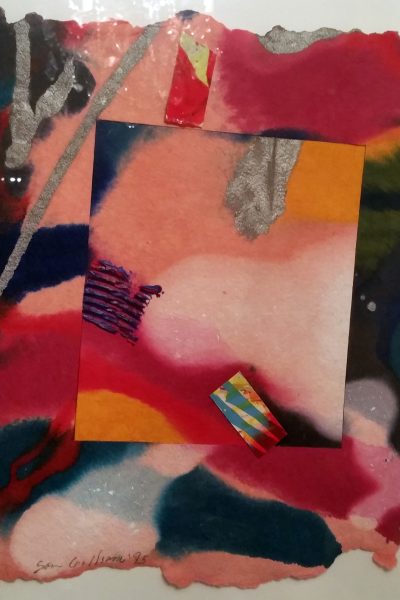
Untitled mixed-media collage

Gilliam, prolific and innovative, experimented with many media and varied his application as the medium demonstrated its properties.  I went to Sam Gilliam: A Retrospective (see “Awake and Sing!, et al.,” 3 April 2017), an expansive exhibit at the Corcoran Gallery of Art in Washington (15 October 2005-22 January 2006), with my mother, who’d also been invited to the opening, and we found that the show didn’t include any works resembling ours or other pieces I knew Gilliam had made. 


For instance, his short 2002 series, Slats, exhibited at the Marsha Mateyka Gallery near Dupont Circle (5 April-25 May 2002), was a collection of geometric, brightly monochromatic, hard-edged constructions the likes of which Gilliam has never repeated.


One afternoon while window-shopping on Wisconsin Avenue near Tenley Circle, I saw a decorated chair that looked like it had been painted in the same style as Chinese, the formless canvas of many-colored acrylic in my parents’ collection. 


The piece in the gallery window was an ordinary ’50s/early ’60s style kitchen chair covered with multicolored, thickly impastoed acrylic paint in the same style as the “ribbons” that are woven through the shaped canvas of Chinese.  Mother and I agreed that it must be Gilliam’s work, so we asked in the shop and we were right—and yet, the painted chair didn’t resemble Chinese in any other respect.
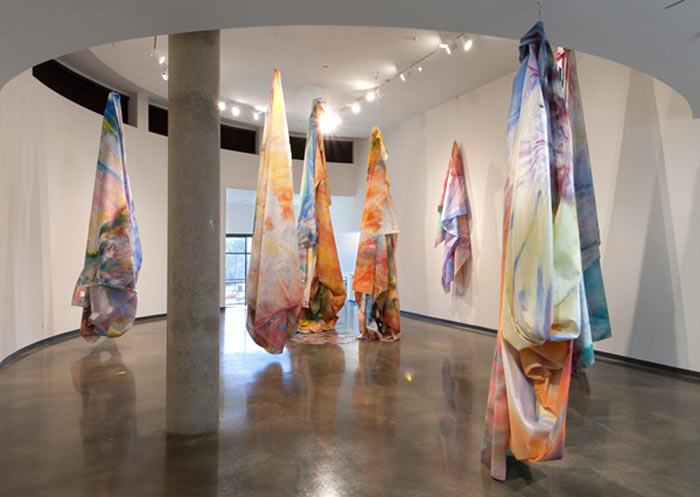
Close to Trees at the Katzen Center


On another of my visits to Washington, Mother and I drove over to American University’s Katzen Art Center on Ward Circle to see Sam Gilliam: Close to Trees (2 April-14 August 2011; discussed in “Picasso, Bearden, Gilliam, and Gauguin,” 26 June 2011), an exhibit of draped nylon and polypropylene cloths brightly dyed with acrylic colors, especially created for the Katzen’s third floor.  Gilliam had transformed the space into a forest of color which visitors walked around and past as if strolling through a grove of trees. 


The artist had worked with draped fabric before—a project in Japan in the 1990s that led to a site-specific installation of painted cloth at the American Craft Museum (now the Museum of Arts and Design) in New York City in February-April 1992.  The exhibit was accompanied by a talk on 19 November 1991 on the textile work in Japan that I attended.


Indeed, an increasing amount of Gilliam’s work from the ’70s on was with unframed, unstretched, formless paintings that was distinct from the habitual work created by his fellow Washington Color School artists.  He’s often described as having liberated color painting from the flat, two-dimensional format that was the standard among first generation WCS painters.


The drape paintings appeared in Gilliam’s career as early as the 1960s and ’70s, when the artist essentially invented the form.  He took the canvas off its traditional stretcher, stained it with vivid colors, and then draped the fabric on the walls, from the ceilings, or over props. 


A drape painting is a blend of installation, painting, and sculpture.  Each installation is different, and Gilliam is strongly guided by the way the light of the display space plays on the folds of the painted fabric.  The element of improvisation, both in the creation and the display of his art, is a great part of what excites me about Gilliam’s work.  It evokes Jackson Pollock (1912-56; see “Jackson Pollock: A Collection Survey: 1924-1954,” 4 March 2016) and Morris Louis (1912-62; see “Morris Louis,” 15 February 2010) with respect to Gilliam’s innovative technique.


Though Louis, a Washington School artist who painted in the ’50s and ’60s, abandoned stretchers and easels in the mid-1950s, pouring paint directly onto canvases laid out on the floor of his dining room, he framed the results in the traditional rectilinear format after he finished the piece.


Annie Truitt (1921-2004; see “Art in D.C. (Dec. ’09-Jan. ’10),” 18 January 2010), another first-gen Washington Colorist, abandoned canvas altogether, making painted wooden columns her signature art form.  Most WCS artists, however, stuck with stretched, usually primed—Louis worked on unprimed canvas, and Gilliam used unprimed fabrics of various composition—as their medium of choice.
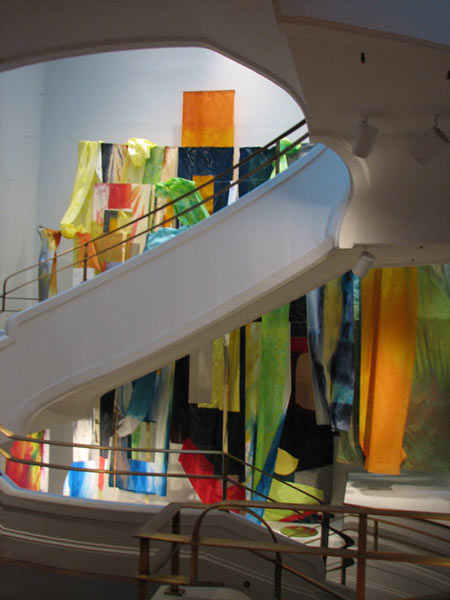
Flour Mill at the Phillips Collection


In 2011, Gilliam created a work specifically for the elliptical staircase of Washington’s Phillips Collection.  This site-specific installation of draped, painted fabric, which the artist dubbed Flour Mill—it was inspired by 1938 abstract painting Flour Mill II by Arthur Dove (1880-1946), owned by the Phillips Collection—though itself abstract, was meant to evoke something specific and concrete.  Gilliam’s Flour Mill was on view 29 January-24 April 2011 to help mark the Collection’s 90th anniversary.

Gilliam exhibited frequently with galleries across the country (David Kordansky Gallery, Los Angeles; Pace Gallery, New York and London; Marsha Mateyka Gallery, Washington, D.C.; Galerie Barbara Weiss, Berlin) and his works are in the collections of many museums around the world. 


His first museum show was at the Phillips Collection in 1967; among the other prominent collections that include Gilliam’s work are the National Gallery of Art, the Hirshhorn Museum and Sculpture Garden, and the Smithsonian American Art Museum, all in Washington; the Museum of Modern Art, the Whitney Museum of American Art (see “Spilling Over: Painting Color in the 1960s (Whitney Museum of American Art)” in “Hopper and Turner at the National Gallery & Color Painting at the Whitney,” 23 April 2019), and the Metropolitan Museum of Art, all in New York; London’s Tate Modern; and the Musée d’Art Moderne in Paris.


While the drape paintings dominated Gilliam’s work in the latter part of his career, he didn’t stick exclusively to that medium.  He returned often to draping, but moved into other forms as the impulse stimulated his imagination.  He was a lifelong, tireless experimenter.  The decorated chair and two of my parents’ three Gilliams—as well as my own piece—are examples of the artist’s flexibility.
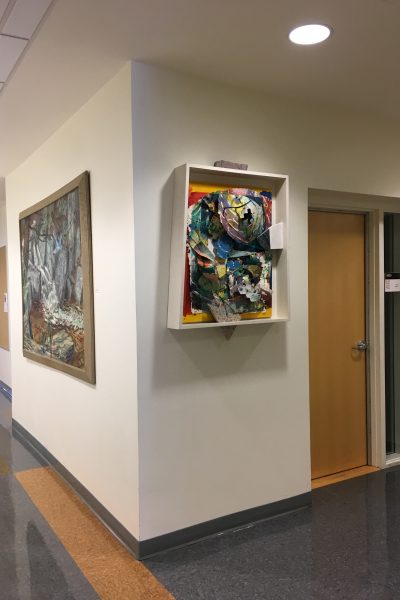
Petals at W&L University

For example, one of Gilliam’s visits to my parents’ apartment was in August 1989.
  The artist had offered my parents two pieces from his Tulips series, which he described as assemblages on handmade paper with marble, mounted in constructed boxes, in exchange for an investment in the project.  My folks were giving me one of the monoprints, so I was present when Gilliam brought the pieces for my parents to see. 


Gilliam himself mounted Petals for my parents because it takes a special bracket fixed to the wall, onto which fits a wooden flange on the back of the box frame, which is very heavy because of its construction and the addition of the marble “appendages.”  (While my piece, Flowers, is square, Mother and Dad’s Petals isn’t, so mounting it plumb required a sharp eye . . . or a modicum of luck!)


My dad and I had to install Flowers ourselves when we got it to my Manhattan apartment.  The artist, though, had thoughtfully made an instructional diagram of the mounting process, adhered to the back of the wooden box, for this purpose.  The print, as Gilliam called these works, has pride of place in my apartment: on the living room wall directly opposite the sofa. 


Flowers is easily one of my most favorite pieces of art in my own small collection.  (Sharing that honor is an Alexander Calder [1898-1976] lithograph entitled Magie Eolin (1972)—the nearest translation for which I can come up with is “magic of the wind.”  It hangs opposite Flowers, above the sofa.  [See “Calder: Hypermobility at the Whitney,” 21 August 2017, and “Alexander Calder: Modern from the Start (MoMA, 2021-22),” 28 January 2022.])


Gilliam came to my folks’ home again in March 1990 to hang Chinese, an unframed, shaped canvas with ribbons of painted canvas that must be woven through it.  It’s therefore formed differently every time it’s hung and takes on a completely different character depending on who’s done the installation. 
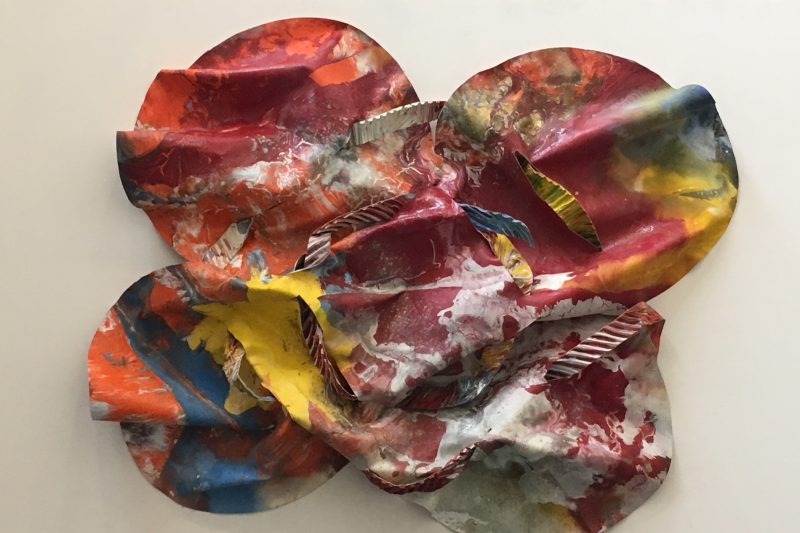
Chinese


Gilliam hung Chinese, which the artist defined as “an acrylic [painting] on canvas, woven and assembled, mounted directly on the wall in the manner of the drape paintings of the late 60’s and early 70’s,” in my parents’ dining room so that it bent around the corner of an entranceway into the living room. 


A derivative of the draped pieces, Chinese has no predetermined and immutable shape, no frame, no definitive dimensions, but it’s somewhat more rigid than the thinner fabric allows the drape painting to be, and has to be fastened to a wall or panel of some kind.


(When the University curator was planning not just the initial exhibit of my folks’ art collection in Lexington, but the eventual display of the artworks in various buildings on the campus, this became a conundrum.  W&L is almost 275 years old and there are many buildings on the campus that date back to the days of George Washington; the University doesn’t permit the use of nails on the walls—including the walls of the Kamen Gallery, though for different reasons.
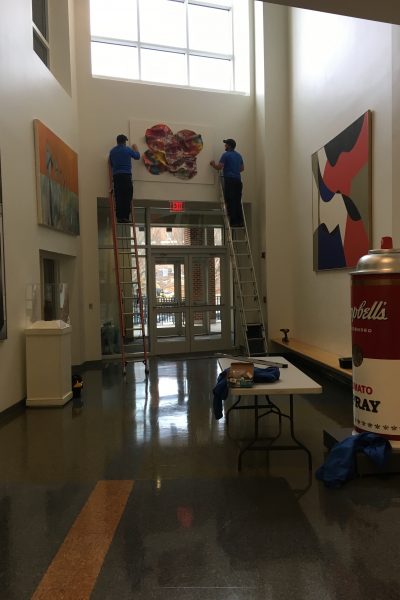
Mounting Chinese at W&L.
Note the mounting board.


(Framed art can be hung in many ways that don’t require putting nails and hooks into ancient plaster walls, but Chinese was designed to be nailed directly to its mounting surface.  What to do?  I suggested mounting the painting on a board and hanging the backing the way the curator would hang a framed work.  I believe that’s what she did.)


Gilliam returned in the mid-1990s to rehang Chinese—a title I didn’t even know until the curator of the University Collections of Art and History at W&L discovered it while mounting the collection for its introductory exhibit in 2017—when Mother moved to a smaller apartment in her building. 


I was with Mom and whimsically suggested that the painting should climb up onto the ceiling—so a lobe reached up onto the ceiling in Mom’s new sitting room.   The painting is rather large; unfurled, it’s approximately 48" x 48".


When Mom moved to Bethesda in October 2013, I mounted Chinese, under Mother’s direction, in the living room and it climbed onto the ceiling again, but I wasn’t as pleased with the result as I had been when Gilliam had hung the work with our input.    


(Until Mother moved to this last residence, which I helped her do, and we transported Chinese to the new apartment, I never knew what it looked like spread out; it turns out, the canvas is shaped like a four-leaf clover.)


As the abstract painting has no pre-established configuration, it will always bear an imprint of the displayers’ whims and tastes.  That’s what delights me about this painting, making it one of my favorites of my parents’ collection.


What makes Flowers a favorite in my own collection is that it’s just different.  Nothing else I own is anything like it—though that’s true of other art I have, too.  (For instance, Ossidiana VI [1959] by Franco Assetto [1911-91] isn’t really a “painting”; the pigment is something Assetto developed called “aluminum gel,” a chemical compound, the coloration of which is caused by the different chemicals added to the gel.  Aluminum gel is weather-resistant, so some of Assetto’s works were made for outdoor display.)


Oddly, the components of the Tulips series are not uncommon in late 20th-century art.  Hand-made paper is very widespread; so is monoprinting.  Collages fashioned from paper which the artist himself has decorated with printing or painting is a known technique, and so is using paper cut into pieces after being printed or painted.  Box frames for constructions are fairly common, and so are insertions of various materials. 


Still, no one I knew did all these things in one work of art or did them quite as innovatively as Sam Gilliam did in Tulips.  When I saw Flowers and Petals sitting on the floor of my parents’ living room, it thrilled me at first glance.  I knew immediately that I wanted one of them.  My only problem: which of the two did I want more? 


In the end, my choice was more a whim than a considered decision.  I never second-guessed it in the ensuing years, though.  When I die, the two parts of Tulips that Sam Gilliam gave my folks and me in 1989 will be reunited at Washington and Lee University since . . . well, who can say how many decades?  Since the artist made them.


21 September 2014

'The Washington School of Color'


When I was recently in Bethesda, Maryland, on a visit to my mother, I saw a short review in the Washington Post about an art show at a commercial gallery right near my mom’s apartment, the Marin-Price Galleries on Wisconsin Avenue.  The exhibit was The Washington School of Color, a collection of works by members of the mid-20th-century group of artists in the Nation’s Capital who originated the movement of that name (more commonly known as the Washington Color School), the only art movement identified with Washingon, D.C.  The Washington School of Color, which ran from 2 to 27 August, featured works by Leon Berkowitz (1911-87), Howard Mehring (1931-78), James Hilleary (1924-2014), and John Chapman Lewis (1920-95).  Special emphasis was given to the hard-edged work of Hilleary whose Op Art-like canvases bear a striking resemblance to the brighter, more vivid paintings of Kenneth Noland (1924-2010), one of the Color School’s more prominent members who’s not represented in this show.  

In fact, of the founders of WCS in the late 1950s, none of the movement’s leading lights—Noland, Morris Louis (1912-62), Gene Davis (1920-85), and Anne Truitt (1921-2004)—were part of the Marin-Price exhibit—which may account for its short run of only 23 days as well as the low attendance; we were alone in the small gallery when Mom and I spent an hour or so there on Monday afternoon, the 25th.  (The likely prices of these artists’ work may explain their omission more than any aesthetic decision: the costliest pieces in the Marin-Price show were $10,000 and $20,000, far lower, I’d guess, than a Louis or Noland would demand.)  Normally, I’d have thought, the curiosity value for area residents and visitors combined with the sheer vibrancy of the WCS masters’ works would have brought out a large number of viewers (not to mention potential buyers).  As it was, however, The Washington School of Color was a disappointing affair, not only lacking in star power, but in verve and excitement—two of the principal responses I, at least, get from displays of the best of WCS art.  (Washington Post art critic Mark Jenkins, estimating that the undated works largely came from the 1960s, noted the lack as well: “The more elemental shapes and hues came later.”)  My disappointment, of course, may just have been because some of those artists’ work is among my favorite of modern art; I’ve described these works as “extremely colorful and enticing.”  I called the poured, “rich and intense” acrylic stains of Morris Louis “luminous,” for example.  Noland’s Op Art hybrids I described as “bright and striking” and “exciting to look at” as they “seem to pulse and spin.”  (I’ve reported on ROT on several exhibits of WCS artists, including Anne Truitt in “Art in D.C. (Dec. ’09-Jan. ’10)” on 18 January 2010, “Morris Louis” on 15 February 2010, and, in passing mention, Kenneth Noland in “Picasso, Bearden, Gilliam, and Gauguin” on 26 June 2011—which also covers an exhibit of the work of Sam Gilliam, a later member of the movement.  I also mentioned the WCS and several of its member artists in “Washington Art Matters,” 5 September 2013.)

Marin-Price’s Washington School of Color, with its focus on the lesser lights of the movement, was basically a pale reflection of the power of the WCS.  The Post’s Jenkins also suggested that the display didn’t include the “mature styles” of some of the “less-celebrated” WSC painters.  Leon Berkowitz was represented, among other pieces, by a large (53" x 65") action abstract painting, Untitled (Spain) (1955), that was essentially gray (at a Color School exhibit?  Really?).  James Hilleary’s pieces were dominated by angular chevrons, mostly dichromatic (many of which looked to me as if they were different-colored versions of the same patterns) which reminded me of washed-out Nolands.  Where Noland’s stripes are bold and bright, Hilleary’s are pastel and pale, giving a watered-down feel to the work.  The offerings of John Chapman Lewis seemed like wannabe Mark Rothkos and the paintings of Howard Mehring, covering a variety of styles, also suffered, in my view, from lack of vibrancy and boldness in their palette.  My mother and I used to have a regular benchmark for art shows we liked: we’d suggest a “midnight shopping trip” to pick up the pieces we liked best.  I wasn’t moved to come back to the Marin-Price for a late-night raid on this collection

There were many practitioners of the Washington Color School movement including most notably Berkowitz, Davis, Noland, Louis, Hilleary, Mehring, Lewis, Thomas “Tom” Downing (1928-85), Sam Gilliam (b. 1933), Truitt, and Paul Reed (b. 1919).  Other artists associated with the group include Mary Pinchot Meyer (1920-64), Jacob Kainen (1909-2001), and Alma Thomas (1891-1978), among others.  The movement, which dealt with the effect of light on color, was a form of abstract art that grew out of color field painting, a type of abstraction itself that experimented with covering large areas of the canvas with solid pigment, as exemplified by the work of Mark Rothko (1903-70) and Helen Frankenthaler (1928-2011).  (Color field painting is one of the two branches of Abstract Expressionism in the United States.  The other is known as action painting, the style which characterizes the best-known works of Jackson Pollock.)  The movement was a departure from the Abstract Expressionism then prevalent in New York art circles: “It was about color and light and form,” said Beatrice Gralton, curator of the 2011 Corcoran Gallery’s Washington Color and Light.  “It was about an all-over approach to imaging-making.  It was really this reduction to the most pure, elemental aspects of art making.”  

In 1953, Louis and fellow D.C. artist Noland visited New York where they saw paintings by Abstract Expressionists Pollock (1912-56) and Franz Kline (1910-62).  The two Washington painters also paid a call on Frankenthaler at her New York studio where she introduced them to the idea of pouring the pigment to stain unprimed canvases.  This newly popular technique created intense color and accentuated the grain of the untreated canvas.  Louis has said that Frankenthaler, essentially the founder of color field painting, created “a bridge between Pollock and what was possible.”  Returning to Washington and working with other Washington-based artists like Davis, Downing, and Reed, the two painters helped develop what became known as the Washington Color School.  The early Washington colorists were among the first artists to experiment with the newly-developed, water-soluble acrylic paints, which they diluted to stain the raw canvas with translucent color rather than paint a previously primed canvas with opaque oil colors.  They experimented with all kinds of new techniques, essentially trying whatever came to mind.  They poured, dripped, dabbed, and dribbled the acrylic pigments onto unframed and unstretched canvases, using the floor (in Louis’s case, of his dining room) as the easel, the technique used by Jackson Pollock.  

(Simplistically, the difference between staining and painting is that with painting, the pigment coats the surface of the canvas or other medium forming a thick, solid crust while with staining, the pigment seeps into the fabric and is absorbed by the fibers, creating a tint through which the texture and grain of the cloth is visible.  Furthering this distinction is the practice of priming the canvas for an oil painting; that is, covering the raw fabric with a coat of white or neutral paint before applying pigment.  The stained canvases of the WCS artists were unprimed so the thinned acrylic is absorbed readily instead of sitting on the surface.)

The WCS movement was formalized in 1965 when a group of painters who lived and worked in the National Capital, including Louis, Noland, Davis, Reed, Mehring, and Downing, displayed works in Washington Color Painters, an exhibit at the now-defunct Washington Gallery of Modern Art, a non-profit institution near the city’s Dupont Circle (where several art venues, including the Gres Gallery in which my parents were then involved and the Jefferson Place Gallery, a promoter of WCS painters, were located) that featured contemporary art between 1961 and 1968.  This show established Washington’s place in the nation’s art scene when Clement Greenberg (1909-94), the country’s most influential art critic in the middle of the last century, saw the exhibit and declared the staining of canvas with color a “school” (“I’m tickled by the idea of a ‘Washington School’ in art,” the critic wrote in a postcard to Davis.)  Washington Color Painters toured the country and defined what is now the city’s signature art movement and the name Washington Color School made it into the art textbooks and “put our city on the national art map,” as Jean Lawlor Cohen put it in Washington Art Matters.  “Everybody was into transferring their thinking from oil paint to acrylic,” said Sam Gilliam, “so that when you got together, you talked paint.”  So for about a decade, according to John Anderson, art reviewer for the Washington City Paper, “seemingly every artist in Washington was under the spell of Abstract Expressionism and the so-called Washington Color School.”

(Greenberg, a champion not only of Abstract Expressionism and color field painting, but Louis and Noland themselves, had introduced the Washington artists to Frankenthaler, thus perhaps sewing the seed of the WCS movement even before its inception.  By dint of his reception of Washington Color Painters, he was clearly the midwife of WCS; perhaps he was also the matchmaker who made it possible as well.  Though some art historians credit critic Clement Greenberg with originating the name Washington Color School, the show’s organizer, WGMA director Gerald Nordland probably coined it.  A few writers even deny either man came up with the phrase, but whatever the doubt for its source, art journalists needed a label in order to write about this new collection of hot young artists from the Nation’s Capital.)  

Washington had just become a true art center in its own right a few decades earlier because of the proliferation of museums (Corcoran, 1874; Phillips, 1921; National Gallery, 1941) and art schools (city universities established art departments: Howard University, 1921; American University, 1925; Catholic University, 1930 as the Division of Art and renamed the Department of Art in 1943; the Corcoran School of Art was founded in 1890).  This situation assured that the city would have regular exposure to the best art, including contemporary forms, and a steady flow of young artists.  Some historians note that Washington is close to New York City but not so close that its artists would lose their independence; as Clement Greenberg phrased it: “From Washington you can keep in steady contact with the New York art scene without being subjected as constantly to its pressures to conform as you would be if you lived and worked in New York.”  It also didn’t hurt that two local critics, at the Washington Post and Times-Herald and the Evening Star, were receptive and enthusiastic observers of the hometown art scene.  (Other art journalists dismissed much of the work of these upstarts as the output of monkeys with paintbrushes which “make Jackson Pollock look like Rembrandt.”)

At the same time, while the post-World War II generation of Washington artists were continuing the traditions of 20th-century American art, the next group broke with that model and, in the view of editor and curator Jean Lawlor Cohen, “entered love affairs with color and geometry, scale and materials, . . . intent on finding a breakthrough vision.”  Just as the previous generation of American artists had struggled to break away from the European model, their Washington successors wanted to break away from the influence of the New York Expressionists.  Though D.C. had a population of just under a million inhabitants in 1950 and ’60 (probably over a million in the whole metro area), it still had the feel of a small town, and discrete communities, like the art world, were even more communal.  The young painters all knew one another, at least casually or professionally: they attended the same talks and lectures, went to the same showings, taught or studied at the same studios, and got together and “talked paint,” as Sam Gilliam put it.  The “new” wasn’t just upon the Washington colorists, they were inventing it.  As Thomas Downing said of his own work, at the end of the ’50s, the young artists were “trying everything”; by the turn of the decade, Paul Reed declared, “We felt enormous momentum and excitement” and sculptor Anne Truitt quipped, “The brew began to boil up.”  

Following their initial impact at the WGMA show, as the original group of artists came to dominate the art community in the District from the ’60s into the ’70s, Davis, Mehring, Downing, and Reed exhibited at other galleries in the area. The original Washington Color School painters expanded into a second generation, which included Sam Gilliam and Rockne Krebs (1938-2011), and the movement continued to bear influence over the Washington art scene and beyond even as some of the original artists moved on to other work.  Some leading WSC artists didn’t survive the ’60s (Louis, Meyer) or the ’70s (Mehring, Thomas), but their influence and that of their Washington Color Schoolmates on American art stretched through the rest of the 20th century and on into the 21st.  Hilda Shapiro Thorpe (1920–2000), a color field painter who made large abstract paintings and handmade-paper, balsa, or sheet-metal sculptures, taught a generation of Washington-area artists and helped perpetuate the Color School movement into the present.  “I guess today you’d say that we learned to think outside the box,” Gilliam said, “but we also learned to think in the context of the larger art world.”  Among the later painters who bears the stamp of the WSC is Lou Stovall (b. 1937), a friend and colleague of Gilliam’s whose work I first saw in 2011 and have admired (read “coveted”) since.

The main tenet of the colorists was to cover their canvases with unified blocks of bright, pure colors.  In a review of a 2003 gallery show that featured James Hilleary’s work, Washington Post art critic Michael O’Sullivan wrote that he’s “able to distill lyricism out of pure line and color,” a founding principle of the colorists’ art.  Like abstract painters, with whom the colorists shared many parallels, color field painters rejected the representation of identifiable figures.  WCS artists generally painted abstracts, and there are parallels between the Color School and Abstract Expressionism, though there are significant differences as well.  The WSC adherents were more formalist than the Abstract Expressionists, more prone to decorativeness and less forbiddingly philosophical.  Though the use of stripes, washes, and fields of single colors of paint, for instance, was common to most artists in both groups, Washington colorists eschewed symbolism in their art, feeling that even abstract forms distracted viewers from experiencing the pure color.  There weren’t supposed to be any subjective, emotional connotations in the hues or forms on the canvas: red was just a color, not an expression of passion; the painting was just art, nothing more meaningful or symbolic.  It was all supposed to lead to a pure sensation of enjoyment.  Baltimore Sun art critic Glenn McNatt capsulized this art: “Swirls of color, limpid washes of pigment that jump out and envelop the viewer, eye-popping stripes that seem to march across the canvas to a syncopated, ragtime beat.”  Painter Thomas Downing spoke of “the expressive potential of pure color—the necessity for a form which was simple and direct to convey it.”  The focus on purity of form strongly links color field painting with Minimalist art, as you can see in Anne Truitt’s brightly painted, formalistic  wooden structures, for example.  Morris Louis pared his paintings down to just what he felt was necessary, the bare minimum to create his effects.

The Washington Color School wasn’t strictly a “school” in the sense that most art movements connote by that title.  The artist didn’t work together or collaborate on techniques and styles; the WCS wasn’t an organized group.  They didn’t socialize as a group (though they knew each other for the most part and some, like Louis and Noland, were friends, as were Kainen and Davis).  The commonalities they encompassed were designated by critics and curators for the most part.  Each of the WCS artists had an idiosyncratic and personal style: Howard Mehring favored Z shapes; Alma Thomas was influenced by patterns of light; Paul Reed painted elaborate spheres; Thomas Downing’s circles looked like discs; Kenneth Noland was known for his hard-edged lines, chevrons, and, most distinctive, circles which were sometimes called “targets”; Morris Louis poured broad stripes of color on mostly raw, white canvases; Gene Davis was all about straight lines; Anne Truitt made geometric wood sculptures painted in high-gloss colors.  What linked them was, first, that they all lived and worked in the relatively small art community of Washington, D.C., and that they shared certain significant stylistic qualities: they worked in oversized formats, focused on color in bold and striking ways, painted in abstract shapes and forms, and used hard-edged stripes and swaths of (most often acrylic) pigment.   

The Washington Color School continues to hold the interest of exhibitors and spectators alike.  In the years before Marin-Price’s Washington School of Color, there were many other exhibits focused on the art and artists of the movement.  Over 30 arts institutions in Washington mounted a city-wide celebration of color field painting, ColorField.remix, including exhibitions at galleries and museums of works by members of the Washington Color School (such as Morris Louis, Kenneth Noland, Thomas Downing, Alma Thomas, Gene Davis, Leon Berkowitz, and Sam Gilliam), during the spring and summer of 2007.  Later in 2007 and ’08, the Smithsonian Institution’s Hirschhorn Museum and Sculpture Garden housed Morris Louis Now: An American Master Revisited and in 2009-10, the same museum presented Anne Truitt: Perception and Reflection.  In 2011, the Mitchell-Innes & Nash Gallery in New York City’s Chelsea, the center of the newest of contemporary art, held Kenneth Noland: Paintings 1958-1968 and a group of Washington, D.C., art collectors began the Washington Color School Project, to gather and publish information about the history of the color painters, notably Davis, Louis, and Reed, and abstract art in Washington.  Sam Gilliam’s works have been displayed in D.C. shows at the Corcoran Gallery of Art in 2005-06 and the Katzen Art Center at American University in 2011, and in a site-specific project at the Phillips Collection, also in 2011.  (The Katzen show Washington Art Matters in 2013 spotlighted the Washington Color School in its survey of the art scene in the Nation’s Capital from the 1940s through the 1980s.)  Earlier this year, two galleries in Brookland, in the Northeast section of the District, mounted Under the Influence: Reverberations of the Washington Color School, a show devoted to  current “acolytes and a few antagonists” of the WCS.  


05 September 2013

'Washington Art Matters'


The American University Museum at the Katzen Arts Center, a gallery my mom and I used to visit periodically because it’s right near where she used to live, spotlighted the art of my hometown this summer.  Five exhibitions featuring works by Washington artists opened 15 June and closed 11 August.  I only caught one show, Washington Art Matters: 1940s-1980s, a comprehensive exhibit of about 80 artists, occupying the entire third floor of the AU Museum, that told the story of art made in the Capital over five decades (starting just before I was born, as it happens).  This was reportedly the first significant endeavor by a museum to present a comprehensive retrospective of the District’s most prominent artists.  The exhibition, which Mom, two friends, and I saw two days before it closed, was based on Washington Art Matters: Art Life in the Capital 1940-1990, a book published in June by the Washington Arts Museum, a recently-closed organization dedicated to the presentation and promotion of the city’s art and art history, and co-authored by Jean Lawlor Cohen, Benjamin Forgey, Sidney Lawrence, and Elizabeth Tebow. 

As I wrote in my report “Art in D.C. (Dec. ’09-Jan. ’10),” 18 January 2010: “[S]ince at least the post-World War II years, the Nation’s Capital has been a true art center.  Not only have the big museums . . . long been important venues for displaying and viewing art of many cultures and eras, but Washington had long had a vibrant retail gallery presence. . . . .  But all of these facts aren’t what made Washington an art center.  That would be the community of artists, some native Washingtonians . . ., others born elsewhere but drawn to the active art scene there.”  Washington, though, was an unlikely place for an art center to blossom: aside from its innate conservative taste (which the emerging artists soon challenged and quickly exploded), the book’s authors point out: “Despite a number of optimistic gallery owners, the city had no bohemian neighborhood, no cafes or coffee houses to pull the artists and their patrons, no gathering places for a subculture during the war.”  By the start of the next decade, however, “all the elements for a Washington art community were in place.  The city had commercial galleries and a growing, albeit low-profile, base of collectors.  It had an academic center—American University—providing a regional presence and a link to the national scene.  But most importantly, Washington had a critical mass of brashly confident free spirits.” 

Most of the painters and sculptors of that culture are represented by at least (and largely) one work in AU’s Washington Art Matters (including several who’ve showed up in some of my past blog reports).  Despite a few notable sculptures (Ann Truitt most prominently), some “constructions” (Yuriko Yamaguchi's Water and Dream, 1989) and several photographs (Sally Mann and a handful of others), the exhibit is clearly “a painter’s showcase,” as O’Sullivan of the Washington Post observed, because, he asserted, “Washington has traditionally been a painting town.”  Neither the AU exhibit nor the WAM book claim to be comprehensive; the AU Museum has computers placed around the galleries inviting visitors to type in the names of artists whom they think should have been included but weren’t, and the authors of the book’s preface baldly state, “No doubt many artists, institutions and events have been missed, although they deserve mention.”  Nonetheless, both the book and the show made the point that, even in Washington’s segregated society before the mid-’50s, the city’s largely African-American population contributed greatly to the art scene, with many successful black-owned galleries (including the Barnett-Aden Gallery, the subject of John Nathaniel Robinson’s 1947 painting First Gallery, displayed in the show) and important African-American artists (aside from Robinson, others on exhibit at AU included Lois Mailou Jones, Alma Thomas, Sylvia Snowden, Jeff Donaldson, Allen “Big Al” Carter, Martin Puryear, Sam Gilliam, and Michael Platt).

Though the AU Museum mounts many exhibits of work from all around the country and the globe (a sixth show at the Katzen showcased a San Francisco artist), it’s known for showing local art, something director and curator Jack Rasmussen initiated when the museum opened in 2005.  (The other four exhibits in the series were Kitty Klaidman: Beneath the Surface, which highlighted recent mixed media paintings by the Washington artist; Nan Montgomery: Opposite and Alternate, consisting of the artist’s recent oil paintings; Raya Bodnarchuk: Form, spotlighting sculptures by the influential mentor in Washington art for 40 years; and Tim Tate: Sleep Walker, which featured video installations by the District’s best known contemporary glass artist, as well as collaborations with Pete Duvall, a Washington photographer, and Richard Schellenberg, a painter, sculptor, and video artist in the city.) 

“Museums were not showing Washington art except on very rare occasions,” Rasmussen said in a May interview with American, the American University magazine.  (The Washington Show, a 1985 exhibit at the Corcoran Gallery of Art, was one such rarity.)  “It’s important to have local artists on your side,” added Rasmussen.  “They support you, they talk to their friends, the friends come, and all this makes it possible to have a scene in which people want to participate.”  (In the mid- and late ’50s, as I’ve reported before, my parents were partners in a small art gallery in Washington, and the managing partner was adamant about not letting it become a “Washington gallery.”  As a result, she turned down exhibits by some artists who became highly regarded, such as Kenneth Noland and Morris Louis, one of each of whose canvases were included in Washington Art Matters.).

According to John Anderson of Washington City Paper, Rasmussen got wind last year of the planned publication of WAM’s Washington Art Matters and the authors gave the director-curator a list of the artists to be covered in the book.  He opened a gap in the Katzen’s exhibition schedule and went about assembling the samples for an AU show paralleling the book.  The AU Museum already owned about a third of the works in the prospective show, so Rasmussen started borrowing the rest from private collections and three large museums in Washington, putting the exhibit together in less than 10 weeks, which may account for a cobbled-together feel.  In a way, however, this also made AU’s Washington Art Matters a doubly Washingtonian show—the artists have lived and worked in the District and the art on exhibit came from local sources, too. 

Anderson quoted the Washington Post’s Paul Richard on the 1985 Corcoran show: “Any show so varied, it is bound to leave a blur,” adding that AU’s Washington Art Matters “pursues the same mission” and therefore encountered the same drawback.  Anderson thought the exhibit felt like an eclectic art auction, and I can’t disagree.  To try to cover half a century of one region’s artistic creativity (or, really, any human endeavor) is asking for a blurry, unfocused outcome: individual elements may be interesting, even stunning, but the overall experience is bound to be a little like herding cats.  If you make each cat a different color and breed, you get an idea what viewing Washington Art Matters was like.  My father used to say of the popular restaurant meal back in the day, the mixed grill, that it had too much of some things and not enough of anything; that’s a bit like what Washington Art Matters was like.  Not that the effort was unworthy (as I’ll try to explain shortly).

Rasmussen’s Washington Art Matters, a title whose double entendre I rather like, both for the book and for the exhibit, is divided vaguely into three sections: a small gallery (with a long tail) of works from the 1940s and ’50s; a larger, quasi-circular space with art from the later ’50s and, mostly, the 1960s; and, over the bridge-like ramps across the gap of the museum’s atrium (a gulf between the Vietnam and pre-Vietnam turbulence and the post-Watergate wildness?), into the 1970s and ’80s.  If some sort of developmental timeline was Rasmussen’s aim, it was subverted by the fact that when we got off the elevator on the third floor, more-or-less directly in front of us was a view of Gene Davis's untitled 1966 canvas of vertical rainbow-colored stripes and, across that gallery but still in sight as we stepped away from the elevator door, Morris Louis’s vertically dripped, bright-colored stains and Kenneth Noland’s equally colorful op-art bull’s-eye target.  (For a report on a Louis show and a mention of Noland’s work, see “Morris Louis,” 15 February 2010, and “Picasso, Bearden, Gilliam, and Gauguin,” 26 June 2011.)  To start the exhibition at its chronological beginning, we had to make a sharp right turn to view a small wall displaying a little collection of works from the 1940s, including an abstract geometric print by Jacob Kainen and a serene, black-and-white linoleum-block print by Lila Asher, a woman my mother’s known since they were at summer camp together as children.  (My parents also knew Kainen, but not well.  I own a Kainen print and both my mom and I own an Asher; both artists specialized in printmaking.)  These artists are among those Jean Lawlor Cohen calls “The Old Guard.”

Following the chronology of the layout, as my friend Rich did, the works of the 1950s trailed off to the left of the elevators in a long, narrow gallery where Marjorie Phillips’s Night Baseball (1951), a very literal painting of a ballgame with which I wasn’t familiar, was on display.  The artist was the wife of Duncan Phillips, the man who founded the Phillips Collection, and I wondered if the baseball diamond depicted might have been the old Griffith Stadium, home of the original Washington Senators ball club (subject of Damn Yankees).  I found out later, on a website of the Phillips Collection (which loaned the painting to AU) that not only does the painting depict Griffith Stadium, but the game in progress is the Nats playing the hated New York Yankees (“Joltin’ Joe” is at the plate)—an iconic match-up!  (Hey, maybe that game was the inspiration for Damn Yankees, which, after all, opened on Broadway only four years later.)

It was easy, however, to keep walking up the ramp from the ’40s works into the larger space that housed the art of 1970s and ’80s or peel off into the 1960s (pulled in by the extremely colorful and enticing Noland, Davis, and Louis canvases I mentioned).  If that happened, as it did to my mother and Sallie, the other friend who was with us, you lose any progression Rasmussen wanted to demonstrate, any sense that one generation of Washington artist fed the next or was nurtured by the previous one.  “[V]isual artists stand on the shoulders of other artists,” observed F. Lennox Campello, an artist, art dealer, and critic (and author of 100 Artists of Washington, D.C.) who blogs at Daily Campello Art News.  Artistic lineage—how the baton of tradition is passed on at times and then rejected and replaced at others—is one of the show’s sub-themes,” asserted O’Sullivan in the Post, though I can’t say I caught it in the gallimaufry of works in AU’s Washington Art Matters. 

Also in the ’50s-’60s gallery was Stair (1977—yeah, the chronology gets a little . . . ummm, creative), one of Sam Gilliam’s draped hangings; an earlier Davis (Black Flowers, 1952, with elongated vertical stem-like abstractions topped with red-and-white puffs); Pietro Lazzari’s Bull (c. 1950), a thick application of “concrete” into which the artist incised the abstract silhouette of a raging bull; and one of Anne Truitt’s glossily painted, minimalist wooden-tower sculptures (this one in silver gray).  “There’s lots to look at in this gallery,” remarked O’Sullivan.  (For a report on work by Gilliam, see “Picasso, Bearden, Gilliam, and Gauguin,” and for a brief discussion of Truitt’s art, see “Art in D.C. (Dec. ’09-Jan. ’10),” both mentioned above.)  The Post writer called these Washington Color School pieces “iconic” works, and for me they were the most salient works and artists in the exhibition, but that may just be because some of those artists’ work is among my favorite of modern art.  It may also be that this gallery alone, as City Paper’s Anderson pointed out, presented “a coherent sense of identity or movement happening in D.C.” because during that period, “seemingly every artist in Washington was under the spell of Abstract Expressionism and the so-called Washington Color School.  After that, District art hopped all over the map.” 

(In the late ’50s through the mid-’60s, Morris Louis with other Washington artists like Kenneth Noland and Gene Davis, all of whom have canvases in Washington Art Matters, helped develop what became known as Color Field painting—simultaneously establishing the Washington Color School, a name that, like Impressionism, was taken from the title of an exhibition.  The principal tenet of the colorists was to cover their canvases with unified blocks of bright, pure colors.  Like abstract painters, with whom the colorists shared many parallels, Color Field painters rejected the representation of identifiable figures.  In addition, colorists also eschewed symbolism in art, feeling that even abstract forms distracted viewers from experiencing the pure color.  There weren’t supposed to be any subjective, emotional connotations in the hues or forms on the canvas.  Red was just a color, not an expression of passion.  The painting was just art, nothing more meaningful or symbolic.  It was all supposed to come to a pure sensation of enjoyment.  The focus on purity of form strongly links Color Field painting with Minimalist art—as we see in the work of Anne Truitt.  Louis, for instance, pared his paintings down to just what he felt was necessary, the bare minimum to create his effects.)

Hopping all over the map was openly demonstrated in the last gallery of AU’s Washington Art Matters which focused on the District’s art scene of the ’70s and ’80s.  The media employed as well as the subjects and the styles, not to mention the creative dynamic and the points being made by the artists, weren’t emblematic of just a herd of cats—but cats on PCP.  Like the pop music that started after 1975 or so, the art from that era on began to appeal to me less and less.  (Okay, I’m not just a geezer, I’m a reactionary geezer.  So, sue me!)  Not much in this gallery affected me—it was all mostly a matter of curiosity.  The most interesting piece in this collection was among the half dozen or so photographs: one by Sally Mann.  I’m not much of a fan of art photography, but Mann, whose work has been controversial as well as praised since she made the scene in the mid- and late ’70s, is known to me because she was a teenaged townie when I was in college.  (Her mother ran the university book store.  By the time I was a junior and senior, Mann began dating some of my younger schoolmates—it’s a small school—so I knew who she was.)  I had no idea she was considered a Washington artist, though.  Mann’s from Virginia, where she still lives with her family, but not the D.C. suburbs across the Potomac; she’s from central Virginia, the Shenandoah Valley.  (Benjamin Forgey, in the WAM book, suggests that the Washington metropolitan region should include the Shenandoah Valley and other areas far from the city’s immediate suburbs, but Rasmussen didn’t make such a stretch notable in his AU display.)  I was surprised to see her work included in Washington Art Matters, but I’m no authority.  (I guess that’s obvious, isn’t it?)

Nonetheless, the exhibition was worth having been mounted and having seen.  As Campello, the art blogger, advised art students and gallery directors, “[T]ake the opportunity to visit and learn about our area's visual arts footprint.”  (He also strenuously recommended his fellow artists see the show.  “[T]his is Washington . . .,” he admonished local artists, “so go and pay homage to your predecessors.”)  I knew that D.C. had an art life—because I’m a hometown chauvinist and my family’s been involved on the fringes of the Washington art community (after the gallery ownership, my dad became involved in the private precursor of what’s now the National Museum of African Art in the ’60s and ’70s, then he served as a docent at the National Portrait Gallery through the ’80s into the early ’90s; my mother’s still friendly with Lila Asher and Sam Gilliam) most of my life—but a lot of people, including a lot of Capital-area residents, have no idea.  At AU’s Washington Art Matters, I was surprised at how many of the artists’ names I didn’t recognize—and I mean even before the mid-’70s.  That’s me, the Washington chauvinist, like I said.  I knew this world existed—I just didn’t know as much about it as I thought I did! 

Washington has always had a sort of inferiority complex; Anderson wrote about D.C.’s sense of competition with New York over the significance of its indigenous art, but that’s not what I mean.  While I was growing up in Washington, there was little sense that the city was a true community, with a municipal character unique to itself and a cultural life of its own, not something connected to or derived from the federal government.  Before his short stint as a Foreign Service Officer, my dad ran an ordinary business, the kind every city and town has (he operated movie theaters); the parents of all my friends were in the same line—doctors, dentists, vets, lawyers, shoe store-owners, builders, liquor importers, factory-owners, even some farmers (because back then there were still family farms in Maryland and Virginia just outside the city).  To all of us, Washington was just our home city—but to everyone else, including many of the kids I went to school with (politician’s kids, military brats, children of foreign diplomats), Washington was the “capital of the United States,” the seat of government, not a real town.  We had poor restaurants, little in the way of theater, a losing joke of a baseball team (Washington: “First in war, first in peace, and last in the American League!”) that even left town in 1960.  People traveled out of town to shop for clothes and we even had to go to Baltimore for deli.  (Assignment to Washington was not considered a plumb posting for foreign diplomats.  It was a backwater.  The book quotes one art dealer who arrived from France in 1945: “Washington was a village.  Cows were grazing on Georgia Avenue.”)  It took until the 1980s for Washington to grow into a real community, establishing itself at the same time as a cultural center.  But the fact that through all that time, there was an indigenous and vibrant art world in the District meant that real people did live there, that Washingtonians made things other than laws and bureaucratic rules.  The decades covered by WAM’s book and AU’s exhibit “bracket the evolution of Washington, D.C.’s art identity,” assert the book’s authors.

It’s high time Washingtonians and everyone else knew about this part of my native city.  That, Mr. Rasmussen, is more than worthy of a major art exhibit.  (It would be great, and really interesting, if a show devoted to Washington-area artists were mounted in New York and maybe traveled to cities like L.A. and Chicago.)  Even if the show is messy and unfocused artistically, without a clear aesthetic message, many of the artists in the show are good and quite a few are even great.  When I visited Quebec some years ago and then Vancouver, I made a point of going to the museums that were dedicated to the local art.  Both collections were mediocre at best, uninspiring—even the Québécois, who are more French than the French, didn’t inherit the art gene from their Old World forebears.  I mean, name three world-famous Canadian artists.  Okay, name one . . . .  That’s not a problem in Washington—you can name famous D.C. artists—it’s just that most people don’t know that’s where they’re from.  There wasn’t a damn thing wrong with the art on the AU walls—this wasn’t a bad art show; the problem was only that there were too many trees to see the forest.  But the mere fact that there was a Washington Art Matters is laudable and beneficial.  Not that either the book on which the exhibit was based nor the American University show was didactic—the book is dubbed “conversational” by Anderson.  In O’Sullivan’s words, Washington Art Matters was “an attempt to tell the story—make that the stories—of a city’s art scene, from the musty if modernist old guard to the funky vanguard”—and a most welcome one.  The city needed it, and the world needed it.  As Campello put it: “[T]hank you to American University Museum Director Jack Rasmussen, whose drive and insight and skill shows and demonstrates what a museum can do to become . . . a key part of a city.”

Washington Art Matters: Art Life in the Capital 1940-1990 (available from the AU Museum Shop and Amazon.com, but not at ordinary bookstores, including Barnes & Noble or The Strand) represents the final project of the Washington Arts Museum, a curatorial institution that, since its inception in 1999, mounted exhibits of work by significant, perhaps neglected, regional artists.  ”The focus of almost all the museums within the city is not local,” says the now-defunct non-profit’s website.  As part of its mission, WAM has documented Washington’s artistic history in audiotaped interviews and videotaped panel discussions with artists, curators, gallery directors, and others in the city’s art scene.  (The tapes and other WAM archival materials have been turned over to the Smithsonian Archives of American Art.)  WAM founders Renee Butler and Giorgio Furioso see the book, which covers the years of WAM’s primary focus, as a finale to their efforts “to spotlight Washington‘s unique and creative community and history and to provide an alternative to the largely national and international focus of the city’s longstanding private and public art institutions and museums.”   (I stopped in at the Museum Store to have a look at the book and I overheard the clerk explaining to another customer that the creators of Washington Art Matters are planning a sequel which will bring the history of the District of Columbia’s art up to the present, covering the last two decades of local creativity.)  In terms that can also be applied to Rasmussen’s art show at the Katzen, Campello called the book an “intense and important labor of love” and Benjamin Forgey, a former art and architecture critic for the Washington Star  and the Washington Post, dubbed his afterword, “Art Life on the Edges,” “what I would like to be a love letter to Washington as an art city.”  That sort of goes for my report here, too, but I’d call mine a “thank-you note.”

[The gallery my parents bought into in the 1950s was the Gres Gallery, 1729 20th Street, N.W.  I once considered writing an article on the little gallery, but I found a dearth of documentation (though I suppose if I made a research trip to D.C., I’d find some information bearing on its history).  It got a passing mention in Washington Art Matters, however, so in the interest of nostalgia (mine), I’ve decided to append it to my report:

[What most artists wanted even then [the 1950s] was gallery representation, an agent who not only provided space for shows but also promoted sales and kept the books.  Fortunately, the still-active commercial pioneers . . . were joined by a number of new galleries . . . .

[One of the most ambitious was north of Dupont Circle, the Gres Gallery founded by a South American woman named Madame Tanya Gres [this is an error: Mrs. Gres was Spanish and her name was Tana], who soon sold the operation to 10 shareholders putting up $1,000 apiece.  Their manager Mrs. Hart Perry traveled to Europe and South America. Selecting works for first-in-America exhibits, such as oils by “a skinny young artist” named Fernando Botero.

[Although the Gres had little interest in showing local art, it created excitement among collectors who, until then bought only in New York and Chicago.  And it created a social scene—with Larry Rivers, playing jazz piano into the night.  Alice Denney remembers that gallery goers would arrive at her less-endowed operation the Jefferson Place Gallery trailing balloon bouquets from the Gres’s more elaborate openings.

[Gres Gallery was only the second gallery in the U.S. to mount a solo show of Fernando Botero’s work; MoMA bought his Mona Lisa from the Gres show.  It was the first U.S. gallery to exhibit abstract paintings from Poland in Fifteen Polish Painters, a whole show MoMA took to New York.  By the turn of the decade, most of the partners, many of whom were Foreign Service Officers, were transferred out of the country—my own parents went to Germany in 1962—and Gres Gallery closed.  “Helping out” in the gallery—I stuffed envelopes and such—and meeting artists at the vernissages the partners hosted are some of the most vivid and cherished memories of my childhood.  When I hung around the gallery and met some of the artists, none of their names meant anything to me at the time—I just knew they were artists and created the works I saw at the gallery.  I even made collages (cut-out construction paper, to be sure), inspired by a collagist exhibited at the gallery.  The experience provided me with an exciting and eye-opening art education before I was a teenager, and the influence has remained strong ever since.

[By the way, one additional sidelight, concerning Marjorie Phillips’s Night Baseball.  I doubt I was at that Nats-Yankees game—I’d have been four then—but later my dad took me to Griffith Stadium.  More significant, at least in terms of my memories, is the fact that Clare Griffith, the daughter of Calvin Griffith, owner of the Senators for whose adoptive father, Clark, the stadium was named, was a classmate in middle school.  I remember we got to listen to an occasional game on the radio in class, but I don’t think that was because of Griffith’s influence—Sidwell Friends School didn’t work that way—but we had an outing to a Nats game in the spring and there was also a pool party for the whole class at the Griffith’s home while Clare was at Sidwell as well.  (Calvin Griffith was the Branch Rickey of Washington.  He didn’t integrate the Senators, but he took our home team away, moving it Minnesota after the 1960 season where they became the Twins.  I lost interest in baseball at about that same time—but I don’t recall that that was a result of Griffith’s betrayal.  (I went away to school in ’61 and then abroad in ’63.  When I got to college, I did manage the ball team for two season.)]