Showing posts with label military intelligence. Show all posts

13 May 2022

FSB: Field Station Berlin


[Frequent readers of Rick On Theater will know that I was a Military Intelligence Special Agent in the army and was stationed in Berlin from July 1971 to February 1974.  I was a nine-triple-six (my Military Occupation Specialty was 9666, Counterintelligence Officer; the enlisted agents were 97B’s), and assigned to Berlin Station of the 66th Military Intelligence Group, a unit of the U.S. Army, Europe.  

[Our offices were in the main Berlin Brigade compound on Clayallee in Zehlendorf, the same compound where the U.S. Commander, Berlin, a two-star general, and the Commanding Officer of the Berlin Brigade, a one-star general, both had their headquarters.  Also in the former Luftwaffe headquarters complex was the U.S. Mission to Berlin, the post of the highest-ranking American diplomat in the occupied city.

[On the first day I reported to Berlin Station, I noticed two black Russian sedans, Volgas or Moskviches, parked, one by each exit from the compound.  Aside from being black, the Soviet vehicles were very recognizable because they looked like stylistic throw-backs to the early ’50s. 

[I asked about them, and the agent who was assigned to help me get acclimated told me that the cars with their GRU-agent occupants (Glavnoye Razvedyvatelnoye Upravleniye – Главное Разведывательное Управление; Main Intelligence Directorate, the Soviet Union’s military intelligence agency) were almost always there, just watching, taking notes, and probably photos—and that within an hour of my arrival, the Soviets knew my name, rank, and assignment.   

[Berlin Station’s offices, low profile but not covert, were right at the front of the main building.  Next to us, in an unmarked office, was the positive intelligence unit, the agents who ran intelligence-gathering operations.  It was staffed by officers with the MOS of 9668, Area Intelligence Officer, and the enlisted counterpart, 97C.  They were covert; we could communicate, when we had to talk face-to-face, via a locked iron gate between the two 66 MI sections located in the basement.

[We were both spooks, trip-sixes and six-eights.  That’s what we and others called those of us in the intelligence racket.

[Berlin was also home to another facility of the military intelligence field.  This post is about that strange and super-spooky place.  It was not a facility about which much was known, even to other intel personnel like me, but pretty much everyone knew of its existence because . . . well, it was impossible not to.  I’ll let you read why that was so.

[And remember: everything you’re about to read is the emes, the truth—to the best of my knowledge.  I’m not joking and I’m not trying to spoof you.

[Now, a quick précis of pertinent history.  World War II in Europe ended with Germany’s surrender on 8 May 1945 (Victory in Europe, or VE, Day).  Combat changed to occupation and the three wartime allies, Britain, the United States, and the Soviet Union, became the administrators of what had been the Third Reich.

[Agreements made among the three national leaders at the Yalta Conference (4-11 February 1945), attended by Prime Minister Winston Churchill (1874-1965), President Franklin Roosevelt (1882-1945), and General Secretary Joseph Stalin (1878-1953), and at the Potsdam Conference (17 July-2 August 1945), with Churchill, Stalin, and President Harry Truman (1884-1972), who succeeded Roosevelt upon the latter’s sudden death in April, divided Germany into three occupation zones and made special provisions for Berlin (geographically inside the Soviet Zone of Occupied Germany) to be administered separately by the three victors.

[At the conferences, the Soviets had rejected an equal share in the Occupation for France, so the U.S. and Britain agreed that French zones of Germany and Berlin would be ceded from their zones.  Berlin was therefore divided into four occupation sectors: the Soviet Sector, commonly known as East Berlin, was approximately one-third of the former German capital city, with about a million inhabitants, and the British, U.S., and French Sectors, consolidated as West Berlin, together were about two-thirds of the city with approximately 2½ million people. 

[Because there hadn’t been a peace treaty to end World War II, Berlin was still under occupation until 1990, when a formal peace was finally negotiated.  While the Western Allies had relinquished political responsibility for what became the Federal Republic of Germany, or West Germany, in 1949, Berlin remained occupied territory. 

[The Federal Republic was declared on 23 May 1949 and the Soviets followed with the declaration of the German Democratic Republic on 7 October.  The East Germans established East Berlin as their capital (West Germany made Bonn its provisional capital, pending the return of Berlin to freedom), but the city remained occupied territory for 45 years. 

[The British, American, and French forces turned the civil administration of the city over to the Berliners and there was a functioning elected municipal government, but the three sector commanders—a major general in the case of the U.S. Commander, Berlin (USCOB)—still had almost unchecked authority of not only the military and official civilian personnel under their control, but the ordinary civilians who lived in or visited Berlin.  When push came to shove, what the generals wanted, they got.

[The Berlin Wall that divided the city for 28 years appeared early on 13 August 1961 when the GDR threw up a temporary barrier of barbed wire and trenches along the boundary between the Soviet Sector and the three Western sectors and around the western border with East Germany.  For about a year from 18 August, the GDR constructed a permanent wall of concrete blocks, topped with barbed wire.  The Wall was pulled down by energized Berliners starting on 9 November 1989 (see “Berlin Wall,” 29 November 2009).

[I’ve written frequently on ROT about my life in MI and West Berlin, Spy Central in Europe during the Cold War.  Among the posts touching on or derived from that experience are “Berlin Station,” 19 and 22 July 2009; “Berlin Wall,” 29 November 2009, “Top Secret America,” 17 September 2010; “Berlin Memoir,” 16 December 2016, 20 January, 9 and 19 February, 11 and 29 March, and 13 April 2017; “Who’s Who in CIA: A Cold War Relic,” 8 May 2018, “‘Ritchie Boys: The Secret U.S. Unit Bolstered by German-Born Jews that Helped the Allies Beat Hitler’” reported by Jon Wertheim, 19 May 2021, and “Open source intelligence combats disinformation on Russia’s war against Ukraine” by Miles O'Brien and Will Toubman, 17 April 2022.]

In the 1950 Twentieth Century-Fox movie The Big Lift (see my post on Rick On Theater, 31 August 2017), there are several scenes of Berliners shoveling debris into wheelbarrows.  The movie was made on location in Berlin starting in May 1949, just after the end of the Soviet blockade (June 1948 to May 1949) and only five years after the end of World War II in Europe. 

The wartime destruction had to be cleared by hand because the deprivations of Germany after the war, especially in Berlin due to the blockade, made gasoline-powered machinery unavailable.  In addition, the post-war unemployment was so great that hiring out-of-work Berliners to clear the rubble served a benefit.  

With the male population decimated by the war, it was Berlin’s women (such as the war widow in The Big Lift played by Cornell Borchers with whom Montgomery Clift’s character falls in love) who cleaned up the rubble.  These debris-collectors were called Trümmerfrauen or ‘rubble women.’

What the movie doesn’t show is that most of that debris was taken to a site in the borough of Wilmersdorf in the southwest of the city, near the Grunewald (‘greenwood’), Berlin’s forested “Central Park.”  The debris was piled into a mountain named Teufelsberg (‘devil’s mountain’), the highest spot in the city at about 365 feet above sea level (and 265 feet above the surrounding terrain).              

Undated photograph (ca. 1950s) of trucks dumping wartime rubble on 

the growing Teufelsberg in Wilmersdorf, West Berlin. Ullstein Bild


Teufelsberg—the name was taken from the mound’s proximity (about a half mile south) to a small lake in the Grunewald called Teufelssee (‘devil’s lake’), a place of legend and folklore since ancient times—was used as a dump site for debris through the 1950s and was finally landscaped in 1972.  Some 98 million cubic yards of debris from West Berlin—the Soviets disposed of the rubble in their sector in their own way, much of it deposited outside the city—was collected to create the artificial mountain.  That’s the approximate equivalent of the remains of 400,000 bombed buildings. 

In February 1955, a 79-foot-long ski jump opened on the mound, then a larger one opened in March 1962, with room for 5,000 spectators.  Ski jumping stopped in 1969 because the civilian recreation was incompatible with the super-secret military activities going on above.  The jumps fell into decay from lack of maintenance and were removed in 1999 because they allegedly interfered with that activity (discussion of which is coming up).

For a brief time in the ’70s and ’80s, the district of Wilmersdorf produced wine on the southern slope of mountain.  Up to 120 liters (a little less than 32 gallons) of Wilmersdorfer Teufelströpfchen (Wilmersdorf devil’s droplets) were bottled per year.

It wasn’t just what the mountain was made of or how it was created that’s a curiosity. however; there were many such artificial mounds in bomb-damaged cities all over Germany and much of Europe after the war.  It was what was under the mountain.

Buried beneath Teufelsberg are the remains of a uncompleted Nazi military-technical college designed by Hitler’s chief architect, Albert Speer (1905-81).  Only the shell of the compound was finished, but the construction was so sturdy that all the Allies’ attempts to demolish it, even with aid of explosives, failed.  

The Occupation forces decided, therefore, to entomb it under war debris instead.  The Wehrtechnische Fakultät (faculty of defense technology), planned as a department of the reconceived Technical University in Berlin, is down there still today, buried under about 63 million tons of rubble.

 

Teufelsberg Cross-Section (2013) by Brendan Jamison, coloured plastic blocks, 50 x 67 x 2 cms. The grey structure at the bottom represents the buried Faculty of Defense Technology. Photography: © Tony Corey for Jamison Sculpture Studio.

At the peak of Teufelsberg, the U.S. Army Security Agency, the military counterpart to the National Security Agency formed in 1945, built an elaborate “listening station” called Field Station Berlin, the most secret place in Berlin.  FSB was one of the West’s largest spy stations, arguably the most important of the Cold War era. 

The military unit of the ASA to which personnel who staffed FSB were assigned changed designations a few times over the lifetime of the listening station.  (The NSA had some of its own analysts, researchers, and linguists based at Teufelsberg.)  In 1976, two years after I left Berlin, USASA was folded into the U.S. Army Military Intelligence Branch, the combat support branch in which I was commissioned, to form the U.S. Army Intelligence and Security Command (INSCOM).

Construction of FSB was begun in 1963 (a mobile listening station was installed on Teufelsberg in 1961, the year the Berlin Wall went up, restricting access to East Berlin), so it didn’t exist when The Big Lift was filmed.  Even if it did, the filmmakers probably wouldn’t have been allowed to mention that that’s where all the rubble was heading.  Now, of course, Teufelsberg’s all over the ’Net—a sci-fi ghost town!

Usually just called Teufelsberg by Berliners, the listening facility, known to insiders simply as “The Hill” (and as “America’s Big Ear” to the East Germans and Soviets) was located in the occupied city’s British Sector even though it was a U.S. site.  The Brits had one building on the spy site, but essentially we just shared whatever poop we got with them and the French.

Everyone knew FSB was there—you could see the bulbous towers and antennas, resembling some futuristic city, from many parts of Berlin; with the facility’s large and distinctive structures, and the huge antenna field, low visibility was just not possible or practical.  

The listening station had three immense globes, two radomes (radar domes) perched on top of three-story-high towers and another soaring six stories higher.  Each radome globe contained huge, 40-foot satellite antennas and the most up-to-date listening technology, allowing the U.S. and its allies to intercept satellite signals, radio waves, microwave links, and other transmissions before translating, interpreting, and analyzing the findings.
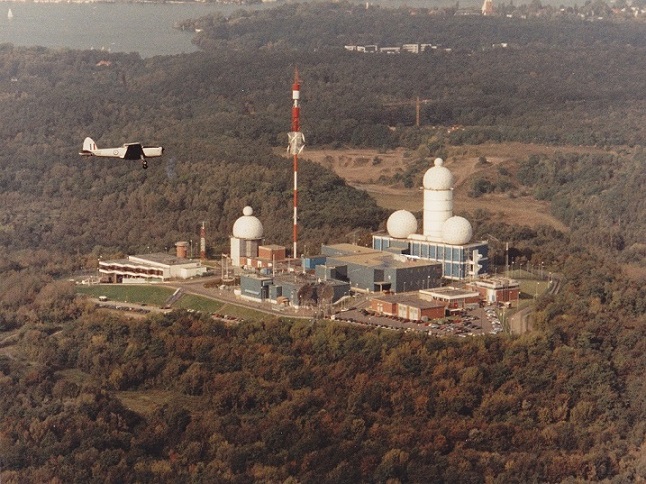
                    Teufelsberg Field Station Berlin, ca 1985. Photograph courtesy of John Evans.

The radomes, which look like gigantic, teed-up golf balls, had no radar equipment despite their name.  The Allied forces already had radar surveillance covered with installations at Berlin’s airports: Tempelhof in the American sector, Tegel in the French sector, and Gatow in the British sector.  (Teufelsberg was used briefly for air traffic control on civilian flights in 1994.)

The people who worked at The Hill had a saying, very popular apparently—a sort of unofficial motto: “In God we trust, all others we monitor.”

Very few who didn’t work there, however, knew what went on.  I knew about FSB, of course, but even as an intel officer, I was never on the site in my 2½ years in West Berlin.  I was my unit’s resident Russian linguist, so I got info copies of transcripts of telephone conversations from the Soviet military headquarters in Potsdam; they came from FSB.  The “Big Ear” was a major target of Soviet espionage both because of its extreme sensitivity and because it was aimed at them.

As a Military Intelligence Special Agent, I had security clearances for which you’d need clearances just to know what the initials stood for.  (That’s not a joke or hyperbole.)  One of my former classmates from the Russian language program was assigned to FSB’s sister listening station in Helmstedt, on the border between the Federal Republic and the German Democratic Republic. 

I took the Duty Train over from Berlin one weekend to visit him, and despite my clearances, he couldn’t tell me what he did, aside from the obvious: listening in on (and, should hostilities break out, disrupting) Russian, East German, and Warsaw Pact communications. 

Even today, 20 years after FSB ceased operations, many of its operations are still classified and former staffers are prohibited from talking about what they did there.  Documents pertaining to the spy site that are still secret are due for declassification soon; some, in fact, may have been released in the past couple of years.

I was a counterintelligence officer, engaged in “human intelligence,” or HUMINT—that’s spies and counterspies, “sources,” and “subjects”—and “electronic intelligence,” or ELINT, more familiar as bugs, taps, and electronic eavesdropping.  

Since I was in counterintelligence, my responsibility was the defense against these things, rather than gathering actionable intelligence to use against our opponents.  FSB had a positive intelligence mission—as did our sister unit whose covert base was next door to our “low profile” offices.  We trip-sixes had a brass sign at the front door and a number—just one, though (it was 9666, the same number as our CO’s staff car license plate)—listed in the Berlin Brigade phone book. 

We got “phone-ins” and “walk-ins”—people, mostly Germans, who presented themselves to the German Labor Force guards at the compound’s front gate and asked for the OSS or CIC (Office of Strategic Services, World War II forerunner of the Central Intelligence Agency, or the Counter Intelligence Corps, WWII predecessor of the army’s MI Branch) if they were old enough, or the CIA, if they were younger. 

The guards would call us and we’d send an agent out to escort them to our interview room and hear their stories (some of which I recount in “Berlin Station, Part 2,” posted on 22 July 2009, “Berlin Memoir, Part 3,” 20 January 2017, and “Berlin Memoir, Part 4,” 9 February 2017).

The six-eights next door had none of that; you wouldn’t know they were there unless you were supposed to.

ELINT and SIGINT, or “signals intelligence,” intercepting over-air communications like radio, microwave, and now wifi, was the bailiwick of the ASA and, therefore, FSB.  As you might imagine, Berlin was an especially important location for a listening post during the Cold War, situated, as it was, 110 miles east of the Iron Curtain inside Warsaw Pact territory.

Being up on Teufelsberg gave the listening station clear reception for a large swath of Soviet controlled Eastern Europe.  The State of Brandenburg, which includes Berlin, is extremely flat terrain so there are few obstructions to interfere with radio and microwave transmissions.

Bristling with antennas, domes, spheres, and silos, The Hill looked like a set from the space opera Star Trek (or Raumschiff Enterprise, as it was entitled on German TV).  There were enough microwave transmitters and receivers on top of the complex to zap all the “Grunie pigs,” the wild boar that roamed the Grunewald, into roast pork!

The power of the tech at FSB convinced most Berliners and many East Germans that all the microwave communications inside the GDR were probably recorded.  Satellite transmissions and radio communications were all intercepted and analyzed.  Wireless communication systems in West Berlin were also monitored, and the wire-based communication were tapped by other installations.  

Everyone believed that even small radio-transmitted bugs installed in any room in the city were picked up by FSB’s state-of-the-art antenna systems.  Some of this was true—probably unbeknownst to the rumor-mongers—but much of it was just uninformed scuttlebutt.

There were always rumors about this super-secret place.  Most of them were ridiculous, but sometimes, odd things did occur.  A couple of the false rumors concerned a tunnel Berliners believed the ASA GI’s dug into the mound and all the way down to the Wehrtechnische Fakultät.  Two reasons for the tunnel were proposed: one was that it was an escape route in case of emergency; the other was that it was a means of access to a secret subterranean submarine base beneath the mountain.

No tunnel has ever been found, but there’s one story that was actually true: every year in late July and early August, the reception of radio signals from stations far to the east were stronger than during the rest of the year.  No one could figure out why at first, until someone noticed that the heightened reception coincided with the annual German-American Folk Festival in Zehlendorf, the district where the U.S. Army headquarters was (and, incidentally, where my quarters were).  

Every year at the end of July and the beginning of August, the American forces sponsored the German-American Volksfest on a vacant plot behind the main PX on Clayallee (which was right across the street from my Berlin Station).  Each year, the festival spotlighted some aspect of American culture; in the three Volksfests I attended, it was The Wild West, Hawaii, and Las Vegas.

The Volksfest had entertainment drawn from the talents of GI’s from all over USAREUR, street-fair food and games, a beer tent (natch), and carnival rides.  (We had a Hawaiian noncom in the unit when I arrived, and when the 1972 Volksfest came around, he taught us some Hawaiian words and expressions.  One was “Suck ’em up!” which isn’t actually Hawaiian, but it’s the island version of “Down the hatch!”  Another was the Hawaiian word for ice cream, which was being sold all over the fairgrounds: aikalima.)  

The signal-booster, it turned out, was the Ferris wheel.  So, every year after determining that, the Berlin Brigade commander held the wheel over for a few extra weeks after the Volksfest closed.

No escape tunnel was ever found after the FSB site was vacated by the ASA and explored by urban explorers and the construction workers of the new private owners.  Something else wasn’t found on the grounds of the listening station: a protective bunker for the GI’s and civilian spooks assigned there. 

It’s curious that at a place in the sights of all the missile-guidance systems of the Soviet Union, there was no bunker.  The spooks on The Hill had all the materiel needed to destroy classified documents and tech, plus some small arms, but no place to take refuge.  Explanation: they were expendable—and they knew it.

No bunker could withstand the type of targeted attack the Soviets would have launched at FSB, something they’d have been planning for since the place was built.  It would have been a waste of time and money to build one, the FSB analysts understood.  The Soviet tanks would overrun the city within hours of a conventional attack, and The Hill would have been a priority target.

This was something the spooks at Berlin Station also contemplated.  Think about this: West Berlin, with an American military force amounting to an oversized brigade with maybe a score of tanks (an enhanced company), a smaller contingent of British and French soldiers, no German troops (except for the police, who received infantry training), was surrounded by a Soviet tank army.  That’s about 300,000 soldiers and anywhere from 500 to 1,000 tanks.  

And that doesn’t count the East German forces, or any other Warsaw Pact troops stationed in the GDR. What the hell were we going to do if the Soviets decided to launch the balloon?  Fight?  Whom?  All the Russians would have to do, we reminded ourselves, was roll up to Checkpoints Charlie and Bravo, post a few guards—we were already surrounded by a wall—and put up a sign, “Berlin POW Camp,” and then go around the city without firing a shot—though they’d probably want to lob a few rounds at The Hill. 

The ASA soldiers on The Hill knew this, too.  They had another saying: “First to know, first to glow.”  (They anticipated a nuclear attack, we didn’t.)

With the fall of the Soviet Union and the subsequent reunification of Germany, FSB became obsolete; it was decommissioned in 1992 and stripped of its sensitive equipment.  There didn’t seem to be anyone to listen to anymore—though I suspect that since Vladimir Putin and his kleptocrats and oligarchs came to power in Russia, some in the Pentagon and at Fort Meade wish they’d had the foresight to hold onto it against that eventuality. 

The 11½-acre site was turned over to the city of Berlin, then sold to private developers in 1996.  The firm, which paid 5.2 million Deutschmarks (about $350,000 then, about $640,000 today) for the former FSB, wanted to build luxury apartments, a hotel and restaurant, and a spy museum on the grounds.  Costs soared beyond profitability, however, and the plans were abandoned.

Struggles over what to do with it stalled other development plans, and then a building boom after the reunification made the plans redundant and unprofitable.  The site’s now covered with graffiti (among the most popular words scrawled on the buildings are, unsurprisingly, ‘ALIEN’ or ‘ALIENS’) and street art, and is disintegrating into ruin, but it’s still a draw for lookie-loos, urban explorers, graffiti artists, and adrenalin junkies even though it’s under 24-hour guard. 
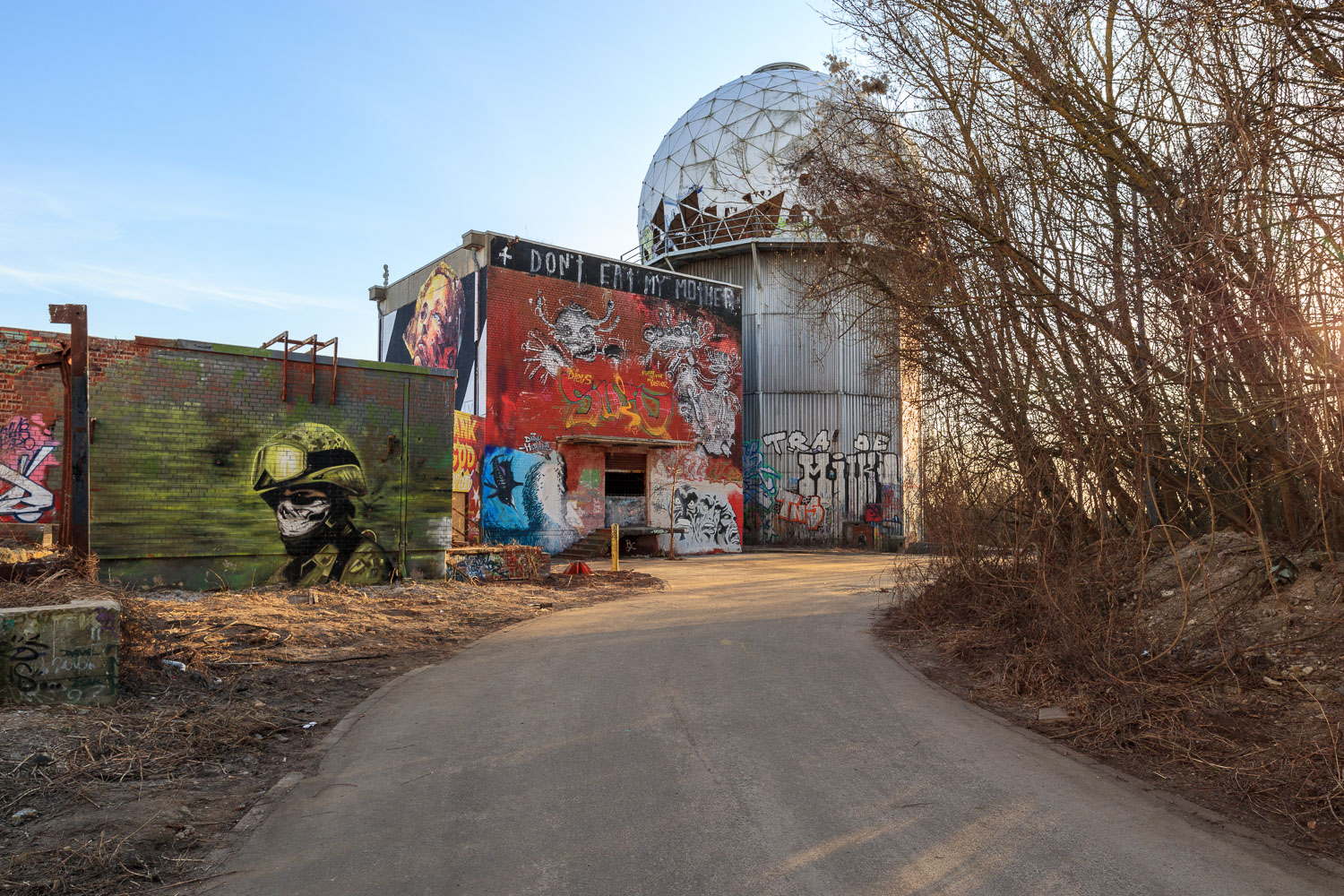
     2018 photos showing current state of the former FSB at Teufelsberg.  
        Photo by Michael Hodgson.
                         

The spy complex was an immediate attraction for tourists looking for an off-beat place to explore as soon as it closed and the ASA left the building.  At first it was by surreptitious entry—there weren’t any security guards at first, just a fence—but then the new owners hired sentries and started charging for tours (or, for a lower fee, simple admission if you just wanted to wander around on your own).  This isn’t officially available anymore, but people still come to see the weirdest ghost town on Earth.

There’s no electricity or running water; at least one multi-story elevator shaft is open and empty, a real safety hazard; there’s little light in some locations; the whole place is littered with construction debris, broken glass, rusty metal, spent spray cans, abandoned (and heavily graffitied) cars, and garbage.  And yet the urban spelunkers come.

It’s “spooky” in two ways now: one, because it’s where spooks—intel agents like me—used to work: and two, because it’s silent, empty, and decaying, like a non-lethal Chernobyl.

The site’s prospects are in limbo; no one seems to know what to do with it.  Plans have been proposed, including the repurchase of the former spy station by the city of Berlin, but none have gone beyond the talking stage, often due to cost. 

One proposed deal in 2008, involving filmmaker David Lynch, was for building something called a “Vedic Peace University,” focusing on yoga and transcendental meditation and featuring a 12-story, 164-foot-high “Tower of Invincibility” to house 1,000 students. The city turned down the proposal.

Over the years since The Hill closed as a USASA station, Teufelsberg has been a location for several movies and television programs, including one espionage cable series, Berlin Station, that aired on Epix from 2016 to 2019.  Berlin Station was the name of my actual CI unit of the 66th MI Group (part of U.S. Army, Europe) from 1971 to 1974.

FSB had also been the subject or setting for many books, both memoirs and novels.  Two of the latter are Voices Under Berlin: The Tale of a Monterey Mary (CreateSpace Independent Publishing Platform, 2008) and Reunification: A Monterey Mary Returns to Berlin (CreateSpace Independent Publishing Platform, 2013).  Both books are by T. H. E. Hill, which is a pseudonym (get it?) for a 74-year-old retired ASA linguist who served at FSB in the mid-‘70s.  (A “Monterey Mary” is a graduate of the Defense Language Institute in Monterey, California.  I went there in 1970 and ’71 and, curiously, I never heard the term before.)

There’s a movement, especially among the Teufelsberg veterans, to preserve FSB as a memorial.  In 2006, the area was legally declared woodland, ending any development plans, and in 2018, it was given Denkmalschutz (‘monument protection’), a designation similar to landmark status in the U.S., for its historical importance as a Cold War site.  This designation eliminated the possibility of new building on the site.

Today, guided tours and paid admission to the late FSB or not, Teufelsberg is popular with mountain bikers, hikers, and paragliders.  In the summer, visitors can enjoy 360-degree panoramic views of the whole city and beautiful sunsets there, and in the winter, the mountain’s small ski slope and the cross-country ski trail are popular.

But what to do with the abandoned FSB is still a conundrum.


19 May 2021

"Ritchie Boys: The Secret U.S. Unit Bolstered by German-Born Jews that Helped the Allies Beat Hitler"

reported by Jon Wertheim 

[On 24 April, I posted “Latter-Day Esthers & Women Maccabees,” a collection of three articles that tell the stories of Jewish women who fought the Nazis in World War II or helped the Allied war effort by spying on the occupying German forces in Hungary.  

[Now comes “Ritchie Boys,” broadcast on the CBS news magazine 60 Minutes on 9 May, which tells some of the story of a group of American soldiers in World War II who used their knowledge of the German language and German culture and society to help combat the Nazi regime in the Third Reich.

[In a way, I was a descendent of the Ritchie Boys.  I was a counterintelligence Special Agent in the army in the 1970s, an officer in Military Intelligence, an army branch which grew out of the work of the men like those profiled below.  Furthermore, my father was assigned to the Counter Intelligence Corps (CIC), the agency that became MI, during the Occupation of Germany in 1945.

[The Ritchie Boys, as you’ll read, were soldiers who were trained at the Military Intelligence Training Center (MITC) at Camp Ritchie in Washington County in western Maryland, about a mile south of the Pennsylvania state line.  (The nearest populated place to the military reservation is Highfield-Cascade, Maryland, which is surrounded by it.  It’s 16 miles northeast of Hagerstown, Maryland, the county seat; 68 miles northwest of Baltimore; 70 miles northwest of Washington, D.C.; and 173 miles due north of Richmond, Virginia.) 

[After 1942, GI’s with knowledge of German and the languages of the Nazi-occupied countries or those allied with the Third Reich were trained in intelligence, counterintelligence, and interrogation (also psy-war, but I didn't know about that part).

[MITC operated from 1942 to 1945; Camp Ritchie (later Fort Ritchie) continued until 1998.  The U.S. Army Intelligence School (USAINTS) was established in 1950 at Fort Holabird in Baltimore, Maryland (where I trained in 1971 as a counterintelligence Special Agent – see my post on Rick On Theater “Berlin Memoir,” 16 and 31 December 2016, 20 January 2017, 9 and 19 February 2017, 11 and 29 March 2017, and 13 April 2017), and moved to Fort Huachuca, Arizona, as the U.S. Army Intelligence Center and School (USAICS) in 1971.]

The Ritchie Boys were responsible for uncovering more than half the combat intelligence on the Western Front during World War II. For the many German-born Jews in their ranks, defeating the Nazis was heartbreakingly personal.

For as casually as we often toss around the word “hero,” sometimes no lesser term applies. Tonight we’ll introduce you to members of a secret American intelligence unit who fought in World War II. What’s most extraordinary about this group: many of them were German-born Jews who fled their homeland, came to America, and then joined the U.S. Army.  Their mission: to use their knowledge of the German language and culture to return to Europe and fight Nazism. The Ritchie Boys, as they were known, trained in espionage and frontline interrogation. And incredibly, they were responsible for most of the combat intelligence gathered on the Western Front. For decades, they didn’t discuss their work. Fortunately, some of the Ritchie Boys are still around to tell their tales, and that includes the life force that is Guy Stern, age 99.

Jon Wertheim: You work 6 days a week, you swim every morning, you lecture, any signs of slowing down?

Guy Stern: Well I think not (laugh) but I don’t run as fast, I don’t swim as fast but I feel happy with my tasks.

A few months shy of turning 100, Guy Stern drips with vitality. He still works six days a week and if you get up early enough, you might catch him working out at his local park in the Detroit suburbs.

But ask him about his most formative experience - and he doesn’t hesitate. It was his service in the military during World War II.  

Jon Wertheim: What was it like for you, leaving Nazi Germany, escaping as a Jew, and the next time you go back to Europe it’s to fight those guys?  What was that like?

Guy Stern: I was a soldier doing my job and that precluded any concern that I was going back to a country I once was very attached to.

Guy Stern: I had a war to fight and I did it. 

This is Guy Stern 80 years ago.  He is among the last surviving Ritchie Boys - a group of young men – many of them German Jews – who played an outsized role in helping the Allies win World War II.  They took their name from the place they trained - Camp Ritchie, Maryland  – a secret American military intelligence center during the war.

Starting in 1942, more than 11,000 soldiers went through the rigorous training at what was the army’s first centralized school for intelligence and psychological warfare. 

David Frey: The purpose of the facility was to train interrogators.  That was the biggest weakness that the army recognized that it had, which was battlefield intelligence and the interrogation needed to talk to sometimes civilians, most of the time prisoners of war, in order to glean information from them.

David Frey is a professor of history and director of the Center for Holocaust Studies at the U.S. Military Academy at West Point.

Jon Wertheim: How effective were they at gathering intelligence?

David Frey: They were incredibly effective. 60-plus percent of the actionable intelligence gathered on the battlefield was gathered by Ritchie Boys

Jon Wertheim: 60% of the actionable intelligence?

David Frey: Yes

David Frey: They made a massive contribution to essentially every battle that the Americans fought - the entire sets of battles on the Western Front.

Recruits were chosen based on their knowledge of European Language and culture, as well as their high IQs. Essentially they were intellectuals. The largest set of graduates were 2,000 German-born Jews.

David Frey: If we take Camp Ritchie in microcosm, it was almost the ideal of an American melting pot. You had people coming from all over uniting for a particular cause.

Jon Wertheim: All in service of winning the war?

David Frey: All in service of winning the war. And there’s nothing that forges unity better than having a common enemy.

David Frey:  You had a whole load of immigrants who really wanted to get back into the fight.

Immigrants like Guy Stern. He grew up in a close-knit family in the town of Hildesheim, Germany. When Hitler took power in 1933, Stern says the climate grew increasingly hostile.

Guy Stern: My fellow students – it was an all male school – withdrew from you.

Jon Wertheim: because you were Jewish you were ostracized?

Guy Stern: That is correct.

Guy Stern: I went to my father one day and I said “classes are becoming a torture chamber” 

By 1937, violence against Jews was escalating. Sensing danger, Stern’s father tried to get the family out.  But the Sterns could only send one of their own to the U.S. They chose their eldest son. 

Jon Wertheim: Do you remember saying goodbye to your family?

Guy Stern: Yes

Jon Wertheim: What do you remember from that?

Guy Stern: Handkerchiefs (pause), I couldn’t know at that point that I would never see my siblings or my parents again nor my grandmother and so forth and so on.

Guy Stern arrived in the U.S. alone at age 15, settling with an uncle in St. Louis. When the Japanese bombed Pearl Harbor in 1941, Stern, by then a college student, raced to enlist.

Guy Stern: I had an immediate visceral response to that and that was this is my war for many reasons.  Personal, of course, but also this country - I was really treated well.

In New York, Paul Fairbrook had a similar impulse. Now 97, Fairbrook is the former dean of the Culinary Institute of America. His Jewish family left Germany in 1933 when he was 10. 

Jon Wertheim: Why did you want to enlist initially?

Paul Fairbrook: Look I’m a German Jew.  And there’s nothing that I wanted more is to get some revenge on Hitler who killed my uncles, and my aunts and my cousins and there was no question in my mind, and neither of all the men in Camp Ritchie.  So many of them were Jewish.  We were all on the same wavelength.  We were delighted to get a chance to do something for the United States.

At the time though, the military wouldn’t take volunteers who weren’t born in the U.S. But within a few months the government realized these so-called enemy aliens could be a valuable resource in the war. 

Paul Fairbrook: You can learn to shoot a rifle in 6 months but you can’t learn fluent German in 6 months. And that’s what the key to the success was[.]

Paul Fairbrook: You really know an awful lot of the subtleties when you’re having a conversation with another German and we were able to find out things out in their answers that enabled us to ask more questions. You really have to understand it helps to have been born in Germany in order to – in order to do a good job.

Both refugees like Fairbrook and Stern, as well as a number of American born recruits with requisite language skills, were drafted into the Army and sent to Camp Ritchie.

Jon Wertheim: How did you find out you were going to go to Camp Ritchie?

Guy Stern: I was called to the company office and told you’re shipping out, and I said “may I know where I’m going?” and he said “no, military secret”. 

Jon Wertheim: They swore you to secrecy?

Guy Stern: Yes.

Originally a resort, Camp Ritchie was a curiously idyllic setting to prepare for the harshness and brutality of war. Nestled in the Blue Ridge Mountains of Maryland – it was away from prying eyes and prying spies – but close enough to decision makers at the [P]entagon. 

Jon Wertheim: Give us a sense of the kinds of courses they took.

David Frey: Well the most important part of the training was that they learned to do interrogation, and in particular of prisoners of war.

David Frey: Techniques where you want to get people to talk to you.  You want to convince them you’re trustworthy.

David Frey: But they also did terrain analysis, they also did photo analysis, and aerial reconnaissance analysis. They did counterintelligence training.

Jon Wertheim: This was really a broad range of intelligence activities.

David Frey: It was a very broad range. And they did it all generally in 8 weeks

Jon Wertheim: What you describe, it almost sounds like these were precursors to CIA agents.

David Frey: They were in fact. Some of them were trained as spies and some of them went on to careers as spies

Victor Brombert: My parents were pacifists so the idea of my going to war was for them calamitous, however they realized that it was a necessary war, especially for us.

Victor Brombert, now 97 years old, is a former professor of romance languages and literature at Yale and then Princeton. He was born in Berlin to a Russian Jewish family. When Hitler came to power, the Bromberts fled to France, and then to the U.S., eager to fight the Nazis, he, too, joined the Army. After recruiters found out he spoke 4 languages, they dispatched him to Camp Ritchie, where strenuous classroom instruction was coupled with strenuous field exercises.  

Victor Brombert: There were long and demanding exercises and close combat training.  “How to kill a sentry from behind.” I thought, “I’m never going to do that,” but I was shown how to do it.

Jon Wertheim: So physical combat training as well as intelligence?

Victor Brombert: Yes, well with a stick.  You sort of swing it around the neck from behind and then pull.  

Among the unusual sights at Ritchie: a team of U.S. Soldiers dressed in German uniforms. The Ritchie Boys trained for war against these fake Germans with fake German tanks made out of wood. Another unusual sight: towering over recruits, Frank Leavitt, a World War I veteran and pro wrestling star at the time, was among the instructors.  

Training was designed to be as realistic as possible. The Ritchie Boys practiced street-fighting in life-size replicas of German villages and questioned mock civilians in full scale German homes. Some of the prisoners were actual German POWs brought to the camp so the Ritchie Boys could practice their interrogation techniques. 

Jon Wertheim: I understand you – you had sparring partners. You playacted

Victor Brombert: One had to playact with some of the people were acting as prisoners and some of them were real prisoners.

By the spring of 1944, the Ritchie Boys were ready to return to Western Europe – this time as naturalized Americans in American uniforms.  

Still, if they were captured, they knew what the Nazis would do to them.  

Some of them requested new dog tags – with very good reason.

Jon Wertheim: This dog tag says Hebrew. Did your dog tag identify you as Jewish?

Guy Stern: I preferred not having it. I asked them to leave it off.

Jon Wertheim: You didn’t want to be identified as Jewish going back to Western Europe.

Guy Stern: No because I knew that – the contact with Germans might not be very nice.

On June 6, 1944, D-Day, the Allies launched one of the most sweeping military operations in history. A mighty onslaught of more than 160,000 men, 13,000 aircraft, and 5000 vessels.   

Guy Stern: We were on a PT boat taking off from Southampton. And we all were scared.  We were briefed that the Germans were not going to welcome us greatly. As a Jew, I knew I might not be treated exactly by the Geneva rules.  

Divided into 6-man teams the Ritchie Boys were attached to different Army units. When they landed on the beaches of Normandy, Wehrmacht troops were waiting for them – well-armed and well prepared.  

Victor Brombert was with the first American armored division to land on Omaha Beach.  He is still haunted by what he experienced that day.

Victor Brombert: I saw immense debris.  Wounded people.  Dead people.

Victor Brombert: I remember being up on a cliff the first night over Omaha Beach. And we were strafed and I said to myself, “now, it’s the end” because I could – you could feel the machine gun bullets

Jon Wertheim: Is that when you first realized – I’m – I’m in a war here?

Victor Brombert: Yes, I realized that I was afraid.  I never calculated that there is such a thing as terror, fear.  So I experienced viscerally, fear.

On the front lines from Normandy onwards, the Ritchie Boys fought in every major battle in Europe, collecting tactical intelligence, interrogating prisoners and civilians, all in service of winning the war.

In 1944, the Ritchie Boys headed to Europe to fight in a war that was for them, intensely personal. They were members of a secret group whose mastery of the German language and culture helped them provide battlefield intelligence that proved pivotal to the Allies’ victory. The Ritchie Boys landed on the beaches of Normandy on D-Day and helped liberate Paris. They crossed into Germany with the Allied armies, and witnessed the horrors of the Nazi concentration camps.  All the while, they tracked down evidence and interrogated Nazi criminals later tried at Nuremberg. It was also in Europe that some of them, like Guy Stern, learned what had happened to the families they left behind.  

By the summer of 1944, German troops in Normandy were outnumbered and overpowered. The allies liberated Paris in August and drove Nazi troops out of France.  But Hitler was determined to continue the war. In the Ardennes region of Belgium, the Germans mounted a massive counteroffensive, which became known as the Battle of the Bulge.

Jon Wertheim: I see a tent in the background of that photo right in front of you

Guy Stern: Yes, that’s my interrogation tent

Jon Wertheim: So this is you on the job.  You’re in Belgium?

Guy Stern: Yes, doing my job interrogating.  Right.

Amid the chaos of war, Guy Stern and the other Ritchie Boys had a job to do. Embedded in every army unit, they interrogated tens of thousands of captured Nazi soldiers as well as civilians – extracting key strategic information on enemy strength, troop movements, and defensive positions. They then typed up their daily reports in the field to be passed up the chain of command.

Victor Brombert: Our interrogations - it had to do with tactical immediate concerns.  And that’s why civilians could be useful and soldiers could be useful, “where is the minefield?” very important because you save life if you know where the mine – “where is the machine gun nest?”  “How many machine guns do you have there?” “where are your reserve units?” and if you don’t get it from one prisoner, you might get it from the other.  

97-year-old Victor Brombert says they relied on their Camp Ritchie training to get people to open up.

Victor Brombert: We improvised according to the situation. According to the kind of unit, according to the kind of person we were interrogating. But certainly what did not work was violence or threat of violence. Never. What did work Is complicity.

Jon Wertheim: What -What do you mean?

Victor Brombert: By complicity I mean, “Oh we are together in this war. You on one side and we on this side. Isn’t it a miserable thing? Aren’t we all sort of, tired of it?”

Jon Wertheim: The shared experience?

Victor Brombert: The shared experience, exactly. Giving out some cigarettes also helps a lot. A friendly approach - trying to be human. 

The Ritchie Boys connected with prisoners on subjects as varied as food and soccer rivalries but they weren’t above using deception on difficult targets. The Ritchie Boys discovered that the Nazis were terrified of ending up in Russian captivity and they used that to great effect. If a German POW wouldn’t talk, he might face Guy Stern dressed up as a Russian officer. 

Guy Stern: I had my whole uniform with medals. Russian medals and I gave myself the name Commissar Krukov.

Jon Wertheim: That’s what you called yourself?

Guy Stern: That was my pseudonym.

Jon Wertheim: How did you do commissar?

Guy Stern: Thank you for asking (laugh) I gave myself all the accouterments of looking like a fierce Russian commissar.

Guy Stern: And some we didn’t break but 80% were so darned scared of the Russians and what they would do.

Jon Wertheim: So there’s a real element of - costumes and deception and accents. 

Guy Stern: Yes and it’s theatrics in a way yes.

Their subjects ranged from low-level German soldiers to high ranking Nazi officers including Hans Goebbels, brother of Hitler’s chief propagandist, Joseph Goebbels.

Another bit of indispensable Ritchie Boy handiwork: the order of battle of the German Army. Paul Fairbrook helped write this compact manual -  known as the red book  – which outlined in great detail the makeup of virtually every Nazi unit, information every Ritchie Boy committed to memory.  

Paul Fairbrook: When the soldiers said “I’m not going to talk” they could say “wait a minute. I know all about you. Look, I got a book here and it tells me that you were here and you went there and your boss was this.” And they were impressed with that.

Jon Wertheim: So it sounds like this gave the officers in the field a guide to the German Army so they could then interrogate the German POW’s more efficiently.

Paul Fairbrook: That’s exactly right.  

The Ritchie Boys earned a reputation for delivering important tactical information fast, making a major contribution to every battle on the Western Front.  

Jon Wertheim: Their work saved lives?

David Frey: Absolutely. They certainly saved lives. I think that that’s quantifiable.

David Frey teaches history to cadets at the U.S. Military Academy at West Point.

David Frey: Part of what the Ritchie Boys did was to convince German units to surrender without fighting. 

Jon Wertheim: And you’re saying some of that originated at Camp Ritchie?

David Frey: Much of it originated at Camp Ritchie because it had never – it hadn’t been done before. How do you appeal to people in their own language? Knowing how to shape that appeal was pretty critical to the success of the mobile broadcast units.  

In trucks equipped with loudspeakers, Ritchie Boys went to the front lines under heavy fire, and tried, in German, to persuade their Nazi counterparts to surrender. They also drafted and dropped leaflets from airplanes behind enemy lines.  

Jon Wertheim: This was one of the leaflets that was dropped out?

Guy Stern: Out of a plane. I have some that were shot.  

Guy Stern: This one was our most effective leaflet and why was that?  Because Eisenhower had signed it and the Germans had an incredibly naïve approach to everything that was signed and sealed.

Jon Wertheim: And you think because it had that signature, somehow that certified it.

Guy Stern: Yes, that carried weight and the belief in the printed matter was very great.

Jon Wertheim: That’s the kind of thing you would know.

Guy Stern: Yes.

Jon Wertheim: As a former German who understood the psychology and the mentality.

Guy Stern: That’s correct.  

Apart from the fighting, there were other threats confronting the Ritchie Boys. Given their foreign accents, they were in particular danger of being mistaken for the enemy by their own troops, who instituted passwords at checkpoints.  

Victor Brombert: What happened to one of the Ritchie Boys - at night on the way to the latrine, he was asked for a password and he gave the name - the word for the password - but with a German accent. He was shot right away and killed.

Jon Wertheim: Did you ever worry your accent might get you killed?

Victor Brombert: Yes of course. You know, I don’t talk like an Alabama person or a Texan.

By the spring of 1945, Allied Forces neared Berlin and Hitler took his life in his underground bunker. Germany surrendered on May 8 of that year. 

Jon Wertheim: What do you remember feeling that day?

Guy Stern: Elated.

Guy Stern: It was absolutely, “we won kid!” (laugh)

Jon Wertheim: And those are your – those are your comrades.

Guy Stern: Yes.

Jon Wertheim: Those are your guys.

Guy Stern: Yes.

But joy turned to horror as Allied soldiers - and the world - learned the full scale of the Nazi mass extermination.  

Guy Stern recalls arriving at Buchenwald Concentration Camp three days after its liberation, alongside a fellow American sergeant. 

Guy Stern: We were walking along and you saw these emaciated, horribly looking, close to death people.  And so I fell back behind because I didn’t want to be seen crying to a hardened soldier and then he looked around to look where I was, how I was delayed, and he, this good fellow from middle of Ohio was bawling just as I was.

A few days later, Stern returned to his hometown, hoping to reunite with his family.  But Hildesheim was now in ruins. A childhood friend described to Stern how his parents, younger brother and sister had been forced from their home and deported.

Guy Stern: They were killed either in Warsaw or in Auschwitz.

Guy Stern: None of my family survived.  I was the only one to get out.   

Jon Wertheim: Did you ever ask yourself why me?  Why were you the one that made it to the United States?

Guy Stern: Yes, even last night.  And I said “Well, huh, in slang, there ain’t nothing special about you, but if you were saved, you got to show that you were worthy of it. And that has been the driving force in my professional life.  

Jon Wertheim: So as a way to honor your family that perished.

Guy Stern: Yeah.

After the war, Guy Stern, Victor Brombert and Paul Fairbrook came home, married, and went to Ivy League schools on the G.I. Bill.  Guy Stern became a professor for almost 50 years.

They all rose to the top of their fields, as did a number of other Ritchie Boys, says history professor David Frey. 

Jon Wertheim: I understand there are some Ritchie Boys (that) became fairly prominent figures.

David Frey: There are a whole variety of prominent Ritchie Boys.  

It turns out author J.D. Salinger was a Ritchie Boy.  So was Archibald Roosevelt, grandson of Theodore Roosevelt. As was philanthropist David Rockefeller.

David Frey: Some became ambassadors. Some became critical figures in the creation of the CIA. Others were actually really important in American science.

Jon Wertheim: So there’s all sorts of impact years and years and years after the war from this – this camp in Maryland?

David Frey: It was not only the short term impact on the battlefield.  It was an impact on war crimes. They were critical in terms of arresting the - some of the major figures and gathering the evidence for Nuremberg, then shaping the cold war era, they really played a significant role.

Jon Wertheim:  How do you think we should be recalling the Ritchie Boys?

David Frey: I think we look at this group and we see true heroes.  We see those who are the greatest of the greatest generation.  These are people who made massive contributions.  Who helped shape what it meant to be American and who – in some cases – gave their lives in service to this country.

Jon Wertheim: This - This is a remarkable story.  Why do so few Americans know about this?

David Frey: Because it involves military intelligence, much of it was actually kept secret until the - the 1990’s.

David Frey: A lot of what was learned and the methods used are important to keep secret. And only in the early 2000’s did we begin to see reunions of the Ritchie Boys. 

Now in their late 90s, these humble warriors still keep in touch, swapping stories about a chapter in American history now finally being told.   

Jon Wertheim: What is it like when you get together and reflect on this experience going on 80 years ago?

Guy Stern: We always find another anecdote to tell. (laugh)

Jon Wertheim: You have a smile on your face when you think back.

Guy Stern: Yes, this is what happens.

It was hard for us not to notice that beyond the stories runs a deep sense of pride.

Paul Fairbrook: (laugh) You bet your life I’m proud of the Ritchie Boys. It was wonderful to be part of them! 

Paul Fairbrook: I was proud to be in the American army and we were able to do what we had to do.  I don’t think we’re heroes.  But the opportunity to help fight and win the war was a wonderful way.  I can look anybody straight in their eye and say I think I’ve earned the right to be an American.  And that’s what – that’s what it did for me.

—Produced by Katherine Davis. Associate producer, Jennifer Dozor. Broadcast associate, Elizabeth Germino. Edited by Stephanie Palewski Brumbach and Robert Zimet.

© 2021 CBS Interactive Inc. All Rights Reserved.

[L. Jon Wertheim is the executive editor of Sports Illustrated and has contributed to 60 Minutes since 2017.  The 2020‑21 season is his fourth on 60 Minutes.

[My father was one of the Ritchie Boys, a fact that’ll come up in “Letters from the Fronts,” my future multi-part post based on the correspondence between my future mother, a Red Cross social worker, and father, a captain of field artillery, in the year after they met on New Year’s Day 1945.  (This project is currently in progress, but it’s a long process.)  After combat in Europe ended in May 1945, Dad was detailed to the CIC and served in the Occupation as a Nazi-hunter.)

[The 60 Minutes story (video and transcript: https://www.cbsnews.com/news/world-war-ii-jews-escape-nazi-germany-hitler-60-minutes-2021-05-09/) focuses on the German-Jewish refugees who trained there, but my dad said that the first recruits were GI’s from all over who spoke any of the enemy languages or the languages of German-occupied territories.  There’s more to this story, some of which I tell in “Letters.”

[My father wasn’t a refugee or even an immigrant; he was born in the United States.  His parents and grandparents were immigrants, but not from Germany (my paternal grandfather came from the Ukraine and my grandmother was born in Latvia), though German was the language of my great-grandparents’ homes.  That’s how my father learned German.  (He also studied the language in high school and college.)]